
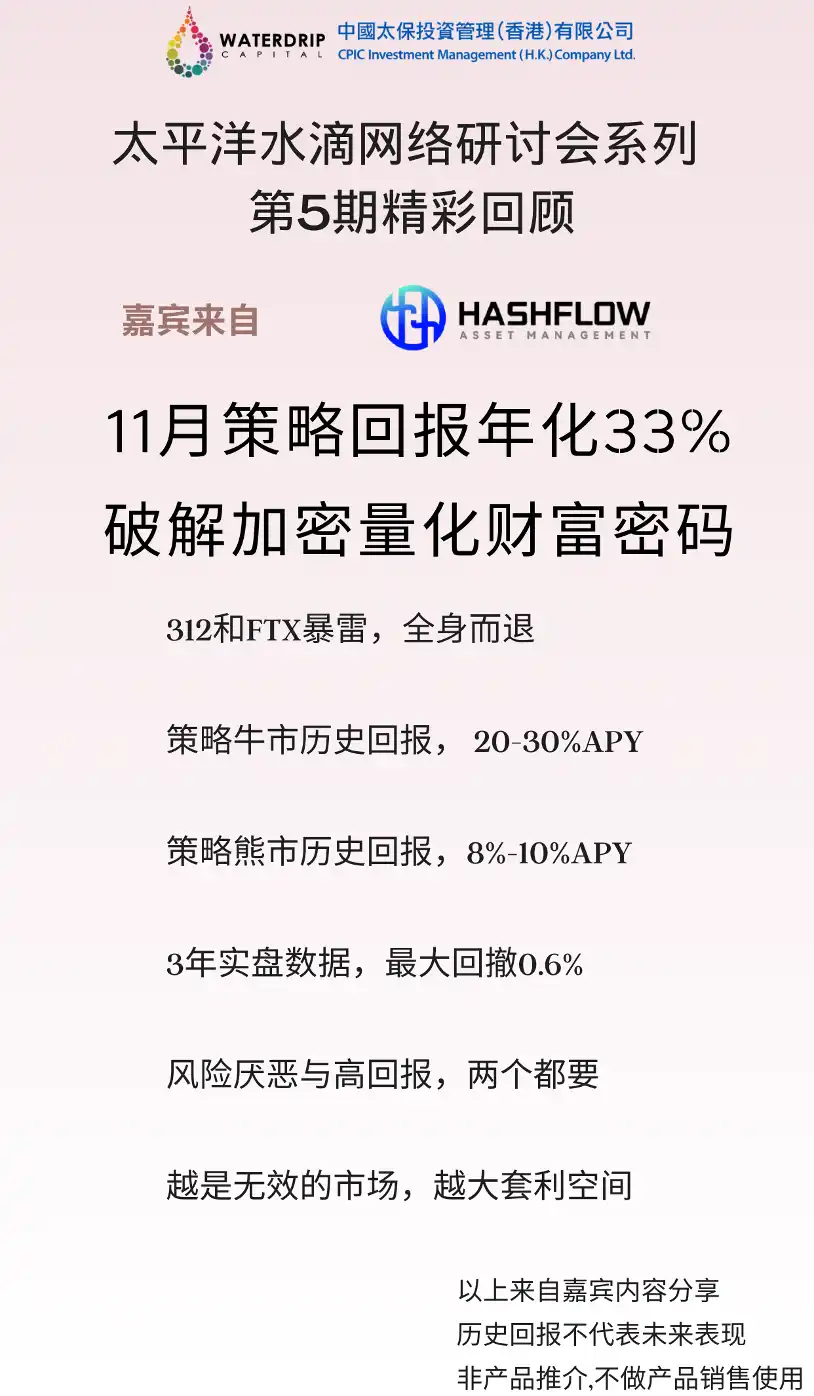
Pacific Water Drop Network Webinar Series Selection: Unlocking the Wealth Code of Cryptographic Quantitative Arbitrage



In the ever-changing cryptocurrency market, quantitative arbitrage strategy has gradually become a sought-after wealth code by investors due to its stability and risk control. In this issue of the webinar, Pacific Droplet has invited two partners, Allen and Leon, from Hashflow Asset Management. The webinar is hosted by Xiaozhou, Executive Director of Taiping Asset Management Hong Kong, to explore the core logic of this strategy and its market potential together with the audience.
Guest Introduction
· Allen: Coming from a traditional finance background, Allen has previously worked extensively in areas such as stocks and futures. In 2018, he transitioned into the cryptocurrency market, pioneering the introduction of traditional market quantitative models into crypto trading. With over six years of digital asset quantitative trading experience, his led crypto asset quant team successfully hedged against crises in both the 2020 3/12 event and the 2022 FTX flash crash.
· Leon: With years of experience in hedge funds and risk management, Leon has previously worked at Citibank and top domestic hedge funds. Since 2018, he has been focusing on quantitative arbitrage strategies in the cryptocurrency market.
· Host: Xiaozhou, currently the Executive Director of Taiping Asset Management Hong Kong, has long been dedicated to the field of fixed income investments.
Exciting Q&A Content
Opening: The Birth and Background of Quantitative Arbitrage Strategy
Xiaozhou: Allen and Leon, both of you were originally senior professionals in the traditional finance field. What prompted you to enter the cryptocurrency market and make quantitative arbitrage your main focus?
Allen: "In traditional finance, algorithmic trading is already very mature. However, when we entered the cryptocurrency market in 2018, we found that the market's volatility, retail investor proportion, and overall immaturity were very suitable for the application of quantitative strategies. The cryptocurrency market's unique mechanisms, such as perpetual contracts and funding rates, also brought us brand-new arbitrage opportunities."
Leon: "At that time, we saw many trading mechanisms in the crypto market similar to the traditional market, but due to lower liquidity and insufficient market participant expertise, quantitative arbitrage had significant room. Coupled with our team's deep experience in algorithmic trading, we quickly identified opportunities."
Question 1: Please provide a specific introduction to the operational logic and revenue source of quant arbitrage?
Allen: "The essence of quant arbitrage is to profit from the spread between spot and perpetual contracts. We buy spot and simultaneously short perpetual contracts. Since holding a long position in perpetual contracts incurs funding rates, this cost ultimately becomes the arbitrageur's source of income."
Leon: "The core advantage of this strategy is that through the hedge between spot and futures, we can achieve market neutrality. Regardless of whether the market is up or down, the portfolio will not be affected by price fluctuations."
Key Points Summary:
· Funding Rate: Settled every 8 hours, with an annualized return of 20%-30% in a bull market and still maintaining 8%-10% in a bear market.
· Risk Neutrality: Hedging between spot and futures ensures stable returns, avoiding market volatility.
Question 2: With high market volatility and complexity in operations, how does quant arbitrage ensure long-term stability?
Allen: "We utilize a unified margin account, integrating fund management between spot and futures to avoid cross-account fund risks. Additionally, we rely on the deep liquidity of blue-chip coins (such as BTC, ETH) for fundamental security."
Leon: "Furthermore, our dynamic rotation mechanism is another key point. We monitor funding rates of all mainstream coins daily and adjust the portfolio based on returns and risks to maximize profits and minimize risks."
Key Points Summary:
· Unified Margin Account: Simplifying fund flow, reducing settlement risks.
· Dynamic Rotation: Real-time allocation adjustments to optimize returns and risks.
Question 3: If the market spread suddenly widens or funding rates turn negative, how do you deal with these potential risks?
Allen: "When the spread widens, we will timely reduce positions or reconfigure based on real-time monitored retracement data. Additionally, the deep liquidity of blue-chip coins ensures that the spread quickly reverts."
Leon: "As for negative funding rate, we have established a strict stop-loss mechanism. If a certain asset experiences a negative funding rate for 5 consecutive days, we will remove it from the portfolio."
Key Takeaways:
· Risk Management: Reduce position, rebalance, or lower leverage.
· Stop-Loss Mechanism: Asset removed if negative funding rate persists for more than 5 days.
Question 4: For some investors, holding BTC directly may seem more attractive. So why choose quantitative arbitrage?
Leon: "The returns from holding the asset directly are entirely dependent on market price fluctuations, posing high risks. Quantitative arbitrage, on the other hand, offers a low-risk, stable return option. For risk-averse investors, this balance is crucial."
Allen: "For portfolio management, we also recommend combining asset holding with quantitative arbitrage to achieve enhanced returns. Holding assets captures upside potential, while arbitrage strategies mitigate volatility risks."
Key Takeaways:
· Low-Risk Stability: Suitable for risk-averse investors.
· Portfolio Advantage: Combination of asset holding and arbitrage for enhanced returns.
Question 5: How long can the cryptocurrency market's bull run last? How long can the high-yield phase of arbitrage strategies be sustained?
Allen: "Based on historical cycles, the cryptocurrency market experiences a halving event approximately every four years. We anticipate that the high-yield phase of the bull market may continue for the next 6 months, until the market enters the early stages of a bear market."
Leon: "Even in a bear market, quantitative arbitrage remains a preferred strategy. Through precise management and diversified asset allocation, we can continue to maintain low drawdowns and stable returns."
Key Takeaways:
· Bull Market Phase: High-yield period expected to last 6 months.
· Bear Market Advantage: Strategy has a small drawdown and can still provide steady returns.
Question 6: Many viewers are interested in the specific operation of quantitative arbitrage, such as what the actual process would be with $1 million?
Allen: "We would use spot and perpetual contracts for arbitrage. For example, $1 million can be used to buy $2 million worth of spot and simultaneously short an equivalent amount of perpetual contracts. This involves moderate leverage, usually kept within two times. This operation ensures that the profit comes from funding rates rather than market fluctuations."
Leon: "Furthermore, current trading platforms support unified margin accounts, which greatly simplifies the operational process. In the past, we needed to constantly rebalance between spot and contract accounts, but now all operations can be completed within the same account, reducing fund transfer risk and improving efficiency."
Key Points Summary:
· Leverage Control: Moderate leverage amplifies profits while reducing risk.
· Unified Account: Simplifies operational processes, reducing fund flow risks.
Question 7: Quantitative arbitrage seems to have low drawdown but still carries risks. Could you explain in detail what potential risks there are and how to manage these risks?
Allen: "Main risks include:
· Spread Fluctuation: The spread at the time of establishing a position may widen in the short term, leading to unrealized losses.
· Negative Funding Rate: Although the funding rate is mostly positive in the long term, it can also turn negative in the short term."
To counter these risks, we have established strict stop-loss rules. If a currency has a negative funding rate for 5 consecutive days, we will remove it from the portfolio. Additionally, through multi-currency allocation, we have reduced the impact of single currency volatility."
Leon: "The recovery of drawdown mainly depends on two points:
· Spread Reversion: Market spreads will eventually return to normal ranges."
· Funding Rate Recovery: Long-term positive returns will gradually offset short-term negative returns.
Key Points Summary:
· Spread Volatility and Negative Funding Rate: Main sources of risk, but effectively controlled through multi-currency allocation and strict stop-loss.
· Drawdown Recovery Mechanism: Relies on spread regression and funding rate recovery.
Question 8: In extreme market conditions, such as sudden large price swings, how does quantitative arbitrage respond?
Leon: "We have taken various measures:
· Position Diversification: The allocation of a single currency does not exceed 5%.
· Dynamic Rebalancing: When the spread widens, positions are reduced to lower risk. If the spread is deemed to be at its limit, we will add to the position in the opposite direction to capture gains."
Allen: "The team's technology and processes are also crucial. For example, during the 3/12 Event (March 12, 2020), many trading platforms experienced downtime, but our system was able to issue alerts promptly and quickly increase positions after system recovery, ultimately profiting."
Key Points Summary:
· Diversified Allocation: Reducing single currency risk.
· Technical Safeguards: Addressing extreme events through alerts and rapid response systems.
Question 9: How does the performance of quantitative arbitrage differ in a bull market versus a bear market? Is there a significant difference in returns?
Allen: "In a bull market, funding rates are higher, and arbitrage returns are usually between 20%-30% annualized. In a bear market, funding rates decrease, and annualized returns are around 8%-10%. Even in a bear market, arbitrage strategies can still provide steady returns because risks and volatility have been hedged."
Leon: "In a bear market, we pay more attention to funding rate rotation, ensuring maximum returns by selecting the optimal currency. For example, in past bear markets, through optimized currency allocation, we kept the overall drawdown to less than 0.6%."
Key Points Summary:
· Bull Market Returns: Up to 30%.
· Bear Market Returns: Approximately 8%-10%, very low risk.
Question 10: I understand that a quantitative arbitrage strategy is somewhat like a cash management enhancement tool in traditional finance. Is it more suitable to switch from traditional bonds or money market funds to this strategy rather than directly engaging in high-risk assets?
Allen: "Your understanding is very accurate! The characteristic of a quantitative arbitrage strategy is stable low risk. It is more like an upgraded version of a cash management tool. Compared to bonds or money market funds, our annualized returns are higher, while the risk remains at an extremely low level."
Leon: "Indeed. For the conservative portion of asset allocation, quantitative arbitrage is a very ideal choice. Especially for institutional investors or high-net-worth clients, traditional cash management tools have lower yields in the current interest rate environment, while our strategy can achieve a significant enhancement."
Key Points Summary:
· Cash Management Tool Upgrade: Higher returns, very low risk.
· Asset Allocation Recommendation: Suitable for investors transitioning from bonds or money market funds.
Question 11: If the spot price continues to rise and we short perpetual swaps, will our returns be affected due to high funding rates?
Allen: "That's a very good question. In a unified account, the P&L of spot and perpetual swaps is calculated together. Even if the funding rate rises, our returns mainly come from spread fluctuations and positive funding rate income. Additionally, our system will automatically adjust margin to ensure the stability of the overall position and avoid one-sided risk."
Leon: "The advantage of a unified account structure is that it can manage the assets of spot and contracts together, reducing liquidity issues and margin top-ups, while ensuring the stability of the overall strategy."
Key Points Summary:
· Unified Account: Comprehensive calculation of PnL to ensure overall revenue.
· Funding Rate Risk Management: Revenue mainly comes from spreads and positive funding rates.
Question 12: In an extreme market environment, such as the 3·12 Event in 2020, how does quantitative arbitrage respond?
Leon: "In extreme events like 3·12, we immediately reduce our position to ensure risk control. At the same time, our technical systems will alert us quickly to help adjust our strategy. Additionally, we focus on trading in large-cap coins with high liquidity, such as BTC and ETH, to avoid losses due to insufficient liquidity in small-cap coins."
Allen: "Such extreme volatility may also present opportunities for us. For example, post-market recovery, by quickly increasing our position to capture spread income, we achieved excess returns after the 3·12 event." Extreme market volatility is both a challenge and an opportunity for us.
Key Takeaways:
· Risk Control: Timely position reduction, focus on large-cap coins.
· Technical Support: Alert system and rapid adjustment mechanism.
The above is the full content of this seminar. We invite you to continue following the Pacific Water Drop Network Webinar.
This article is contributed content and does not represent the views of BlockBeats.
You may also like

Morning Report | BitMine increased its holdings by 126,971 ETH last week; trader Eugene announced his exit from the crypto market

Wang Chuan: How can one not feel anxious after the neighbor Old Wang made thirty times profit by investing in storage stocks? (Seven) - A quarter-century cycle

Cryptocurrency CEXs are flocking to sell US stocks, and traditional brokerages are facing an "uninvited guest."

$75 billion in foreign capital has fled, and South Korean retail investors have absorbed it all using leverage

Japan’s Three Megabanks Plan Joint Stablecoin Issuance in Fiscal 2026
MUFG, SMBC, and Mizuho reportedly plan to jointly issue fiat-pegged stablecoins in fiscal 2026, signaling Japan’s growing push into bank-led digital payment infrastructure.

Humanity Discloses H Token Dual-Chain Attack Details, With Losses on Ethereum and BSC Exceeding $36 Million
Humanity said the H token attack across Ethereum and BSC caused more than $36 million in losses after leaked ProxyAdmin keys enabled malicious contract upgrades and token minting.
White House Discusses CLARITY Act With Law Enforcement Ahead of Senate Vote
The White House discussed the CLARITY Act with law enforcement ahead of a Senate vote, focusing on illicit finance risks and developer protections.

Bitcoin Trading Guide 2026: Strategies for Experienced Traders

What Is XAUT and PAXG? Why Tokenized Gold Is Booming in 2026

Will the SpaceX IPO Hurt Bitcoin? Here's What Traders Are Watching

Foreign selling in the South Korean stock market accelerates, with cumulative net sales reportedly reaching $75 billion this year
On June 9, The Kobeissi Letter, citing Goldman Sachs data, reported that global investors are selling South Korean stocks at an unusually rapid pace. In the latest trading session, foreign investors sold about $801 million worth of Kospi constituent stocks again; total foreign outflows last week reached about $10 billion, and the market has been in net foreign selling on nearly every trading day over the past month. According to the data cited in the report, foreign investors have sold about $75 billion worth of South Korean stocks so far this year. Meanwhile, South Korean retail and institutional investors together recorded roughly $69 billion in net buying over the same period, suggesting that the market’s main buying support has come from domestic capital rather than returning overseas funds. The information currently disclosed still mainly comes from The Kobeissi Letter’s retelling and Goldman Sachs data summaries, while public details on the statistical period and the specific definition of “selling” remain relatively limited.

Fortune Warns of Strategy’s Financing Structure Risks as Bitcoin Premium Narrows
Fortune warned that Strategy’s Bitcoin treasury model faces growing financing risks as MSTR’s net asset premium narrows and preferred stock dividend pressure increases.

Ferrari Challenge Le Mans: Carl Moon to Dominate in WEEX Livery

Sahara AI Responds to SAHARA’s Sharp Drop: No Contract or Product Security Issues Found, Internal Investigation Underway
Sahara AI responded to SAHARA’s 60% price drop, saying no token contract or product security issues have been found and an internal investigation is underway.

WEEX Deposit/Withdrawal Dynamic Island: Your Asset Status, Always in Sight
Scaling Crypto Derivatives: The Digital Asset Infrastructure Behind High-Volume Trading
In the fast-moving digital asset ecosystem, derivatives platforms face an extreme architectural test. High-leverage futures markets demand more than just standard security—they require absolute operational precision, zero-latency matching engines, and ironclad structural scalability, all while navigating intense market volatility.
As global platforms scale to meet these demands, the industry is shifting away from rigid, monolithic setups toward a more agile, "decoupled" infrastructure philosophy.
The Blueprint for High-Volume Copy TradingFor elite global exchanges like WEEX (founded in 2018), this architectural choice becomes critical when scaling high-volume retail features like social copy trading. When thousands of users automatically mirror the real-time strategies of elite traders simultaneously, it triggers sudden, monumental spikes in concurrent transactional volume.
To prevent execution latency or settlement bottlenecks during these peak volatility events, a platform's primary engine must remain entirely dedicated to risk management, copy-trade synchronization, and order matching.
The Architectural Rule: New-generation platforms must separate front-end user execution engines from heavy backend infrastructural overhead to eliminate operational friction.
By separating these layers, platforms can maintain complete sovereignty over their trading environments and user experiences while strategically aligning with institutional-grade infrastructure ecosystems. This strategic framework allows modern exchanges to leverage advanced Digital Asset Custody infrastructure such as Cobo’s behind the scenes, ensuring that backend wallet management scales elastically alongside trading spikes.
Capitalizing on Market Momentum and 400× LeverageIn a derivatives arena where platforms offer up to 400× leverage on perpetual contracts, capital efficiency and market agility are core business metrics. To capture market momentum, an exchange needs the ability to rapidly expand its asset offerings, supporting everything from legacy crypto assets to sudden, trending altcoins across a massive library of trading pairs.
Adopting a flexible, scalable Wallet-as-a-Service (WaaS) solution such as Cobo’s could completely rewrite the development timeline for high-growth exchanges. Instead of spending months of engineering capital building out custom backend wallet architectures for every new blockchain network, platforms can deploy localized infrastructure in days.
This agility allows platforms to instantly scale their listings to over a thousand trading pairs without compromising security or delaying time-to-market. It mirrors the exact operational advantages seen during high-velocity market events, similar to how advanced wallet infrastructure empowers platforms during sudden asset surges; allowing exchanges to pass that speed and liquidity directly to their global user base.
A Mature Foundation for GrowthThe synergy between trusted infrastructure ecosystems and global trading platforms represents the natural evolution of a maturing crypto market. As WEEX continues to scale its global spot and derivatives offerings for over 6 million users, adopting robust backend paradigms proves that platforms no longer have to compromise between cutting-edge trading velocity and uncompromised structural security.

Get Paid to Onboard? Try WEEX’s New Homepage with Rewards for Registration, Deposit & Trade
WEEX Custom Layout: Build Your Perfect Trading Workspace in Seconds
Morning Report | BitMine increased its holdings by 126,971 ETH last week; trader Eugene announced his exit from the crypto market
Wang Chuan: How can one not feel anxious after the neighbor Old Wang made thirty times profit by investing in storage stocks? (Seven) - A quarter-century cycle
Cryptocurrency CEXs are flocking to sell US stocks, and traditional brokerages are facing an "uninvited guest."
$75 billion in foreign capital has fled, and South Korean retail investors have absorbed it all using leverage
Japan’s Three Megabanks Plan Joint Stablecoin Issuance in Fiscal 2026
MUFG, SMBC, and Mizuho reportedly plan to jointly issue fiat-pegged stablecoins in fiscal 2026, signaling Japan’s growing push into bank-led digital payment infrastructure.
Humanity Discloses H Token Dual-Chain Attack Details, With Losses on Ethereum and BSC Exceeding $36 Million
Humanity said the H token attack across Ethereum and BSC caused more than $36 million in losses after leaked ProxyAdmin keys enabled malicious contract upgrades and token minting.


