
Interpreting the Binance November Listing Effect: How to Seize the Opportunity for Maximum Gain?





Original Article Title: "BNB Hits New High Triggering a Rally: Data Reveals Binance Listing Effect"
Original Article Authors: Viee, Biteye
"ACT was listed for less than 1 hour, and Twitter exploded."
In November, the listing of ACT and PNUT on Binance quickly ignited the entire market. ACT's price surged 10x in just 10 minutes. Some bought A7, some regretted selling too early. Holders became overnight millionaires, leading to a "gold rush" in the meme market in November, all chasing the next hundredfold Shiba Inu.
The feeling of missing out spread like dominoes, triggering widespread speculation about Binance's listing strategy: Why did Binance choose these coins, and who will be the next lucky one?
The outstanding performance of ACT and PNUT has drawn attention to Binance's listing mechanism and sparked new thinking. Behind these narratives and celebrations, what kind of wealth code is hidden? Why can Binance repeatedly ignite the market? The following data analysis will fundamentally reveal the underlying logic of the "Binance Wealth Effect."
01 Binance November New Coin Deep Dive
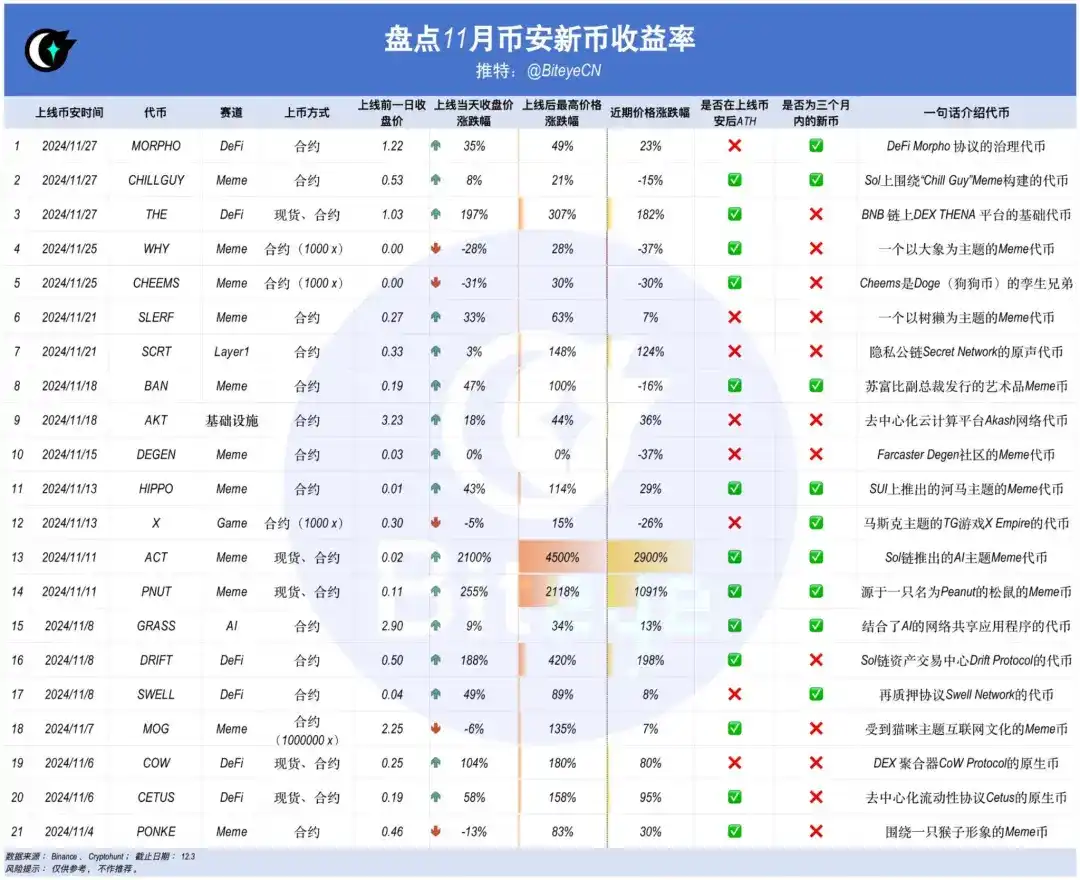
From last month's new coin return rate data, Binance has shown a highly synchronized and flexible strategy in selecting projects according to market trends. In the following table, we will deeply analyze Binance's listing logic from the two dimensions of Wealth Effect and Coin Selection Preference.
1. Data Analysis: Most New Coins Listed on Binance Reach All-Time Highs
Historical data shows that the performance of new coins listed on Binance usually follows a "surge-high-pullback-stability" cycle. Taking ACT and PNUT as examples: in the initial listing period, market sentiment was quickly ignited, and prices skyrocketed rapidly before entering a natural pullback phase. The following analysis will be done step by step:
Significant Short-Term Wealth Effect, Astonishing First-Day Gain
From the data, the wealth effect of new coins listed on Binance is particularly prominent. Especially on the first day, it becomes a crucial window for obtaining high returns. For example:
ACT: On the first day of trading, it saw a staggering 2100% price increase, with the highest surge reaching 4500%, bringing substantial returns to short-term investors.
PNUT: It recorded a 255% price increase on the first day, reaching a peak surge of 2118%, demonstrating strong market potential.
THE: As a non-Meme coin, it had a remarkable performance on its listing day, with a peak increase of 197%, significantly outperforming its peers in the same category.
The explosive growth of these projects can be attributed to Binance's precise selection before listing. Additionally, the initial listing phase often witnesses high market sentiment, leading to an influx of capital and rapid price surges, creating a short-term "wealth effect."
During the peak phase, most new coins set new all-time highs after listing
Data shows that over 60% of tokens hit their all-time high (ATH) after being listed on Binance. This to some extent reflects the influence of new Binance listings in the market.
Furthermore, a closer look reveals that the performance of coins listed in the past three months has been particularly impressive, with 9 new coins quickly setting new ATHs after listing on Binance, almost becoming "must-pump tokens." Surprisingly, even among the 12 older coins, some that previously reached highs in the last bull run or earlier this year experienced renewed surges with Binance's support, with 7 setting new highs post-Binance listing. This demonstrates that, on one hand, new coins often exhibit stronger momentum than established tokens, evident in the market's enthusiasm for new projects. On the other hand, old coins can still break records, highlighting the powerful "Binance effect." Perhaps this is not only a frenzy for new projects in the market but also a robust validation of Binance's listing strategy and platform influence.
After pullbacks, most tokens still hold investment value
Despite some new coins experiencing pullbacks after short-term surges, overall, more than half of the tokens still maintain significant gains above 20% from their listing prices, such as the standout performers ACT, PNUT, DRIFT, THE, showing strong market resilience.
A pullback does not necessarily mean a loss of investment value; on the contrary, it may present an opportunity for potential long-term investment.

2. Binance Listing Strategy: Following the Trend, Returning to Users and the Market
By interpreting this data, you will find an interesting phenomenon: Meme coins occupy a considerable proportion in Binance's new listings, such as CHILLGUY, BAN, SLERF, and others. This is not a coincidence. In the past few months, the explosive power of the Meme sector has been widely recognized, with Meme coins becoming a hot topic in the cryptocurrency market due to their strong community culture, social media effects, and low entry barriers. Binance clearly hit the mark on this market sentiment wave.
Meme coins listed on Binance often possess several core features: "Broad Narrative, Strong Community, Fair Distribution of Tokens."
Broad Narrative and Moderate Market Cap: Select projects with widespread influence, a clear narrative, and a relatively small market cap, which not only lowers the entry barrier for users but also ensures market activity.
Strong Community Cohesion: Prioritize Meme coins with strong influence in overseas communities, capable of driving global market sentiment and sparking discussions in the Chinese community.
Fair Token Distribution: Ensure project mechanisms are transparent and fair, avoiding excessive token concentration or market manipulation risks.
For example, projects like CHILLGUY and SLERF had already accumulated a large number of users and topic popularity on-chain before being listed on Binance. The ACT community has strong cohesion, the AI Agent narrative is broad enough, and very innovative.
It can be seen that Binance's Meme listing logic is not just a simple pursuit of hot trends. Looking back at the first half of this year, the market was critical of high FDV tokens, but Binance did not blindly list new tokens; instead, it supported and endorsed small and medium-sized market cap tokens. In the second half of the year, a more flexible and market-oriented response strategy was chosen—selecting tokens with genuine community foundations and narrative potential. The performance of ACT and PNUT is the best proof of this strategy: behind the wealth effect release lies a precise grasp of market demand.
02 Binance's Multi-faceted Strategy for New Coin Listings
The data analysis above mainly targets tokens listed on Binance through spot or futures trading. In fact, Binance's "listing" strategy has long surpassed traditional spot trading, forming a mature and diversified mechanism. Whether you are a high-risk appetite veteran player or a newcomer seeking stability, Binance has corresponding strategies and channels that allow users to choose what fits them best, even pursuing multiple strategies simultaneously. Next, let's outline several popular participation methods provided by Binance:
1. Spot vs. Futures
Spot and futures trading are the most common ways for users to participate in the market. When a new coin is listed, the spot market often experiences a surge in prices. Especially during this recent wave of meme coins, many players seized the opportunity for gains in the spot market. On the other hand, the futures market is more suitable for traders seeking high leverage and returns, allowing both long and short positions to capture profits from market volatility.
Strategy: Conduct In-Depth Research on New Projects, Avoid Being a "Headless Fly"
Each time a new coin is listed, market sentiment quickly heats up, but the real winners are often those who have done their homework in advance. By conducting thorough research on a project's whitepaper, tokenomics, and community engagement, one can assess the project's true potential.
2. Launchpool
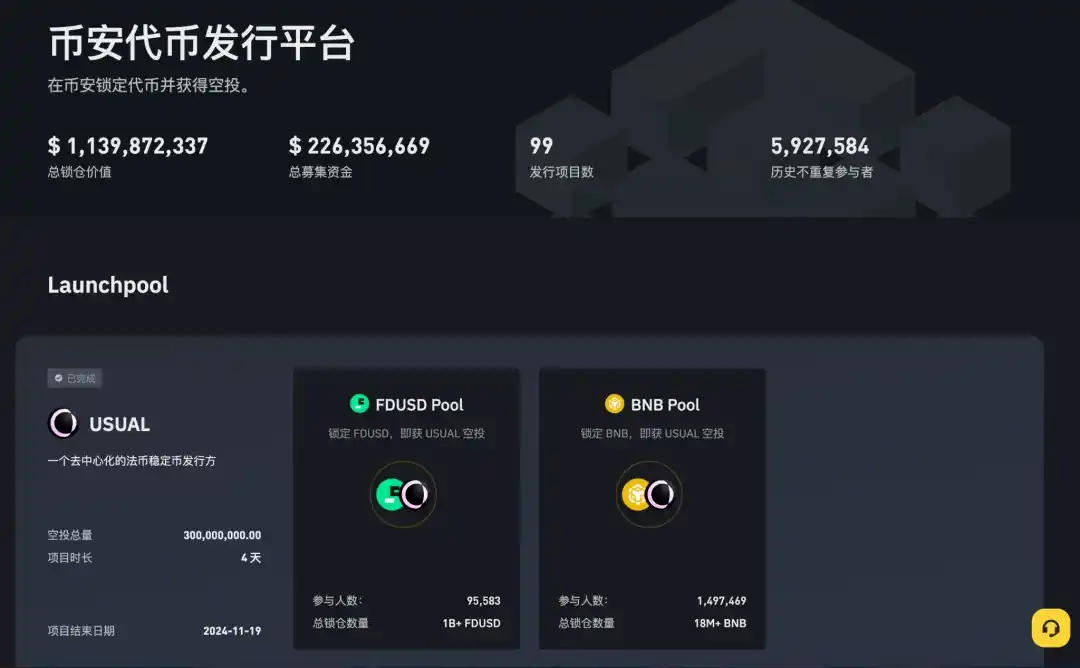
Binance's Launchpool is the preferred choice for zero-risk mining and stable yields, providing users with the opportunity to stake assets such as BNB and FDUSD for mining rewards. Successful projects launched on the platform, such as ENA and TON, not only offer project tokens but also high annualized returns. Earlier this year, Launchpool sparked a trend, with some projects even reaching annualized returns of over 200%, becoming a key channel for chasing new coins.
The figure below by Biteye, using publicly available Binance data, calculates the annualized return rate of projects launched since 2024.
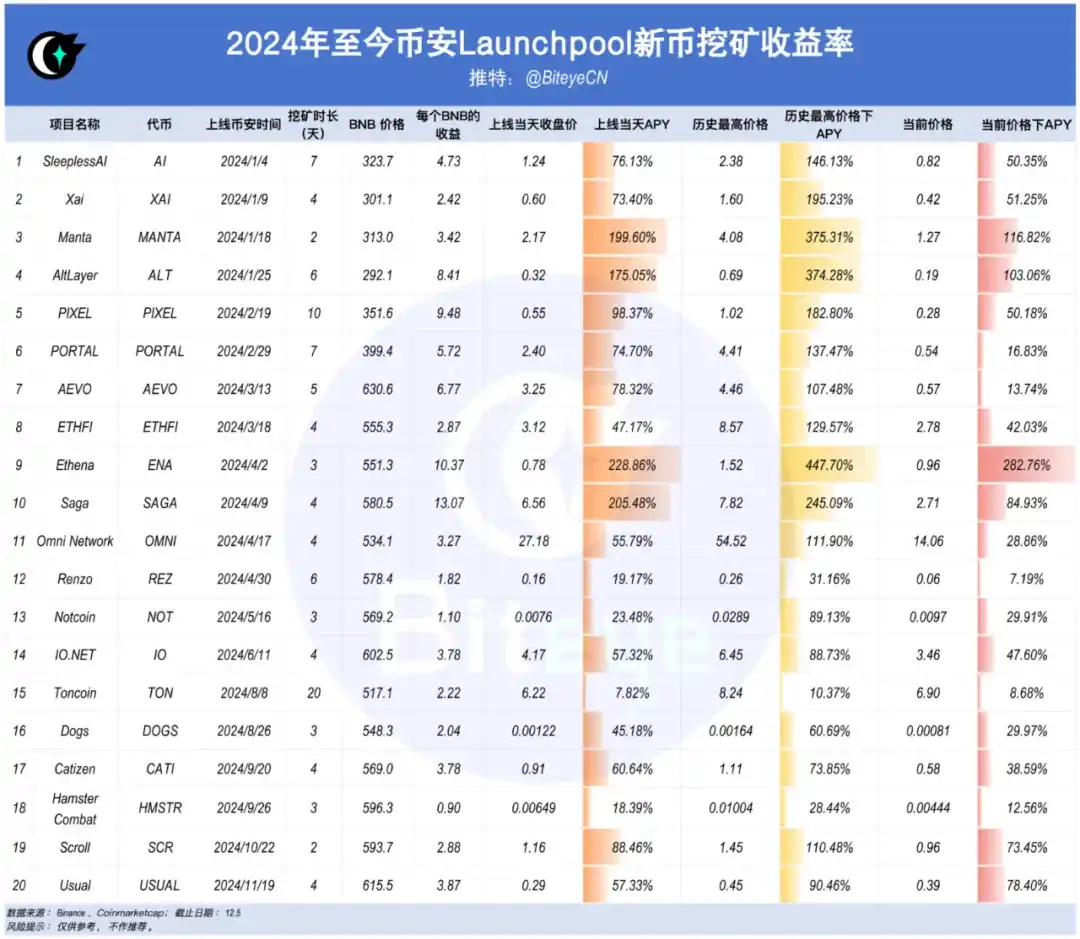
Looking at data from nearly 20 Launchpool launches, most projects showed outstanding APY performance on the first day, with an average yield of over 100%. For example, Ethena's APY on launch day was as high as 288.86%, and at its peak price, the APY reached an astonishing 447.7%. Similarly, Manta reached a historical high APY of 375.31%, demonstrating significant profit potential.
Furthermore, from the list of coins launched, it is evident that there are many high-quality projects with strong fundamental support, which is one of the key reasons for their subsequent price appreciation. For instance, Usual had an APY of 57.33% on launch day, and its current market performance surpasses the opening, with an APY of 78.40%. The same trend is seen with ENA, which currently has an APY of 282.72%, far exceeding its performance on launch day.
Overall, Binance Launchpool not only provides a secure, low-threshold participation opportunity, but also offers substantial rewards. Additionally, Launchpool yields are stable, without the need to take on significant risks. Especially for users holding BNB long-term, the rewards are significant.
Strategy: Focus on Launchpool and Airdrop Opportunities for Incremental Gains
For investors with a lower risk appetite, Launchpool and BNB holder airdrops are excellent entry points. Holding BNB allows for participation in mining, cost averaging, and serves as a key source of low-risk returns.
3. Pre-Trading
Pre-trading is a new feature provided by Binance for users, allowing them to buy and sell specific tokens before the token is officially listed on the spot market, thus locking in price advantages earlier. This phase usually involves significant volatility but also signifies potential high return opportunities.
Strategy: Utilize Pre-Trading to Seize Market Opportunities
Pre-trading offers an opportunity for early positioning but comes with high volatility. Setting reasonable take-profit and stop-loss levels to avoid blind chasing of gains or losses is a core pre-trading strategy.
4. BNB Holder Airdrop
For users holding BNB long-term, airdrop events are undoubtedly one of the most robust "earn while holding" strategies, where holding equals earning. Binance regularly takes snapshots of BNB holders and airdrops tokens of newly listed projects. For example, before the launch of some popular projects, BNB holders may qualify for token airdrops. At the end of November, Binance's latest HODLer airdrop launched the second phase for the Thena (THE) airdrop. According to user-provided data, an average of 1 BNB received 1.455 THE tokens, with THE's current price around 2.9U, making the returns quite substantial.
5. Megadrop Web3 Wallet Tasks
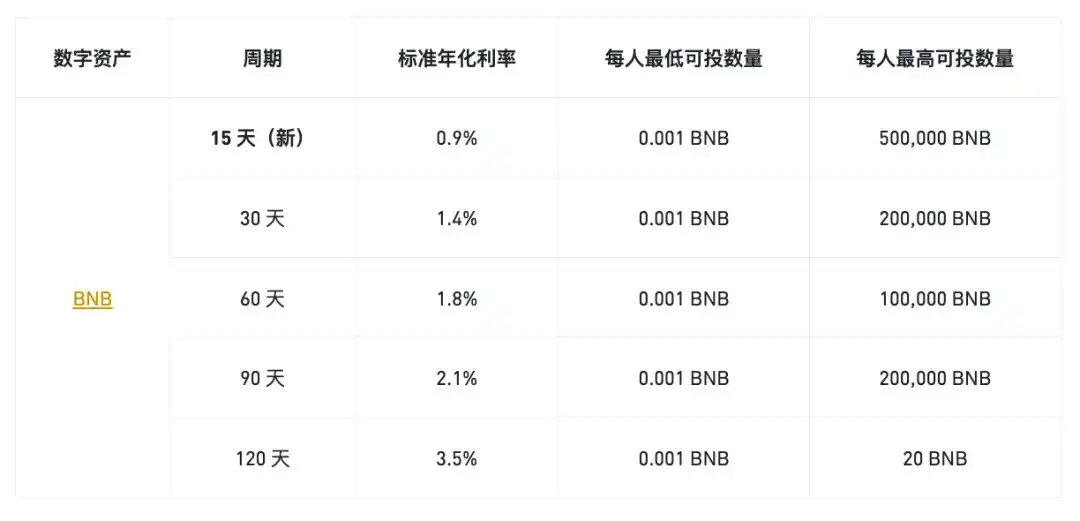
The Megadrop platform offers two participation methods: locking BNB and completing Web3 tasks. Users can accumulate points by subscribing to BNB time-locked products, with longer lock-up periods and higher quantities resulting in more points. Additionally, these time-locked BNBs automatically participate in Launchpool mining, achieving a "two birds with one stone" effect without additional actions. For retail investors with limited BNB holdings, completing tasks in the Binance Web3 wallet can also earn airdrop points, significantly lowering the participation threshold.
The previously announced Binance Product Revenue List showed that the standard annualized interest rate for subscribing to the BNB120-day fixed-term product is around 3.5%.
The following chart shows the revenue estimation for two Megadrops, from which it can be seen that the annualized interest rate basically meets expectations and even exceeds 3.5%. If participating in the Web3 task at the same time, there is a probability of doubling, for example, the BounceBit annualized rate can reach up to 9.7%.
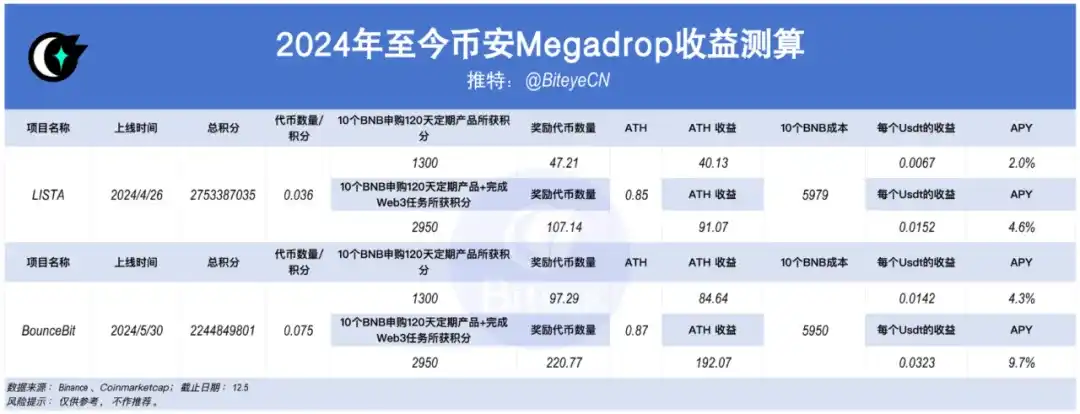
Compared to Launchpool, Megadrop focuses on providing users with early participation opportunities before listing, while reducing the threshold through on-chain tasks to more user-friendlyly attract new users. Launchpool calculates rewards based on staking BNB or specific tokens, covering more projects and suitable for long-term investors. Overall, Megadrop has expanded the audience for Binance's initial offerings and injected more vitality into BNB and Web3 wallets.
In conclusion, whether it's the classic spot and contract gameplay or the innovative Launchpool, pre-trading, and Web3 tasks, it can be seen that Binance's ambition is not limited to short-term surges, but is creating a comprehensive revenue ecosystem.
03 How to Understand Binance's Listing Effect?
The Twitter crypto ecosystem is both a wealth amplifier and a narrative generator.
In the second half of 2024, the rise of the Meme market has become an undeniable trend. From the classic SHIB to the recent hot ACT, the most significant feature of Meme coins is undoubtedly their high virality and strong community attributes. Unlike VC coins, the key to Meme coins lies in their narrative ability, whether they can leverage community emotions, which determines the fate of the coin. Behind these tokens, there is not only liquidity but more of a cultural phenomenon and community force. They can quickly form self-propagating effects on social platforms, attracting a large number of investors and retail participants. This also makes the Meme market the main battleground for hot money.
As the market gradually moves towards rationality, Binance also demonstrates a more profound influence on long-term value.
For example, THENA (THE), a liquidity protocol recently launched by Binance, is a project with low TVL, low market cap, and low financing. This indirectly reflects that Binance focuses on projects that can help the market develop in a healthier and more sustainable direction, filtering out projects that are more valuable to the industry, rather than just focusing on popularity and capital. This may lead to a movement towards the demystification of the crypto market bubble.
In this sense, Binance is more like a "wealth generator" that transforms tokens into a form of "narrative capital" through precise token selection, strict listing standards, and a powerful traffic amplification effect, driving the entire industry towards a healthier, more rational direction.
04 New Coin Practical Tips: Understanding the Market, Keeping Up with the Pace
Whether you are a novice or a veteran, understanding Binance's multi-dimensional "listing" mechanism is just the first step. The real challenge is how to safely and efficiently seize opportunities during this process. This is a game that requires strategy, patience, and insight. Here are some battle-tested tips that may help everyone navigate the next round of opportunities with ease.
1. Stay Updated on Market Dynamics and KOL Analysis, Focus on Community Popularity
The crypto market is driven by emotions, especially during the new coin listing period. Paying attention to KOL opinions on Twitter can usually capture the market sentiment. In addition, the success of meme coins lies in community consensus, and potential projects can be identified in advance through social media, on-chain data, etc.
2. Seize the Best Entry Point, Pay Attention to Take Profit and Stop Loss
New coins experience the highest volatility during the initial listing, often accompanied by significant rallies and pullbacks. It is recommended to establish a clear entry and exit strategy to avoid emotional operations. Particularly within the first hour after a new coin is listed, the market sentiment can fluctuate sharply, requiring special caution. Due to the high volatility on the opening day, set a take profit point to avoid missing opportunities due to greed.
3. Diversify Investments, Avoid an "All-In" Mentality
The market always carries risks. By diversifying funds into different new coin projects, not only can the impact of failure in a single project be mitigated, but it can also increase the overall stability of returns.
05 Conclusion
Every new coin listing is a market litmus test, a self-test for each player, and a competition about market trends, community power, and investor sentiment.
In the cryptocurrency wealth game, the real winners have always been those who understand the market and keep up with the pace. For ordinary investors, seizing the opportunity of a Binance new coin not only requires keeping up with the platform's trend but also requires a deep understanding of its listing logic.
Where will the next ACT or PNUT be? Stay sharp, participate cautiously and flexibly, Binance has set the stage, but how the story unfolds ultimately depends on ourselves.
You may also like

Morning Report | BitMine increased its holdings by 126,971 ETH last week; trader Eugene announced his exit from the crypto market

Wang Chuan: How can one not feel anxious after the neighbor Old Wang made thirty times profit by investing in storage stocks? (Seven) - A quarter-century cycle

Cryptocurrency CEXs are flocking to sell US stocks, and traditional brokerages are facing an "uninvited guest."

$75 billion in foreign capital has fled, and South Korean retail investors have absorbed it all using leverage

Japan’s Three Megabanks Plan Joint Stablecoin Issuance in Fiscal 2026
MUFG, SMBC, and Mizuho reportedly plan to jointly issue fiat-pegged stablecoins in fiscal 2026, signaling Japan’s growing push into bank-led digital payment infrastructure.

Humanity Discloses H Token Dual-Chain Attack Details, With Losses on Ethereum and BSC Exceeding $36 Million
Humanity said the H token attack across Ethereum and BSC caused more than $36 million in losses after leaked ProxyAdmin keys enabled malicious contract upgrades and token minting.
White House Discusses CLARITY Act With Law Enforcement Ahead of Senate Vote
The White House discussed the CLARITY Act with law enforcement ahead of a Senate vote, focusing on illicit finance risks and developer protections.

Bitcoin Trading Guide 2026: Strategies for Experienced Traders

What Is XAUT and PAXG? Why Tokenized Gold Is Booming in 2026

Will the SpaceX IPO Hurt Bitcoin? Here's What Traders Are Watching

Foreign selling in the South Korean stock market accelerates, with cumulative net sales reportedly reaching $75 billion this year
On June 9, The Kobeissi Letter, citing Goldman Sachs data, reported that global investors are selling South Korean stocks at an unusually rapid pace. In the latest trading session, foreign investors sold about $801 million worth of Kospi constituent stocks again; total foreign outflows last week reached about $10 billion, and the market has been in net foreign selling on nearly every trading day over the past month. According to the data cited in the report, foreign investors have sold about $75 billion worth of South Korean stocks so far this year. Meanwhile, South Korean retail and institutional investors together recorded roughly $69 billion in net buying over the same period, suggesting that the market’s main buying support has come from domestic capital rather than returning overseas funds. The information currently disclosed still mainly comes from The Kobeissi Letter’s retelling and Goldman Sachs data summaries, while public details on the statistical period and the specific definition of “selling” remain relatively limited.

Fortune Warns of Strategy’s Financing Structure Risks as Bitcoin Premium Narrows
Fortune warned that Strategy’s Bitcoin treasury model faces growing financing risks as MSTR’s net asset premium narrows and preferred stock dividend pressure increases.

Ferrari Challenge Le Mans: Carl Moon to Dominate in WEEX Livery

Sahara AI Responds to SAHARA’s Sharp Drop: No Contract or Product Security Issues Found, Internal Investigation Underway
Sahara AI responded to SAHARA’s 60% price drop, saying no token contract or product security issues have been found and an internal investigation is underway.

WEEX Deposit/Withdrawal Dynamic Island: Your Asset Status, Always in Sight
Scaling Crypto Derivatives: The Digital Asset Infrastructure Behind High-Volume Trading
In the fast-moving digital asset ecosystem, derivatives platforms face an extreme architectural test. High-leverage futures markets demand more than just standard security—they require absolute operational precision, zero-latency matching engines, and ironclad structural scalability, all while navigating intense market volatility.
As global platforms scale to meet these demands, the industry is shifting away from rigid, monolithic setups toward a more agile, "decoupled" infrastructure philosophy.
The Blueprint for High-Volume Copy TradingFor elite global exchanges like WEEX (founded in 2018), this architectural choice becomes critical when scaling high-volume retail features like social copy trading. When thousands of users automatically mirror the real-time strategies of elite traders simultaneously, it triggers sudden, monumental spikes in concurrent transactional volume.
To prevent execution latency or settlement bottlenecks during these peak volatility events, a platform's primary engine must remain entirely dedicated to risk management, copy-trade synchronization, and order matching.
The Architectural Rule: New-generation platforms must separate front-end user execution engines from heavy backend infrastructural overhead to eliminate operational friction.
By separating these layers, platforms can maintain complete sovereignty over their trading environments and user experiences while strategically aligning with institutional-grade infrastructure ecosystems. This strategic framework allows modern exchanges to leverage advanced Digital Asset Custody infrastructure such as Cobo’s behind the scenes, ensuring that backend wallet management scales elastically alongside trading spikes.
Capitalizing on Market Momentum and 400× LeverageIn a derivatives arena where platforms offer up to 400× leverage on perpetual contracts, capital efficiency and market agility are core business metrics. To capture market momentum, an exchange needs the ability to rapidly expand its asset offerings, supporting everything from legacy crypto assets to sudden, trending altcoins across a massive library of trading pairs.
Adopting a flexible, scalable Wallet-as-a-Service (WaaS) solution such as Cobo’s could completely rewrite the development timeline for high-growth exchanges. Instead of spending months of engineering capital building out custom backend wallet architectures for every new blockchain network, platforms can deploy localized infrastructure in days.
This agility allows platforms to instantly scale their listings to over a thousand trading pairs without compromising security or delaying time-to-market. It mirrors the exact operational advantages seen during high-velocity market events, similar to how advanced wallet infrastructure empowers platforms during sudden asset surges; allowing exchanges to pass that speed and liquidity directly to their global user base.
A Mature Foundation for GrowthThe synergy between trusted infrastructure ecosystems and global trading platforms represents the natural evolution of a maturing crypto market. As WEEX continues to scale its global spot and derivatives offerings for over 6 million users, adopting robust backend paradigms proves that platforms no longer have to compromise between cutting-edge trading velocity and uncompromised structural security.

Get Paid to Onboard? Try WEEX’s New Homepage with Rewards for Registration, Deposit & Trade
WEEX Custom Layout: Build Your Perfect Trading Workspace in Seconds
Morning Report | BitMine increased its holdings by 126,971 ETH last week; trader Eugene announced his exit from the crypto market
Wang Chuan: How can one not feel anxious after the neighbor Old Wang made thirty times profit by investing in storage stocks? (Seven) - A quarter-century cycle
Cryptocurrency CEXs are flocking to sell US stocks, and traditional brokerages are facing an "uninvited guest."
$75 billion in foreign capital has fled, and South Korean retail investors have absorbed it all using leverage
Japan’s Three Megabanks Plan Joint Stablecoin Issuance in Fiscal 2026
MUFG, SMBC, and Mizuho reportedly plan to jointly issue fiat-pegged stablecoins in fiscal 2026, signaling Japan’s growing push into bank-led digital payment infrastructure.
Humanity Discloses H Token Dual-Chain Attack Details, With Losses on Ethereum and BSC Exceeding $36 Million
Humanity said the H token attack across Ethereum and BSC caused more than $36 million in losses after leaked ProxyAdmin keys enabled malicious contract upgrades and token minting.


