
ChatGPT's Second Anniversary: Where Does the Opportunity Lie for Decentralized AI? DeepBrain Chain (DBC) Has the Answer


ChatGPT has just celebrated its two-year anniversary since launch. In these two years, the world has seen many changes, with the resurgence of AI technology being a significant force. OpenAI quickly became a focal point, sparking concerns and controversies. Elon Musk publicly criticized OpenAI, stating that its operations were not as "open" as its name implies. From data collection to algorithms and data usage, its processes are full of opacity, resembling a "black box." While recognizing the convenience that AI technology brings to production, we now also need to realize: Can artificial intelligence technology be open-sourced?
In the traditional AI development path, high computational costs, centralized data storage, and technological barriers have placed multiple restrictions on developers. This is where the field of cryptography, or more accurately, blockchain technology, can come into play. On November 28, Google Cloud, a tech giant with abundant resources, and the crypto project DeepBrain Chain held a decentralized AI event to specifically discuss this issue and opportunity.
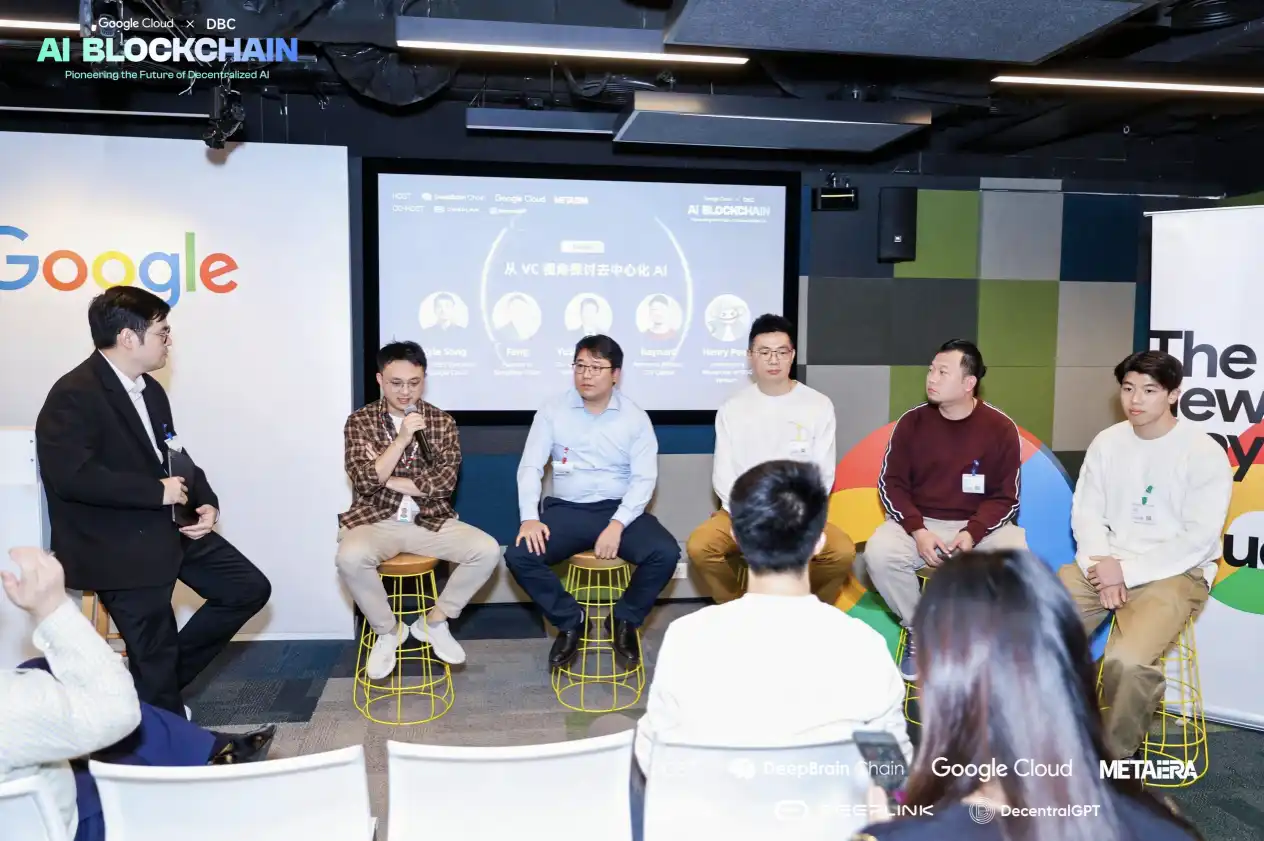
DeepBrain Chain (referred to as DBC) was established in 2017, driven by the DeepBrain Chain Foundation and the DeepBrain Chain Council to promote DBC's development. In 2021, DBC 1.0 GPU, a distributed GPU computing power network, went online, and DBC 2.0 is the world's first AI public chain. After 7 years of development, the public chain testnet was launched in August of this year, with the mainnet scheduled to go live in mid-December.
DBC 2.0: The First Decentralized AI Public Chain
The field of artificial intelligence is already highly competitive, but decentralized AI technology still has room for development in current practical applications. DeepBrain Chain, as a pioneer in the early layout of AI technology in the crypto field, has now made initial progress in technology development, mechanism design, and ecosystem construction.
How to Balance Decentralized AI Performance, Cost, and Resource Bottlenecks?
Firstly, DBC 2.0 is compatible with the EVM smart contract standard, supporting developers to issue tokens, deploy smart contracts, and develop decentralized AI applications based on its public chain. This allows any AI project to easily achieve decentralization through the DBC ecosystem and maintain long-term stable operation.
In terms of public chain performance, DBC supports 1000 transactions per second and has a block time of only 6 seconds, providing robust support for building complex AI applications. Moreover, each transaction costs less than $0.0001 in Gas fees, significantly reducing development costs. Additionally, DBC is fully compatible with the EVM, allowing existing DApps to seamlessly migrate to the platform, further lowering the technical barrier for developers.
Secondly, DBC 2.0 adopts a decentralized AI model for operation. Ethereum's founder Vitalik has warned that relying on centralized AI models may lead to users being bound by data and algorithms, while DBC 2.0 addresses this issue by supporting the fully decentralized deployment and operation of AI models.
The traditional development of decentralized AI projects typically requires funding in the tens of millions of dollars and takes 3-4 years. In contrast, DBC's efficient development tools shorten the development cycle to 3 months and reduce costs to the million-dollar level through simple API interfaces and AI container deployment functionality. More importantly, decentralized model operation effectively protects user privacy and avoids the risk of data leakage.
Thirdly, DBC 2.0 provides GPU free trials and high-performance support. By launching a token-based mining mechanism, DBC enables developers to trial GPU resources for free, significantly shortening the development cycle. The efficient resource integration capability, reducing the traditional timeline from 3 to 4 years to just 3 months, provides strong technical support for the rapid implementation of decentralized AI.
The high cost of computing power has always been the biggest bottleneck for the AI industry, especially for small and medium-sized AI companies, as the purchase and rental costs of GPU resources deter them. DBC 2.0 offers a new solution path where developers only need to issue their own token and launch a GPU mining mechanism to freely access GPU resources, breaking away from the traditional high-cost model. Furthermore, miners receive token rewards for contributing computing power. This mining incentive model not only alleviates developers' financial burden but also attracts more computing power to join, promoting ecosystem expansion. This inclusive model allows more small and medium-sized AI projects to use high-quality computing resources at low cost, thereby driving innovation and development in the AI industry.
In summary, DBC has not only optimized resource allocation but has also provided a new development platform for AI projects with efficiency, security, and low cost through decentralization and economic incentives.
From Cloud Gaming to Decentralized Inference Network, Comprehensive Coverage in Diverse Scenarios
The above has introduced some of the core advantages of DBC 2.0, a decentralized AI public chain. Building upon this, DBC has also developed a group of high-quality ecosystem projects, showcasing how to drive AI technology beyond boundaries and bring revolutionary changes to the global market.
As one of the core projects in the DBC ecosystem, DeepLink integrates AI and blockchain technology to provide a low-latency rendering solution for cloud gaming. By involving GPU providers in the "Orion Hunt" competition, DeepLink has brought over 2000 GPU nodes to DBC, not only driving the overall ecosystem's resource expansion but also paving a low-cost, high-performance path for the cloud gaming industry.
When it comes to the layout of decentralized AI models, DecentralGPT has become a star project of DBC. Positioned against OpenAI, DecentralGPT adopts an open-source approach, emphasizing data privacy and transparency, aiming to provide users with more autonomy in AI services. Its recent launch of a multi-million dollar GPU competition has not only attracted GPU providers from around the world but also further solidified DBC's resource advantage in the decentralized AI field, helping to grow the entire ecosystem.
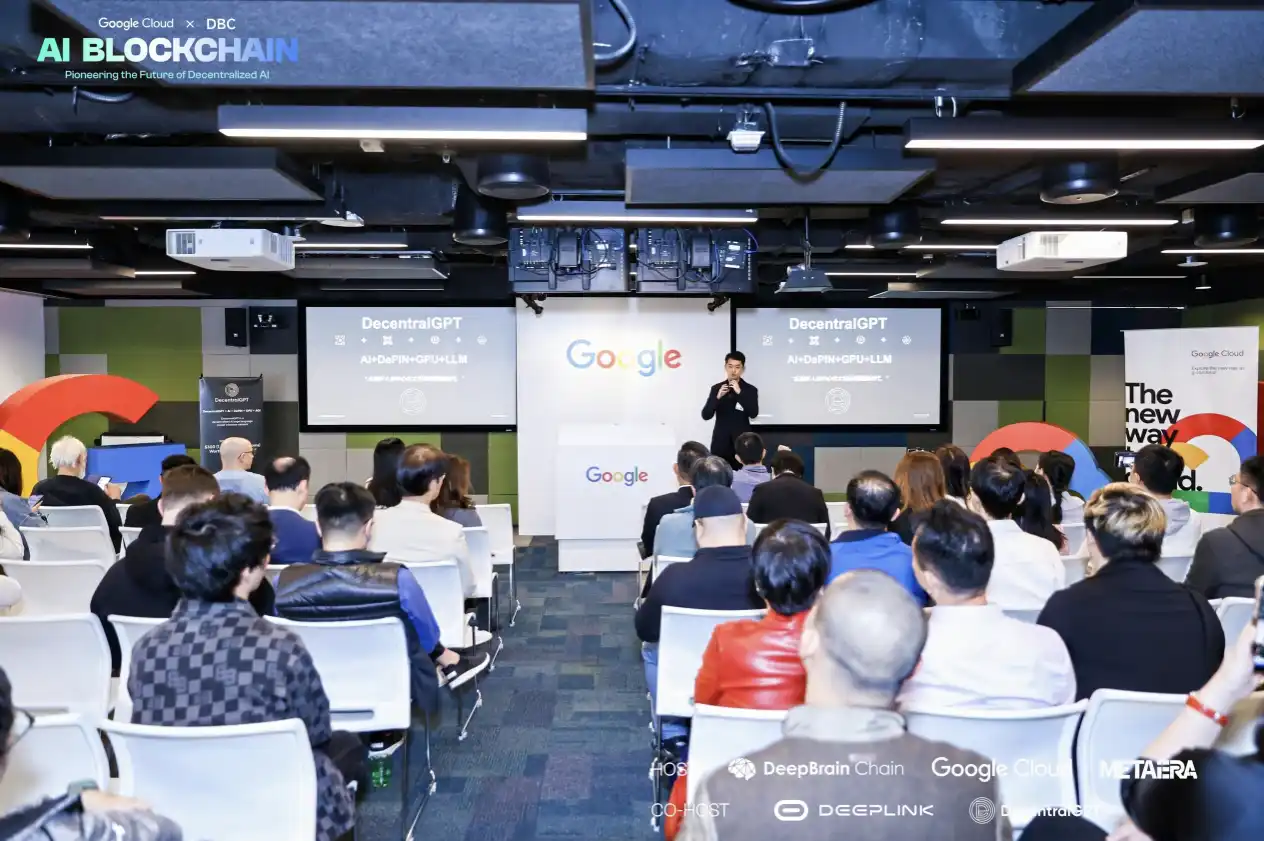
DecentralGPT Analyst Ze Ren Li on the Value of "DecentralGPT: Decentralized AI Large Language Model" Speech
The DBC ecosystem is not limited to core technical breakthroughs but also widely covers diverse scenarios through a series of innovative projects. SuperImage uses decentralized AI for image generation, supporting various text-to-image models, allowing users to generate high-fidelity artwork in seconds, providing a new realm of possibilities for digital creation. Meanwhile, DRCpad focuses on the primary market trading of AI nodes, laying a solid foundation for DBC's decentralized AI ecosystem through project filtering and incubation of high-quality projects.
In addition, DBC's business collaboration with HYCONS CLOUD has expanded to fields such as artificial intelligence, autonomous driving, biomedicine, and cloud gaming, providing a convenient collaboration channel for enterprises and developers in need of GPU resources. This resource-sharing model lowers the barrier to computing power for various industries and drives technological inclusivity.
At the infrastructure level, DBC also provides comprehensive tool support. DBCSCAN, as its EVM browser, has launched its testnet, supporting smart contract deployment and transaction queries. DBCWallet is feature-rich, covering POS staking, governance voting, treasury proposals, etc., providing developers and users with a complete ecosystem operation platform. These tools and platforms further enhance the user experience and development convenience of the DBC ecosystem.
DBC's ecosystem AI projects also span a wide range of areas from AI financial forecasting to AI scientific exploration. For example, AIDF positions itself as a decentralized financial forecasting platform, AITalk focuses on AI conversation interaction, DeepVideo and Hyper 3D explore the potential of video generation and 3D model generation, respectively. Whether for gaming like GameNPC and GamerGPT or for education and scientific research like MathAI and BioFold, these projects together outline various perspectives of the DBC decentralized AI ecosystem.
Overview of DBC 2.0 Tokenomics
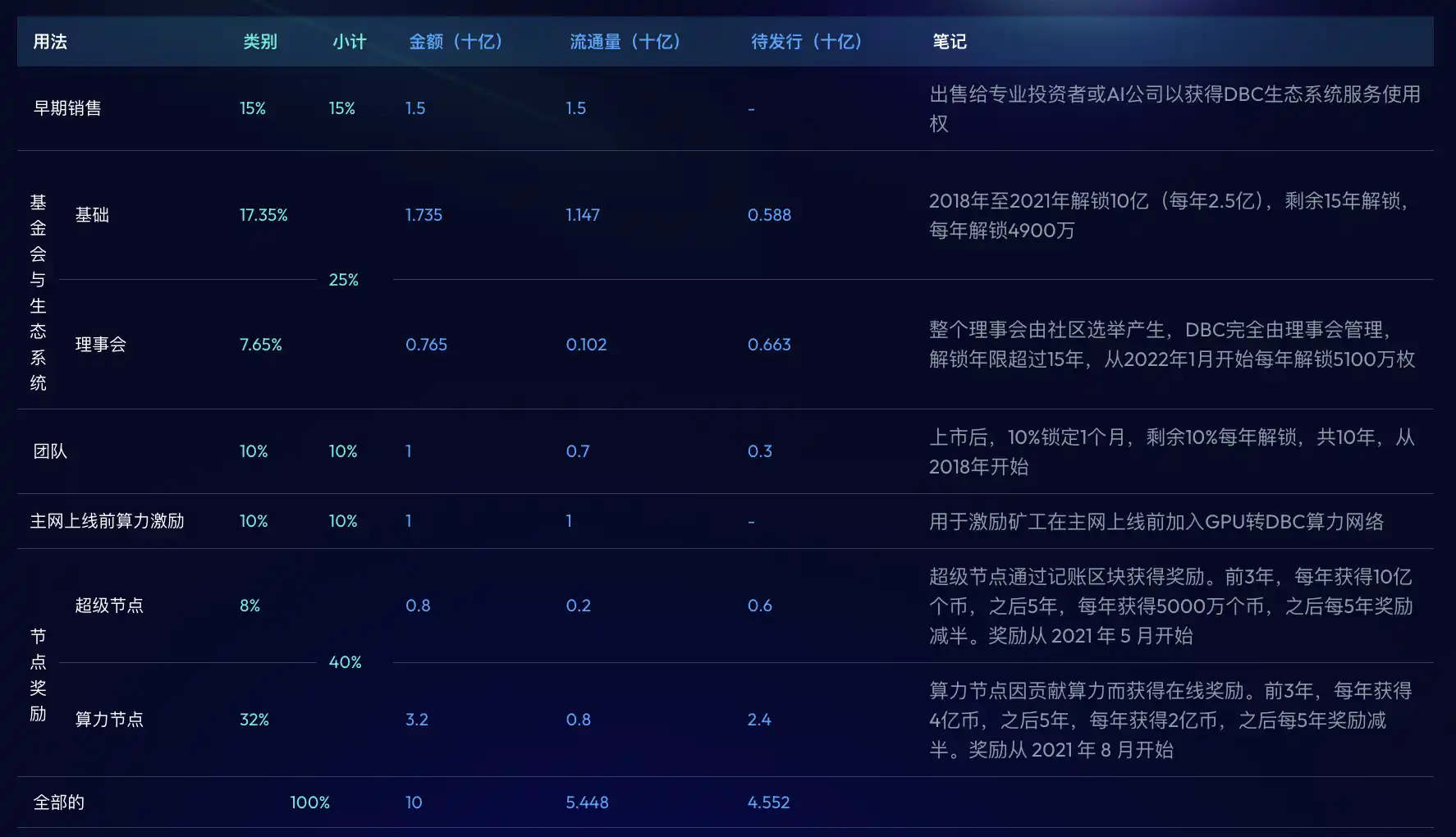
The total supply of DBC (DeepBrainChain) tokens is 10 billion, with a fixed supply that will never increase, and is expected to be fully issued in approximately 100 years. DBC adopts a deflationary model, where the GPU leasing fee paid by users will be burned based on different proportions of the total GPU count: when the network's GPU count is below 5,000, the burn rate is 30%; when it exceeds 5,000, the rate increases to 70%; and when it reaches or exceeds 10,000, the burn rate rises to 100%.
Users need to purchase DBC tokens through a trading platform or other channels to pay for GPU leasing fees. This mechanism ensures that each GPU lease will reduce the circulating supply of DBC in the market. Additionally, miners need to stake DBC to provide GPU services, with an initial stake of 1,000 DBC per GPU (currently valued at $4). As the number of GPUs increases, the total staked DBC amount will also increase accordingly. As of now, the total DBC staked by GPU miners network-wide has reached 74,680,376 tokens, accounting for 1.33% of the total issuance.
DBC POS Supernodes are required to stake DBC to receive block rewards, with the current total staked DBC across the network being 1,466,792,420, accounting for 26.14% of the total DBC issuance.
Furthermore, DBC tokens also serve as the governance token of the DeepBrainChain network. The network elects 21 committee members through a POS mechanism to collectively manage the Ecosystem Development Fund. The Committee DAO holds elections every four months, and all candidates are ranked based on the number of votes received, with each DBC being equal to one vote. The treasury funds managed by the Committee DAO are used to support ecosystem development, further driving the sustainable operation and growth of the DeepBrainChain network.
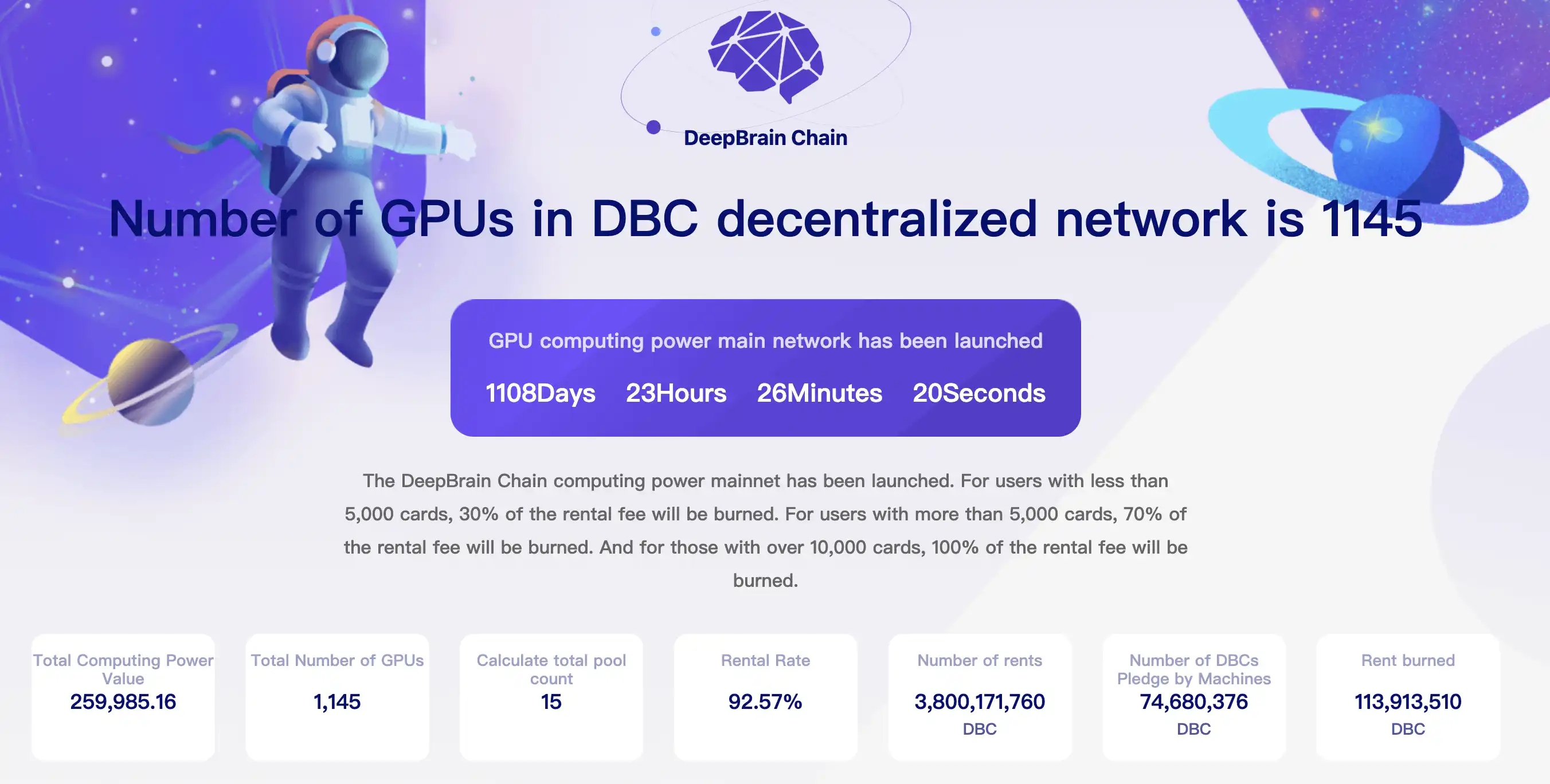
As mentioned earlier, the DBC 2.0 Testnet was launched in August. With several months passed, how is the current performance?
According to the official information, the current DBC total hash rate has reached 259,985.16, with over 1145 GPUs, a GPU leasing rate of 92.58%, and GPU leasing consuming over 113 million DBC, demonstrating the high efficiency of its resource utilization.
The more ecological applications there are, the greater the ecosystem's demand for GPU. The more DBC transactions used per day, the more DBC destroyed, and the greater the value of DBC.
Take the cloud internet cafe application as an example. Cloud internet cafe users need to purchase coins on the transaction market to use GPU. For every additional GPU, 30% of the tokens purchased from the transaction market will be destroyed. If there are 1000 cloud internet cafes, each cafe has 100 machines, each machine is used for 10 hours a day, paying $0.1 per hour, with 30% being destroyed. Tokens worth $900,000 are destroyed every month.
Based on a coin price of $0.002USDT, over 400 million coins need to be destroyed in a month. At the same time, to support 1000 cafes, 70,000 machines are needed, and an additional 7 billion coins need to be staked.
Traditional Tech Giants and the Symphony of Decentralized AI
At the intersection of artificial intelligence and blockchain technology, the DBC AI public chain is starkly contrasting with traditional decentralized computing power projects. Decentralized computing power projects mainly target centralized AI enterprises, with competitors including giants such as Google and Microsoft, providing computing power support to centralized AI through GPU rental. However, this market competition is extremely fierce, with almost all tracks dominated by centralized enterprises, resulting in an internal competition characterized by high computing costs and limited price flexibility.
In contrast, the DBC AI public chain serves AI developers, opening up a brand-new decentralized AI market. With empowering developers at its core, DBC provides infrastructure for the decentralized AI ecosystem, helping developers rapidly refactor business models, thereby avoiding the dilemma of low user migration costs and intense price competition in the centralized AI model. This strategy not only fills the gap in the decentralized AI market but also opens up a new blue ocean for AI technology exploration and innovation.
Meanwhile, DeepBrain Chain has also partnered with tech giant Google Cloud. The conference on November 28, themed "Driving the Future of Decentralized AI," showcased the interim results of this collaboration, outlining the vision of traditional tech giants collaborating with decentralized technology platforms to forge the future.
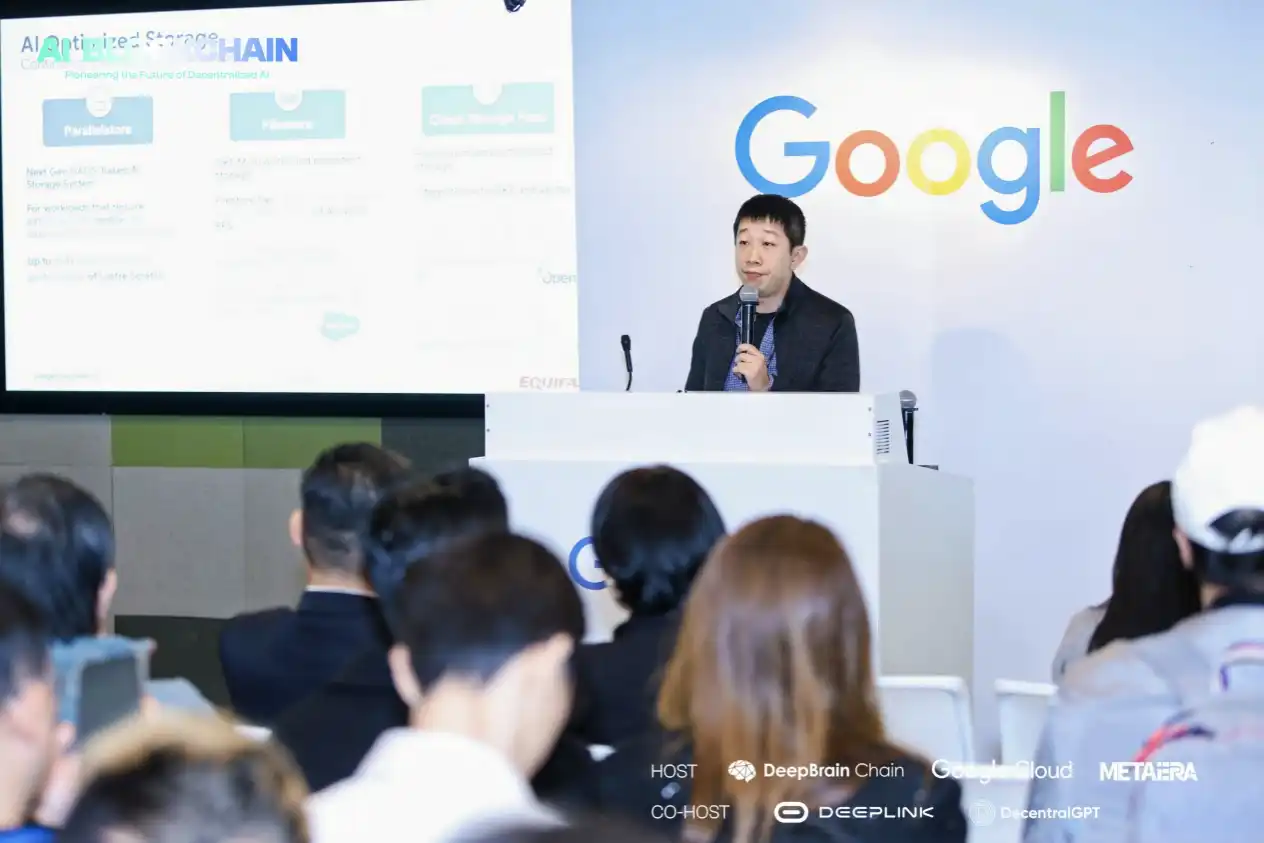
Google Cloud Solutions Architect Leon Li on "Decentralized AI: Leveraging GPU for Distributed Inference on Google Cloud" keynote speech
First of all, Google Cloud provides powerful computing power support for the DBC ecosystem. A decentralized AI network requires a large number of GPU resources, and for miners lacking GPU devices, Google Cloud's GPU service has become an important supplement, allowing more participants to easily join the DBC ecosystem. At the same time, it has brought new user growth points and business models to Google Cloud.
Google Cloud has also reduced the barrier to entry for users through its "one-click mining" feature, allowing users to run AI model images and participate in mining various AI tokens on the DBC AI public chain without requiring a deep technical background. This convenience has attracted more developers and users, further expanding the scale of the decentralized AI ecosystem and laying the foundation for the popularization of AI technology.
It is reported that DeepBrain Chain is establishing a special fund to incubate more innovative deAI projects. The success of these projects will further drive the prosperity of the DBC chain itself, forming a virtuous cycle of mutual promotion between the ecosystem and infrastructure.
Google Cloud will continue to empower DeepBrain Chain with technology and resources, while DeepBrain Chain, through the innovation of decentralized AI technology, attracts more developers and users to join, collectively driving the rapid growth of this emerging market. This partnership model injects new momentum into the decentralized AI ecosystem and opens up new development paths for the global AI market.
You may also like

Morning Report | BitMine increased its holdings by 126,971 ETH last week; trader Eugene announced his exit from the crypto market

Wang Chuan: How can one not feel anxious after the neighbor Old Wang made thirty times profit by investing in storage stocks? (Seven) - A quarter-century cycle

Cryptocurrency CEXs are flocking to sell US stocks, and traditional brokerages are facing an "uninvited guest."

$75 billion in foreign capital has fled, and South Korean retail investors have absorbed it all using leverage

Japan’s Three Megabanks Plan Joint Stablecoin Issuance in Fiscal 2026
MUFG, SMBC, and Mizuho reportedly plan to jointly issue fiat-pegged stablecoins in fiscal 2026, signaling Japan’s growing push into bank-led digital payment infrastructure.

Humanity Discloses H Token Dual-Chain Attack Details, With Losses on Ethereum and BSC Exceeding $36 Million
Humanity said the H token attack across Ethereum and BSC caused more than $36 million in losses after leaked ProxyAdmin keys enabled malicious contract upgrades and token minting.
White House Discusses CLARITY Act With Law Enforcement Ahead of Senate Vote
The White House discussed the CLARITY Act with law enforcement ahead of a Senate vote, focusing on illicit finance risks and developer protections.

Bitcoin Trading Guide 2026: Strategies for Experienced Traders

What Is XAUT and PAXG? Why Tokenized Gold Is Booming in 2026

Will the SpaceX IPO Hurt Bitcoin? Here's What Traders Are Watching

Foreign selling in the South Korean stock market accelerates, with cumulative net sales reportedly reaching $75 billion this year
On June 9, The Kobeissi Letter, citing Goldman Sachs data, reported that global investors are selling South Korean stocks at an unusually rapid pace. In the latest trading session, foreign investors sold about $801 million worth of Kospi constituent stocks again; total foreign outflows last week reached about $10 billion, and the market has been in net foreign selling on nearly every trading day over the past month. According to the data cited in the report, foreign investors have sold about $75 billion worth of South Korean stocks so far this year. Meanwhile, South Korean retail and institutional investors together recorded roughly $69 billion in net buying over the same period, suggesting that the market’s main buying support has come from domestic capital rather than returning overseas funds. The information currently disclosed still mainly comes from The Kobeissi Letter’s retelling and Goldman Sachs data summaries, while public details on the statistical period and the specific definition of “selling” remain relatively limited.

Fortune Warns of Strategy’s Financing Structure Risks as Bitcoin Premium Narrows
Fortune warned that Strategy’s Bitcoin treasury model faces growing financing risks as MSTR’s net asset premium narrows and preferred stock dividend pressure increases.

Ferrari Challenge Le Mans: Carl Moon to Dominate in WEEX Livery

Sahara AI Responds to SAHARA’s Sharp Drop: No Contract or Product Security Issues Found, Internal Investigation Underway
Sahara AI responded to SAHARA’s 60% price drop, saying no token contract or product security issues have been found and an internal investigation is underway.

WEEX Deposit/Withdrawal Dynamic Island: Your Asset Status, Always in Sight
Scaling Crypto Derivatives: The Digital Asset Infrastructure Behind High-Volume Trading
In the fast-moving digital asset ecosystem, derivatives platforms face an extreme architectural test. High-leverage futures markets demand more than just standard security—they require absolute operational precision, zero-latency matching engines, and ironclad structural scalability, all while navigating intense market volatility.
As global platforms scale to meet these demands, the industry is shifting away from rigid, monolithic setups toward a more agile, "decoupled" infrastructure philosophy.
The Blueprint for High-Volume Copy TradingFor elite global exchanges like WEEX (founded in 2018), this architectural choice becomes critical when scaling high-volume retail features like social copy trading. When thousands of users automatically mirror the real-time strategies of elite traders simultaneously, it triggers sudden, monumental spikes in concurrent transactional volume.
To prevent execution latency or settlement bottlenecks during these peak volatility events, a platform's primary engine must remain entirely dedicated to risk management, copy-trade synchronization, and order matching.
The Architectural Rule: New-generation platforms must separate front-end user execution engines from heavy backend infrastructural overhead to eliminate operational friction.
By separating these layers, platforms can maintain complete sovereignty over their trading environments and user experiences while strategically aligning with institutional-grade infrastructure ecosystems. This strategic framework allows modern exchanges to leverage advanced Digital Asset Custody infrastructure such as Cobo’s behind the scenes, ensuring that backend wallet management scales elastically alongside trading spikes.
Capitalizing on Market Momentum and 400× LeverageIn a derivatives arena where platforms offer up to 400× leverage on perpetual contracts, capital efficiency and market agility are core business metrics. To capture market momentum, an exchange needs the ability to rapidly expand its asset offerings, supporting everything from legacy crypto assets to sudden, trending altcoins across a massive library of trading pairs.
Adopting a flexible, scalable Wallet-as-a-Service (WaaS) solution such as Cobo’s could completely rewrite the development timeline for high-growth exchanges. Instead of spending months of engineering capital building out custom backend wallet architectures for every new blockchain network, platforms can deploy localized infrastructure in days.
This agility allows platforms to instantly scale their listings to over a thousand trading pairs without compromising security or delaying time-to-market. It mirrors the exact operational advantages seen during high-velocity market events, similar to how advanced wallet infrastructure empowers platforms during sudden asset surges; allowing exchanges to pass that speed and liquidity directly to their global user base.
A Mature Foundation for GrowthThe synergy between trusted infrastructure ecosystems and global trading platforms represents the natural evolution of a maturing crypto market. As WEEX continues to scale its global spot and derivatives offerings for over 6 million users, adopting robust backend paradigms proves that platforms no longer have to compromise between cutting-edge trading velocity and uncompromised structural security.

Get Paid to Onboard? Try WEEX’s New Homepage with Rewards for Registration, Deposit & Trade
WEEX Custom Layout: Build Your Perfect Trading Workspace in Seconds
Morning Report | BitMine increased its holdings by 126,971 ETH last week; trader Eugene announced his exit from the crypto market
Wang Chuan: How can one not feel anxious after the neighbor Old Wang made thirty times profit by investing in storage stocks? (Seven) - A quarter-century cycle
Cryptocurrency CEXs are flocking to sell US stocks, and traditional brokerages are facing an "uninvited guest."
$75 billion in foreign capital has fled, and South Korean retail investors have absorbed it all using leverage
Japan’s Three Megabanks Plan Joint Stablecoin Issuance in Fiscal 2026
MUFG, SMBC, and Mizuho reportedly plan to jointly issue fiat-pegged stablecoins in fiscal 2026, signaling Japan’s growing push into bank-led digital payment infrastructure.
Humanity Discloses H Token Dual-Chain Attack Details, With Losses on Ethereum and BSC Exceeding $36 Million
Humanity said the H token attack across Ethereum and BSC caused more than $36 million in losses after leaked ProxyAdmin keys enabled malicious contract upgrades and token minting.


