
After MiniMax's Stock Price Rebounds 92%: What Remains When a Model Company Removes the Model

 Prefer us on Google


Original Title: "After MiniMax's Stock Price Rebounds 92%: What Remains When a Model Company Removes the Model"
Original Author: Dongcha Beating
On August 31, MiniMax surged by 16.18%. Since its low point in July, the stock has rebounded by 92%, with a market capitalization returning to HKD 124.9 billion.
Three months ago, the market had just held a memorial service for this company. The stock price had dropped more than 80% from its peak, leading to a loss of HKD 300 billion in market value.
On August 26, MiniMax released its mid-year report, showing a year-on-year revenue growth of 283%, with B-end revenue increasing by 703%; by August, the company's ARR had exceeded USD 800 million, and the token consumption in July was 20 times that of January.
A few days later, what brought MiniMax back into the discussion was a model it did not create itself.
H3 Max.
Infinite Channel
On August 3, MiniMax open-sourced H3, a 33 billion parameter model capable of processing text, images, video, and audio simultaneously. fal took its open-source weights, continued with post-training, and optimized it with its own inference infrastructure, ultimately creating H3 Max.
According to fal, for generating a 5-second video, H3 Max's throughput can reach about 35 times that of MiniMax's official endpoint.
On August 29, Rehan Sheikh, an engineer from the American generative AI infrastructure company fal, connected H3 Max to Twitch for a live broadcast. The content of the live stream was not pre-prepared video. As the visuals played, the model generated content in real-time. Each segment lasted 5 seconds, at 768p, with synchronized audio, and the generation time was about 3 seconds.
Generation was faster than playback.
As a result, viewers could decide the plot direction through comments, and new storylines would appear on the screen within seconds. As long as the machine kept running, this channel could theoretically continue indefinitely. Over one weekend, it attracted about 5 million views, and some who disliked AI-generated content nicknamed it the "Infinite Slop Machine."
The underlying model is the same, but what truly widened the gap is the post-training, inference optimization, hardware scheduling, and deployment methods after the model was delivered.
One media outlet reported it with the headline:
"Post-Train Beats Parent"
This incident appears to be a beautiful engineering optimization, yet it raises a bigger question behind MiniMax's rebound.
If models can be open-sourced, taken away, and further trained, or even improved by others to be faster and better, then what should the market price for a model company?
To answer this question, let's first take a look at the company fal.
This company does not train foundational models. Its business involves taking models trained by other companies, running them on its own infrastructure, and selling them to developers. The faster new models come out, the quicker its shelf updates.
After integrating models, fal performs inference optimization, hardware scheduling, and deployment, reducing speed and cost to a more commercially viable level. Over 2.5 million developers use its generative models, and the company's ARR has reached about USD 400 million, with a team of only 70 people.
In the past year, fal's revenue has grown about 60 times, and its valuation has reportedly risen from USD 4.5 billion to about USD 8 billion.
Sequoia conducted an in-depth interview with fal's founding team, during which Sequoia Capital partner Pat Grady mentioned that the fal team observed in the second and third quarters of 2025 that the half-life of the top five video models was only 30 days.
The term "half-life" comes from physics, originally referring to the time required for half of the radioactive substance's atomic nuclei to decay; in this context, it refers to the time required for about half of the top five video models to be replaced by new models.
A model that just reached the top could be replaced by another within a month. However, regardless of how models change, developers always need a platform to run them.
fal has secured this position.
Developers pay per call for each image or video generated. After integrating with a platform like fal, they can switch to whichever model is currently the best without needing to re-integrate APIs or build infrastructure. Models can change monthly, but the platform's position is hard to replace.
fal's CEO Burkay Gur once said, "When content generation becomes infinite, limited things become more valuable."
This company itself is a business born out of the rapid depreciation of models. H3 was created by MiniMax, but the users, revenue, and usage data of H3 Max will primarily remain with fal. The more successful H3 Max becomes, the sharper this issue becomes.
Moreover, fal is still a private company, and it cannot be purchased on the public market.
From HKD 1,100 to HKD 200
When MiniMax went public, the market believed in a different story.
This company works on text, voice, and video models, with C-end products like Talkie and Conch AI, and B-end products like APIs. Compared to startups focusing on single models, it seemed closer to a complete multimodal business loop.
On January 9 of this year, MiniMax went public with an issue price of HKD 165, oversubscribed by 1,848 times, and closed up 109% on the first day. On March 10, the stock price broke through HKD 1,100 during trading, with a market capitalization exceeding Baidu at one point.
That was when the market most believed in this story.
The turning point came in June. On June 1, MiniMax released its flagship model M3, with 428 billion parameters. Compared to GLM-5.2 and DeepSeek V4 released around the same time, its model size was smaller. The official emphasis was on training and engineering efficiency, with a system capable of continuous 12-hour unattended operation, autonomously training four models, and accelerating CUDA kernels by 9.4 times.
Then the problems arose. The community found that some of the official results came from self-testing, and there were significant discrepancies between third-party actual tests and public figures. The synchronized adjustment of billing rules also led to a significant increase in consumption speed for some old users.
On June 5, the company publicly apologized, stating that "M3 requires more computing power, which is our oversight," and ten days later, the flagship model, which had been online for only two weeks, was permanently reduced in price by 50%; shortly after, on June 16, Zhizhu released GLM-5.2, and the top spot of the open-source list was immediately taken, with M3's lead lasting only two weeks. On the first day of the lifting of restrictions on July 9, MiniMax fell by 20%, and a few days later, the stock price had dropped more than 80% from its peak.
The day after the crash, Yan Junjie announced that he would no longer receive a salary until AGI was achieved and would allocate personal shares to reward the team and support open-source initiatives. On that day, the company completed a placement of HKD 16 billion, receiving about 7 times the subscription.
By August 26, MiniMax presented a sufficiently impressive mid-year report, with revenue increasing by 283% year-on-year, B-end revenue growing by 703%, and R&D investment continuing to rise rapidly. The next day, the stock price only rose by 4%.
The market is clearly still waiting for something else.
Core Assets
The biggest problem for model companies is that product updates happen too quickly.
In early June, M3 had just reached the top, and half a month later, it was surpassed by GLM-5.2; followed by the releases of DeepSeek V4, GLM-5.3, and Kimi K3 in succession. The current number one may change hands with the next model release, with a lead window of only a few weeks.
Leading can only be measured in weeks; relying solely on one model clearly cannot support a company's long-term valuation.
Thus, over the past year, the market has been searching for the true core assets of model companies.
The most direct answer is the next-generation model, but the next generation will also quickly become outdated. As long as the industry continues to iterate rapidly, the ability to "create new models" can only ensure that a company does not get eliminated, but it does not explain why it is worth holding long-term.
A more convincing answer is the ability to create models.
Many model releases this year have already proven that the same foundation, relying solely on post-training and environment, can also produce significant capability leaps.
Zhizhu's GLM-5.3 and GLM-5.2 use the same 753 billion parameter foundation, and the real changes come from a larger training environment and reinforcement learning post-training. Terminal-Bench 3.0 scores jumped from 4.6 to 28.3, with no re-training of the foundation, yet the results improved significantly.
Tang Jie later referred to this as a "controlled variable experiment."
Kimi K3 has established over 50 million sandbox environments during training and evaluation, with a significant amount of machine time spent waiting for model inference. Operations like freezing, resuming, and forking have been compressed to the tens of milliseconds, allowing the model to repeatedly try, fail, and restart in vast real-world environments.
Cline even allowed K3 to modify its own training scaffolding. After 17 hours of no human intervention, its score improved from 77.5 to 88.8.
What model companies find truly difficult to replicate has shifted from a single weight to a complete system of production weights, post-training weights, and evaluation weights.
Anthropic spends over $1 billion a year on reinforcement learning environments. OpenAI has purchased tens of thousands of Macs for computer-use agents for the same reason.
The barriers to entry and investment for building such systems are rapidly increasing, and they are not solely in the hands of model companies.
Cursor's Composer 2 is a typical example. Its underlying technology is based on the open-source Kimi K2.5 from the Dark Side of the Moon, but the market's valuation of Cursor is clearly unrelated to Kimi K2.5.
Cursor has accumulated a wealth of real programming behaviors, developer workflows, and reinforcement learning systems trained around this data. The foundational model comes from others, but what truly matters is what remains after the model is used.
Fal is similar. It took the H3 weights and created H3 Max. Users generate videos on fal, and the revenue first goes to fal, with the data also initially retained by fal.
Upstream model companies provide the most expensive raw materials, while downstream may accumulate what can genuinely compound in value. Technical complexity and value capture ability do not naturally correspond.
Thirty years ago, a similar situation occurred in the personal computer industry. The chip was the most complex part of the machine, but ordinary consumers recognized Dell and Compaq. Intel took over a decade to reinsert itself into consumers' view with "Intel Inside."
### Model Companies Minus Models
Thus, to assess the value of a model company, one might consider a subtraction approach. After subtracting model weights, replicable inference optimizations, and post-training capabilities that can be taken over by third parties, what remains is what the company can truly possess long-term.
MiniMax has proactively conducted such an experiment. On August 3, it open-sourced H3. In a short time, hundreds of derivative models appeared, with downloads reaching tens of millions. Chip platforms like Huawei Ascend, Muxi, and AMD quickly completed adaptations, and many developers and partners joined in.
Although the weights were open-sourced, corporate contracts and API revenues did not diminish—just in July, before H3 was open-sourced, MiniMax's token consumption was already 20 times that of January, and these still count on its books.
More importantly, H3 did not release everything. The two managed modules, H3-Context-IR and Regenerate-2 K, remain under MiniMax's control. To output higher-spec 2 K videos, one still needs to call official services. This is a typical open-source strategy: spreading foundational capabilities to grow the ecosystem while retaining the parts that can generate commercial returns on the server side.
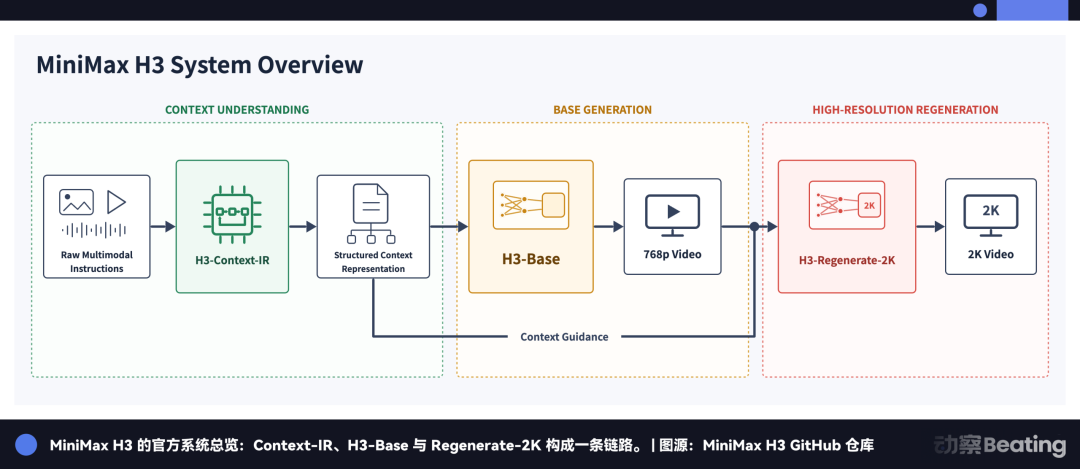
Thus, H3 Max's significance to MiniMax is not just that "others have optimized my model faster," but it demonstrated that subtraction to the market for the first time.
The mid-year report provided part of the answer: B-end revenue grew by 703%, with ARR exceeding $800 million. At least so far, open-sourcing has not led to a loss of all value. But H3 Max also showcased another half of the risk: user relationships, calling revenues, and usage data may settle on downstream platforms.
### Bull vs. Bear
In late August, MiniMax's stock price rebounded nearly double from its low, while the short-selling ratio rose to about 20%, reaching a high.
Bulls see what remains after the subtraction. For example, enterprise clients, API revenues, real calls, data backflow, and the system's ability to continue training the next generation of models. In the public market, such assets are scarce, and there are limited model companies available for purchase, giving MiniMax a clear scarcity premium.
The explosive popularity of H3 Max also provided a very intuitive reference for this money. If a company like fal is worth $8 billion, and one of fal's hottest new products is built on H3, then how much is the company behind H3 worth?
This is the bull's line of thought.
The bear's perspective is that if weights can be taken for free, post-training can be completed by fal, and inference speed can be improved by third parties by 35 times, then why should all these capabilities remain in MiniMax's valuation?
This also explains MiniMax's unusual stock performance over the past few months; financial reports can only reflect how much the company is currently earning, but what the market truly cares about is what it can retain after open-sourcing. H3 Max was the first to put this answer on the table.
### Backflow
After releasing H3, MiniMax is actually facing a very old business problem. A company can voluntarily give up a layer of scarcity, provided it knows where the next layer of money is.
Red Hat made such a choice once.
The source code of Linux has never belonged to Red Hat; anyone can download, modify, and redistribute it for free. What Red Hat ultimately sells is not Linux itself, but the stable versions, long-term maintenance, technical support, and certification systems that enterprises are willing to pay for.
The wider open-source software spreads, the larger the market for this service becomes. In 2019, IBM spent $34 billion to acquire Red Hat, and what it bought was certainly not a copy of the Linux source code that anyone could download.
What is released must be able to bring back value.
This is also what MiniMax needs to prove after open-sourcing H3.
The market has already seen the diffusion. Models are being downloaded, adapted, and retrained, and third-party products like H3 Max are starting to emerge.
What remains to be seen is whether this diffusion can ultimately reflect in MiniMax's own revenue and assets.
It could be more enterprise clients, possibly a continuous increase in API consumption, or data and feedback left by developers during usage that eventually re-enters post-training and becomes part of the next generation of models.
If these elements can form a cycle, the more H3 is taken away, the more entry points MiniMax will gain.
If the cycle does not form, the situation will be completely different.
The influence of the model may grow larger, and the ecosystem may become more prosperous, but the most valuable customer relationships, usage data, and transaction entry points will ultimately settle in others' hands. By then, MiniMax may provide foundational capabilities but fail to capture most of the value generated by this round of diffusion.
Therefore, what H3's open-sourcing truly needs to test is not the download count or how many companies announce adaptations. Those numbers can only prove that it has spread far enough.
In the coming quarters, what needs to be observed is how much money can still come back after it is released. Red Hat has enterprise service contracts, Google has search and advertising. MiniMax also needs to find its own pipeline.
-- Price
This content is provided for general informational purposes only and doesn't constitute financial, investment, legal, or tax advice. Any events, rewards, online promotions, or related information mentioned herein should not be considered a recommendation, solicitation, or invitation to purchase, sell, trade, or otherwise deal in any crypto assets. Crypto assets are highly volatile and may result in loss. The availability of WEEX services, products, and related events may vary by region. You are responsible for ensuring that your participation is in accordance with applicable local laws and regulations.
You may also like

Natura Changes CEO: Carlucci Returns After a Decade
Warren Buffett Turns 96: The Investments That Made Him a Wall Street Legend
Meta Faces Dilemma After AI Layoffs: Cybersecurity Incidents Up 40%, Cleanup Time Up 70%

Bull Secures €387.8 Million Contract for LUMI-AI Supercomputer

Chinese AI Through the Eyes of Silicon Valley VCs: Sanctions Didn't Lock It Down, but Instead Brought Out a 'Monster'
Consolidation in Ranges and Rate Reevaluation: Trader Assesses Bitcoin and Ethereum Movement Scenarios
Digital Ruble Fails to Generate Significant Interest Among Russians, Says Sberbank
AI Scam Hits $3.2 Million Per Incident, Crypto Security Battlefield Shifts from 'Code' to 'Scams'

Matt Damon to Keynote at Ripple Swell 2026 in New York
How Paintings Could Have Become Part of the Digital Economy, but Didn't
Shein's IPO and China's PMI: What Changes for Markets
From Pay to One-Stop Asset Management, BiyaPay Expands Global Diverse Financial Services Boundaries

Trump's Cryptocurrency Scheme Rakes in $1.4 Billion While Investors Lose $4.7 Billion
AI Creates Abundance, BTC Creates Scarcity: What Web3 Truly Changes Is Not Production Relations, But Value Relations
Cryptocurrency Arbitrage and Price Scanning: How Quants Identify Inefficiencies in Funding Rates and Spreads Using Trading APIs
DRAM Shortage Until 2030: How to Position Yourself on Memory Giants?
Why Stablecoins Can't Serve as Credit Despite Being Transferable and Store of Value?
Bernstein Comments on Seven Memory Types: After HBM, DRAM and NAND Compete for the Next Trillion-Dollar Market
After Impacting Two Generations, Meta Ordered to Pay $18 Billion

What is Thinking Cat (HMM)? Reasons Why Ownerless Tokens Can Still Fail

Derivatives Begin to Drive Spot Markets: South Korea's Asset Pricing Power is Flowing Out
ECB Official Calls on Central Banks to Embrace Blockchain
The 25th Word: A Secret Vault in Your Ledger Signer
Tom Lee's Latest Interview: Four Catalysts That Will Drive ETH Up This Year

After a 10-Week Buying Pause, Is Strategy Finally Returning to 'Buy, Buy, Buy' Mode?
Barron Trump Hides from Public Life Due to Assassination Fears, Melania Respects His Decision
Bitcoin is no longer just a risky asset, says BlackRock executive
Saylor Sounds the Horn, and This Time He Really Has Ammunition
The Battle of HIP-4 Begins: Who Will Become the New trade.xyz?
NAVI Prime: How the Largest Lending Protocol on Sui Innovates to Pave the Way for a $10 Billion Fund After $30 Billion in Loans Over Three Years?
Natura Changes CEO: Carlucci Returns After a Decade
Warren Buffett Turns 96: The Investments That Made Him a Wall Street Legend
Meta Faces Dilemma After AI Layoffs: Cybersecurity Incidents Up 40%, Cleanup Time Up 70%
Bull Secures €387.8 Million Contract for LUMI-AI Supercomputer
Chinese AI Through the Eyes of Silicon Valley VCs: Sanctions Didn't Lock It Down, but Instead Brought Out a 'Monster'
Consolidation in Ranges and Rate Reevaluation: Trader Assesses Bitcoin and Ethereum Movement Scenarios

Contents
Latest articles




Latest coin listings on WEEX


