
 Buy Crypto
- Markets
 Futures
- Spot
- Copy Trade
- Earn
- More
Will Ethereum See a Strong Breakout After the End of the Staking Net Outflow?

Original Title: "Ethereum Staking Key Reversal: Entry Funds Double Exit Funds"
Original Author: KarenZ, Foresight News
As 2025 comes to a close, the Ethereum network has experienced a key turning point: the validator "entry queue" has reversed and surpassed the "exit queue."
This means that after months of market dynamics, the funds attempting to stake Ethereum and become validators now far exceed the funds looking to unstake and exit.
This change is not just a numerical shift, but also a barometer of market sentiment and network fundamentals, signaling a gradual easing of selling pressure that has persisted for months. It also indicates that with factors such as returning institutional confidence, the Pectra upgrade optimization, DeFi deleveraging, and other drivers at play, the Ethereum network is entering a new phase of security enhancement and capital accumulation.
Ethereum Validator Queue Reversal
According to the latest data from the Ethereum Validator Queue, there are currently approximately 739,824 ETH in line to enter the network, with an estimated wait time of 12 days and 20 hours; the exit queue has only 349,867 ETH, requiring about 6 days to clear.
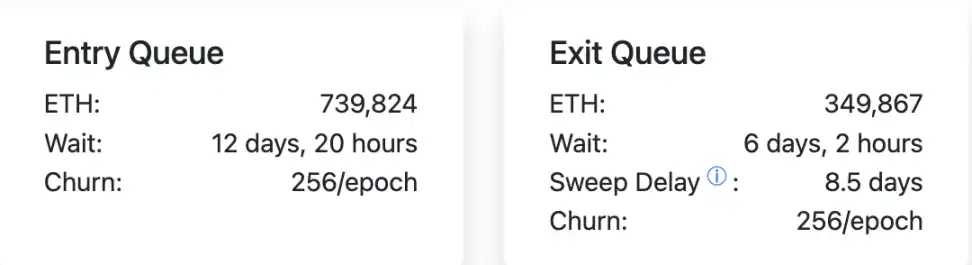
Furthermore, the current total staked Ethereum is around 35.50 million ETH, accounting for 29.27% of the total supply, with the number of active validators reaching 983,600.
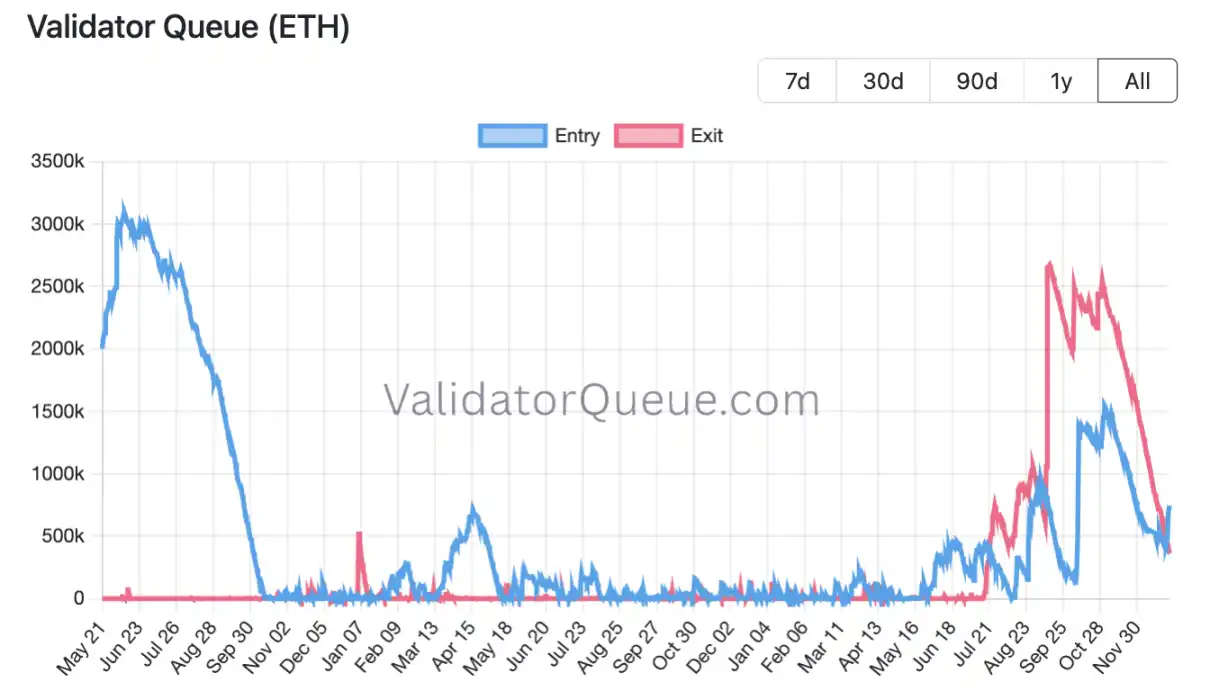
What is the Validator Queue? Why is it Important?
In the Ethereum proof-of-stake (PoS) mechanism, to ensure consensus stability, the protocol dictates that nodes cannot enter and exit at will, but rather must adjust through a "Churn Limit" mechanism.
Currently, the maximum number of validators that can join (activate) or exit in each epoch (approximately 6 minutes and 24 seconds) is set at 256 ETH, equivalent to a processing capacity of about 57,600 ETH per day.
· Entry Queue: The queue for staking 32 ETH to apply as a validator. Queue growth indicates strong staking demand, with funds bullish on long-term returns.
· Exit Queue: The queue for withdrawing funds. Queue growth typically signals selling pressure, liquidity demand, or deleveraging behavior.
Therefore, the validator queue is not only an indicator of network health, but also a barometer of market sentiment.
How Will the Validator Queue Change in 2025?
Throughout the year 2025, the Ethereum validator queue experienced significant fluctuations:
· First half of the year to autumn: Multiple record-high queue exits, mainly due to institutional rotation, profit-taking, DeFi deleveraging (such as Aave's surging borrowing rates leading to stETH loop liquidations), and individual security incidents (such as Kiln exiting all Ethereum validator nodes in September).
· Mid-September: Queue exits peaked at 2.67 million ETH, with a waiting time of up to 46 days.
· September to October: Brief "queue entries" surge, later dominated by "queue exits" again.
· November: "Queue entries" grew back to over 1.5 million ETH, but "queue exits" briefly surpassed 2.5 million ETH.
· End of December: "Queue entries" reversed, with approximately 739,824 ETH currently queued to enter the network, while "queue exits" have only 349,867 ETH.
The Four Core Drivers Behind the December Reversal
This reversal was not accidental but the result of the combined forces of capital, technology, and the macro environment:
Large Stakes from Treasury Companies like BitMine
Just two days before the reversal (December 25-27), BitMine staked a total of 342,560 ETH (approximately $1 billion), directly driving the queue reversal.
Furthermore, BitMine had previously stated its intention to launch dedicated staking infrastructure — the Manufacturing Validator Network (MAVAN) — in the first quarter of 2026, demonstrating its long-term commitment to the Ethereum staking ecosystem.
Simultaneously, another leading treasury company, SharpLink, fully staked nearly 100% of its ETH, further bolstering the momentum of fund inflows.
Despite facing challenges in the current crypto treasury race, with some institutions slowing down their ETH accumulation, and even cases of sell-offs like ETHZilla, the bold moves by top players like BitMine and SharpLink have largely shored up the Ethereum staking ecosystem's fundamentals.
Pectra Upgrade Optimizes Staking Experience
The Pectra upgrade implemented in May 2025 introduced key improvements through EIP-7251: increasing the maximum effective validator balance from 32 ETH to 2048 ETH, enabling reward compounding, and validator consolidation. This reduced the operational costs for institutions managing thousands of validator nodes and provided technical convenience for large fund entry.
Kiln Re-Staking Reopened
Following a security incident in September 2025, Kiln underwent a massive validator exodus. While it is unclear when Kiln resumed staking, data from Beaconcha.in shows that Kiln currently holds a 1.68% share in the Ethereum staking ecosystem.
DeFi Deleveraging Nearing Completion
In the previous months of June and July, a rise in Aave's borrowing rates forced the closure of stETH leveraged-loop strategies, leading to temporary selling pressure. Recently, as the deleveraging process gradually unfolded, the related exit demands have subsided, with market entry demands taking the lead.
Partial Institutional Bottom Fishing
After multiple days of market adjustment, some institutions are bullish on the long-term value of ETH. Trend Research is prepared to continue accumulating ETH with $1 billion. On December 25, according to a conversation with Ai Yi and Jack Yi himself, the actual cost of ETH that Trend Research has been accumulating since November is around $3150, meaning their current holding of 645,000 ETH is experiencing an unrealized loss of approximately $143 million. After an additional $1 billion injection, the average cost expectation for ETH is projected to be around $3050.
Summary
The Ethereum validator "queue in" surpassing "queue out" marks the initial formation of a staking net inflow-dominant trend since July. This shift is not merely a numerical leap but a crucial signal of market confidence rebuilding. Of course, whether this leading trend can sustain stability remains to be tested over time.
While Ethereum spot ETFs have not yet shown significant net inflows, the on-chain fundamentals' improvement is evident. As Joseph Chalom, Co-CEO of SharpLink Gaming, mentioned earlier this month, the surge in stablecoins, tokenized RWAs, and the growing interest of sovereign wealth funds could drive Ethereum's TVL to grow tenfold by 2026.
Standing on the tail of 2025, has Ethereum prepared itself for a breakthrough year in 2026? The answer is left to time to reveal.
You may also like

Naval personally takes the stage: The historic collision between ordinary people and venture capital

a16z Crypto: 9 Charts to Understand the Evolution Trends of Stablecoins

Refutation of Yang Haipo's "The End of Cryptocurrency"

Can a hairdryer earn $34,000? Interpreting the reflexivity paradox of prediction markets

6MV Founder: In 2026, the "landmark turning point" for crypto investment has arrived

Abraxas Capital Mints $2.89 Billion USDT: Liquidity Boost or Just More Stablecoin Arbitrage?
Abraxas Capital just received $2.89 billion in freshly minted USDT from Tether. Is this a bullish liquidity injection for crypto markets, or is it business as usual for a stablecoin arbitrage giant? We analyze the data and the likely impact on Bitcoin, altcoins, and DeFi.
A VC from the Crypto world said AI is too crazy, and they are very conservative
The Evolutionary History of Contract Algorithms: A Decade of Perpetual Contracts, the Curtain Has Yet to Fall

Kicked out by PayPal, Musk aims to make a comeback in the cryptocurrency market

Solana ETF News: What Is a Solana ETF and Why Is Goldman Sachs Betting $108 Million on SOL?
Solana ETF news today shows Goldman Sachs disclosed a $108M position while total SOL ETF inflows reached $1.45B. Analysts now expect up to $6B in institutional demand as Solana trades 71% below its all-time high.

Bitcoin ETF News Today: $2.1B Inflows Signal Strong Institutional Demand for BTC
Bitcoin ETFs news recorded $2.1B inflows over 8 consecutive days, marking one of the strongest recent accumulation streaks. Here’s what the latest Bitcoin ETF news means for BTC price and whether the $80K breakout level is next.
Michael Saylor: Winter is Over – Is He Right? 5 Key Data Points (2026)
Michael Saylor tweeted yesterday “Winter‘s Over.” It is short. It is bold. And it has the crypto world talking.
But is he right? Or is this just another CEO pumping his bags?
Let us look at the data. Let us be neutral. Let us see if the ice has really melted.

WEEX Bubbles App Now Live Visualizes the Crypto Market at a Glance
WEEX Bubbles is a standalone app designed to help users quickly understand complex crypto market movements through an intuitive bubble visualization.

Polygon co-founder Sandeep: Writing after the chain bridge chain explosion

Major Upgrade on Web: 10+ Advanced Chart Styles for Deeper Market Insights
To deliver more powerful and professional analysis tools, WEEX has rolled out a major upgrade to its web trading charts—now supporting up to 14 advanced chart styles.
Morning Report | Aethir secures a $260 million enterprise contract with Axe Compute; New Fire Technology acquires Avenir Group's trading team; Polymarket's trading volume surpassed by Kalshi

Why a Million-Follower Crypto KOL Chooses WEEX VIP?
Discover why top crypto KOL Carl Moon partnered with WEEX. Explore the WEEX VIP ecosystem, 1,000 BTC protection fund, and exclusive rewards for serious traders.

CoinEx Founder: The Crypto Endgame in My Eyes
Naval personally takes the stage: The historic collision between ordinary people and venture capital
a16z Crypto: 9 Charts to Understand the Evolution Trends of Stablecoins
Refutation of Yang Haipo's "The End of Cryptocurrency"
Can a hairdryer earn $34,000? Interpreting the reflexivity paradox of prediction markets
6MV Founder: In 2026, the "landmark turning point" for crypto investment has arrived
Abraxas Capital Mints $2.89 Billion USDT: Liquidity Boost or Just More Stablecoin Arbitrage?
Abraxas Capital just received $2.89 billion in freshly minted USDT from Tether. Is this a bullish liquidity injection for crypto markets, or is it business as usual for a stablecoin arbitrage giant? We analyze the data and the likely impact on Bitcoin, altcoins, and DeFi.


 App
App