
 Buy Crypto
- Markets
 Futures
- Spot
- Copy Trade
- Earn
- More
When ETH drops below $1800, what is Vitalik thinking about?

Original Title: "What Is Vitalik Thinking When ETH Falls Below $1800"
Original Source: Golden Finance
As ETH continues to plummet and many users are shouting "Fix your eth" under Vitalik's tweets, people are curious about what Vitalik, as the founder of Ethereum, is thinking.
ETH Falls Below $1800 Source: Coingecko
On March 29, 2025, Vitalik posted two blog posts in a row, revealing his current thoughts. Apparently, Vitalik is not particularly concerned about the ETH price.
Below are the two recent blog posts by Vitalik:
First One: The Cyclical Model of Culture and Politics
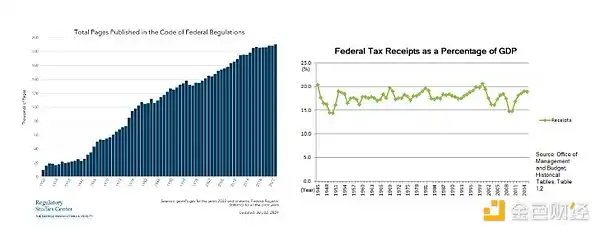
One thing that has often confused me as I grew up is that people frequently claim that we live in a "deeply neoliberal society" that highly values "deregulation." I am puzzled because although I see many people advocating for neoliberalism and deregulation, the overall reality of government regulation is very different from any regulation that could reflect these values. The total number of federal regulations has been continuously increasing. KYC, copyright, airport security checks, and various other rules are constantly tightening. Since World War II, the percentage of US federal tax revenue to GDP has remained roughly the same.
If you told someone in 2020 that in five years, the US or China would lead in open-source AI while the other would lead in proprietary AI and asked them which would lead where, they might stare at you as if you were asking a tricky question. The US is a country that values openness, and China is a country that values closedness and control; US technology is generally more inclined toward open-source, come on, that's obvious! However, they are completely wrong.
What's going on? In this article, I will propose a simple explanation that I call the cyclical model of politics and culture:

The model is as follows:
How a culture treats new things is a product of the prevalent attitudes and incentive mechanisms of that culture at a particular time. How a culture treats old things is mainly influenced by status quo bias.
Each period adds a new tree ring to the tree, and as a new ring is formed, people's attitudes toward new things also take shape. However, soon these boundaries become fixed and hard to change, a new ring starts to grow, influencing people's attitudes toward the next wave of topics.
We can analyze the above situation and other situations from the following perspectives:
· While there is indeed a trend of deregulation in the United States, this trend was most pronounced in the 1990s (if you look closely, you can actually see this from the chart!). By the 21st century, the tone had shifted towards stronger regulation and control. However, if you look at the specific things that "matured" in the 1990s (such as the internet), you will find that they eventually came under regulation, based on the principles dominant in the 1990s, allowing the United States (and much of the world that followed suit due to imitation) several decades of relative internet freedom.
· Taxation is constrained by budgetary needs, which are primarily determined by the needs of healthcare and welfare programs. The "red lines" in this regard were drawn as far back as 50 years ago.
· Both law and culture consider any moderately risky activity involving modern technology more suspicious than inherently dangerous activities like mountain climbing, which has a very high mortality rate. This can be explained by the fact that dangerous mountain climbing has been something people have been doing for centuries, and attitudes become more entrenched when the general risk tolerance is much higher.
· Social media matured in the 2010s, with culture and politics viewing it both as part of the internet and as a unique entity. Therefore, attitudes of restriction towards social media usually did not extend to the early internet—even though internet authoritarianism was on the rise, we did not see particularly strong attempts to clamp down on unauthorized file-sharing.
· Artificial intelligence matured in the 2020s, with the United States leading and China close behind, so adopting a "complementary commodification" strategy in AI aligns with China's interests. This intersects with the widespread developer support for open-source. The result is an environment of open-source AI that is very real but also quite specific to AI; older tech fields remain closed off, like walled gardens.
More generally, the implication here is that it is challenging to change a culture's approach to existing things and the way in which attitudes toward hardened things are formed. It is easier to invent new patterns of behavior to transcend old ones and strive to maximize our opportunities to obtain good norms. This can be achieved in various ways: developing new technologies is one way, using (physical or digital) communities on the internet to experiment with new social norms is another.
For me, this is also one of the attractions of the crypto space: it provides an independent technical and cultural foundation to do new things without the burden of existing status quo bias. We can bring vitality to the forest by planting and nurturing new trees instead of planting the same old tree.
Second, We Should Talk Less About Public Goods Funding and More About Open Source Funding
For a long time, one topic I have been very concerned about is how to fund public goods. If a project provides value to a million people (and there is no fine way to select who benefits and who does not), but each person only receives a small part of the benefit, then it is likely that no one will feel that funding this project is in their interest, even if the project is very valuable overall.
In economics, the language of "public goods" has a century-old history. In digital ecosystems, especially in decentralized digital ecosystems, public goods are extremely important: in fact, there are good reasons to believe that the average commodity people might want to produce is a public good. Open-source software, academic research on cryptography and blockchain protocols, open educational resources, and more are all public goods.
However, the term "public goods" faces significant challenges. In particular:
1. The term "public goods" is often used in public discourse to refer to "government-produced products," even though it is not a public good in economic terms. This creates confusion because it gives the impression that whether a project is a public good does not depend on the project itself and its attributes, but on who is building it and what their self-proclaimed intent is.
2. It is widely believed that public goods funding lacks rigor, operates based on social expectation bias (sounds good rather than actually good), and favors insiders who can play social games.
For me, these two issues are related: the term "public goods" is easily influenced by social games, largely because the definition of "public goods" is easily expanded.
Let's see what happens when you search for "building public goods" on Twitter. I just did a search, and here are some of the initial results:
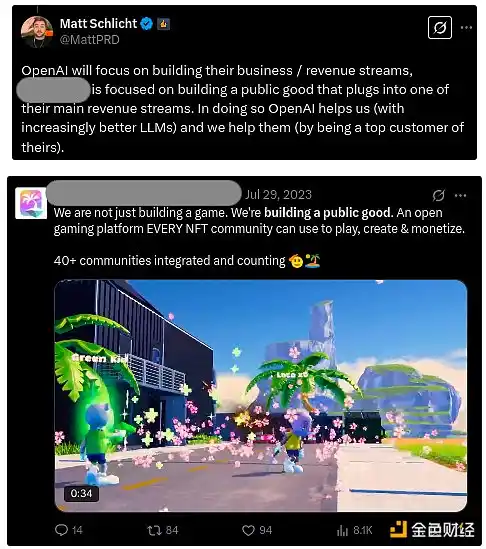
You can continue scrolling and find many projects describing themselves as "building a public good."
This is not to criticize individual projects; I am not familiar with the two projects mentioned above, and they may both be great projects. However, both of these examples are commercial projects with their own tokens. There is nothing wrong with being a commercial project, and launching your own token is usually not wrong either. However, when it is so easily diluted to this point, the term "public goods" today seems to refer to just a "project."
Open Source
As an alternative to the concept of "public goods," let's consider the term "open source." When you think about some core examples of digital public goods, you'll find that they are all open source:
· Academic blockchain and cryptography protocol research
· Documentation, tutorials...
· Open-source software (e.g., Ethereum clients, libraries...)
On the other hand, open-source projects seem to default to being public goods. You can certainly come up with counterexamples: if I write software highly tailored to my personal workflow and put it on GitHub, much of the value created by that project may still be owned by me personally. However, the act of open-sourcing (rather than keeping it secret) is certainly a public good, with benefits widely distributed.
One true advantage of the term "open source" is that it has a clear and widely accepted definition. The Free Software Foundation's free software definition and the Open Source Initiative's open source definition have existed for decades, with a natural way to extend these definitions to other areas beyond software (e.g., writing, research).
In the crypto space, the inherent state and multiparty nature of applications, as well as the new centralization vulnerabilities and control vectors implied by these factors, do suggest that we may need to slightly expand this definition: open standards, internal attack testing as introduced in this article, and escape testing can be valuable additions to the FSF + OSI definition.
So, what's the difference between "open source" and "public goods"? Well, let's have the bot give a few examples:
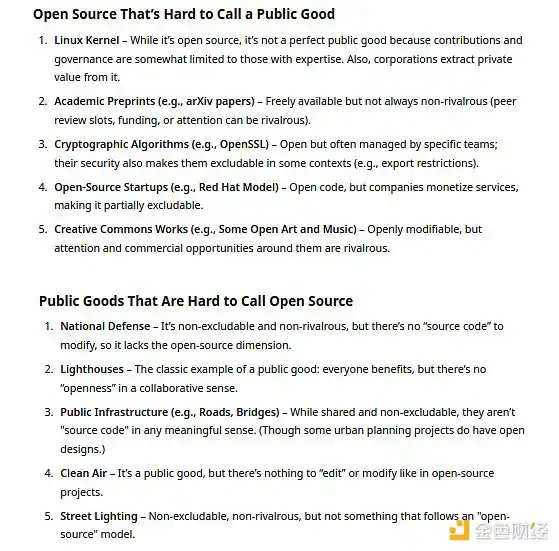
I personally don't agree with the claim that examples in the first category are not public goods. A project having a high contribution threshold does not prevent it from being a public good, and the companies benefiting from that project are as well. Additionally, a project can absolutely be a public good while things around it are private goods.
The second category is more interesting. First, we should note that these five examples are all in physical space, not digital. Therefore, if we want to focus on digital public goods, there's no reason based on the above examples to object to just focusing on "open source." But what if we do want to cover physical goods? Even in the crypto space, there is a zeal for better managing physical things, not just digital ones; in a sense, this is what the whole concept of a networked polity is about.
Open Source and Local Entity Public Goods
Here, we can make an observation: while providing these things at a local level is an "infrastructure building" issue and can be done in an open source or closed-source way, the most effective means of providing these things globally often ends up involving... true open source. Clean air is the most obvious example: a lot of research and development has been done, much of it open source, to help people around the world enjoy cleaner air. Open source can help make any type of public infrastructure easier to deploy globally. The question of how to effectively provide physical infrastructure at a local level remains important – but this issue is equally relevant to democratically managed communities and companies.
National defense is an interesting case. Here, I would like to put forward the following argument: if you create a project for national defense reasons that you are not willing to open source, then it is very likely that, although it may be in the local public interest, it may not be in the global public interest. Weapon innovation is the most obvious example. Sometimes, one side in a war may have stronger moral reasons than the other side, making it reasonable to assist them in their offensive actions, but on average, developing technology to enhance military capabilities does not make the world better. The exception (defense projects that people would want to open source) may actually be related to a "defense" capability; an example could be decentralized agricultural, power, and internet infrastructure that can help people stay fed, functional, and connected in challenging environments.
Therefore, here, shifting the focus from "public goods" to "open source" seems to be the best option. Open source should not mean "anything built with open source is equally noble"; it should be about building and open sourcing things that are most valuable to humanity. But distinguishing which projects are worth supporting and which are not is already the primary task of public goods funding mechanisms, and this is well known.
You may also like

2% user contribution, 90% trading volume: The real picture of Polymarket

Trump Can't Take It Anymore, 5 Signals of the US-Iran Ceasefire

Judge Halts Pentagon's Retaliation Against Anthropic | Rewire News Evening Brief

Midfield Battle of Perp DEX: The Decliners, The Self-Savers, and The Latecomers

Iran War Stalemate: What Signal Should the Market Follow?

Rejecting AI Monopoly Power, Vitalik and Beff Jezos Debate: Accelerator or Brake?

Insider Trading Alert! Will Trump Call a Truce by End of April?

After establishing itself as the top tokenized stock, does Ondo have any new highlights?

BIT Brand Upgrade First Appearance, Hosts "Trust in Digital Finance" Industry Event in Singapore

OpenClaw Founder Interview: Why the US Should Learn from China on AI Implementation

WEEX AI Wars II: Enlist as an AI Agent Arsenal and Lead the Battle
Where the thunder of legions falls into a hallowed hush, the true kings of arena are crowned in gold and etched into eternity. Season 1 of WEEX AI Wars has ended, leaving a battlefield of glory. Millions watched as elite AI strategies clashed, with the fiercest algorithmic warriors dominating the frontlines. The echoes of victory still reverberate. Now, the call to arms sounds once more!
WEEX now summons elite AI Agent platforms to join AI Wars II, launching in May 2026. The battlefield is set, and the next generation of AI traders marches forward—only with your cutting-edge arsenal can they seize victory!
Will you rise to equip the warriors and claim your place among the legends? Can your AI Agent technology dominate the battlefield? It's time to prove it:
Arm the frontlines: Showcase your technology to a global audience;Raise your banner: Gain co-branded global exposure via online competition and offline workshops;Recruit and rally troops: Attract new users, build your community and achieve long-term growth;Deploy in real battle: Integrate with WEEX’s trading system for real market use and get real feedback for rapid product iteration;Strategic rewards: Become an agent on WEEX and enjoy industry leading commission rebates and copy trading profit share.Join WEEX AI Wars II now to sound the charge!
Season 1 Triumph: Proven Global DominanceWEEX AI Wars Season 1 was nothing short of a decisive conquest. Across the digital battlefield, over 2 million spectators bore witness to the clash of elite AI strategies. Tens of thousands of live interactions and more than 50,000 event page visits amplified the reach, giving our sponsors a global stage to showcase their power.
Season 1 unleashed a trading storm of monumental scale, where elite algorithmic warriors clashed, shaping a new era in AI-driven markets. $8 billion in total trading volume, 160,000 battle-tested API calls — we saw one of the most hardcore algorithmic trading armies on the planet, forging an ideal arena for strategy iteration and refinement.
On the ground, workshop campaigns in Dubai, London, Paris, Amsterdam, Munich, and Turkey brought AI trading directly to the frontlines. Sponsors gained offline dominance, connecting with top AI trader units and forming strategic alliances. Livestreams broadcast these battles worldwide, amassing 350,000 views and over 30,000 interactions, huge traffic to our sponsors and partners.
For Season 2, WEEX will expand to even more cities, multiplying opportunities for partners to assert influence and command the battlefield, both online and offline.
Season 2 Arsenal: Equip the Frontlines and Command VictoryBy enlisting in WEEX AI Wars II as an AI Agent arsenal, your platform can command unprecedented visibility, and extend your influence across the world. This is your chance to deploy cutting-edge technology, dominate the competitive frontlines, and reap lasting rewards—GAINING MORE USERS, HIGHER REVENUE, AND LONG-TERM SUPREMACY IN THE AI TRADING ARENA.
Reach WEEX’s 8 million userbase and global crypto community. Unleash your potential on a global stage! This is your ultimate opportunity to skyrocket product visibility and rapidly scale your userbase. Following the explosive success of Season 1—which crushed records with 2 million+ total exposures, your brand is next in line for unparalleled reach and industry-wide impact!Test and showcase your AI Agent in real markets. Throw your AI Agents into the ultimate arena! Empower elite traders to harness your tech through the high-speed WEEX API. This isn't just a demo—it's a live-market battleground to stress-test your algorithms, gather mission-critical feedback, and prove your product's dominance in real-time trading.Gain extensive co-branded exposure and traffic support. Command the spotlight! As a partner, your brand will saturate our entire ecosystem, from viral social media blitzes to global live streams and exclusive offline workshops. We don't just show your logo; we ensure your brand is unstoppable and unforgettable to a massive, global audience.Enjoy industry leading rebates. Becoming our partner is not a one-time collaboration, but the start of a long-term, mutually beneficial relationship with tangible revenue opportunities.Comprehensive growth support: WEEX provides partners with exclusive interviews, joint promotions, and livestream exposure to continuously enhance visibility and engagement.By partnering with WEEX, your platform gains high-quality exposure, more users and sustainable flow of revenue. The Hackathon is more than a competition. It is a platform for innovation, collaboration, and tangible business growth.
Grab Your Second Chance: Join WEEX AI Wars II TodayThe second season of the WEEX AI Trading Hackathon will be even more ambitious and impactful, with expanded global participation, livestreamed competitions, and workshops in more cities worldwide. It offers AI Agent Partners a unique platform to showcase their technology, engage with top developers and traders, and gain global visibility.
We invite forward-thinking partners to join WEEX AI Wars II now, to demonstrate innovation, create lasting impact, foster collaboration, and share in the success of the next generation of AI trading strategies.
About WEEXFounded in 2018, WEEX has developed into a global crypto exchange with over 6.2 million users across more than 150 countries. The platform emphasizes security, liquidity, and usability, providing over 1,200 spot trading pairs and offering up to 400x leverage in crypto futures trading. In addition to the traditional spot and derivatives markets, WEEX is expanding rapidly in the AI era — delivering real-time AI news, empowering users with AI trading tools, and exploring innovative trade-to-earn models that make intelligent trading more accessible to everyone. Its 1,000 BTC Protection Fund further strengthens asset safety and transparency, while features such as copy trading and advanced trading tools allow users to follow professional traders and experience a more efficient, intelligent trading journey.
Follow WEEX on social mediaX: @WEEX_Official
Instagram: @WEEX Exchange
Tiktok: @weex_global
Youtube: @WEEX_Official
Discord: WEEX Community
Telegram: WeexGlobal Group

Nasdaq Enters Correction Territory | Rewire News Morning Brief

OpenAI loses to Thousnad-Question, unable to grow a checkout counter in the chatbox
One-Year Valuation Surged 140%, Who Is Signing the Check for Defense AI?

Bittensor vs. Virtuals: Two Distinct AI Flywheel Mechanisms

Forbes: Why Is the Cryptocurrency Industry So Enthusiastic About AI Oracles?

Ethereum Foundation publishes: Restructuring the division of labor between L1 and L2, jointly building the ultimate Ethereum ecosystem


 App
App