
What are the chances of a 5X MOONSHOT for HYPE?

 Prefer us on Google

Original Title: Arthur Hayes predicts 150 for HYPE: Can Hyperliquid's trading boom make it happen?
Original Author: Ishika Kumari, AMB Crypto
Translation: Peggy, BlockBeats
Editor's Note: Against the backdrop of increasing macro uncertainty and sustained low sentiment in the crypto market, a tantalizing deviation is emerging: investor sentiment remains in the "extreme fear" zone, yet some asset prices are slowly moving upward.
Recently, the decentralized derivatives trading platform Hyperliquid (HYPE) has become the talk of the town. BitMEX co-founder Arthur Hayes publicly set a target price of $150 (about 5 times the current price), attracting market attention. As of March 12, 2026, the HYPE price is around $36, with a 5% increase in the last 24 hours and a cumulative increase of over 11% in the past 7 days.
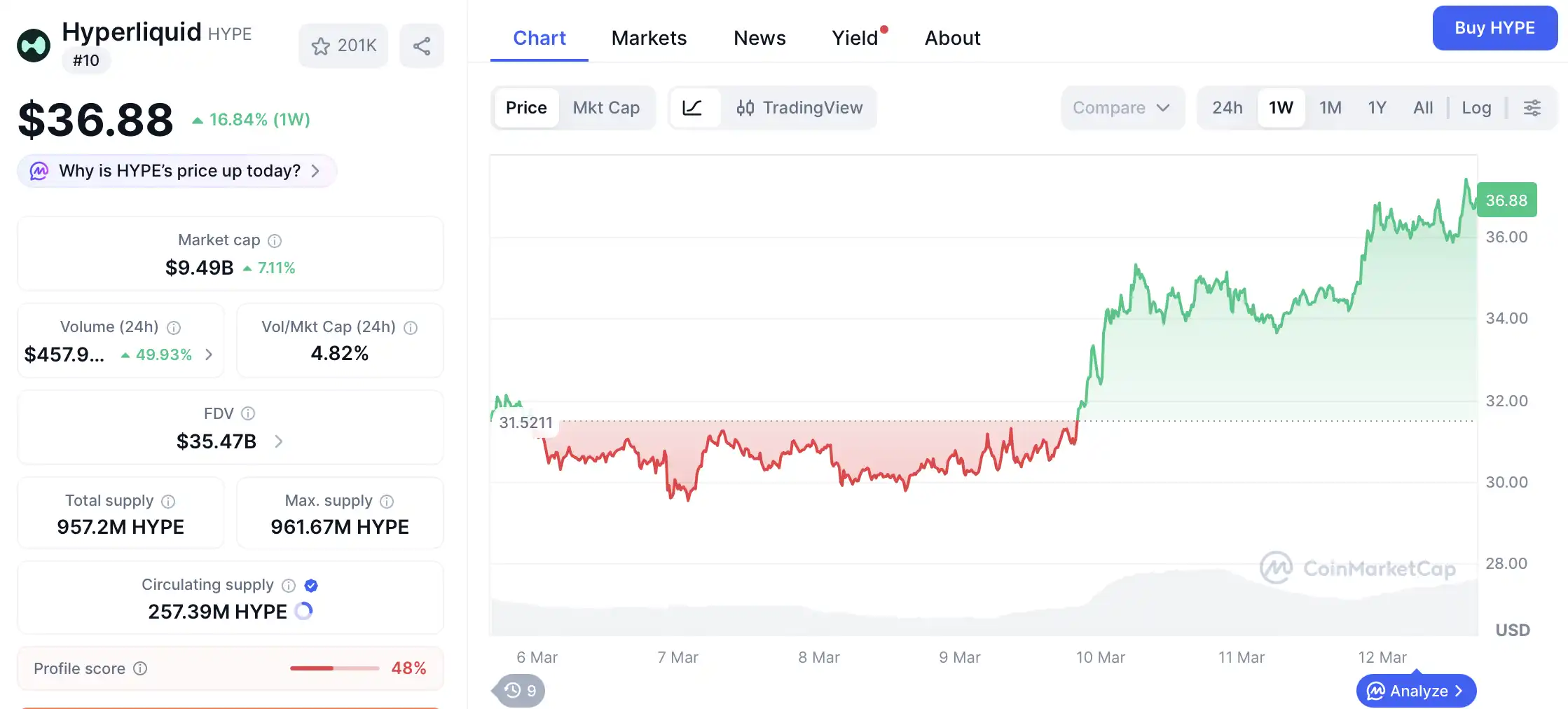
Community interpretations around its price surge include various explanations: for example, the platform uses about 97% of its revenue for token buybacks and burns, creating a value-capture mechanism directly linked to trading activity; the HIP-3 mechanism allows users to create more types of perpetual markets on-chain, expanding potential trading demand; meanwhile, the lower ADV/OI ratio is also seen by some market participants as a more "authentic" signal of trading volume.
This article synthesizes the views of Arthur Hayes and several community participants, attempting to understand the structural reasons behind HYPE's recent strength in a market environment where sentiment remains cautious.
Below is the original text:
The crypto market is currently in a rather delicate state: prices are slowly rising, but investor sentiment remains extremely dismal.
The Crypto Fear and Greed Index still lingers in the "extreme fear" zone. However, for seasoned market participants like BitMEX co-founder Arthur Hayes, this disconnect between price and sentiment actually signals something else.
Arthur Hayes: $150 Target Price for HYPE
Hayes believes that instead of focusing solely on short-term price fluctuations or hastily shorting the market, attention should be turned to decentralized exchanges (DEX).
He reviewed past market cycles and pointed out that during the 2023 consolidation phase, despite overall tough conditions for traders, trading platforms like GMX still achieved continuous growth through trading fees.
In his view, as more and more trading activity moves on-chain, Hyperliquid (HYPE) could also follow a similar development path.
In contrast, institutions like Tether or Circle usually keep profits within the company; however, Hyperliquid adopts a different mechanism—about 97% of the revenue is used for buyback and burn of HYPE tokens, reducing market circulation and providing long-term price support.
Based on this business model, Arthur Hayes believes that the price of HYPE has the potential to rise to $150.
"My target price for HYPE in August 2026 is $150. With the price around $30 when I write this article, this implies roughly a 5x upside."
Related Reading: "Arthur Hayes: Why is HYPE a 5x potential target?"
What Conditions Does Hyperliquid Need to Explode?
However, to truly have a realistic foundation for this target price, Hyperliquid still needs to achieve stronger growth. Currently, the platform's annualized revenue is about $843 million, but to support such a valuation, the revenue scale needs to increase to approximately $1.4 billion.
One key growth driver may come from HIP-3.
HIP-3 allows users to create permissionless perpetual contract markets on-chain and directly peg the underlying assets to traditional assets. For example, the Nasdaq 100 index or precious metals. To launch such markets, users need to stake 500,000 HYPE tokens.
Although this mechanism has been launched not long ago, HIP-3 has already contributed about 10% of Hyperliquid's revenue. If more traders in the future start hedging traditional asset risks on-chain, this business segment could see significant expansion.
Community-Wide Bullish HYPE
Echoing Hayes' sentiment, an X user also stated, "Even if the world is in a state of war, holding HYPE may still be the best decision."
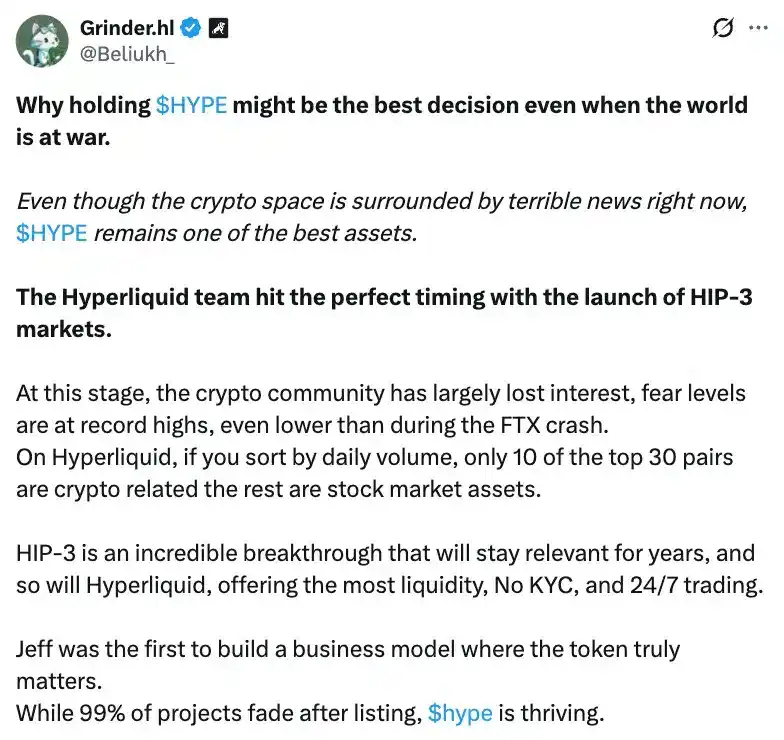
Tweet Content: Why holding HYPE may still be the best decision even if the world is in a state of war. Despite the entire crypto space being surrounded by various negative news, HYPE remains one of the best assets.
The Hyperliquid team hit a perfect timing with the release of the HIP-3 market. At this stage, the overall crypto community has significantly lost interest, with panic levels hitting an all-time high, even more dismal than during the FTX collapse period. On Hyperliquid, if you sort by daily trading volume, among the top 30 trading pairs, only 10 are crypto-related, with the rest being traditional market assets.
HIP-3 is a breathtaking breakthrough and will remain significant in the coming years; so will Hyperliquid—it offers the highest liquidity, no KYC required, and 24/7 trading.
Jeff is the first to establish such a business model: the token itself truly matters in this system. While 99% of projects gradually disappear after launch, HYPE continues to thrive.
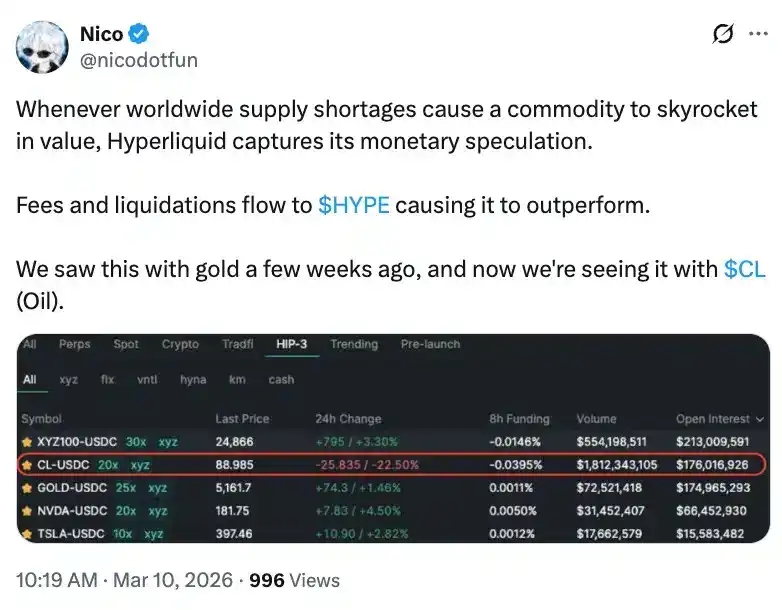
In addition, another user also mentioned, "As long as global supply shortages lead to a surge in a certain commodity's price, Hyperliquid captures the currency speculation demand. Transaction fees and settlement-generated revenue all flow into HYPE, causing it to outperform the market. We saw this a few weeks ago with gold, and now we are witnessing the same phenomenon with CL (crude oil)."
Another key indicator supporting the bullish view is the ADV/OI ratio (Average Daily Volume / Open Interest).
Arthur Hayes referenced this indicator and stated, "Among the top five perpetual contract DEXs, Hyperliquid has the most genuine trading volume because it has the lowest ADV/OI ratio."
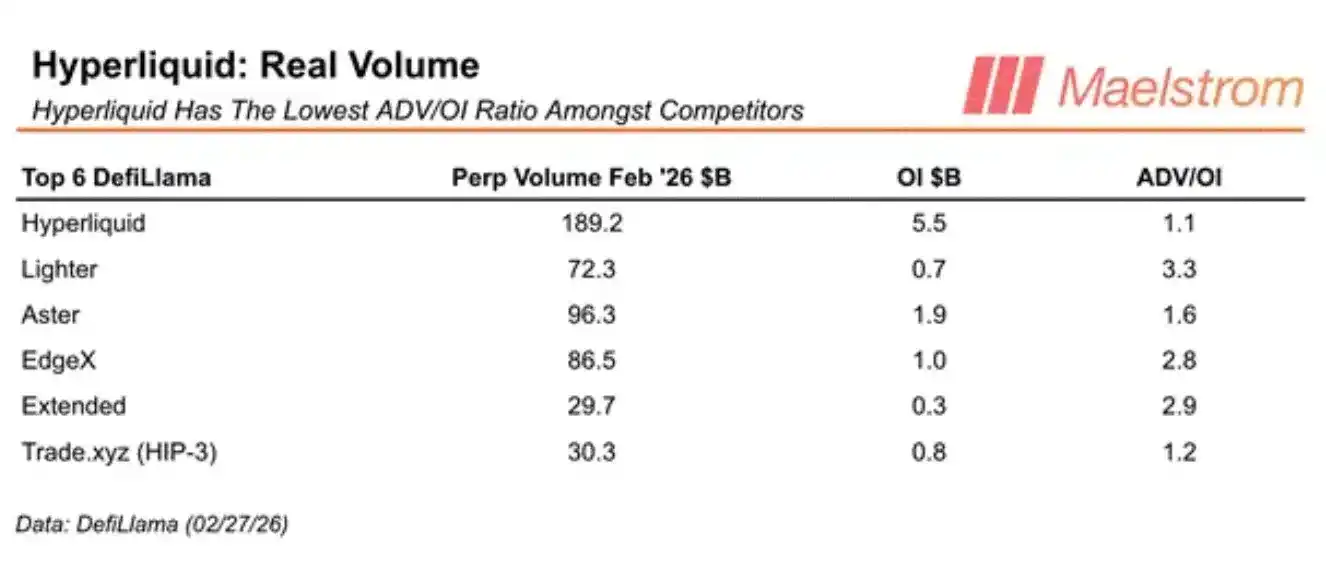
However, Hayes also believes that over time and as the market environment changes, Hyperliquid's visible share of the overall average daily volume (ADV) will continue to increase.
&HYPE: Price vs. On-chain Metrics
Meanwhile, at the time of writing, the HYPE's trading price is around $34.98, up 13.37% in the past 24 hours. However, despite the strong price performance, on-chain data indicates that market sentiment remains relatively cautious.
Santiment's data shows that between mid-January and mid-February, there was a noticeable divergence between developer activity and market sentiment: project development activity continued to progress, but market sentiment did not warm up accordingly.
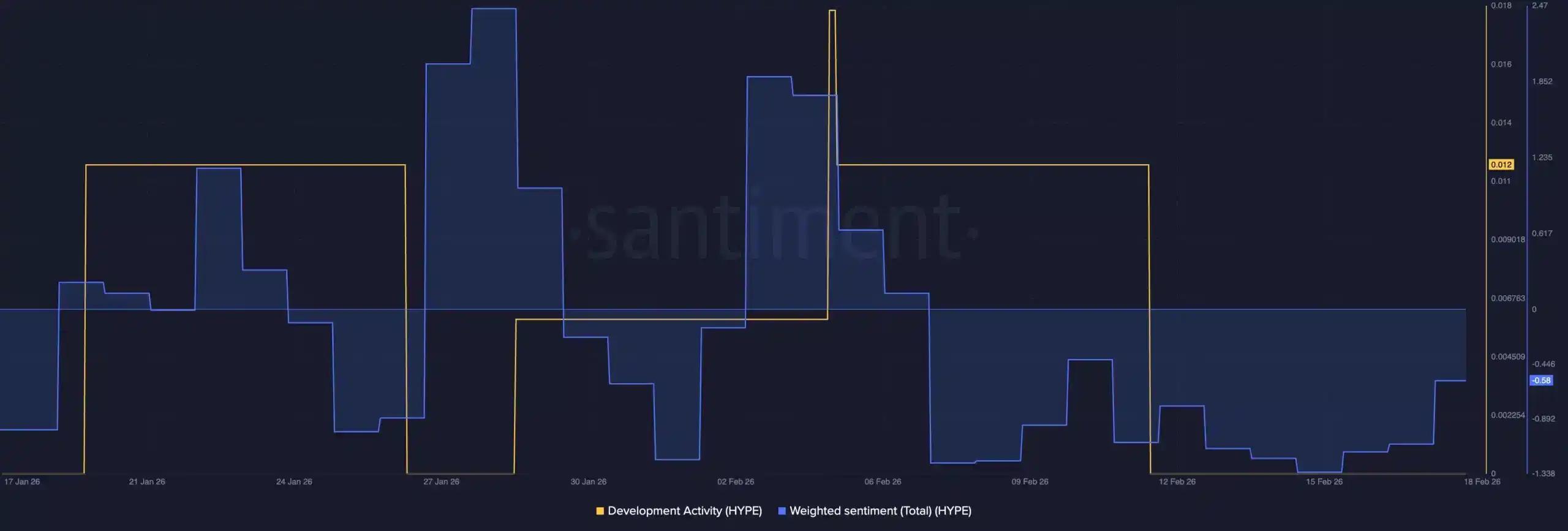
Source: Santiment
However, investor sentiment remains mostly negative, primarily because traders are more focused on short-term price fluctuations. Only recently has market sentiment started to recover, indicating that the market may finally be recognizing the platform's continuously improving utility and revenue model.
Notably, this is not the first time Hayes has expressed strong confidence in HYPE. As early as February 21, this BitMEX co-founder stated on X that he was consistently accumulating HYPE and had set a target price of $150.
In his earlier assessment, this target price could be achieved by July 2026; however, in the latest prediction, the timing has been postponed to around August 2026. However, this is premised on the protocol achieving an annualized revenue of approximately $1.4 billion.
Final Summary
Indicators like Hyperliquid's low ADV/OI ratio suggest that its trading activity comes more from real users rather than artificially inflated volume.
Meanwhile, market sentiment remains cautious, indicating that investors are still awaiting clearer signals to confirm the platform's ability to achieve sustainable growth.
-- Price
This content is provided for general informational purposes only and doesn't constitute financial, investment, legal, or tax advice. Any events, rewards, online promotions, or related information mentioned herein should not be considered a recommendation, solicitation, or invitation to purchase, sell, trade, or otherwise deal in any crypto assets. Crypto assets are highly volatile and may result in loss. The availability of WEEX services, products, and related events may vary by region. You are responsible for ensuring that your participation is in accordance with applicable local laws and regulations.
You may also like

Hyperliquid HPC Calls for Unified Regulation of Perpetual Contracts

MemeToro Emerges as Key Altcoin in Bull Run Amid Sector Rotation
Daily Trading Volume of DEX Increases to $12.9 Billion

Will Crypto-Trump Cause a Pump?

Hyperliquid Policy Center pushes SEC, CFTC for equity perps framework

Kinetiq Launches Hyperliquid L2 Network Elysium, HYPE as Native Gas Token

Kinetiq Launches Elysium L2 Network to Enhance Hyperliquid Performance
Bitget CEO Gracy Chen says BTC rebound unsustainable, plans to buy near 50000

Is Zhao Changpeng Still at the Poker Table After the Peace Hotel?

What is a margin call? A guide to forced selling and leverage risk

Interview with a Renowned Crypto Analyst: Don't Expect Precise Bottom Calls, the 200-Week Moving Average Remains a Good Investment Opportunity
Market makers build 603 million USD BTC, ETH shorts on Hyperliquid

HyperEVM Records Daily Fees of $538,100

RWA deposits triple to $7.4B as DeFi activity falls
![[Market Update] KOSPI Drops 3.12% Amid 8.7% Decline in Samsung Electronics, Bitcoin Holds at $76,000](/public-static/19_79f5ad314d.png?format=avif)
[Market Update] KOSPI Drops 3.12% Amid 8.7% Decline in Samsung Electronics, Bitcoin Holds at $76,000

Perpetual Contracts Dominate Bitcoin and Ethereum Markets: The SpaceX Case Demonstrates Their Impact

User Loses 550,000 USDC After Clicking Google Ads

Crypto Market on July 30: Binance Prepares Metal Options, Gumi Launches Fund, Luno Cuts Staff

Hyperliquid's Path to U.S. Compliance: From No License to Licensed HIP-3
Top 20 Cryptocurrencies: New Market Leaders and the Battle for Infrastructure
HYPE Spot ETF Sees Net Inflow of $3.88 Million Last Week
Joseph Lubin joins KBW2026 speaker lineup with Upbit
ETFs for Altcoins: Which Funds Are Attracting Capital and Who Is Outpacing Bitcoin

Cryptocurrency Market on July 28: Hong Kong Banks Prepare for Quantum Risks, X Money Receives Infrastructure, and XAUt Passes Sharia Certification
CZ Discusses Memestock Innovation, Senator Calls for Cryptocurrency Ban

CME Resumes Individual Stock Futures, Reclaims Trading Entry
Wintermute Increases Short Exposure in Cryptocurrency to $191 Million
$668 Million Stablecoin Inflow Marks Third Highest Weekly Record
Binance Ends Wealth Effect of Exchanges, Trump Starts New Wave of Wealth Creation

Puff DEX Open Interest Reaches $20.9 Billion, Setting a Record High for the Year
Hyperliquid HPC Calls for Unified Regulation of Perpetual Contracts
MemeToro Emerges as Key Altcoin in Bull Run Amid Sector Rotation
Daily Trading Volume of DEX Increases to $12.9 Billion
Will Crypto-Trump Cause a Pump?
Hyperliquid Policy Center pushes SEC, CFTC for equity perps framework
Kinetiq Launches Hyperliquid L2 Network Elysium, HYPE as Native Gas Token

Contents
Latest articles


Latest coin listings on WEEX


