
 Buy Crypto
- Markets
 Futures
- Spot
- Copy Trade
- Earn
- More
Vitalik wrote a proposal teaching you how to secretly use AI large models

Original Title: "Vitalik Wrote a Proposal to Teach You How to Secretly Use AI Large Models"
Original Translation: Deep Tide TechFlow
The whole world is talking about AI, and the discussion about crypto on the timeline has quieted down a lot.
At the same time, ETH has been hovering around 2000 for almost two months, and it seems like not many people care about what Vitalik says or does.
However, when I recently dug into his updates, I found out that AI has influenced more than just us. In the past month, a significant portion of what he has posted is related to AI, and it has gone into the level of technical solutions.
One of the most worthy of discussion is a proposal he and Ethereum Foundation's AI lead Davide Crapis jointly posted on ethresear.ch on February 11, titled "ZK API Usage Credits."
In one sentence: Using zero-knowledge proofs to anonymously call AI large models.
Currently, whether you use ChatGPT or call Claude's API, there is only one payment method:
Register an account, link an email, link a credit card.
Every conversation, every prompt, the platform knows it's from you. What you asked, when you asked, how many times you asked, all tied to your real identity.
Vitalik and Crapis's proposal offer another path.
1. The user deposits some money into a smart contract, for example, 100 USDC.
2. The contract records this deposit in an on-chain encrypted whitelist. Each time you call the API, you don't have to reveal your identity; you just need to generate a zero-knowledge proof.
3. It can prove two things to the service provider: you are on the whitelist, and your balance is sufficient. But the proof itself does not reveal which one you are on the list.
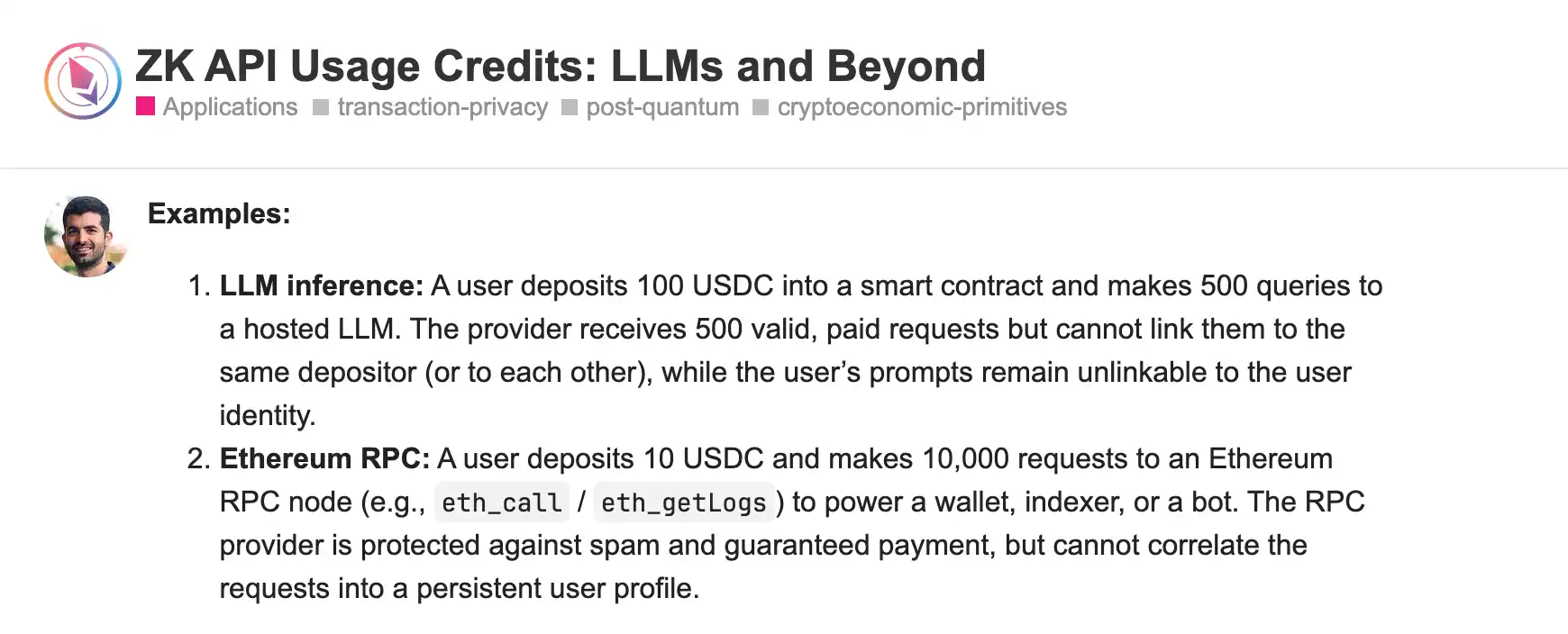
The service provider can receive the money, prevent abuse, but never know who you are throughout the process.
You can think of this proposal as something Vitalik believes in the AI age, users should not have to give up their identity to use an AI tool.
This proposal is currently at the research stage and is still far from being implemented. Major model manufacturers may not agree with this approach; at the same time, the proposal's comment section is full of rebuttals and questions, suggesting that AI model manufacturers will always find ways to know your true identity.
However, the significance of this proposal is not solely about whether it can be implemented or not.
Privacy has been Vitalik's focus for ten years. From early support for Tornado Cash to driving zero-knowledge proofs to be a core technical route of Ethereum, this line has never been interrupted. It's just that in the past few years, in the context of the cryptocurrency industry, privacy has always lacked a large enough story to carry it forward.
AI has filled in that story. When you talk to large models more than anyone else every day, privacy is a real need.
Vitalik Embracing AI
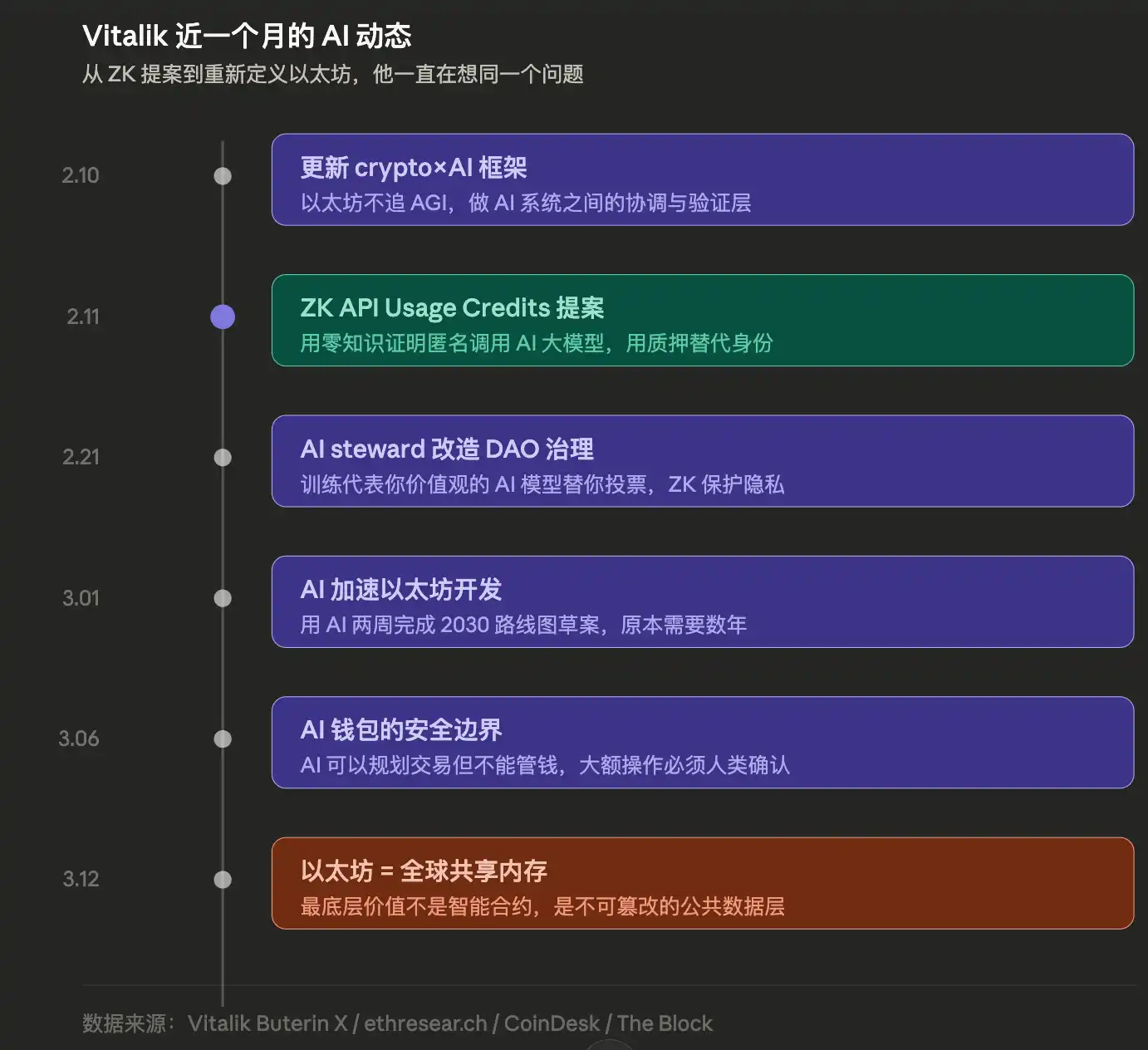
From February to now, a considerable part of what Vitalik has posted on X is related to AI, so dense that it doesn't seem like casual chat.
Yesterday he posted a long thread, saying that he recently went to a cryptography conference, where people care about privacy, care about open source, care about anti-censorship... but have no feelings for blockchain.
Among that group, he did a thought experiment:
Forget "we are the Ethereum community," start from scratch and think about where Ethereum is most useful.
His conclusion is that Ethereum's most fundamental value is as a bulletin board. A place where anyone can write, anyone can read, no one can change, and no one can delete.
In the context of AI, this may be the most important thing Vitalik has said in the past two years.
We are entering an era of infinite generation at almost no cost. Text, images, videos, identities—AI can mass-produce them. When everything can be forged, what will become scarce?
All these questions will ultimately point to the same place: a public, persistent, irreversible data layer. And a record that no one can tamper with is precisely what Ethereum can do.
Over the past two years, Ethereum's scrutiny can be summed up in one question: What do you have that can't be replaced by others?
Looking back, Vitalik has not provided a direct answer to this question.
However, the Ethereum Foundation has quietly done a few things over the past year: formed a 50-person privacy team, established a nearly 50-person privacy research cluster, released the Kohaku privacy framework, and appointed a dedicated AI lead; in the 2026 roadmap, institutional-grade privacy and faster transaction finality are listed as top priorities.
Looking back at his intensive output this month, most of it is basically about discussing Ethereum's privacy and scalability issues in the context of AI.
I think Vitalik is betting on one thing: the more powerful AI becomes, the more rigid the demand for privacy and validation infrastructure. Whether Ethereum can meet this demand is another matter, but he has clearly chosen his table.
ETH is still hovering around 2000. Most people still don't pay much attention to what he has been saying recently.
But perhaps in a few years, looking back, what should have been paid attention to is this current period.
You may also like

From x402 to MPP: Cloudflare's crucial vote, will it go to Coinbase or Stripe?

BlackRock CEO issues annual open letter: The wave of tokenization has arrived, and we will lead this trend

When Backpack backstabs the community

When gold is no longer a safe haven, and Bitcoin continues to panic

Trump, the World's Largest Oil Trader

If the US and Iran have not reached an agreement in 5 days, what other cards does Trump have?

Tether Whale Dumps £12 Million, Backing Crypto’s ‘British Trump’
Ethereum Foundation Post: Rethinking the Division of Work Between L1 and L2 to Build the Ultimate Ethereum Ecosystem

Two Major Prediction Market Platforms Unite Rarely, What Is the Story Behind This New Fund?
Dragonfly Partners: Most agents will not engage in autonomous trading, how can crypto payments prevail?

US AI Startup Goes All In on Chinese Mega-Model | Rewire News Morning Brief

Trump Lies Again: A "Five-Day Pause" Psyop, How Wall Street, Bitcoin, and Polymarket Insiders Synced Uposciogen

When a Token Becomes Labor, People Become the Interface

Ceasefire News Leaked Ahead of Time? Large Polymarket Bets on Outcome Before Trump's Tweet
BlackRock CEO's Annual Shareholder Letter: How is Wall Street Using AI to Keep Profiting from National Pension Funds?

Sun Valley Releases 2025 Financial Report: Bitcoin Mining Revenue Reaches $670 Million, Accelerating Transformation to AI Infrastructure Platform
On March 16, 2026, in Dallas, Texas, USA, CanGu Company (New York Stock Exchange code: CANG, hereinafter referred to as "CanGu" or the "Company") today announced its unaudited financial performance for the fourth quarter and full year ended December 31, 2025. As a btc-42">bitcoin mining enterprise relying on a globally operated layout and dedicated to building an integrated energy and AI computing power platform, CanGu is actively advancing its business transformation and infrastructure development.
• Financial Performance:
Total revenue for the full year 2025 was $688.1 million, with $179.5 million in the fourth quarter.
Bitcoin mining business revenue for the full year was $675.5 million, with $172.4 million in the fourth quarter.
Full-year adjusted EBITDA was $24.5 million, while the fourth quarter was -$156.3 million.
• Mining Operations and Costs:
A total of 6,594.6 bitcoins were mined throughout the year, averaging 18.07 bitcoins per day; of which 1,718.3 bitcoins were mined in the fourth quarter, averaging 18.68 bitcoins per day.
The average mining cost for the full year (excluding miner depreciation) was $79,707 per bitcoin, and for the fourth quarter, it was $84,552;
The all-in sustaining costs were $97,272 and $106,251 per bitcoin, respectively.
As of the end of December 2025, the company has cumulatively produced 7,528.4 bitcoins since entering the bitcoin mining business.
• Strategic Progress:
The company has completed the termination of the American Depositary Receipt (ADR) program and transitioned to a direct listing on the NYSE to enhance information transparency and align with its strategic direction, with a long-term goal of expanding its investor base.
CEO Paul Yu stated: "2025 marked the company's first full year as a bitcoin mining enterprise, characterized by rapid execution and structural reshaping. We completed a comprehensive adjustment of our asset system and established a globally distributed mining network. Additionally, the company introduced a new management team, further strengthening our capabilities and competitive advantage in the digital asset and energy infrastructure space. The completion of the NYSE direct listing and USD pricing also signifies our transformation into a global AI infrastructure company."
"As we enter 2026, the company will continue to optimize its balance sheet structure and enhance operational efficiency and cost resilience through adjustments to the miner portfolio. At the same time, we are advancing our strategic transformation into an AI infrastructure provider. Leveraging EcoHash, we will utilize our capabilities in scalable computing power and energy networks to provide cost-effective AI inference solutions. The relevant site transformations and product development are progressing simultaneously, and the company is well-positioned to sustain its execution in the new phase."
The company's Chief Financial Officer, Michael Zhang, stated: "By 2025, the company is expected to achieve significant revenue growth through its scaled mining operations. Despite recording a net loss of $452.8 million from ongoing operations, mainly due to one-time transformation costs and market-driven fair value adjustments, the company, from a financial perspective, will reduce its leverage, optimize its Bitcoin reserve strategy and liquidity management, introduce new capital to strengthen its financial position, and seize investment opportunities in high-potential areas such as AI infrastructure while navigating market volatility."
The total revenue for the fourth quarter was $1.795 billion. Of this, the Bitcoin mining business contributed $1.724 billion in revenue, generating 1,718.3 Bitcoins during the quarter. Revenue from the international automobile trading business was $4.8 million.
The total operating costs and expenses for the fourth quarter amounted to $4.56 billion, primarily attributed to expenses related to the Bitcoin mining business, as well as impairment of mining machines and fair value losses on Bitcoin collateral receivables.
This includes:
· Cost of Revenue (excluding depreciation): $1.553 billion
· Cost of Revenue (depreciation): $38.1 million
· Operating Expenses: $9.9 million (including related-party expenses of $1.1 million)
· Mining Machine Impairment Loss: $81.4 million
· Fair Value Loss on Bitcoin Collateral Receivables: $171.4 million
The operating loss for the fourth quarter was $276.6 million, a significant increase from a loss of $0.7 million in the same period of 2024, primarily due to the downward trend in Bitcoin prices.
The net loss from ongoing operations was $285 million, compared to a net profit of $2.4 million in the same period last year.
The adjusted EBITDA was -$156.3 million, compared to $2.4 million in the same period last year.
The total revenue for the full year was $6.881 billion. Of this, the revenue from the Bitcoin mining business was $6.755 billion, with a total output of 6,594.6 Bitcoins for the year. Revenue from the international automobile trading business was $9.8 million.
The total annual operating costs and expenses amount to $1.1 billion.
Specifically, they include:
· Revenue Cost (excluding depreciation): $543.3 million
· Revenue Cost (depreciation): $116.6 million
· Operating Expenses: $28.9 million (including related-party expenses of $1.1 million)
· Miner Impairment Loss: $338.3 million
· Bitcoin Collateral Receivable Fair Value Change Loss: $96.5 million
The full-year operating loss is $437.1 million. The continuing operations net loss is $452.8 million, while in 2024, there was a net profit of $4.8 million.
The 2025 non-GAAP adjusted net profit is $24.5 million (compared to $5.7 million in 2024). This measure does not include share-based compensation expenses; refer to "Use of Non-GAAP Financial Measures" for details.
As of December 31, 2025, the company's key assets and liabilities are as follows:
· Cash and Cash Equivalents: $41.2 million
· Bitcoin Collateral Receivable (Non-current, related party): $663.0 million
· Miner Net Value: $248.7 million
· Long-Term Debt (related party): $557.6 million
In February 2026, the company sold 4,451 bitcoins and repaid a portion of related-party long-term debt to reduce financial leverage and optimize the asset-liability structure.
As per the stock repurchase plan disclosed on March 13, 2025, as of December 31, 2025, the company had repurchased a total of 890,155 shares of Class A common stock for approximately $1.2 million.

The US AI Startup Is Loving China's Open Source Model



 App
App