
 Buy Crypto
- Markets
 Futures
- Spot
- Copy Trade
- Earn
- More
Upstream and downstream are starting to fight, all for the sake of everyone being able to "Lobster"

「What truly brings crab to the table of millions of households is not the first person who ate crab, but the chefs who are dedicated to making crab even more delicious.」
This quote is used to describe the rapid development caused by OpenClaw, and it couldn't be more appropriate. The novel AI species "Lobster" has created a new narrative of AI assistants/employees, elevating people's expectations and outlook on AI to a new level. However, due to its rapid popularity, a considerable number of newcomers to the "Lobster" are not deeply understanding it, so we also see news like this:
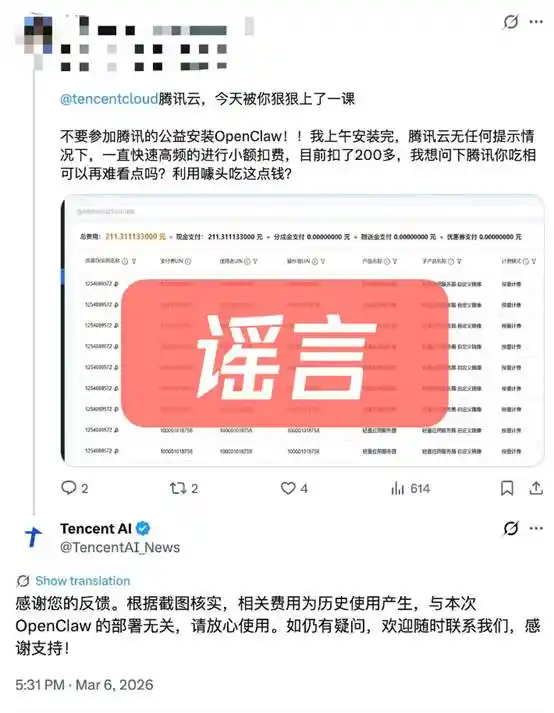
And the two new things that garnered widespread attention yesterday, Perplexity's Personal Computer and Base44's Superagents, have shown us a new trend that is rapidly brewing—from "Lobster" to "AI assistant," the narrative is quickly upgrading. People may soon no longer be entangled in "raising lobsters" because the arrival of mass-market, accessible AI assistants will happen even faster than we imagine.
Personal Computer
According to Perplexity, the Personal Computer is an AI assistant that combines Perplexity Computer and runs locally 24/7 on a device (Mac Mini). It can access local files, apps, and sessions on the Mac Mini, enabling a mode where an instruction is given to the device, and AI operates across files and apps, combining all local data to complete tasks.
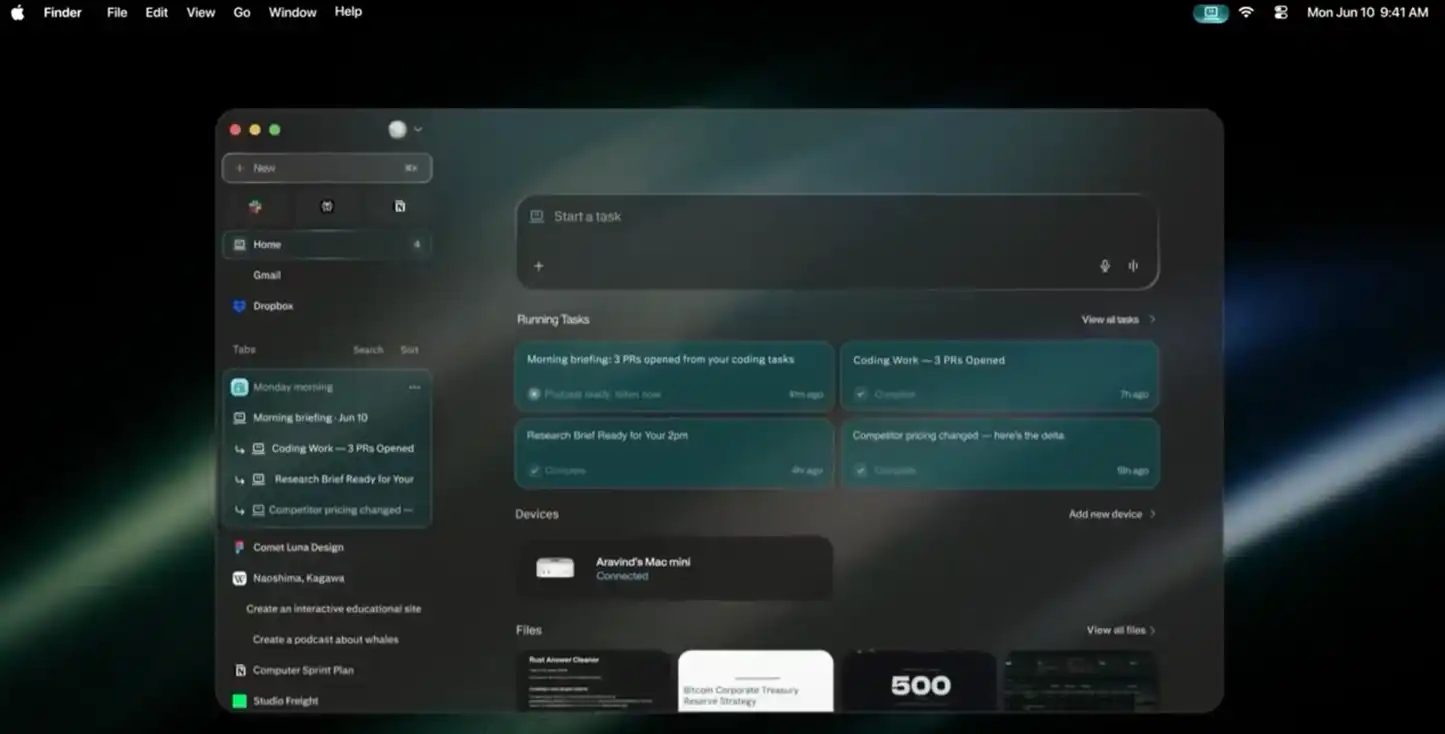
In terms of security, every sensitive operation requires user approval, all operations are logged, and there is a forced shutdown mechanism. At the same time, users can control the Personal Computer anytime, anywhere from any device, just like a boss in real life can direct employees' work anytime, anywhere.
Perplexity's previous work was AI-driven search and research tools. It does not have large models of its own but combines search engines and AI to generate responses, routing search queries to multiple models for in-depth research.
As a downstream application, when the "Lobster" brings a steady stream of revenue to upstream model providers, Perplexity, this AI search unicorn, with a valuation exceeding $20 billion, and its 2025 revenue estimated by many to exceed a billion dollars, can be said to have a unique position.
But they keenly grasped the pain point of "lobster farming," taking the lead in the "lobster use" track with a Personal Computer closer to a mature product form.
Superagents
If using a Personal Computer requires buying a Mac Mini, Base44's Superagents provide a cheaper option—without spending "Apple money" on local service, achieving the same effect directly through the browser.

By using Superagents through a browser, connecting the app accounts that need to be managed to Superagents (such as the Google suite, Whatsapp, Telegram, Slack, and more), Superagents can autonomously work based on the user's task schedule.
Directly using an AI assistant through a webpage and app is definitely a major trend of the future.
Base44's annual recurring revenue has already exceeded one billion dollars, but the company was acquired by Wix for $80 million in June last year. Such a brilliant move seems unsurprising and expected in this AI era.
Domestic Tech Giants Have Also Taken Action Early
Prior to Perplexity and Base44, "lobster farming" had already brought a "golden age" to upstream large model manufacturers:
- Kimi's 20-day cumulative revenue exceeded the total revenue for the entire year of 2025, with a post-investment valuation breaking $10 billion directly from the $5 billion C-round financing completed on December 31, 2025.
- Minimax had an annual total revenue of approximately $79 million in 2025, with a massive loss of up to $1.872 billion for the year. However, its ARR (Annual Recurring Revenue) for just one month in February this year exceeded $150 million, with the company's monthly subscription volume surpassing the total revenue for all of 2025. Since its Hong Kong stock market listing in January, the stock price has more than doubled, and the market value has surpassed Baidu.
- Zhipu also listed on the Hong Kong stock market in January this year, in a burning cash loss state as well. However, at its peak, the stock price increased more than five times compared to the listing price, and the market value once exceeded Baidu's.
However, the deployment, use, and maintenance barriers of "Lobster" itself have significantly hindered the general public from transforming the novelty and enthusiasm of "raising lobsters" into practical use. It has not easily evolved into a mature, consumer-friendly product. Similar to Google's Nexus phones with the most native Android system, but most people are not custom ROM enthusiasts; they just find the native Android experience too primitive compared to various major manufacturers' customized Android.
Whether it is the domestic large-scale model giants thriving in the token industry or other domestic major factories that are less prominent in the "Lobster" craze, everyone seems to have realized this — the true significance of "Lobster" is actually opening up the "AI Assistant" track at the user awareness level. Various devices around the general public, from large (car infotainment systems) to small (a smart desk lamp on a desk), in the future, AI's integration into our lives is not just a more advanced and efficient search and answering tool but plays a role in all aspects of work and life.
This reminds me of when Wi-Fi was not yet widely available, and people would think whether a phone had Wi-Fi capability was irrelevant because even if it did, there might not necessarily be a hotspot to connect to. However, the march of time and technology development do not pause for any manufacturer. What may seem like a "nice-to-have" now could be an irrecoverable market share loss in the future.
Therefore, not only overseas projects like Perplexity and Base44, when the English-speaking community is excited about these two projects, the domestic layout has long been underway. Various major manufacturers have successively integrated "Lobster" into their own ecosystems:
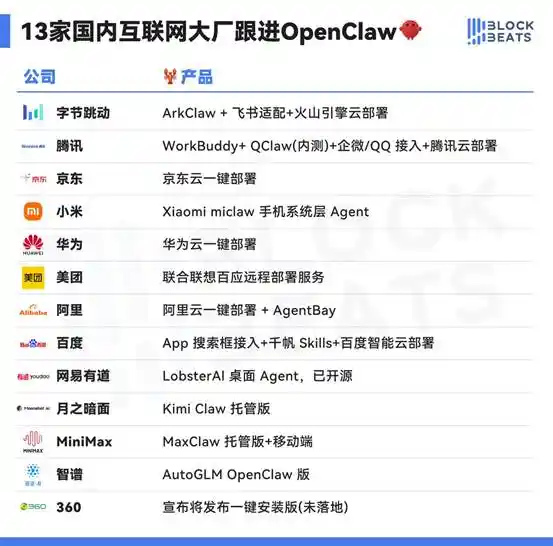
Users only need to have and use a handy AI assistant/employee through a daily high-frequency channel (such as WeChat, QQ, Feishu, Baidu search, etc.), and whether this employee is called "Lobster" is not important.
Conclusion
The general public is not AI experts, and it's also challenging to make everyone understand the pros and cons of large models. They may not even grasp what cross-application or contextual means. However, for technology to mature into a product form, it needs to permeate everyone's lives and become commonplace for everyone.
Just like how in the 3G era, we might have thought that even faster mobile internet was useless, but now we are used to watching various high-definition, and even 4K, content on our phones.
Everyone can become a boss, directing AI as their own employee, era. From asking AI for things to having AI do things for them, this significant user experiential change is initiated by "Lobster" and will also be meticulously packaged by various major manufacturers in the market into a truly user-oriented "delicacy."
AI has become a part of everyone's life, and this era has already begun. Upstream and downstream AI vendors are also about to start fighting for this era of transformation.
You may also like

From x402 to MPP: Cloudflare's crucial vote, will it go to Coinbase or Stripe?

BlackRock CEO issues annual open letter: The wave of tokenization has arrived, and we will lead this trend

When Backpack backstabs the community

When gold is no longer a safe haven, and Bitcoin continues to panic

Trump, the World's Largest Oil Trader

If the US and Iran have not reached an agreement in 5 days, what other cards does Trump have?

Tether Whale Dumps £12 Million, Backing Crypto’s ‘British Trump’
Ethereum Foundation Post: Rethinking the Division of Work Between L1 and L2 to Build the Ultimate Ethereum Ecosystem

Two Major Prediction Market Platforms Unite Rarely, What Is the Story Behind This New Fund?
Dragonfly Partners: Most agents will not engage in autonomous trading, how can crypto payments prevail?

US AI Startup Goes All In on Chinese Mega-Model | Rewire News Morning Brief

Trump Lies Again: A "Five-Day Pause" Psyop, How Wall Street, Bitcoin, and Polymarket Insiders Synced Uposciogen

When a Token Becomes Labor, People Become the Interface

Ceasefire News Leaked Ahead of Time? Large Polymarket Bets on Outcome Before Trump's Tweet
BlackRock CEO's Annual Shareholder Letter: How is Wall Street Using AI to Keep Profiting from National Pension Funds?

Sun Valley Releases 2025 Financial Report: Bitcoin Mining Revenue Reaches $670 Million, Accelerating Transformation to AI Infrastructure Platform
On March 16, 2026, in Dallas, Texas, USA, CanGu Company (New York Stock Exchange code: CANG, hereinafter referred to as "CanGu" or the "Company") today announced its unaudited financial performance for the fourth quarter and full year ended December 31, 2025. As a btc-42">bitcoin mining enterprise relying on a globally operated layout and dedicated to building an integrated energy and AI computing power platform, CanGu is actively advancing its business transformation and infrastructure development.
• Financial Performance:
Total revenue for the full year 2025 was $688.1 million, with $179.5 million in the fourth quarter.
Bitcoin mining business revenue for the full year was $675.5 million, with $172.4 million in the fourth quarter.
Full-year adjusted EBITDA was $24.5 million, while the fourth quarter was -$156.3 million.
• Mining Operations and Costs:
A total of 6,594.6 bitcoins were mined throughout the year, averaging 18.07 bitcoins per day; of which 1,718.3 bitcoins were mined in the fourth quarter, averaging 18.68 bitcoins per day.
The average mining cost for the full year (excluding miner depreciation) was $79,707 per bitcoin, and for the fourth quarter, it was $84,552;
The all-in sustaining costs were $97,272 and $106,251 per bitcoin, respectively.
As of the end of December 2025, the company has cumulatively produced 7,528.4 bitcoins since entering the bitcoin mining business.
• Strategic Progress:
The company has completed the termination of the American Depositary Receipt (ADR) program and transitioned to a direct listing on the NYSE to enhance information transparency and align with its strategic direction, with a long-term goal of expanding its investor base.
CEO Paul Yu stated: "2025 marked the company's first full year as a bitcoin mining enterprise, characterized by rapid execution and structural reshaping. We completed a comprehensive adjustment of our asset system and established a globally distributed mining network. Additionally, the company introduced a new management team, further strengthening our capabilities and competitive advantage in the digital asset and energy infrastructure space. The completion of the NYSE direct listing and USD pricing also signifies our transformation into a global AI infrastructure company."
"As we enter 2026, the company will continue to optimize its balance sheet structure and enhance operational efficiency and cost resilience through adjustments to the miner portfolio. At the same time, we are advancing our strategic transformation into an AI infrastructure provider. Leveraging EcoHash, we will utilize our capabilities in scalable computing power and energy networks to provide cost-effective AI inference solutions. The relevant site transformations and product development are progressing simultaneously, and the company is well-positioned to sustain its execution in the new phase."
The company's Chief Financial Officer, Michael Zhang, stated: "By 2025, the company is expected to achieve significant revenue growth through its scaled mining operations. Despite recording a net loss of $452.8 million from ongoing operations, mainly due to one-time transformation costs and market-driven fair value adjustments, the company, from a financial perspective, will reduce its leverage, optimize its Bitcoin reserve strategy and liquidity management, introduce new capital to strengthen its financial position, and seize investment opportunities in high-potential areas such as AI infrastructure while navigating market volatility."
The total revenue for the fourth quarter was $1.795 billion. Of this, the Bitcoin mining business contributed $1.724 billion in revenue, generating 1,718.3 Bitcoins during the quarter. Revenue from the international automobile trading business was $4.8 million.
The total operating costs and expenses for the fourth quarter amounted to $4.56 billion, primarily attributed to expenses related to the Bitcoin mining business, as well as impairment of mining machines and fair value losses on Bitcoin collateral receivables.
This includes:
· Cost of Revenue (excluding depreciation): $1.553 billion
· Cost of Revenue (depreciation): $38.1 million
· Operating Expenses: $9.9 million (including related-party expenses of $1.1 million)
· Mining Machine Impairment Loss: $81.4 million
· Fair Value Loss on Bitcoin Collateral Receivables: $171.4 million
The operating loss for the fourth quarter was $276.6 million, a significant increase from a loss of $0.7 million in the same period of 2024, primarily due to the downward trend in Bitcoin prices.
The net loss from ongoing operations was $285 million, compared to a net profit of $2.4 million in the same period last year.
The adjusted EBITDA was -$156.3 million, compared to $2.4 million in the same period last year.
The total revenue for the full year was $6.881 billion. Of this, the revenue from the Bitcoin mining business was $6.755 billion, with a total output of 6,594.6 Bitcoins for the year. Revenue from the international automobile trading business was $9.8 million.
The total annual operating costs and expenses amount to $1.1 billion.
Specifically, they include:
· Revenue Cost (excluding depreciation): $543.3 million
· Revenue Cost (depreciation): $116.6 million
· Operating Expenses: $28.9 million (including related-party expenses of $1.1 million)
· Miner Impairment Loss: $338.3 million
· Bitcoin Collateral Receivable Fair Value Change Loss: $96.5 million
The full-year operating loss is $437.1 million. The continuing operations net loss is $452.8 million, while in 2024, there was a net profit of $4.8 million.
The 2025 non-GAAP adjusted net profit is $24.5 million (compared to $5.7 million in 2024). This measure does not include share-based compensation expenses; refer to "Use of Non-GAAP Financial Measures" for details.
As of December 31, 2025, the company's key assets and liabilities are as follows:
· Cash and Cash Equivalents: $41.2 million
· Bitcoin Collateral Receivable (Non-current, related party): $663.0 million
· Miner Net Value: $248.7 million
· Long-Term Debt (related party): $557.6 million
In February 2026, the company sold 4,451 bitcoins and repaid a portion of related-party long-term debt to reduce financial leverage and optimize the asset-liability structure.
As per the stock repurchase plan disclosed on March 13, 2025, as of December 31, 2025, the company had repurchased a total of 890,155 shares of Class A common stock for approximately $1.2 million.

The US AI Startup Is Loving China's Open Source Model



 App
App