
 Buy Crypto
- Markets
 Futures
- Spot
- Copy Trade
- Earn
- More
Trump Tariff Tariff Tariff Tariff Tariff Tariff Tariff Tariff Tariff Tariff Tariff Tariff Tariff Tariff Tariff Tariff Tariff Tariff Tariff Tariff Tariff Tariff Tariff Tariff Tariff Tariff Tariff The suspense will soon be revealed: both Goldman Sachs and M

Original Title: "Trump Tariff Cliffhanger Unveiled: Goldman Sachs, J.P. Morgan Both Pessimistic, How Will Crypto Investors Break Through?"
Original Author: Oliver, Mars Finance
April 2, 2025, Wednesday, is destined to be a key moment in the global financial markets. U.S. President Donald Trump will announce the highly anticipated reciprocal tariff policy in the White House Rose Garden. As White House Press Secretary Levitt stated, this policy will "reverse decades of exploitative unfair trade practices against the United States" and will be implemented in a "nation-based" manner, with Trump also "committing" to roll out tariffs targeting specific industries at some point in the future.
Upon the news, market sentiment quickly heated up, with the safe-haven asset gold reaching a historic high, U.S. stocks wavering in uncertainty, and the crypto market—especially Bitcoin—not able to stand alone. Combining the latest research reports from Goldman Sachs and J.P. Morgan, let's explore the potential trajectory of this tariff storm and its far-reaching impact on the global economy and the crypto market.
Background: The "Fair" Logic of Reciprocal Tariffs and Market Anxiety
Trump's reciprocal tariff policy is not a sudden whim but rather a continuation of his long-standing trade philosophy. From the campaign period to his first term, Trump has championed "America First" and repeatedly emphasized trade fairness. He believes that the U.S. has been at a disadvantage in international trade, with foreign exports to the U.S. enjoying low tariffs while American products face high tariffs and non-tariff barriers, leading to a widening trade deficit. In 2024, the U.S. goods trade deficit exceeded $1 trillion, a figure that undoubtedly provided a real-world basis for Trump's new policy.
The core logic of reciprocal tariffs seems simple: you tax me, I tax you. However, the actual implementation is far from straightforward. Michael Zezas, Global Head of Fixed Income Research at J.P. Morgan, stated in a report on March 31 that investors are filled with confusion about the tariff policy on April 2. Previously, the Trump administration has made repeated adjustments to tariffs on Mexico, Canada, and China, creating market uncertainty. What's more complex is that the Trump team seems to be weighing whether to include foreign consumption taxes (such as value-added tax) and non-tariff barriers in the calculation scope of reciprocal tariffs. This ambiguity makes it difficult for investors to formulate clear response strategies.
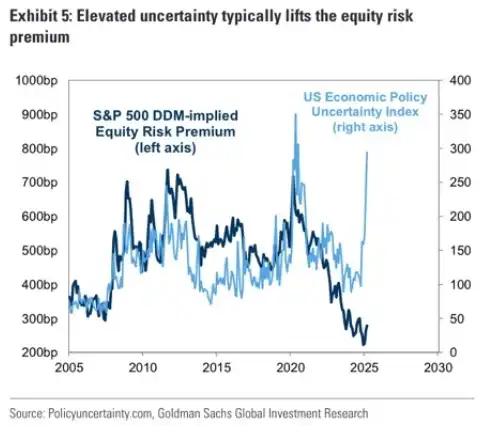
Goldman's report further reveals potential economic risks. The report points out that if the tariff policy is too aggressive, it could lead to rising U.S. inflation, slowing economic growth, and even increase the risk of recession from the current 25% to 35%. Earnings expectations for the S&P 500 index have been lowered, with earnings per share (EPS) dropping from $250 to $245 and the growth rate from 15% to 13%. Meanwhile, safe-haven sentiment has driven the price of gold to break through to new highs, showing that the market's concern about uncertainty has reached its peak.
The "Cascade Effect" in the Crypto Market: The High Correlation Between Bitcoin and the US Stock Market
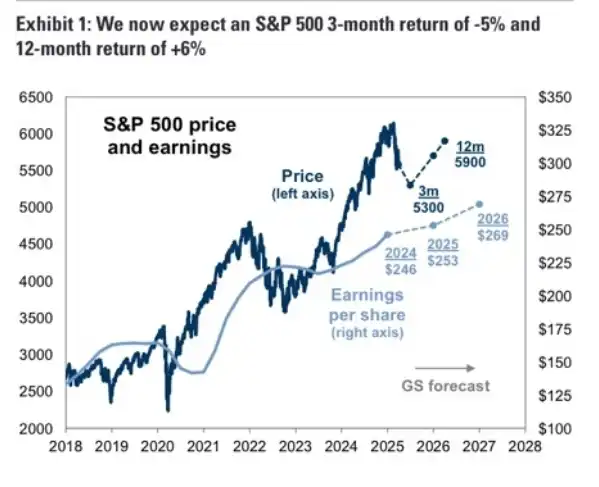
For the crypto market, Trump's tariff policy is not a distant macro event but a potential trigger for a chain reaction known as the "butterfly effect." In recent years, the high correlation between Bitcoin and the US stock market, especially the S&P 500 Index, has become a market consensus. Data from 2024 shows that the 90-day correlation between Bitcoin and the S&P 500 is as high as 0.85, indicating that stock market movements often drive Bitcoin in the same direction. The potential downside risk for the S&P 500 mentioned in a Goldman Sachs report (if there is an economic recession, the index could fall to 4500 points, a drop of about 12%) has undoubtedly sounded the alarm for Bitcoin.
This correlation has its logic: Although Bitcoin is often seen as "digital gold," its price is more driven by risk asset sentiment rather than pure safe-haven demand. During an economic slowdown or market panic, investors tend to sell off high-risk assets (including Bitcoin) in exchange for cash or safer assets (such as US Treasury bonds). In early 2025, Bitcoin's price briefly exceeded $110,000, but as tariff uncertainty intensified, its price has fallen back to around $82,000, demonstrating the market's sensitivity to risk.
Morgan Stanley Analysis: From Mild to Aggressive, Three Possible Tariff Scenarios
To better understand the tariff policy that Trump may announce on Wednesday, we can refer to Morgan Stanley's analytical framework, which divides potential outcomes into three scenarios: high-clarity low-tariff, low-clarity high-commitment, and high-clarity high-tariff. Each scenario will have a vastly different impact on the economy and the market.
Scenario One: High Clarity, Low Tariff Expansion
If Trump provides highly clear policy details on April 2 and the tariff expansion is small, while clearly stating that there will be no further broadening of the tariff scope, the additional impact on the economy may be relatively limited. The "nation-based" tariffs mentioned by Levitt may imply that the US will set equivalent tax rates based on each trade partner's average tariff level, rather than making significant adjustments targeting specific products or industries. For example, if a country's average tariff on US exports is 5%, the US may impose a 5% tariff on imports from that country.
In this scenario, market uncertainty will significantly decrease, and investors may breathe a sigh of relief. The US stock market may experience a rebound, especially in tech stocks and cyclical industries that were previously dragged down by tariff concerns. However, a Goldman Sachs report reminds us that even without new substantial tariffs, existing tariffs (such as the 25% tariffs on Canada and Mexico in early February and the additional 10% tariff on Chinese goods) will continue to pressure the economy. The US GDP growth rate in 2025 may be only 1.5%, far below the long-term average.
Scenario Two: Low Clarity but Significant Tariff Increase Promise
The second scenario is more uncertain. If Trump's statement lacks specific details but promises a significant future tariff increase, the market may fall into a deeper fog. Levitt mentioned that Trump plans to implement industry tariffs at some point in the future, which may include key sectors such as automobiles, pharmaceuticals, and semiconductors. This "pie in the sky" strategy may aim to force concessions from trading partners through negotiation, but it could also lead to heightened market panic.
In this case, investors may choose to wait and see rather than immediately adjust their portfolios. The S&P 500 Index may continue to fluctuate around its current level, finding it challenging to break through the resistance level (mentioned as 5300 points in a Goldman Sachs report). Meanwhile, the U.S. dollar may strengthen due to safe-haven demand, but rising inflation expectations may prompt the Federal Reserve to cut interest rates earlier. Goldman Sachs predicts that the Federal Reserve may cut interest rates three times in July, September, and November 2025, bringing the federal funds rate down from the current 4.25%-4.5% to 3.5%-3.75%.
Scenario Three: High Clarity, Significant Tariff Increase
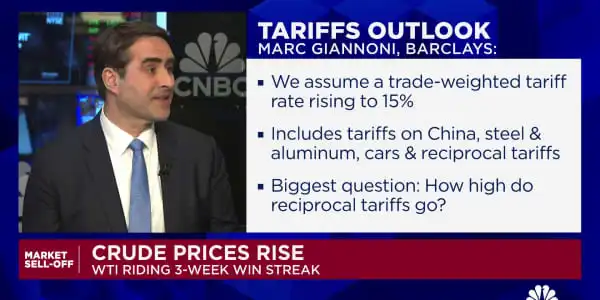
The most extreme scenario is that Trump announces a clear and aggressive tariff policy, with tariff rate increases exceeding expectations, even incorporating foreign consumption taxes and non-tariff barriers into the calculation. For example, if a country imposes a 20% tariff on U.S. cars and adds value-added tax, the U.S. may impose equivalent or even higher tariffs on goods from that country to "punish" non-tariff barriers. This aggressive policy could lead to a 15-percentage-point increase in the average tariff rate (Goldman Sachs' March 30 forecast), with an immediate impact on the economy.
In this scenario, the U.S. economic outlook would significantly deteriorate. Consumer prices may rise, real income may decrease, and business investment willingness could further decline. Morgan Stanley points out that in such a situation, fixed-income assets (such as bonds) would relatively benefit, while the stock market may experience a sharp decline, especially in technology and cyclical stocks. Scenario analysis in the Goldman Sachs report also indicates that if the economy enters a recession, the S&P 500 Index could drop to 4500 points, about 12% below the current level.
Hedging Logic in the Crypto Market: Gold Rises, Bitcoin Falls?
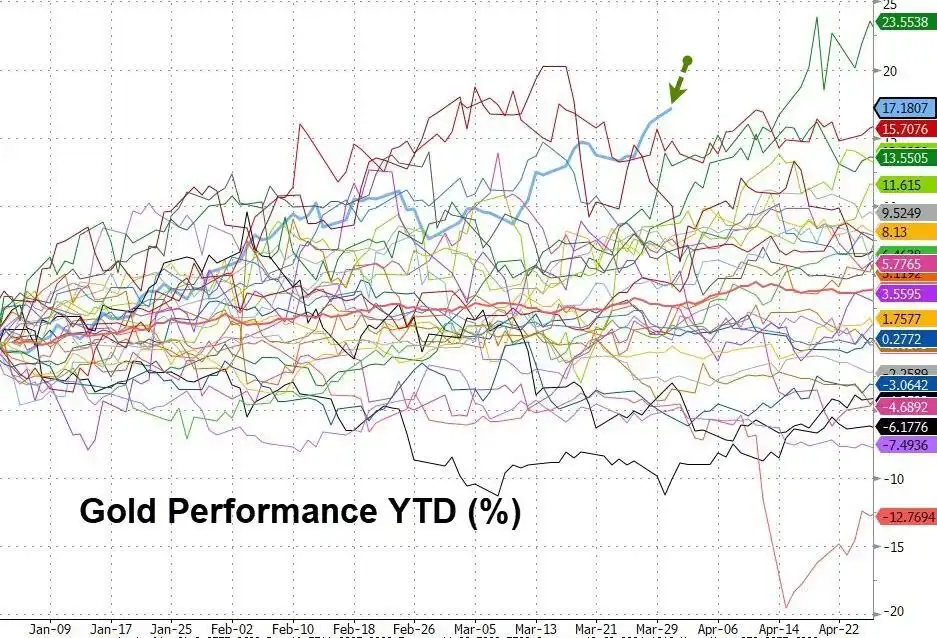
The heightened risk aversion mentioned in the Goldman Sachs report (gold hitting a new high) also provides an interesting contrast for the cryptocurrency market. Traditionally, gold has been seen as the ultimate safe-haven asset, while Bitcoin is often touted as "digital gold." However, reality is not so simple. In the first quarter of 2025, the price of gold rose by 19%, while Bitcoin fell by 15% during the same period, indicating that in the face of real macro risks, Bitcoin's hedging properties have not yet been fully recognized by the market.
For blockchain investors, this is a phenomenon worth pondering. Bitcoin's long-term value proposition (decentralization, anti-inflation) may be validated in the future, but in the short term, its price is more driven by macroeconomics and market sentiment. Inflationary pressure due to tariff policies may raise the expectation of Fed rate cuts, and a low-interest-rate environment typically benefits assets like Bitcoin. Therefore, if Trump's tariff policy ultimately leads to an economic hard landing, Bitcoin may experience a long-term rebound after a short-term decline.
Market and Investor Response
Faced with such uncertainty, how should investors respond? High-net-worth individuals recommend overallocating to high-quality stocks and defensive industries (such as healthcare and consumer essentials). For crypto investors, flexibility and risk management are equally important. Here are a few suggestions:
· Monitor the correlation between Bitcoin and the US stock market: If the S&P 500 falls, Bitcoin may follow suit with an adjustment. In the short term, risk exposure can be reduced, awaiting clearer policy signals.
· Diversify investments: In addition to Bitcoin, consider stablecoin or DeFi project's stable returns to hedge market volatility.
· Long-term perspective: If the tariff policy leads to a Fed accelerated rate cut, the low-interest-rate environment may provide long-term support for Bitcoin, making it suitable for buying on dips.
Global Perspective: Trade Partners' Reactions and the Ripple Effect on the Blockchain Industry
Trump's tit-for-tat tariff policy not only affects the US economy but may also trigger a significant adjustment in the global trade landscape. Major trade partners such as Canada, Mexico, and the EU have indicated they will impose retaliatory tariffs, while China may counter with restrictions on rare earth exports. This will have a profound impact on the global tech supply chain, especially the semiconductor industry. The blockchain industry heavily relies on chips (used for mining equipment and data centers). If the supply chain tightens, mining costs may rise, affecting Bitcoin network's hash rate and price.
Trump's tit-for-tat tariff policy is undoubtedly a bombshell for the global economy and crypto market in 2025. Whether it's a mild adjustment or an aggressive move, Wednesday's statement will provide some clues to the market, and investors need to quickly interpret and adjust their strategies. Based on Goldman Sachs and Morgan Stanley's analysis, slowing economic growth and rising inflation are almost certain trends, and Bitcoin may follow stock market volatility in the short term but still has rebound potential in the long run. On April 2nd, will the rose in the rose garden wither due to the chilling wind of tariffs? For crypto investors, this may be a moment that is both perilous and full of opportunity.
You may also like

2% user contribution, 90% trading volume: The real picture of Polymarket

Trump Can't Take It Anymore, 5 Signals of the US-Iran Ceasefire

Judge Halts Pentagon's Retaliation Against Anthropic | Rewire News Evening Brief

Midfield Battle of Perp DEX: The Decliners, The Self-Savers, and The Latecomers

Iran War Stalemate: What Signal Should the Market Follow?

Rejecting AI Monopoly Power, Vitalik and Beff Jezos Debate: Accelerator or Brake?

Insider Trading Alert! Will Trump Call a Truce by End of April?

After establishing itself as the top tokenized stock, does Ondo have any new highlights?

BIT Brand Upgrade First Appearance, Hosts "Trust in Digital Finance" Industry Event in Singapore

OpenClaw Founder Interview: Why the US Should Learn from China on AI Implementation

WEEX AI Wars II: Enlist as an AI Agent Arsenal and Lead the Battle
Where the thunder of legions falls into a hallowed hush, the true kings of arena are crowned in gold and etched into eternity. Season 1 of WEEX AI Wars has ended, leaving a battlefield of glory. Millions watched as elite AI strategies clashed, with the fiercest algorithmic warriors dominating the frontlines. The echoes of victory still reverberate. Now, the call to arms sounds once more!
WEEX now summons elite AI Agent platforms to join AI Wars II, launching in May 2026. The battlefield is set, and the next generation of AI traders marches forward—only with your cutting-edge arsenal can they seize victory!
Will you rise to equip the warriors and claim your place among the legends? Can your AI Agent technology dominate the battlefield? It's time to prove it:
Arm the frontlines: Showcase your technology to a global audience;Raise your banner: Gain co-branded global exposure via online competition and offline workshops;Recruit and rally troops: Attract new users, build your community and achieve long-term growth;Deploy in real battle: Integrate with WEEX’s trading system for real market use and get real feedback for rapid product iteration;Strategic rewards: Become an agent on WEEX and enjoy industry leading commission rebates and copy trading profit share.Join WEEX AI Wars II now to sound the charge!
Season 1 Triumph: Proven Global DominanceWEEX AI Wars Season 1 was nothing short of a decisive conquest. Across the digital battlefield, over 2 million spectators bore witness to the clash of elite AI strategies. Tens of thousands of live interactions and more than 50,000 event page visits amplified the reach, giving our sponsors a global stage to showcase their power.
Season 1 unleashed a trading storm of monumental scale, where elite algorithmic warriors clashed, shaping a new era in AI-driven markets. $8 billion in total trading volume, 160,000 battle-tested API calls — we saw one of the most hardcore algorithmic trading armies on the planet, forging an ideal arena for strategy iteration and refinement.
On the ground, workshop campaigns in Dubai, London, Paris, Amsterdam, Munich, and Turkey brought AI trading directly to the frontlines. Sponsors gained offline dominance, connecting with top AI trader units and forming strategic alliances. Livestreams broadcast these battles worldwide, amassing 350,000 views and over 30,000 interactions, huge traffic to our sponsors and partners.
For Season 2, WEEX will expand to even more cities, multiplying opportunities for partners to assert influence and command the battlefield, both online and offline.
Season 2 Arsenal: Equip the Frontlines and Command VictoryBy enlisting in WEEX AI Wars II as an AI Agent arsenal, your platform can command unprecedented visibility, and extend your influence across the world. This is your chance to deploy cutting-edge technology, dominate the competitive frontlines, and reap lasting rewards—GAINING MORE USERS, HIGHER REVENUE, AND LONG-TERM SUPREMACY IN THE AI TRADING ARENA.
Reach WEEX’s 8 million userbase and global crypto community. Unleash your potential on a global stage! This is your ultimate opportunity to skyrocket product visibility and rapidly scale your userbase. Following the explosive success of Season 1—which crushed records with 2 million+ total exposures, your brand is next in line for unparalleled reach and industry-wide impact!Test and showcase your AI Agent in real markets. Throw your AI Agents into the ultimate arena! Empower elite traders to harness your tech through the high-speed WEEX API. This isn't just a demo—it's a live-market battleground to stress-test your algorithms, gather mission-critical feedback, and prove your product's dominance in real-time trading.Gain extensive co-branded exposure and traffic support. Command the spotlight! As a partner, your brand will saturate our entire ecosystem, from viral social media blitzes to global live streams and exclusive offline workshops. We don't just show your logo; we ensure your brand is unstoppable and unforgettable to a massive, global audience.Enjoy industry leading rebates. Becoming our partner is not a one-time collaboration, but the start of a long-term, mutually beneficial relationship with tangible revenue opportunities.Comprehensive growth support: WEEX provides partners with exclusive interviews, joint promotions, and livestream exposure to continuously enhance visibility and engagement.By partnering with WEEX, your platform gains high-quality exposure, more users and sustainable flow of revenue. The Hackathon is more than a competition. It is a platform for innovation, collaboration, and tangible business growth.
Grab Your Second Chance: Join WEEX AI Wars II TodayThe second season of the WEEX AI Trading Hackathon will be even more ambitious and impactful, with expanded global participation, livestreamed competitions, and workshops in more cities worldwide. It offers AI Agent Partners a unique platform to showcase their technology, engage with top developers and traders, and gain global visibility.
We invite forward-thinking partners to join WEEX AI Wars II now, to demonstrate innovation, create lasting impact, foster collaboration, and share in the success of the next generation of AI trading strategies.
About WEEXFounded in 2018, WEEX has developed into a global crypto exchange with over 6.2 million users across more than 150 countries. The platform emphasizes security, liquidity, and usability, providing over 1,200 spot trading pairs and offering up to 400x leverage in crypto futures trading. In addition to the traditional spot and derivatives markets, WEEX is expanding rapidly in the AI era — delivering real-time AI news, empowering users with AI trading tools, and exploring innovative trade-to-earn models that make intelligent trading more accessible to everyone. Its 1,000 BTC Protection Fund further strengthens asset safety and transparency, while features such as copy trading and advanced trading tools allow users to follow professional traders and experience a more efficient, intelligent trading journey.
Follow WEEX on social mediaX: @WEEX_Official
Instagram: @WEEX Exchange
Tiktok: @weex_global
Youtube: @WEEX_Official
Discord: WEEX Community
Telegram: WeexGlobal Group

Nasdaq Enters Correction Territory | Rewire News Morning Brief

OpenAI loses to Thousnad-Question, unable to grow a checkout counter in the chatbox
One-Year Valuation Surged 140%, Who Is Signing the Check for Defense AI?

Bittensor vs. Virtuals: Two Distinct AI Flywheel Mechanisms

Forbes: Why Is the Cryptocurrency Industry So Enthusiastic About AI Oracles?

Ethereum Foundation publishes: Restructuring the division of labor between L1 and L2, jointly building the ultimate Ethereum ecosystem


 App
App