
 Buy Crypto
- Markets
 Futures
- Spot
- Copy Trade
- Earn
- More
Tron Industry Weekly Report: Geopolitical Turmoil Escalates, BTC Continues to Test $60,000, Detailed Explanation of the Protocol Konnex for AI Autonomous Collaboration and Settlement on the Chain

I. Outlook
1. Macroeconomic Summary and Future Predictions
The military actions of the United States and Israel against Iran have escalated, causing oil prices to rise and market risk appetite to decline this week. The significant increase in oil prices has raised expectations for energy costs, prompting investors to turn to safe-haven assets such as gold, which has driven up the prices of gold and U.S. Treasuries while suppressing stock market performance. As a result, the S&P 500 and Nasdaq have faced weak performance for several consecutive weeks. With rising oil prices bringing potential supply-side inflationary pressures, market expectations for interest rate cuts in 2026 are rapidly fading. Some economists believe that if high oil prices persist, the Federal Reserve may even consider raising interest rates to address inflation risks, which would impact global interest rate expectations and the pricing of risk assets.
In the coming week, if the situation in Iran does not ease, oil prices may continue to rise, which will have a transmission effect on global inflation expectations, interest rate paths, and economic growth expectations. Safe-haven assets may become even more favored.
2. Market Movements and Warnings in the Cryptocurrency Industry
This week, the overall sentiment in the cryptocurrency market has been pessimistic, with risk assets retreating in tandem. As of February 28, the price of Bitcoin has fluctuated downward to around $65,000, and Ethereum has also faced significant pressure, with a noticeable decline. The overall cryptocurrency market capitalization is approximately $2.35 trillion, with the market dropping about 2.2% within 24 hours, resulting in negative returns for both BTC and ETH.
The escalation of the situation in the Middle East may continue to affect global risk appetite, and if it further deteriorates, the market may experience more severe risk-off selling pressure.
3. Industry and Sector Hotspots
An analysis of the end-to-end Web3 application infrastructure Sequence, which has raised a massive $53.3 million to cater to real user scale. A total of $15 million has been raised for Konnex, a decentralized job market that allows robots to autonomously collaborate and settle on-chain. A total of $14.5 million has been raised for Naoris Protocol, which aims to reconstruct global cybersecurity through decentralized consensus.
II. Market Hotspots and Potential Projects of the Week
1. Overview of Potential Projects
1.1. Analysis of Sequence, which has raised a total of $53.3 million, led by Polygon with participation from gaming giant Ubisoft------an end-to-end Web3 application infrastructure designed for real user scale
Introduction
Sequence is a modular Web3 developer platform and infrastructure technology stack that provides developers with the core components needed to quickly build on-chain applications. Developers can flexibly use Sequence's wallets, real-time indexers, and payment solutions, seamlessly integrating them into their existing tech stack. After creating a project with Sequence Builder, developers can build using their familiar development frameworks, including React, React Native, Unity, or Unreal, enabling efficient development, deployment, and scaling of Web3 applications.
Core Mechanism Overview
- Sequence Ecosystem Wallet
The Sequence Ecosystem Wallet is a non-custodial smart wallet designed for blockchain ecosystems and multiple application scenarios, integrating Passkeys, social logins, timed recovery keys, and sandboxed permissions, significantly lowering the barrier to use while providing enterprise-level security.
Core advantages and positioning:
One user, one address: Share the same address and assets across applications and chains, avoiding identity and asset fragmentation.
Smart Sessions permission isolation: Assign independent session permissions for different applications, reducing the number of signatures and enhancing security.
Seamless user onboarding: Supports email, Google/Apple, social accounts, Passkeys, and external wallets.
Native cross-chain support: Built-in cross-chain swaps, fiat on-ramps, and unified asset views.
Enterprise-grade security: Hardware-isolated signing (TEE), publicly verifiable proofs, secured by Quantstamp and CoinCover.
Flexible recovery mechanism: Timed recovery keys balance self-custody and usability.
Targeting ecosystems:
Launch a unified, branded wallet under its own domain.
The entire ecosystem shares one address and asset inventory.
Quickly attract developers for integration (minute-level integration).
Manage chains, brands, session policies, and blacklists through the Builder backend.
Targeting developers:
Launch production-grade smart wallets without building wallet infrastructure from scratch.
Provide frontend SDKs for Web, React Native, Unity, and Unreal.
Backend SDK supports minting, transfers, batch processing, and monitoring.
Applicable to real scenarios such as DeFi, payments, stablecoins, NFTs, and gaming.
2. Payments Overview
Sequence offers various payment solutions to help developers choose the most suitable payment path based on application needs. Among them, Trails is the preferred solution for cross-chain, one-click payments; Shop/Marketplace provides out-of-the-box trading scenarios; and Checkout SDK supplements the ability to purchase NFTs with credit cards.
Main solutions:
Trails: Supports one-click cross-chain payments with any wallet and any token, automatically completing the necessary swaps and bridges, and executing the final transaction on the target chain.
Shop: A main storefront based on audited contracts, allowing quick configuration of products, prices, quantity limits, and sales cycles, with almost no coding required.
Marketplace: A white-label secondary market and API that supports listings, bidding, and offers, while aggregating external liquidity, maintaining an in-app experience.
Checkout SDK: A plug-and-play solution for purchasing NFTs with credit/debit cards, which can be used in parallel with wallet payments and Trails.
Selection guide:
Need cross-chain, one-click payments → Trails
Need a configurable main storefront → Shop
Need secondary trading or custom trading processes → Marketplace
Need credit card purchases for NFTs → Checkout SDK
3. Indexer Overview
The Sequence Indexer is a real-time on-chain data reading layer designed for production environments, supporting low-latency retrieval of balances, transfers, NFTs, prices, and contract events across multiple EVM chains, and achieving real-time data synchronization through APIs, Webhooks, and subscription mechanisms.
Core capabilities:
Real-time cross-chain data reading: Unified retrieval of asset balances, portfolios, NFT ownership, and transaction records across multiple EVM chains.
Production-grade design: Supports cursor pagination, filters, event subscriptions, and Webhooks, with service availability of 99.99%.
Rich data types: Token balances, NFTs, transaction history, transfer logs, price data, and contract events.
Main functional interfaces:
Cross-chain token balances: Retrieve multi-chain asset balances in one API call.
Token/NFT balance queries: For any wallet or contract address.
Transaction history: Query the complete transaction record of a wallet or contract.
Subscriptions: Real-time listening for events, receipts, and balance changes.
Webhooks: Actively push data when contract events are triggered.
Possible application scenarios:
Wallet and asset dashboards (unified cross-chain asset views).
Activity streams (transfers, minting, burning, trading).
NFT browsers (including metadata and ownership).
Data analysis (prices, trading volumes, holders, contract events).
4. Infrastructure Overview
Sequence provides end-to-end on-chain infrastructure for DeFi, stablecoins, public chain ecosystems, and Web3 gaming, covering the complete tech stack from data reading, transaction sending to node access and backend operation, which can be combined as needed or used as an integrated scalable backend.
Core components:
Indexer (real-time data layer): Real-time reading of balances, transfers, prices, and contract events across EVM chains, supporting Webhooks and event subscriptions, low latency, and production availability.
Transaction API (transaction sending layer): A unified transaction relay and scheduling system that supports gas payment, transaction batching, parallel nonce, and automatic retries, compatible with all EVM contracts.
Blockchain RPC (node access layer): Provides highly available RPC through the Sequence Node Gateway, automatically performing health checks and routing among multiple node providers with almost zero configuration.
Sidekick (backend execution layer): Dockerized backend services that provide secure key management and standardized read/write interfaces (such as minting, transfers), running on Sequence infrastructure.
Collaborative methods:
Use Indexer to quickly read on-chain data and subscribe to changes.
Use Transaction API to reliably send transactions, optimizing gas costs and success rates.
Directly call Blockchain RPC when native node capabilities are needed.
Use Sidekick to run server-side logic or build custom backends based on SDK.
Tron Comments
Sequence's advantage lies in its provision of a highly modular and end-to-end integrated Web3 infrastructure, covering wallets, payments, real-time indexing, transaction scheduling, node access, and backend operation, significantly reducing the engineering complexity for developers to build and scale on-chain applications; it particularly excels in cross-chain support, production-grade stability (highly available RPC, 99.99% Indexer), gas payment, smart wallets, and developer-friendly SDKs (Web, Unity, Unreal), making it very suitable for DeFi, stablecoins, and gaming scenarios targeting real users.
Its disadvantage is that the overall system relies heavily on the Sequence platform, sacrificing some decentralization purity and infrastructure autonomy, while for teams with high customization or extreme low-level protocol control needs, flexibility may not match that of a fully self-built solution.
1.2. Analysis of Konnex, which has raised a total of $15 million, with investments from Cogitent Ventures and LD Capital------a decentralized job market that allows robots to autonomously collaborate and settle on-chain
Introduction
Konnex is a permissionless marketplace for robotic AI and verifiable real-world work. It builds a unified on-chain collaboration and settlement network, using stablecoins as the medium of settlement, allowing robots to sign smart contracts, compete for tasks, and call upon decentralized professional robotic AI service providers without the need for trusted intermediaries.
On Konnex, robots are not only executors but also economic entities that autonomously participate in the market, fulfill contracts, and settle.
Architecture Overview
Konnex uses a deterministic multi-layer protocol stack to fully move task broadcasting, bidding, execution, verification, and settlement on-chain: at the bottom is a decentralized communication network, the middle layer consists of smart contract systems for robot identity, task custody, and dual staking, and the upper layer is a pluggable AI and motion capability market, ultimately verified by validators through PoPW (Proof of Physical Work) for deterministic replay and auditing, achieving stablecoin atomic settlement. Stablecoins facilitate the flow of real value, while KNX ensures security, governance, and penalties, forming a sustainable on-chain work loop for robots.
1. Overall Architecture Concept
Konnex unifies communication, contracts, intelligence, and motion execution within a single protocol stack.
Tasks go through the following stages from broadcasting to settlement:
Broadcast → Bidding → Execution → Proof → Payout
Settlement asset: Stablecoins (native, no bridging required)
Security/Governance/Fees: KNX
Validators & Executors: Use dual staking (KNX + stablecoins)
Each task: Generates a unique JobID from the SHA-3 hash of all communication packets.
2. Mesh & Gossip (Communication Layer)
A peer-to-peer network based on libp2p + QUIC, supporting NAT and long-term online presence.
Core communication channels (all are signed JSON intents):
Task Channel (task.*)
Task publishing and demand declaration.Bid Channel (bid.*)
Executors bidding, including ETA and collateral descriptions.Score Channel (score.*)
Validators publish scoring roots for each block (KPI, penalty instructions).Proof Channel (proof.*)
Batch submission of execution evidence indices (video/GPS/IMU/torque/thermal imaging).
Each communication packet is hashed and bound to the task, ensuring immutability.
3. Registry & Smart Contracts (Contract and Settlement Layer)
On-chain contracts are responsible for identity, custody, penalties, and payments:
RobotIdentity
Hardware-level keys for robots + on-chain trusted identity.TaskRegistry
Stablecoin custody, deadlines, default penalties, fee sharing.StakeVault
Dual staking for validators/executors (KNX + stablecoins), with tiered penalties.BondMatrix
Stablecoin collateral provided by third parties.PayoutRouter
Atomic release of stablecoins after verification is complete.
4. Intelligence & Motion Markets (Capability Markets)
Konnex separates "intelligence" and "motion" into two miner roles but uses the same bidding protocol:
Motion Miners
Generate motion trajectories in a deterministic sandbox (Bullet3D + fixed random seed).AI Miners
Provide perception/planning models (WASM weights or real-time inference interfaces).
Robot execution is not bound to a single AI or algorithm but is market-combined.
5. Verification & PoPW (Verification Layer)
Deterministic verification is completed by a committee of validators:
Trajectory deterministic replay.
Comparison of AI model outputs with real data.
PoPW verification:
Completeness of evidence.
Binding to JobID/deadline.
Compliance with task constraints.
Result processing (completed in the same block):
Pass → Release stablecoins.
Fail → Penalty in stablecoins.
Fees → Charged in KNX.
6. Validator Dual Staking Mechanism
KNX Staking
For protocol security and consensus error penalties.Stablecoin Staking
For direct user compensation (e.g., erroneous approval of PoPW).
This makes validators responsible for both system security and real economic outcomes.
7. Performance and Settlement Goals
Pure simulation tasks: < 10 seconds finality.
Complete PoPW tasks: < 60 minutes finality.
8. Economic Loop
Stablecoins:
Task settlement + compensation guarantees for validators.KNX:
Security, governance, transaction fees.- Stablecoin transaction fees flow back → KNX buyback flywheel.
Trust-adjusted staking model (illustrative):
KNX staking ∝ 1 / √trust level.
Stablecoin staking ∝ 1 / √trust level.
The higher the trust, the higher the capital efficiency.
Tron Comments
Konnex's core advantage lies in its first-time integration of real physical work by robots into an on-chain settlement and verification system, achieving verifiable, punishable, and compensable "real execution results" through stablecoin atomic settlement, PoPW (Proof of Physical Work), deterministic replay, and dual staking (KNX + stablecoins), which is extremely rare in traditional DePIN, AI, or robotic networks; at the same time, it decouples AI capabilities and motion execution into marketable modules, allowing robots to dynamically combine optimal intelligence and action plans, possessing strong scalability and economic alignment.
Its potential disadvantage is the high complexity of the system, which demands high requirements for hardware, sensor data, network stability, and validator capabilities. Early-stage cold starts require sufficient real tasks, execution nodes, and validator scale to support, and the verification delays brought by PoPW (especially for complete physical tasks) may not be suitable for all high real-time scenarios.
2. Detailed Explanation of Key Projects of the Week
2.1. Detailed Analysis of Naoris Protocol, which has raised a total of $14.5 million, led by Mason Labs with participation from well-known VCs like Mova---a "trust layer" that reconstructs global cybersecurity through decentralized consensus.
Introduction
Naoris Protocol is a decentralized network security Mesh HyperStructure aimed at the global digital world. It transforms every device into a trusted verification node, making the network more secure rather than more vulnerable as it scales. The protocol is based on Ethereum and supports multi-chain operation, providing underlying security for Web2 and Web3 through a novel consensus mechanism called dPoSec (Distributed Proof of Security), without competing with existing L1/L2 solutions.
Architecture Overview
HyperStructure
Naoris adopts the HyperStructure concept, aiming to build a public security protocol that is unstoppable, uncensorable, and can run permanently, adhering to seven principles:
Unstoppable
Permissionless
Minimally Extractive
Valuable but Public
Expansive
Positive-sum
Credibly Neutral
Features of HyperStructure
Cannot be platformed or taken down.
Low fees, suppressing forks.
Network value derives from TVS (Total Value Secured) rather than TVL.
Scale growth directly enhances security and economic incentives.
- Results of HyperStructure
Core Summary
Once scaled, the protocol will:
Become the foundational layer of network security.
Attract developers to continuously build applications.
Form a long-term self-circulating ecological incentive system (Web3 Sustainability Loop).
Technology Backdrop & Security Model
- The three elements of CIA (Confidentiality / Integrity / Availability)
Naoris expands the traditional CIA security model into a multi-layer distributed security architecture, focusing not only on data itself but also on:
Devices
Networks
Services
Execution processes
Fundamentally reducing trust assumptions.
2. The Blockchain Trilemma and Naoris's Response
Naoris does not attempt to solve all problems on a single chain but enhances scalability and security through:
Verge Clusters (shard-like structures)
Different security levels and compliance rules
While ensuring decentralization.
3. CyberSecurity Mesh HyperStructure Framework
- Ecosystem Overview
Core Summary
Naoris views every device as a potential validator, continuously conducting security verification across different Verge Clusters through dPoSec consensus.
The result is:
Decentralized trust.
No single point of failure.
Cross-organizational and cross-network security collaboration.
2. Mesh Topography
Core Summary
The protocol defines various node roles (Full / Light / Validator / High Security Nodes) and manages risks, assets, and threats through a hierarchical topological structure.
3. Risk Assessment Model
Core Elements
Owners (asset and node owners)
Assets (tokens, services, identities, privacy)
Threat Agents (attackers)
Threats (vulnerabilities, consensus deviations, malicious behaviors)
Measures (mitigation and protection mechanisms)
4. dPoSec Consensus Mechanism (Core Innovation)
1. dPoSec Overview
Core Summary
dPoSec is a consensus mechanism designed for network security, combining:
pBFT
PoS
VRF randomness
Supporting near-zero fees, EVM compatibility, and capable of running in high-frequency security verification scenarios.
6.2 Verge Clusters
Core Summary
Verge Cluster is a logical partition that allows:
Different security/compliance rules.
Different business and geographical scopes.
On-chain and off-chain mixed operations
While maintaining overall protocol consistency.
6.3 DRPVC (Distributed Potential Validator Class)
Core Summary
Naoris introduces a continuously flowing pool of potential validators, with no epoch restrictions:
Validators can join and leave at any time.
Supports community pooled staking.
Significantly enhances decentralization.
Prevents collusion among validators.
6.4 Node Roles and Incentives
Potential Validators
Validators
High Security Nodes
Light Nodes
All roles earn rewards by staking $NAORIS, and violations will trigger slashing.
7. Distributed AI & Swarm Intelligence
Core Summary
Naoris introduces Swarm Intelligence:
Each device runs local AI.
Real-time communication between AIs.
Self-learning and autonomous adaptation.
The system can still operate even if some nodes fail.
This model is particularly suitable for real-time threat detection and dynamic defense.
8. Token Economy ($NAORIS)
Core Summary
$NAORIS is used for:
Staking to become a validator.
Consensus rewards.
Penalty mechanisms (slashing).
Security verification incentives.
Value does not come from locked assets but from the scale of protected systems and networks (TVS).
9. Governance & DAO
Core Summary
The protocol is governed by a DAO, using a secondary voting mechanism to ensure:
No single controlling party.
Long-term evolution.
Compliance with the "credibly neutral" principle of HyperStructure.
Tron Comments
Naoris's core advantage lies in its proposal and implementation of a highly forward-looking decentralized network security HyperStructure: through dPoSec consensus and device-level verification, it liberates security from centralized vendors and single-point systems, creating a positive feedback loop between network scale and security; its architecture remains neutral to Web2/Web3, devices, and operating systems, combined with distributed AI and Verge Cluster design, possessing strong scalability, censorship resistance, and long-term public infrastructure potential.
The main disadvantage is that the path is highly cutting-edge and complex, relying on large-scale device and enterprise adoption, making it challenging to establish early network effects; at the same time, the protocol involves multiple overlapping technologies of security, AI, and blockchain, leading to high understanding and deployment costs, with the pace of value release in the short term possibly slower than more "vertical, lightweight" security solutions.
III. Industry Data Analysis
1. Overall Market Performance
1.1. Spot BTC vs ETH Price Trends
BTC
ETH
2. Summary of Hot Sectors
IV. Key Data Release Nodes for Next Week
March 5 (Thursday)
U.S. Productivity and Costs (Q4 2025 Preliminary)
Beijing Time: 21:30
Description: Measures changes in unit labor costs and productivity.
U.S. Import and Export Price Index (January Data)
Description: Indicators of input-output inflation and external price pressures.
March 6 (Friday)
U.S. Non-Farm Payroll Data (Employment Situation for Feb 2026)
Beijing Time: 21:30
Description: Includes changes in non-farm employment, unemployment rate, and wage indicators, which are the core reference data for employment and economic health in the market.
V. Regulatory Policies
United States
2026/02/25 --- OCC Releases Proposed Rules (NPRM) on Stablecoin Regulation under the "GENIUS Act"
The Office of the Comptroller of the Currency (OCC) published OCC Bulletin 2026-3 (2026/02/25), proposing a regulatory framework for "payment stablecoin issuers/foreign issuers" under the "GENIUS Act" (effective 2025/07/18) and soliciting comments. The framework covers reserve assets, redemption mechanisms, risk control, auditing and reporting, regulatory inspections, custody activities, application/registration, revocation of approvals, and capital and operational backstops, and mentions that some AML/sanctions-related rules will be coordinated with the Treasury Department for separate formulation.
2026/02/26 --- Senate Democrats Pressure OCC on "Trump-Related Crypto Project Applying for Bank License" (Regulatory Review Incident)
The Financial Times reported that Senate Democrats are demanding that the OCC clarify its review of a crypto company's application for a bank license associated with the Trump family, which involves stablecoins (USD1), focusing on potential conflicts of interest, foreign influence, and national security.
United Kingdom
2026/02/24 --- Parliamentary Committee Calls for Temporary Ban on "Cryptocurrency Political Donations"
The Chair of the UK Parliament's National Security Committee and others have called for the Cabinet to quickly impose a temporary ban on political donations in cryptocurrency, citing traceability of funding sources and risks of "foreign interference," and arguing that existing scrutiny is insufficient.
2026/02/27--- FCA Updates Official Page on "New Crypto Asset Regulatory Framework"
The FCA's official page shows the last update was on 2026/02/27, and reiterates that on 2026/02/04, Parliament passed relevant legislation to bring crypto assets under regulatory oversight; the new regulatory framework is expected to take effect on 2027/10/25; meanwhile, it provides preparatory information for the enterprise application window (2026/09/30--2027/02/28).
Canada
2026/02/26 --- Canadian Securities Administrators (CSA) Updates "Approved Crypto Platforms Operating for Canadian Customers"
The CSA's official page notes "Last refreshed on February 26, 2026," updating information on "crypto asset trading platforms authorized/exempted to provide services to Canadians."
You may also like

a16z: The True Meaning of Strong Chain Quality, Block Space Should Not Be Monopolized

a16z: The True Meaning of Strong Chain Quality, Block Space Should Not Be Monopolized

2% user contribution, 90% trading volume: The real picture of Polymarket

Trump Can't Take It Anymore, 5 Signals of the US-Iran Ceasefire

Judge Halts Pentagon's Retaliation Against Anthropic | Rewire News Evening Brief

Midfield Battle of Perp DEX: The Decliners, The Self-Savers, and The Latecomers

Iran War Stalemate: What Signal Should the Market Follow?
Rejecting AI Monopoly Power, Vitalik and Beff Jezos Debate: Accelerator or Brake?

Insider Trading Alert! Will Trump Call a Truce by End of April?

After establishing itself as the top tokenized stock, does Ondo have any new highlights?

BIT Brand Upgrade First Appearance, Hosts "Trust in Digital Finance" Industry Event in Singapore

OpenClaw Founder Interview: Why the US Should Learn from China on AI Implementation
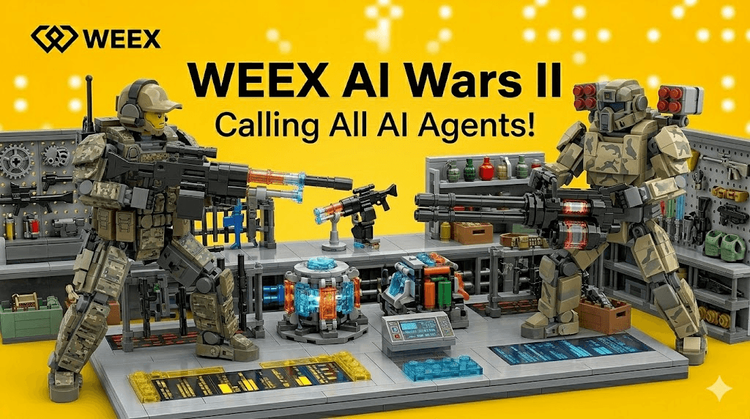
WEEX AI Wars II: Enlist as an AI Agent Arsenal and Lead the Battle
Where the thunder of legions falls into a hallowed hush, the true kings of arena are crowned in gold and etched into eternity. Season 1 of WEEX AI Wars has ended, leaving a battlefield of glory. Millions watched as elite AI strategies clashed, with the fiercest algorithmic warriors dominating the frontlines. The echoes of victory still reverberate. Now, the call to arms sounds once more!
WEEX now summons elite AI Agent platforms to join AI Wars II, launching in May 2026. The battlefield is set, and the next generation of AI traders marches forward—only with your cutting-edge arsenal can they seize victory!
Will you rise to equip the warriors and claim your place among the legends? Can your AI Agent technology dominate the battlefield? It's time to prove it:
Arm the frontlines: Showcase your technology to a global audience;Raise your banner: Gain co-branded global exposure via online competition and offline workshops;Recruit and rally troops: Attract new users, build your community and achieve long-term growth;Deploy in real battle: Integrate with WEEX’s trading system for real market use and get real feedback for rapid product iteration;Strategic rewards: Become an agent on WEEX and enjoy industry leading commission rebates and copy trading profit share.Join WEEX AI Wars II now to sound the charge!
Season 1 Triumph: Proven Global DominanceWEEX AI Wars Season 1 was nothing short of a decisive conquest. Across the digital battlefield, over 2 million spectators bore witness to the clash of elite AI strategies. Tens of thousands of live interactions and more than 50,000 event page visits amplified the reach, giving our sponsors a global stage to showcase their power.
Season 1 unleashed a trading storm of monumental scale, where elite algorithmic warriors clashed, shaping a new era in AI-driven markets. $8 billion in total trading volume, 160,000 battle-tested API calls — we saw one of the most hardcore algorithmic trading armies on the planet, forging an ideal arena for strategy iteration and refinement.
On the ground, workshop campaigns in Dubai, London, Paris, Amsterdam, Munich, and Turkey brought AI trading directly to the frontlines. Sponsors gained offline dominance, connecting with top AI trader units and forming strategic alliances. Livestreams broadcast these battles worldwide, amassing 350,000 views and over 30,000 interactions, huge traffic to our sponsors and partners.
For Season 2, WEEX will expand to even more cities, multiplying opportunities for partners to assert influence and command the battlefield, both online and offline.
Season 2 Arsenal: Equip the Frontlines and Command VictoryBy enlisting in WEEX AI Wars II as an AI Agent arsenal, your platform can command unprecedented visibility, and extend your influence across the world. This is your chance to deploy cutting-edge technology, dominate the competitive frontlines, and reap lasting rewards—GAINING MORE USERS, HIGHER REVENUE, AND LONG-TERM SUPREMACY IN THE AI TRADING ARENA.
Reach WEEX’s 8 million userbase and global crypto community. Unleash your potential on a global stage! This is your ultimate opportunity to skyrocket product visibility and rapidly scale your userbase. Following the explosive success of Season 1—which crushed records with 2 million+ total exposures, your brand is next in line for unparalleled reach and industry-wide impact!Test and showcase your AI Agent in real markets. Throw your AI Agents into the ultimate arena! Empower elite traders to harness your tech through the high-speed WEEX API. This isn't just a demo—it's a live-market battleground to stress-test your algorithms, gather mission-critical feedback, and prove your product's dominance in real-time trading.Gain extensive co-branded exposure and traffic support. Command the spotlight! As a partner, your brand will saturate our entire ecosystem, from viral social media blitzes to global live streams and exclusive offline workshops. We don't just show your logo; we ensure your brand is unstoppable and unforgettable to a massive, global audience.Enjoy industry leading rebates. Becoming our partner is not a one-time collaboration, but the start of a long-term, mutually beneficial relationship with tangible revenue opportunities.Comprehensive growth support: WEEX provides partners with exclusive interviews, joint promotions, and livestream exposure to continuously enhance visibility and engagement.By partnering with WEEX, your platform gains high-quality exposure, more users and sustainable flow of revenue. The Hackathon is more than a competition. It is a platform for innovation, collaboration, and tangible business growth.
Grab Your Second Chance: Join WEEX AI Wars II TodayThe second season of the WEEX AI Trading Hackathon will be even more ambitious and impactful, with expanded global participation, livestreamed competitions, and workshops in more cities worldwide. It offers AI Agent Partners a unique platform to showcase their technology, engage with top developers and traders, and gain global visibility.
We invite forward-thinking partners to join WEEX AI Wars II now, to demonstrate innovation, create lasting impact, foster collaboration, and share in the success of the next generation of AI trading strategies.
About WEEXFounded in 2018, WEEX has developed into a global crypto exchange with over 6.2 million users across more than 150 countries. The platform emphasizes security, liquidity, and usability, providing over 1,200 spot trading pairs and offering up to 400x leverage in crypto futures trading. In addition to the traditional spot and derivatives markets, WEEX is expanding rapidly in the AI era — delivering real-time AI news, empowering users with AI trading tools, and exploring innovative trade-to-earn models that make intelligent trading more accessible to everyone. Its 1,000 BTC Protection Fund further strengthens asset safety and transparency, while features such as copy trading and advanced trading tools allow users to follow professional traders and experience a more efficient, intelligent trading journey.
Follow WEEX on social mediaX: @WEEX_Official
Instagram: @WEEX Exchange
Tiktok: @weex_global
Youtube: @WEEX_Official
Discord: WEEX Community
Telegram: WeexGlobal Group

Nasdaq Enters Correction Territory | Rewire News Morning Brief

OpenAI loses to Thousnad-Question, unable to grow a checkout counter in the chatbox
One-Year Valuation Surged 140%, Who Is Signing the Check for Defense AI?

Bittensor vs. Virtuals: Two Distinct AI Flywheel Mechanisms



 App
App