
 Buy Crypto
- Markets
 Futures
- Spot
- Copy Trade
- Earn
- More
The Wall Street Wolf Behind the Politician's Mask: How Trump Manipulated Market Sentiment with a Dual Identity

Original Article Title: Trump's Tariff Game: "Tariffs for Talks" – Power Play in Market Volatility
Original Article Author: Ac-Core, YBB Capital Researcher
1. Trade War Escalation, 24-Hour Cross-Market Flash Crash Relay Race
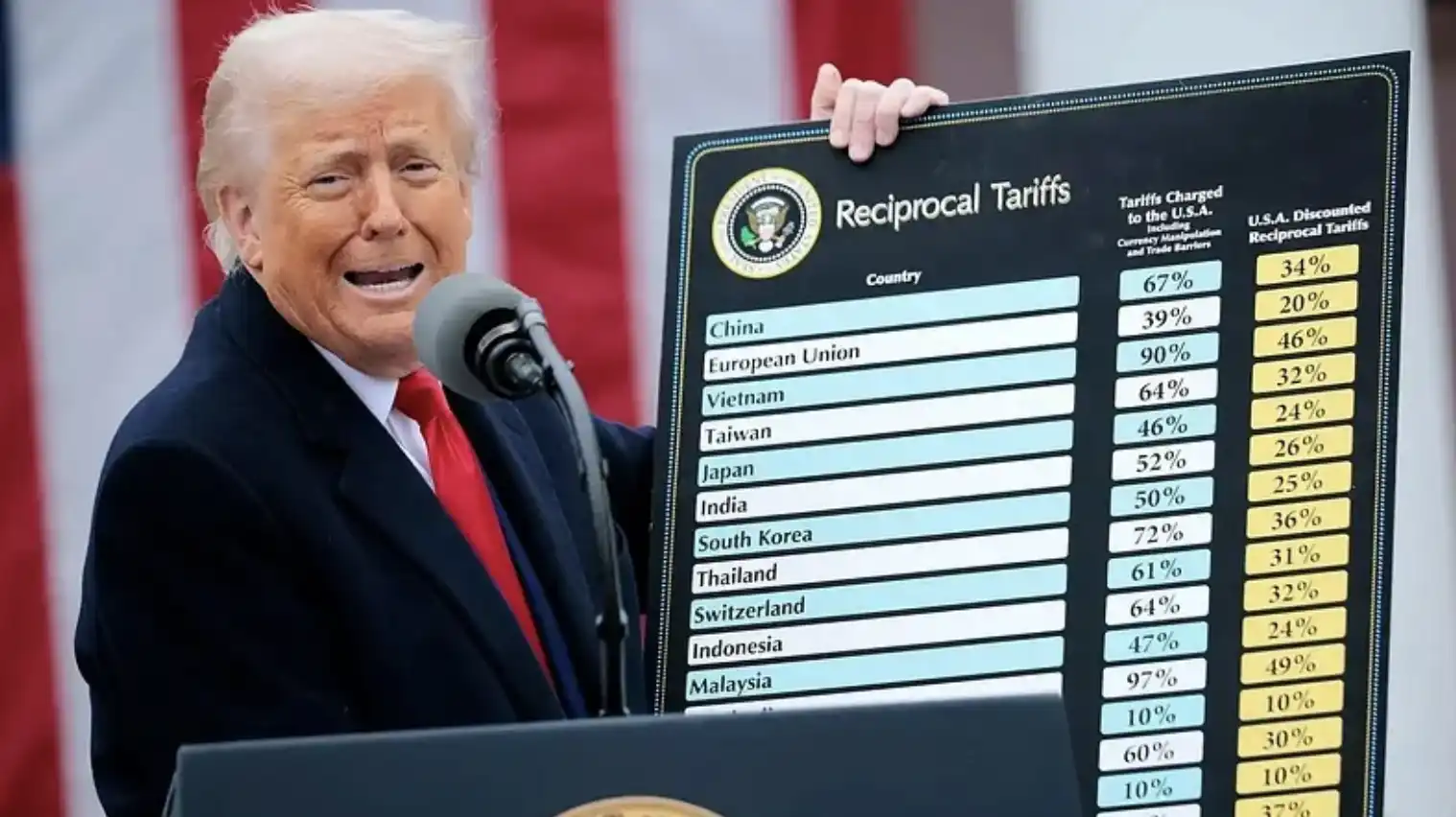
Image Source: Forbes
1.1 Global Financial Market Collapse!
Early on April 7, global financial markets experienced a widespread collapse as trade tensions escalated due to "tit-for-tat tariffs," causing panic selling across stocks, crude oil, precious metals, and even cryptocurrencies. During the Asian session pre-market, US stock index futures continued last week's slump, with Nasdaq 100 futures plummeting by 5%, while S&P 500 and Dow futures both saw declines of over 4%. The European markets were equally gloomy, with Germany's DAX futures dropping by nearly 5%, and Euro STOXX50 and UK FTSE index futures breaching the 4% decline mark.
The Asian markets opened to a selling frenzy: South Korea's KOSPI 200 futures plunged by 5% in the pre-market session, triggering a trading halt; within two hours of the Australian market open, the index's losses widened from 2.75% to 6%; Singapore's Straits Times Index suffered a record single-day decline of 7.29%. The Middle Eastern markets saw an early "Black Sunday," with Saudi Arabia's Tadawul index plummeting by 6.1%, while oil-producing countries like Qatar and Kuwait saw their indices drop by over 5.5%.
Commodity markets were devastated: WTI crude oil broke below the $60 psychological level to hit a two-year low, experiencing a 4% intraday decline; gold unexpectedly lost the $3010 support level, with silver's weekly losses expanding to 13%; the cryptocurrency space saw Bitcoin breaking key support levels and Ethereum plunging by 10% in a single day, shattering the myth of digital assets as a safe haven.
1.2 Impact on the Crypto Market
Short-Term Market Impact
The recent policies of the Trump administration have had a significant impact on the cryptocurrency market's volatility. In January of this year, when Trump signed an executive order calling for the establishment of a cryptocurrency regulatory framework and the study of a national cryptocurrency reserve, the market reacted positively, driving the total cryptocurrency market cap to $3.65 trillion by month-end, achieving a cumulative gain of 9.14%. However, the introduction of tariff policies in February quickly reversed the previous market trends. In particular, following the announcement on February 3 of long-term import tariffs on China, Canada, and Mexico, the cryptocurrency market experienced a significant drop in line with the stock market: Bitcoin saw an 8% decline within 24 hours, while Ethereum plummeted by over 10%, triggering $900 million in liquidations across the network and forcing 310,000 investors into liquidation.
From a transmission mechanism perspective, tariff policy impacts the crypto market through multiple pathways: first, trade frictions intensify global market volatility, driving the US dollar stronger as a safe-haven asset and prompting capital inflows into the US market; second, institutional investors may liquidate crypto assets to offset losses in other parts of their portfolios to manage risks; tariff-induced inflationary pressure may weaken purchasing power, thereby reducing market risk appetite, especially in the highly volatile crypto market.
Long-Term Potential Opportunities
Despite significant short-term impacts, tariff policy may create structural opportunities for the crypto market in the following areas:
Anticipated Liquidity Expansion
The Trump administration may implement expansionary fiscal policies through tax cuts and infrastructure investments to boost market liquidity to offset fiscal deficits or through debt monetization measures. Historical data shows that during the $3 trillion expansion of the Federal Reserve's balance sheet in 2020, the price of Bitcoin surged over 300% concurrently, indicating that a new round of liquidity injection may support crypto assets.
Enhanced Inflation Hedge Properties
Eugene Ephsteyn, Director of Trading and Structured Products at Moneycorp, pointed out that if a trade war leads to a devaluation of the US dollar, Bitcoin may serve as a hedge due to its fixed supply nature. Competitive currency devaluation triggered by tariff policies may encourage more investors to use cryptocurrency as an alternative channel for cross-border capital flows.
II. "Businessman + Dictator = Market Manipulation"
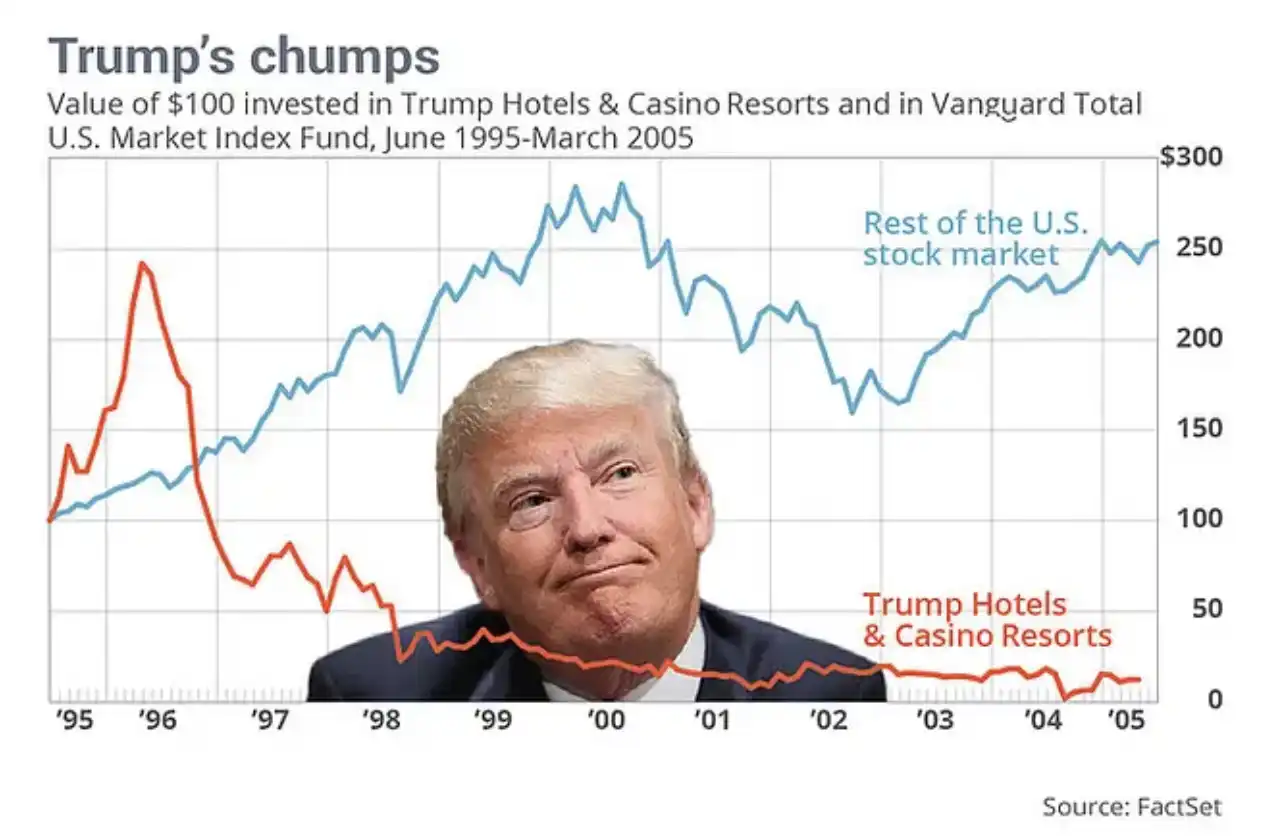
Image Source: marketwatch
2.1 Starting from the Tariff War of Trade Imbalance
In Trump's businessman mindset, the so-called "trade imbalance" is not actually a complex economic concept but more like a price imbalance between the buyer and the supplier in a procurement negotiation. Reference can be made to economist Fu Peng's explanation: Now, the buyer has invited all potential suppliers to the meeting table and said, "We need to renegotiate the terms of cooperation." Doesn't this sound a bit like centralized bidding in the pharmaceutical industry? Yes, Trump's operation is actually a typical bidding war tactic.
If tariffs are viewed as a form of "quote restriction," then the high tariffs set by Trump are actually equivalent to a psychological price set by the buyer in advance in a bid—anyone who wants to win the bid must compete below this price. This kind of setting may sound rough, even a bit impulsive, but it is very common in many actual procurement negotiations, especially in government-led large-scale centralized procurement projects.
Some have questioned whether this was a decision Trump made on the fly by pulling up an Excel sheet temporarily, but that's not the case. His strategy is not that complicated; essentially, it's about artificially setting a "threshold price" to force suppliers to come to the negotiating table. The most direct effect of this move is that whoever doesn't come to negotiate is automatically excluded, because if you don't accept this "maximum price offer," then you will only be taxed under the worst conditions, essentially relinquishing your market access eligibility.
At this point, countries wishing to participate in this "bidding" can only sit down and negotiate with the United States—how tariffs will be reduced, how product quotas will be allocated, and how rules will be changed. While it may seem like a trade confrontation, it's actually more like a round of commercial negotiations driven by strategic gaming. This is why Citibank's Asia Trading Strategy Director, Mohammed Apabhai, clearly stated in his report: what Trump is currently using is a typical negotiation tactic.
For those small and medium-sized suppliers, they actually don't have much room to maneuver, as they find it challenging to negotiate with the purchasing side on their own. Therefore, the purchasing side (i.e., the United States) uses the concessions made by these small suppliers to further pressure larger suppliers. This is a strategy of first breaking through the periphery and then encircling the core. In simpler terms, it's using concessions from the periphery to force key players to compromise.
So, in a sense, Trump's so-called "tariff war" is not entirely about going to war but creating a situation where "negotiation is a must." It's about forcing you to negotiate or forcing you out of the game; this is the approach he truly wants to play.
2.2 "Dictator"
Although the United States has a robust constitutional system and a democratic tradition, during Trump's presidency, many of his words and actions have been widely criticized as having a tendency towards a "dictator." This assessment is not groundless but is built on his multiple challenges to institutional norms, democratic mechanisms, public opinion environment, and power structure. While Trump did not completely break the U.S. institutional framework, his actions exemplified typical dictator characteristics—breaking institutional boundaries, suppressing dissent, and strengthening personal authority.
Undermining institutional checks and balances, circumventing congressional centralized power
During Trump's tenure, he frequently used executive orders to advance policies, including the construction of the U.S.-Mexico border wall, issuing the "Muslim Ban," and reducing environmental regulations, among other significant decisions. He even declared a "national emergency" to tap into military funding when Congress refused to allocate funds for the border wall, bypassing legislative constraints. This behavior undermined the principle of separation of powers in the U.S. Constitution, expanding executive power unprecedentedly, showing clear signs of centralization.
Attacking press freedom, creating an "enemy" style public opinion environment
Trump often refers to the media that criticizes him as "fake news," and even uses the term "enemy of the people" to refer to traditional news organizations such as CNN, The New York Times, and others. He repeatedly attacks journalists, TV hosts, and commentators on Twitter, urging his supporters to harbor animosity towards the media. In political communication studies, this delegitimization of the media is one of the propaganda control strategies commonly used by authoritarian leaders, aiming to weaken the public's trust in diverse information sources and establish an "information monopoly."
Interference with Judicial Independence, Emphasis on "Loyalty over Expertise"
Trump has frequently attacked the judicial system in public, especially when courts rule against his policies, sometimes directly criticizing judges by name. For example, he referred to a judge opposing his immigration policy as a "Mexican," implying that the judge's ruling was unfair. Furthermore, in senior appointments, he often prioritizes loyalty over professional competence, frequently replacing key positions like the Attorney General and FBI Director, severely undermining judicial independence.
Refusal to Accept Election Results, Undermining Peaceful Transfer of Power Tradition
Following the 2020 presidential election, Trump vehemently refused to concede defeat, alleging that the election was "stolen" and repeatedly demanding states to "recalculate" or "overturn the results." More significantly, his remarks ultimately led to the January 6, 2021 Capitol riot, where a large number of supporters stormed the Capitol, attempting to prevent the certification of Biden's victory. This event was widely labeled by the international media as the "darkest day of American democracy," and it was a clear attempt to interfere with the peaceful transfer of power, displaying characteristics of authoritarianism.
Advocating Personality Cult, Creating a "Leader-Only" Narrative
Trump promoted a highly personalized ruling style within the party and government, demanding absolute loyalty. He frequently praised himself at rallies, describing himself as the "greatest president in history" and implying that the country would decline without him. This political discourse created a "savior" type of personal myth, weakening the presence of collective governance and institutional norms, making it susceptible to slipping into personality cult and populism.
2.3 Trump's Double Game: Not a President but a "Stock Market Guru"
Donald Trump, the billionaire from a real estate empire, surprised many when he successfully won the U.S. presidency in 2016 as an "atypical political figure." Looking at his governance style and political behavior, combined with the hypothetical positioning of Trump as a "businessman" and "dictator" mentioned earlier, it is solely a personal opinion that Trump is not a true "president" in the full sense, but more like a "super trader" who uses power, public opinion, and the financial market as tools: a "stock market guru" who turns the White House into a Wall Street trading room to profit from market volatility. Therefore, from the perspective of a "trader," reinterpreting the unorthodox Trump, all his unconventional operations seem to become rational.
Businessman Nature: Viewing the Presidency as a "Super Trading Platform"
Trump is a typical businessman-style political figure. He has been in the business world for decades, adept at creating topics, controlling public opinion, and speculation. He does not govern the country according to political logic but views American and global affairs from a "business perspective." His governance is not for institutional perfection or global leadership but for pursuing "transactional outcomes," emphasizing "America First," fundamentally "profit first."
Moreover, Trump has also shown a strong "dictator" characteristic, especially in the way of guiding public opinion and centralizing power. He controls the information flow, eagerly publishes market-shaking comments through Twitter, such as "We are about to reach a major agreement with China" or "The Fed should cut interest rates," often causing significant fluctuations in the financial markets. For an ordinary president, these remarks may be diplomatic postures; but for a leader who acts with "market manipulation thinking," these are precise tools for controlling market sentiment.
Dictatorial Language Artistry: Intervening in Market Sentiment through Information
If a core feature of a dictator is "control and utilization of information," then Trump is a master in modern society who "shocks the market" through information. He does not need a censorship system or media shutdown but becomes the strongest source of information in the market by creating uncertainty and confrontational emotions.
In the Twitter era, he almost daily releases "market-impactful remarks" like a financial anchor:
"China will sign a huge trade agreement";
"If the Fed does not lower interest rates, the US will lose its competitiveness";
"Oil prices are too high, this is OPEC's fault";
"The border wall will be built, and the market should feel reassured".
These statements themselves do not constitute formal policies but frequently lead to sharp fluctuations in the Dow Jones, S&P 500, gold, and oil markets. The pace of information release, the emphasis of language, and even the timing selection all bear strong traces of market manipulation.
Even more noteworthy is that he repeatedly "shifts" at different times, praising the progress of US-China negotiations today but announcing the imposition of tariffs tomorrow; in the morning, he says the Fed should cut interest rates, and in the afternoon, he claims the US dollar is too weak. This kind of back-and-forth is not political oscillation but precise control of market sentiment, turning fluctuations into controllable harvesting opportunities.
Family Capital Relationship Network: An Arbitrage Channel Built on Power and Information
Trump's business network did not cease after being elected President; instead, it was granted more "legitimacy" and influence. His family members, such as Kushner and Ivanka, remain deeply involved in political and business affairs, holding direct influence in various fields such as Middle East policy, tech investments, and real estate. News about his family trust funds and close friends' investment groups exploiting policy foresight for financial arbitrage has been repeatedly disclosed:
Prior to the implementation of Trump's large-scale tax cuts policy, some funds closely related to him positioned heavily in US stocks;
Whenever Trump hinted at possibly releasing strategic oil reserves or initiating military actions, the energy market always saw suspicious trades in advance;
During the stages of the trade war with China, around Trump's remarks regarding "reaching an agreement," the market's reaction was highly sensitive, often experiencing short-term rallies.
Although insider trading cannot be directly confirmed, his control over information and the concentration of policy decision-making power have given the "arbitrage channel" significant practical value. The President is no longer a representative of the system but rather a "trader" with unlimited privileged information and discourse power.
"Create Chaos—Steer Direction—Reap Results": a typical tactic of market manipulators
Traditional presidents seek stability and continuity, while Trump seems to be constantly "creating chaos." He excels at inducing market panic, then guides market recovery through reassuring statements—a whole process resembling a swing trade:
Fire at Iran—market panic—signals negotiations the next day—market rebound;
Announce escalating tariffs on China—tech stocks plummet—a few days later say "China has been very cooperative"—recovery;
During the virus outbreak, claim the situation is "under control"—brief stock market rebound—subsequent information reversal leads to another decline.
Behind these seemingly casual remarks lies a high degree of emotional guidance and market rhythm coordination. He understands the expected public reaction and acts like a super market operator, leading the collective psyche of global investors.
Post-Trump Era: Personal Brand Continues to Influence the Market
Even after leaving office, Trump still has the ability to influence the market rhythm. With a single announcement of "possibly running again," stocks related to energy, military, social media, and conservative tech immediately react. Taking Trump Media Group (Truth Social) going public through a SPAC as an example, despite lacking substantial profitability, the stock experienced a significant surge—capital markets see "Trump" himself as a speculative target, showcasing the branding and financialization of his persona.
3. The U.S.-orchestrated Cryptocurrency Market: A Collusion of Capital and Power
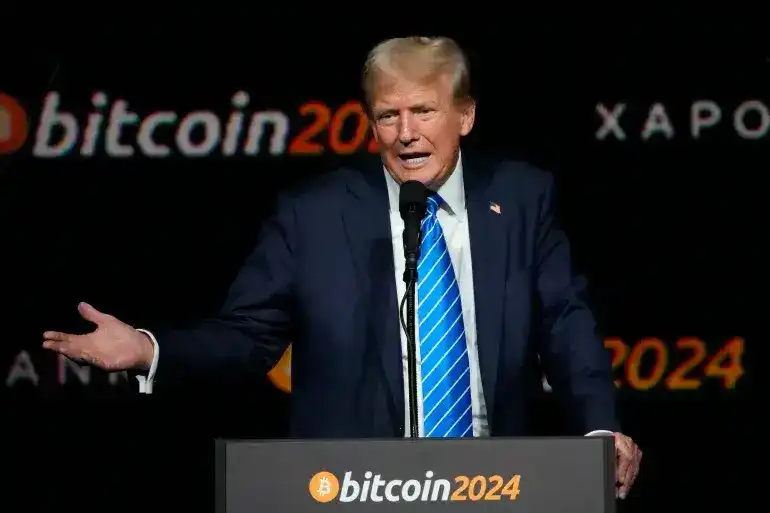
Image Source: Al Jazeera
3.1 Power Reconstruction: Trump Doesn't Want Bitcoin, He Wants a "Americanized" Bitcoin
The current cryptocurrency market is no longer the haven of decentralization ideals, but a new financial colony manipulated by U.S. capital and power in concert. Since the approval of the Bitcoin spot ETF, Wall Street giants like BlackRock, Fidelity, MicroStrategy, and others have rapidly built up BTC spot positions, locking the Bitcoin that originally belonged to the tech community in Wall Street's vaults. Financialization and politicization have become the dominant logic, and the price of crypto assets is no longer determined by market behavior but relies on the Federal Reserve's rate hints, the SEC's regulatory dynamics, and even a presidential candidate's verbal commitment to "supporting crypto."
The essence of this "Americanization" is to re-embed a decentralized asset into a center—the American financial hegemony system. ETFs have made the crypto market rise and fall in harmony with the U.S. stock market. Behind the candlestick chart lies the pulse of the U.S. bond market fluctuations and CPI data. Once seen as a symbol of freedom, Bitcoin is increasingly resembling an "alternative Nasdaq constituent stock that belatedly reflects the Fed's intentions."
3.2 Bitcoin's Strategic Value: Not a Sovereign Reserve Asset, But the U.S. Dollar Hegemony's Gray Spare Tire
The Trump era laid the groundwork for Bitcoin's national financial positioning. Instead of directly declaring support as a traditional politician would, he tacitly allowed hash power migration, relaxed regulatory uncertainties, and supported mining infrastructure, integrating Bitcoin into America's strategic financial resource pool. Amid expectations of a weakening traditional U.S. dollar credit system, Bitcoin is gradually assuming the role of a "non-sovereign reserve asset," being shaped into a safe haven alternative in financial turbulence.
· This deployment is very American: silent annexation without direct conflict. The U.S. has dominated much of Bitcoin's financial infrastructure (Coinbase, CME, BlackRock ETF) and further gained control of on-chain settlement capabilities through the U.S. dollar peg of stablecoins (USDC). When global turmoil, fund safe havens, and trust shifts occur, the U.S. has quietly obtained this "dollar alternative in a de-dollarizing world."
· Perhaps Trump sees further: Bitcoin's belief is unrelated to him; instead, its financial attributes have been tamed into another "currency sovereignty tool" for the U.S. In scenarios where the dollar is constrained, SWIFT is problematic, and fiat currencies devalue, Bitcoin becomes a contingency plan for maintaining power.
3.3 The Truth Behind the Scenes? Trump is Not Just a President, But Also a "Super Whales" in the Flow-based Financial Battlefield
First of all, understand a fact that in any financial market, 90% of the time is dominated by oscillation, and only "big fluctuations can earn big money."
Therefore, considering all viewpoints, Trump superficially appears to be a president, but in reality, he is more like a flow-driven super trader, with the sole purpose of: creating market fluctuations and controlling market fluctuations, all just to earn profits from fluctuations.
Trump is adept at influencing market direction through information, flow, and influence, earning profits from market fluctuation trends as a "speculator." While supporting Bitcoin to become a "strategic reserve of the United States," he also absorbs market liquidity by launching the meme token $TRUMP, which is a market manipulation strategy of "information intervention + liquidity vampirism."
What's even more brutal is that the trend of the crypto market is increasingly dependent on US political games: the Fed's stance, SEC's actions, presidential candidate speeches, congressional hearings emotions... The decentralized crypto system has been deeply intertwined with US dollar policy, US stock structure, and US big capital logic. Today, the crypto market has become an "extended battlefield" of the American financial system.
We are also witnessing a cruel reality: the market seems free but has long been orchestrated; the price seems to fluctuate, but behind it is the one controlling the information and flow setting traps.
You may also like

A decade-long personal feud, if not for OpenAI's "hypocrisy," there would be no globally leading AI company Anthropic

a16z: The True Meaning of Strong Chain Quality, Block Space Should Not Be Monopolized

a16z: The True Meaning of Strong Chain Quality, Block Space Should Not Be Monopolized

2% user contribution, 90% trading volume: The real picture of Polymarket

Trump Can't Take It Anymore, 5 Signals of the US-Iran Ceasefire

Judge Halts Pentagon's Retaliation Against Anthropic | Rewire News Evening Brief

Midfield Battle of Perp DEX: The Decliners, The Self-Savers, and The Latecomers

Iran War Stalemate: What Signal Should the Market Follow?
Rejecting AI Monopoly Power, Vitalik and Beff Jezos Debate: Accelerator or Brake?

Insider Trading Alert! Will Trump Call a Truce by End of April?

After establishing itself as the top tokenized stock, does Ondo have any new highlights?

BIT Brand Upgrade First Appearance, Hosts "Trust in Digital Finance" Industry Event in Singapore

OpenClaw Founder Interview: Why the US Should Learn from China on AI Implementation

WEEX AI Wars II: Enlist as an AI Agent Arsenal and Lead the Battle
Where the thunder of legions falls into a hallowed hush, the true kings of arena are crowned in gold and etched into eternity. Season 1 of WEEX AI Wars has ended, leaving a battlefield of glory. Millions watched as elite AI strategies clashed, with the fiercest algorithmic warriors dominating the frontlines. The echoes of victory still reverberate. Now, the call to arms sounds once more!
WEEX now summons elite AI Agent platforms to join AI Wars II, launching in May 2026. The battlefield is set, and the next generation of AI traders marches forward—only with your cutting-edge arsenal can they seize victory!
Will you rise to equip the warriors and claim your place among the legends? Can your AI Agent technology dominate the battlefield? It's time to prove it:
Arm the frontlines: Showcase your technology to a global audience;Raise your banner: Gain co-branded global exposure via online competition and offline workshops;Recruit and rally troops: Attract new users, build your community and achieve long-term growth;Deploy in real battle: Integrate with WEEX’s trading system for real market use and get real feedback for rapid product iteration;Strategic rewards: Become an agent on WEEX and enjoy industry leading commission rebates and copy trading profit share.Join WEEX AI Wars II now to sound the charge!
Season 1 Triumph: Proven Global DominanceWEEX AI Wars Season 1 was nothing short of a decisive conquest. Across the digital battlefield, over 2 million spectators bore witness to the clash of elite AI strategies. Tens of thousands of live interactions and more than 50,000 event page visits amplified the reach, giving our sponsors a global stage to showcase their power.
Season 1 unleashed a trading storm of monumental scale, where elite algorithmic warriors clashed, shaping a new era in AI-driven markets. $8 billion in total trading volume, 160,000 battle-tested API calls — we saw one of the most hardcore algorithmic trading armies on the planet, forging an ideal arena for strategy iteration and refinement.
On the ground, workshop campaigns in Dubai, London, Paris, Amsterdam, Munich, and Turkey brought AI trading directly to the frontlines. Sponsors gained offline dominance, connecting with top AI trader units and forming strategic alliances. Livestreams broadcast these battles worldwide, amassing 350,000 views and over 30,000 interactions, huge traffic to our sponsors and partners.
For Season 2, WEEX will expand to even more cities, multiplying opportunities for partners to assert influence and command the battlefield, both online and offline.
Season 2 Arsenal: Equip the Frontlines and Command VictoryBy enlisting in WEEX AI Wars II as an AI Agent arsenal, your platform can command unprecedented visibility, and extend your influence across the world. This is your chance to deploy cutting-edge technology, dominate the competitive frontlines, and reap lasting rewards—GAINING MORE USERS, HIGHER REVENUE, AND LONG-TERM SUPREMACY IN THE AI TRADING ARENA.
Reach WEEX’s 8 million userbase and global crypto community. Unleash your potential on a global stage! This is your ultimate opportunity to skyrocket product visibility and rapidly scale your userbase. Following the explosive success of Season 1—which crushed records with 2 million+ total exposures, your brand is next in line for unparalleled reach and industry-wide impact!Test and showcase your AI Agent in real markets. Throw your AI Agents into the ultimate arena! Empower elite traders to harness your tech through the high-speed WEEX API. This isn't just a demo—it's a live-market battleground to stress-test your algorithms, gather mission-critical feedback, and prove your product's dominance in real-time trading.Gain extensive co-branded exposure and traffic support. Command the spotlight! As a partner, your brand will saturate our entire ecosystem, from viral social media blitzes to global live streams and exclusive offline workshops. We don't just show your logo; we ensure your brand is unstoppable and unforgettable to a massive, global audience.Enjoy industry leading rebates. Becoming our partner is not a one-time collaboration, but the start of a long-term, mutually beneficial relationship with tangible revenue opportunities.Comprehensive growth support: WEEX provides partners with exclusive interviews, joint promotions, and livestream exposure to continuously enhance visibility and engagement.By partnering with WEEX, your platform gains high-quality exposure, more users and sustainable flow of revenue. The Hackathon is more than a competition. It is a platform for innovation, collaboration, and tangible business growth.
Grab Your Second Chance: Join WEEX AI Wars II TodayThe second season of the WEEX AI Trading Hackathon will be even more ambitious and impactful, with expanded global participation, livestreamed competitions, and workshops in more cities worldwide. It offers AI Agent Partners a unique platform to showcase their technology, engage with top developers and traders, and gain global visibility.
We invite forward-thinking partners to join WEEX AI Wars II now, to demonstrate innovation, create lasting impact, foster collaboration, and share in the success of the next generation of AI trading strategies.
About WEEXFounded in 2018, WEEX has developed into a global crypto exchange with over 6.2 million users across more than 150 countries. The platform emphasizes security, liquidity, and usability, providing over 1,200 spot trading pairs and offering up to 400x leverage in crypto futures trading. In addition to the traditional spot and derivatives markets, WEEX is expanding rapidly in the AI era — delivering real-time AI news, empowering users with AI trading tools, and exploring innovative trade-to-earn models that make intelligent trading more accessible to everyone. Its 1,000 BTC Protection Fund further strengthens asset safety and transparency, while features such as copy trading and advanced trading tools allow users to follow professional traders and experience a more efficient, intelligent trading journey.
Follow WEEX on social mediaX: @WEEX_Official
Instagram: @WEEX Exchange
Tiktok: @weex_global
Youtube: @WEEX_Official
Discord: WEEX Community
Telegram: WeexGlobal Group

Nasdaq Enters Correction Territory | Rewire News Morning Brief

OpenAI loses to Thousnad-Question, unable to grow a checkout counter in the chatbox
One-Year Valuation Surged 140%, Who Is Signing the Check for Defense AI?



 App
App