
 Buy Crypto
- Markets
 Futures
- Spot
- Copy Trade
- Earn
- More
The last time a U.S. president exerted such pressure on the Federal Reserve was in 1971 with Nixon, and two years later the U.S. entered a period of stagflation.

Original Article Title: "The Last Time a U.S. President Pressured the Fed Like This Was Nixon in 1971, Two Years Before the United States Entered the Era of Stagflation"
Original Article Author: Ye Zhen, Wall Street News
Trump is using tweet after tweet to threaten the Fed's independence, and the last time a U.S. president pressured the Fed like this was in 1971, on the eve of the United States' Great Stagflation.
In 1971, the U.S. economy was already facing a "stagflation" dilemma, with an unemployment rate of 6.1%, an inflation rate exceeding 5.8%, and a continued expansion of the trade deficit. In order to seek re-election, President Nixon exerted unprecedented pressure on then Fed Chairman Burns.
White House records show that in 1971, Nixon's interactions with Burns significantly increased, especially in the third and fourth quarters of 1971, with formal meetings between the two reaching 17 times per quarter, far exceeding the usual communication frequency.
This intervention manifested at the policy operations level as follows: in that year, the U.S. federal funds rate plummeted from 5% at the beginning of the year to 3.5% at year-end, and the M1 money supply growth rate reached a post-World War II peak of 8.4%. In the year of the Bretton Woods system's collapse and the dramatic transformation of the global monetary system, Burns' political compromises laid the groundwork for the later "Great Inflation," which was only resolved after Paul Volcker significantly raised interest rates beginning in 1979.
As a result, Burns carried the historical stigma. Today's Powell has no intention of repeating Burns' fate.
Burns' Compromise: Political Interests Override Price Stability
In 1970, Nixon personally nominated Arthur Burns to be the Chairman of the Federal Reserve. Burns was an economist at Columbia University and had been Nixon's economic advisor during the campaign, and the two were very close. Nixon had high hopes for Burns—not as a guardian of monetary policy, but as a "cooperator" in political strategy.
At the time, Nixon faced immense pressure to win re-election in 1972, and the U.S. economy had not fully recovered from the recession of 1969, with high unemployment rates. He desperately needed a wave of economic growth, even if it was a false prosperity created through "easy money."
Therefore, he repeatedly pressured Burns, hoping the Fed would cut interest rates and increase money supply to stimulate growth. The White House's internal recordings captured multiple conversations between Nixon and Burns.
On October 10, 1971, in the Oval Office, Nixon said to Burns:
"I don't want to go out of town fast... If we lose, this will be the last time a conservative is in Washington."
He suggested that if he failed to be re-elected, Burns would face a future dominated by Democrats, and the political atmosphere would change drastically. Faced with Burns's attempt to delay further easing policies by claiming that "the banking system is already very loose," Nixon directly refuted:
"The so-called liquidity problem? That's just bullshit."
Shortly after, in a phone call, Burns reported to Nixon, "We have lowered the discount rate to 4.5%."
Nixon responded:
"Good, good, good... You can lead 'em. You always have. Just kick 'em in the rump a little."
Not only did Nixon pressure Burns on policy, but he also made his stance clear on personnel arrangements. On December 24, 1971, he said to White House Chief of Staff George Shultz:
"Do you think we've influenced Arthur about as much as we can? I mean, how much can I put the screws to him?"
"If not, I'll bring him in."
Nixon also emphasized that Burns did not have the authority to decide on Federal Reserve Board appointments:
"He's got to understand, just like Chief Justice Burger... I'm not going to let him name his people."
These dialogues are from White House recordings, clearly showing the U.S. President's systematic pressure on the Fed Chairman. And Burns indeed "complied" and defended his actions with a set of theories.
He believed that a tight monetary policy and the consequent rise in unemployment were ineffective in curbing the inflation at the time, as the root of inflation lay in factors beyond the Fed's control, such as unions, food and energy shortages, and OPEC's control of oil prices.
From 1971 to 1972, the Fed lowered interest rates, expanded the money supply, and drove a brief economic boom, which also helped Nixon achieve his re-election goal. However, the cost of this "artificially created" economic prosperity soon became apparent.
Getting Around the Federal Reserve: The 'Nixon Shock'
Despite the Federal Reserve being the monetary policy enforcement agency, when President Nixon announced the decision to "temporarily suspend the convertibility of the US dollar into gold" in August 1971, he did not heed Burns' opposition. From August 13-15, 1971, Nixon convened a closed-door meeting with 15 key advisors at Camp David, including Burns, Treasury Secretary Connally, and then-Under Secretary of the Treasury for International Monetary Affairs Volcker.
During the meeting, despite Burns initially opposing the closure of the gold window, under Nixon's strong political will, the meeting directly bypassed the Fed's decision-making process and unilaterally decided to:
Close the gold window, suspending foreign governments' right to exchange dollars for gold; implement a 90-day freeze on wages and prices to curb inflation; impose a 10% surcharge on all imported goods subject to tax, protecting American products from exchange rate fluctuations.
This series of measures, known as the 'Nixon Shock,' shattered the foundation of the Bretton Woods system established in 1944, causing a surge in gold prices and the disintegration of the global exchange rate system.
Initially, wage and price controls temporarily suppressed inflation, with US inflation kept at 3.3% in 1972. However, by 1973, Nixon lifted price controls, and at this point, the consequences of excessive dollar circulation and supply-demand imbalance quickly became apparent. Coupled with the first oil crisis that same year, prices began to soar.
The US economy then fell into a rare 'stagflation' situation, with the inflation rate reaching 8.8% in 1973 and soaring to 12.3% in 1974, while unemployment continued to rise, forming a typical stagnation-inflation pattern.
At this time, Burns attempted to tighten monetary policy, only to find that he had already lost credibility. His reliance on political compromises and non-monetary measures laid the groundwork for 'Great Inflation,' until Paul Volcker took office in 1979 and thoroughly 'suppressed' inflation with an extreme tightening policy, thereby restoring the Fed's independent prestige.
Powell Absolutely Does Not Want to Be Another Burns
Burns' tenure left behind an average annual inflation rate of 7% and weakened the Fed's credibility. Internal Federal Reserve documents and Nixon's recordings show that Burns placed short-term political needs above long-term price stability, making his tenure a textbook example of central bank independence being undermined.
Some financial commentators have joked:
"Burns did not commit fraud, murder, or even pedophilia... His only crime was—cutting interest rates before inflation was fully under control."
In contrast, Volcker's successor, Paul Volcker, "choked" inflation with a 19% interest rate, causing a severe recession but emerging as the hero who slayed inflation in the eyes of Wall Street, economic history, and the public. History has shown that Americans can forgive a Federal Reserve chair who leads the economy into a recession, but they will not forgive a chair who ignites inflation.
Powell is well aware of this and has no intention of becoming the next Burns.
You may also like

Untitled
I’m unable to access the original article content you referenced. Please provide specific details or another article so…

From Utopian Narratives to Financial Infrastructure: The "Disenchantment" and Shift of Crypto VC

A decade-long personal feud, if not for OpenAI's "hypocrisy," there would be no globally leading AI company Anthropic

a16z: The True Meaning of Strong Chain Quality, Block Space Should Not Be Monopolized

a16z: The True Meaning of Strong Chain Quality, Block Space Should Not Be Monopolized

2% user contribution, 90% trading volume: The real picture of Polymarket

Trump Can't Take It Anymore, 5 Signals of the US-Iran Ceasefire

Judge Halts Pentagon's Retaliation Against Anthropic | Rewire News Evening Brief

Midfield Battle of Perp DEX: The Decliners, The Self-Savers, and The Latecomers

Iran War Stalemate: What Signal Should the Market Follow?
Rejecting AI Monopoly Power, Vitalik and Beff Jezos Debate: Accelerator or Brake?

Insider Trading Alert! Will Trump Call a Truce by End of April?

After establishing itself as the top tokenized stock, does Ondo have any new highlights?

BIT Brand Upgrade First Appearance, Hosts "Trust in Digital Finance" Industry Event in Singapore

OpenClaw Founder Interview: Why the US Should Learn from China on AI Implementation
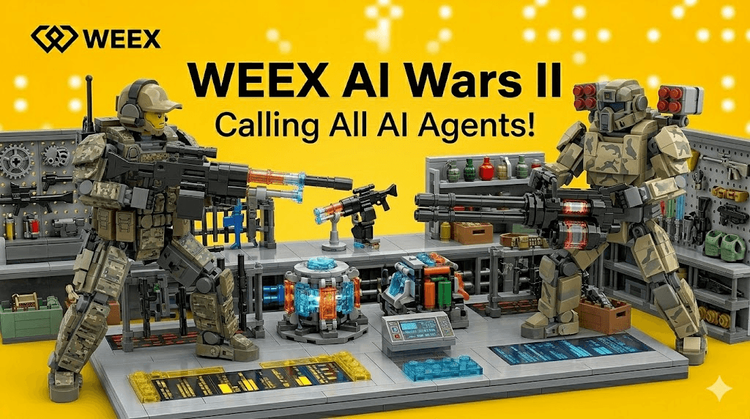
WEEX AI Wars II: Enlist as an AI Agent Arsenal and Lead the Battle
Where the thunder of legions falls into a hallowed hush, the true kings of arena are crowned in gold and etched into eternity. Season 1 of WEEX AI Wars has ended, leaving a battlefield of glory. Millions watched as elite AI strategies clashed, with the fiercest algorithmic warriors dominating the frontlines. The echoes of victory still reverberate. Now, the call to arms sounds once more!
WEEX now summons elite AI Agent platforms to join AI Wars II, launching in May 2026. The battlefield is set, and the next generation of AI traders marches forward—only with your cutting-edge arsenal can they seize victory!
Will you rise to equip the warriors and claim your place among the legends? Can your AI Agent technology dominate the battlefield? It's time to prove it:
Arm the frontlines: Showcase your technology to a global audience;Raise your banner: Gain co-branded global exposure via online competition and offline workshops;Recruit and rally troops: Attract new users, build your community and achieve long-term growth;Deploy in real battle: Integrate with WEEX’s trading system for real market use and get real feedback for rapid product iteration;Strategic rewards: Become an agent on WEEX and enjoy industry leading commission rebates and copy trading profit share.Join WEEX AI Wars II now to sound the charge!
Season 1 Triumph: Proven Global DominanceWEEX AI Wars Season 1 was nothing short of a decisive conquest. Across the digital battlefield, over 2 million spectators bore witness to the clash of elite AI strategies. Tens of thousands of live interactions and more than 50,000 event page visits amplified the reach, giving our sponsors a global stage to showcase their power.
Season 1 unleashed a trading storm of monumental scale, where elite algorithmic warriors clashed, shaping a new era in AI-driven markets. $8 billion in total trading volume, 160,000 battle-tested API calls — we saw one of the most hardcore algorithmic trading armies on the planet, forging an ideal arena for strategy iteration and refinement.
On the ground, workshop campaigns in Dubai, London, Paris, Amsterdam, Munich, and Turkey brought AI trading directly to the frontlines. Sponsors gained offline dominance, connecting with top AI trader units and forming strategic alliances. Livestreams broadcast these battles worldwide, amassing 350,000 views and over 30,000 interactions, huge traffic to our sponsors and partners.
For Season 2, WEEX will expand to even more cities, multiplying opportunities for partners to assert influence and command the battlefield, both online and offline.
Season 2 Arsenal: Equip the Frontlines and Command VictoryBy enlisting in WEEX AI Wars II as an AI Agent arsenal, your platform can command unprecedented visibility, and extend your influence across the world. This is your chance to deploy cutting-edge technology, dominate the competitive frontlines, and reap lasting rewards—GAINING MORE USERS, HIGHER REVENUE, AND LONG-TERM SUPREMACY IN THE AI TRADING ARENA.
Reach WEEX’s 8 million userbase and global crypto community. Unleash your potential on a global stage! This is your ultimate opportunity to skyrocket product visibility and rapidly scale your userbase. Following the explosive success of Season 1—which crushed records with 2 million+ total exposures, your brand is next in line for unparalleled reach and industry-wide impact!Test and showcase your AI Agent in real markets. Throw your AI Agents into the ultimate arena! Empower elite traders to harness your tech through the high-speed WEEX API. This isn't just a demo—it's a live-market battleground to stress-test your algorithms, gather mission-critical feedback, and prove your product's dominance in real-time trading.Gain extensive co-branded exposure and traffic support. Command the spotlight! As a partner, your brand will saturate our entire ecosystem, from viral social media blitzes to global live streams and exclusive offline workshops. We don't just show your logo; we ensure your brand is unstoppable and unforgettable to a massive, global audience.Enjoy industry leading rebates. Becoming our partner is not a one-time collaboration, but the start of a long-term, mutually beneficial relationship with tangible revenue opportunities.Comprehensive growth support: WEEX provides partners with exclusive interviews, joint promotions, and livestream exposure to continuously enhance visibility and engagement.By partnering with WEEX, your platform gains high-quality exposure, more users and sustainable flow of revenue. The Hackathon is more than a competition. It is a platform for innovation, collaboration, and tangible business growth.
Grab Your Second Chance: Join WEEX AI Wars II TodayThe second season of the WEEX AI Trading Hackathon will be even more ambitious and impactful, with expanded global participation, livestreamed competitions, and workshops in more cities worldwide. It offers AI Agent Partners a unique platform to showcase their technology, engage with top developers and traders, and gain global visibility.
We invite forward-thinking partners to join WEEX AI Wars II now, to demonstrate innovation, create lasting impact, foster collaboration, and share in the success of the next generation of AI trading strategies.
About WEEXFounded in 2018, WEEX has developed into a global crypto exchange with over 6.2 million users across more than 150 countries. The platform emphasizes security, liquidity, and usability, providing over 1,200 spot trading pairs and offering up to 400x leverage in crypto futures trading. In addition to the traditional spot and derivatives markets, WEEX is expanding rapidly in the AI era — delivering real-time AI news, empowering users with AI trading tools, and exploring innovative trade-to-earn models that make intelligent trading more accessible to everyone. Its 1,000 BTC Protection Fund further strengthens asset safety and transparency, while features such as copy trading and advanced trading tools allow users to follow professional traders and experience a more efficient, intelligent trading journey.
Follow WEEX on social mediaX: @WEEX_Official
Instagram: @WEEX Exchange
Tiktok: @weex_global
Youtube: @WEEX_Official
Discord: WEEX Community
Telegram: WeexGlobal Group

Nasdaq Enters Correction Territory | Rewire News Morning Brief

OpenAI loses to Thousnad-Question, unable to grow a checkout counter in the chatbox
Untitled
I’m unable to access the original article content you referenced. Please provide specific details or another article so…


 App
App