
 Buy Crypto
- Markets
 Futures
- Spot
- Copy Trade
- Earn
- More
The Evolution of Funding Rates: From the Golden Age of 2021 to the Arbitrage Renaissance of 2024-2025

Abstract
This paper explores the development and importance of funding rates in the cryptocurrency derivatives market, focusing on the origins of funding rates, their operating mechanisms, and the arbitrage strategies they inspire. The paper reviews the "golden age" of funding rate arbitrage in the spring of 2021 and its decline due to market adjustments; it also analyzes the resurgence of funding rate arbitrage opportunities in 2024-2025 with the emergence of innovative stablecoins such as USDe and USDX. In addition, this paper explores the key role of the Chicago Mercantile Exchange (CME) in funding rate pricing, revealing the intersection between traditional finance (TradFi) and decentralized finance (DeFi). Finally, the paper proposes that the dynamics of funding rates are more determined by institutional investors and CME than by emerging stablecoins, calling for a re-examination of the narrative logic of the crypto ecosystem.
Origins of Funding Rates
The origins of funding rates are in the cryptocurrency derivatives market, and in particular, they have evolved from perpetual futures contracts. It acts as a mechanism to keep the price of a perpetual futures contract close to the spot price of the underlying asset. The concept was developed to address issues inherent in traditional futures contracts such as expiration and settlement, which can lead to divergences between the futures price and the spot price.
Key Background on Funding Rates:
· Introduced by Crypto Exchanges: Funding rates became widely recognized and used with the rise of cryptocurrency exchanges like @BitMEX (founded by @CryptoHayes in 2016). BitMEX popularized the perpetual futures contract, a derivative with no expiration date, allowing traders to hold positions indefinitely. To ensure that the contract price remains close to the spot price, funding rates were introduced.
· Mechanism:The funding rate is a fee paid (or received) periodically between longs (buyers) and shorts (sellers) in the market. It is determined by the difference between the perpetual futures contract price and the spot price of the underlying asset. If the perpetual contract price is above the spot price (indicating a bullish market), longs pay shorts; if the price is below the spot price (indicating a bearish market), shorts pay longs.
· Purpose:The funding rate incentivizes traders to take positions that help align the perpetual futures price with the spot price. This reduces the potential for large discrepancies and keeps the market efficient.
· Calculation:The calculation of the funding rate is based on two main components: an interest rate (usually negligible) and a premium index (the difference between the futures price and the spot price). The specific formula may vary between different exchanges.
· Evolution:The funding rate has become a standard feature on major cryptocurrency exchanges, including Binance, OKX, Bybit, Deribit Exchange, and others. It has impacted traditional financial derivatives by introducing innovative approaches to managing price tracking and trader behavior.
The funding rate plays a key role in ensuring the stability and efficiency of the cryptocurrency perpetual futures market, keeping it closely aligned with the underlying spot market.
What is Funding Rate Arbitrage?
Funding Rate Arbitrage is a trading strategy where traders exploit the difference between the funding rate of a perpetual futures contract and the spot price of the underlying asset. The goal is to profit from regular funding payments between long and short positions.
Key Elements:
· Long Spot + Short Perpetual Futures:Traders buy a cryptocurrency (e.g. Bitcoin) on the spot market and simultaneously take a short position on a perpetual futures contract for the same cryptocurrency. This creates a hedged position where the trader is not exposed to asset price fluctuations.
· Profit from High Funding Rates:When funding rates are high (bullish market), traders with short positions receive funding payments from traders with long positions.
Spring 2021 - The Golden Age of Arbitrage
The spring of 2021 is often referred to as the “Golden Age of Funding Rate Arbitrage” for the cryptocurrency market, as funding rates were unusually high at the time, creating opportunities for traders to earn profits using arbitrage strategies. Explaining why this period stands out and how funding rate arbitrage works: · Explosive Market Growth The cryptocurrency market experienced unprecedented growth in early 2021, driven by: 1. Institutional adoption of Bitcoin and other cryptocurrencies (e.g. Tesla, MicroStrategy). 2. The boom in DeFi and the increase in retail participation.
3. Bullish sentiment driving Bitcoin and Ethereum to new peaks.
This has led to a persistent premium on perpetual futures contracts as bullish traders dominate the market.
· Abnormally high funding rates
With long positions greatly outweighing short positions, funding rates have surged to all-time highs. For example:
On exchanges like Binance and Bybit, Bitcoin perpetual funding rates have regularly exceeded 0.1% to 0.3% every 8 hours.
On an annualized basis, this equates to returns of 36% to 108%, far exceeding traditional fixed income investments.
· Arbitrage-friendly market conditions
Market inefficiencies:The large premium on perpetual futures prices creates consistent funding payments.High liquidity:Major exchanges have abundant liquidity, allowing traders to efficiently execute arbitrage strategies.Low counterparty risk:The introduction of insured custody solutions and exchange-provided wallets reduces the risk of holding large amounts of cryptocurrencies for arbitrage.
How traders can take advantage of this opportunity
· Hedging via spot or traditional futures:Traders collect funding payments by taking long positions in the spot market and short positions on perpetual futures contracts without taking on price risk.
· Institutional players enter arbitrage:Hedge funds, proprietary trading firms, and savvy individual investors actively enter the funding rate arbitrage space, deploying large amounts of capital to lock in stable profits.
· Annualized Returns:In some cases, annualized returns exceed 100%, making funding rate arbitrage one of the most attractive risk-free strategies in the crypto markets.
Boom followed by bust
By mid-2021, funding rates normalized as:
· The market experienced a correction after Bitcoin reached $64,000 in April 2021, followed by a sharp drop in May.
· Increased arbitrage competition reduced profitability.
· The emergence of more efficient market participants (e.g., automated market makers, quantitative funds) began to stabilize funding rates.
The Legacy of Spring 2021: Scaling
The Golden Age of Funding Rate Arbitrage in the Spring of 2021 left an indelible mark on the crypto ecosystem, demonstrating both the potential and fragility of exponential market growth. While this period highlighted lucrative opportunities amid bullish market conditions, it also laid the foundation for significant systemic risks that would unfold in the following years.
Opportunities and Market Growth
· Highlighting Funding Rate Dynamics:The high funding rates during this period highlighted the unique role of perpetual futures contracts as a speculative and price discovery tool in crypto markets. Traders and fund managers took advantage of arbitrage opportunities created by the divergence between spot and perpetual prices driven by bullish sentiment.
· The Rise of Institutional Participation:Arbitrage-friendly conditions attracted institutional players and sophisticated fund managers, who began deploying significant amounts of capital in crypto markets. This influx of institutional interest has boosted the legitimacy of cryptocurrencies as an asset class and accelerated innovation in financial products.
· USDT Circulating Supply Surges:One of the most notable results of the period was the dramatic increase in the circulating supply of the key stablecoin, @Tether_to Tether (USDT). From early to mid-2021, USDT supply surged from $4 billion to over $60 billion, reflecting a massive influx of fiat capital into crypto markets. This facilitated trading, arbitrage, and liquidity provision across exchanges.
Chain of Events Post-2021
While the spring of 2021 was filled with optimism, its legacy also includes exposing vulnerabilities that led to a series of catastrophic events:
· Inflows intoAnchor Protocol (Terra/Luna founded byDo Kwon):As fund managers sought higher yields, a significant portion of capital flowed into high-yield platforms like Anchor Protocol, the flagship DeFi project on the Terra blockchain. Anchor attracted capital through Terra’s UST algorithmic stablecoin system, offering unsustainably high APYs (up to 20%). This created a fragile structure that required new capital inflows to maintain yields.
· May 2022 Crypto Market Crash:Terra’s collapse in May 2022 marked one of the largest financial collapses in crypto history. When Anchor Protocol was unable to maintain its gains, UST’s decoupling triggered a death spiral for LUNA, causing over $50 billion in market value to evaporate, wiping out a large portion of the cryptocurrency’s supply.
· Impact on FTX and Alameda (founded by SBF):FTX/Alameda, as important players in the crypto ecosystem, became significant victims of Terra’s collapse. Alameda’s exposure to Terra and role in providing “exit liquidity” for Terra/Luna losses resulted in billions of dollars in losses. This set the stage for FTX’s collapse in November 2022, exposing a house of cards built on opaque trading practices and fund management missteps.
· Impact on Crypto Lenders:Terra’s collapse has far-reaching implications for crypto lenders and hedge funds:
Three Arrows Capital (3AC) (founded by Su Zhu), Genesis (founded by Barry), BlockFi (founded by Zac Prince), Celsius (founded by Alex Mashinsky), and Babel Finance (founded by Flex Yang, who, it’s worth highlighting, retired from Babel Finance in November 2021, returned to restructure the company after the crash, and achieved the only successful restructuring case in 2022) all had significant exposure to Terra and the broader market downside.
The failure of these entities created a ripple effect, further eroding market confidence and draining liquidity.
Key Lessons Learned from the Legacy
· Stablecoins and Liquidity Risk:The rapid growth of stablecoins like USDT in 2021 highlights their critical role in providing liquidity. However, over-reliance on algorithmic stablecoins like UST has exposed systemic vulnerabilities without proper risk management.
· Sustainability of DeFi Yields:Projects like Anchor show the dangers of unsustainable yield promises, especially when those promises are backed by circular economy models or insufficient reserves.
· The interconnectedness of the crypto ecosystem:The 2022 crash revealed the deep interconnectedness of crypto companies, with failures in one link (such as Terra/Luna) rippled through lending, trading, and investment platforms.
· The importance of risk management:These events highlight the need for improved risk management and transparency across crypto companies, including better regulation of stablecoins, lending practices, and centralized exchanges.
Reflections on the 2021 Golden Age
The “Golden Age” of spring 2021 not only symbolized the peak of speculative frenzy and financial innovation in the crypto market, but also sowed the seeds of a series of subsequent failures. The surge in capital inflows, exemplified by the surge in USDT supply, fueled market growth while also creating systemic risks that later shook the entire ecosystem. These events highlight the need for sustainable growth, robust risk management, and more oversight as the cryptocurrency industry matures.
**2024-2025: The Renaissance of Funding Arbitrage with USDe and USDX
Between 2024 and 2025, funding arbitrage sees a renaissance, fueled by the rise of innovative stablecoins like USDe by Ethena (founded by Guy) and USDX by Stables Labs (founded by Flex Yang). These next-generation stablecoins aim to address systemic weaknesses exposed by the collapse of algorithmic stablecoins like UST and create new opportunities for traders and institutions in the funding arbitrage space.
Key Drivers of the Renaissance
The Evolution of Stablecoins
USDe (Ethena):
USDe introduces a novel model that combines on-chain collateral and sophisticated risk management tools to ensure stability.
It is designed to provide the resilience of fiat-backed stablecoins like USDT while leveraging on-chain transparency and decentralization.
USDX (Stables Labs):
USDX uses a similar mechanism, but with a multi-currency strategy behind it. This strategy offers higher risk-adjusted returns than USDe and avoids negative funding rates.
Its dynamic stabilization mechanism mitigates the risk of cascading failures and provides a reliable medium for arbitrage strategies. These stablecoins are designed to maintain a consistent peg to the USD while offering competitive yields, making them ideal for funding rate arbitrage.
Market Maturity and Efficiency
Infrastructure Improvements:
Decentralized exchanges (DEXs) and derivatives protocols have made significant progress, providing higher liquidity, lower slippage, and better transparency compared to previous cycles.
Regulatory Clarity:
After the 2022 crash, the regulatory framework for stablecoins and derivatives markets has become clearer, restoring trust in the ecosystem and attracting institutional investors to re-engage in arbitrage strategies.
High Funding Rate Cycle
Rekindled interest in cryptocurrencies as an asset class has led to a resurgence in bullish sentiment, driving higher funding rates in the perpetual futures market.
The introduction of tokenized real-world assets (RWAs), including tokenized stocks, bonds, and commodities, expands the perpetual futures market beyond traditional crypto assets, creating arbitrage opportunities across multiple asset classes.
Institutional Participation
Hedge funds, proprietary trading firms, and other institutional participants have embraced funding rate arbitrage as a low-risk, high-yield strategy in the crypto derivatives market.
The support of sophisticated stablecoins like USDe and USDX provides reliable liquidity and stability for arbitrage trading.
Mechanics of the New Arbitrage Revival
Classic Arbitrage: Hold Spot, Sell Perpetual Contracts
Traders use USDe and USDX to execute hedging positions:
Hold Spot: Buy the underlying cryptocurrency (such as BTC or ETH).
Sell Perpetual Contracts: Sell a perpetual futures contract for the same cryptocurrency.
In bullish cycles, high funding rates in perpetual markets allow traders to profit from funding payments without taking on the risk of price volatility.
Enhanced Yields through Stablecoin Integration
Yield Enhancement: USDe and USDX offer integrated staking or yield generation mechanisms that allow traders to earn additional interest on their stablecoin holdings while engaging in arbitrage.
Capital Efficiency: These stablecoins are optimized for DeFi protocols, allowing traders to maximize leverage while maintaining lower risk levels.
Cross-Asset Arbitrage
Going beyond crypto, traders can now arbitrage between tokenized real-world assets and their traditional counterparts, using stablecoins as a bridge to liquidity.
Economic Impact
Rebuilding Trust in Stablecoins
The success of USDe and USDX highlights the crypto industry’s ability to learn from past failures and design resilient financial instruments.
This restored trust in stablecoins has attracted a large influx of fiat currencies, boosting liquidity across the crypto market.
Expansion of Arbitrage Opportunities
The rise of a diverse derivatives market, including RWAs, has greatly expanded funding rate arbitrage opportunities.
Arbitrage strategies now provide price stability for a wider range of assets.
Institutionalization of Crypto Arbitrage
Funding rate arbitrage has become a core strategy for hedge funds and asset managers, bridging traditional finance with crypto markets.
The entry of institutional capital has accelerated the growth and professionalization of the crypto derivatives ecosystem.
Stabilization of Cryptocurrency Supply
Unlike the uncontrolled expansion of UST in 2021, the supply growth of USDe and USDX is carefully managed to prevent hyperinflationary dynamics.
This controlled growth ensures a more sustainable arbitrage ecosystem.
Risks and Challenges
Over-reliance on stablecoins
While USDe and USDX provide innovative mechanisms, systemic risks may arise if their models come under pressure under extreme market conditions or regulatory changes.
Competition and Liquidity Fragmentation
The proliferation of stablecoins and derivatives protocols may lead to liquidity fragmentation, making it more difficult to execute arbitrage efficiently.
Market Saturation
As more participants enter the funding rate arbitrage space, returns may decrease due to increased competition, similar to the situation after 2021.
Regulatory Hurdles
As tokenized real-world assets and stablecoins increasingly merge with traditional markets, they may attract greater regulatory scrutiny, potentially impacting arbitrage strategies.
The rapid decline in funding rates is not due to USDe or USDX, but rather to the large positions of TradFi hedge funds on CME after IBIT’s listing
The pricing of funding rates in the cryptocurrency market is influenced by CME Group (Chicago Mercantile Exchange), reflecting the growing interaction between traditional finance (TradFi) and decentralized finance (DeFi) markets.
How CME Influences Funding Rates
CME as a Pricing Benchmark:
CME’s Bitcoin and Ethereum futures contracts are regulated and traded in traditional financial markets. These contracts are often used by institutional investors as a benchmark for pricing derivatives, including perpetual futures contracts in crypto-native markets.
Since CME futures reflect institutional sentiment and are traded in USD, they provide a reliable anchor for pricing differences between spot markets and crypto derivatives.
Arbitrage between CME and crypto futures markets:
Traders often arbitrage between CME futures and crypto perpetual markets on exchanges such as Binance, OKX, Bybit, Deribit Exchange, etc.
If CME futures are trading at a premium or discount to spot prices, it creates arbitrage opportunities that directly impact perpetual futures funding rates:
CME futures premium: indicates bullish sentiment, leading to higher funding rates for perpetual futures.
CME futures discount: indicates bearish sentiment, leading to lower or even negative funding rates.
Institutional participation drives funding rates:
As CME is the gateway for institutional capital to enter the crypto market, its futures prices set the tone for market behavior.
Large institutional investors often hedge CME positions with crypto-native perpetual contracts, aligning funding rate dynamics with CME's futures curve.
Mechanisms of CME's impact on funding rates
· CME basis vs. spot price:
CME basis (the difference between CME futures price and spot price) becomes a key driver of arbitrage flows:
High CME basis incentivizes traders to go short on CME futures while going long on spot or perpetual futures to close the gap and influence funding rates.
A low CME basis (or negative basis) triggers opposite trades, impacting funding rates accordingly.
· CME Futures Expiration:
The quarterly expiration of CME futures introduces a cyclical pattern to the crypto market:
As expiration approaches, large-scale hedging activity can impact funding rates as traders rebalance positions between CME and perpetual futures.
After expiration, the settlement price of CME contracts often resets market expectations, indirectly impacting perpetual futures pricing and funding rates.
· USD Pricing and Market Anchoring:
CME futures are denominated in USD, which provides stability, especially during periods of high volatility, providing a reference for crypto perpetual contracts.
This USD anchoring ensures that funding rates reflect not only crypto-native dynamics, but also broader macroeconomic factors that impact traditional markets.
Why CME’s influence matters
· Bridging traditional and crypto markets:
As a bridge between institutional capital and crypto markets, CME’s influence ensures that funding rates increasingly reflect broader market dynamics, not just those confined to the crypto ecosystem.
· Improving efficiency and price discovery:
Arbitrage between CME futures and crypto derivatives reduces market inefficiencies, ensuring tighter spreads and more accurate pricing across both markets.
· Standardization of derivatives pricing:
As CME sets the standard for regulated futures, its influence on funding rates helps align crypto perpetual contracts with more traditional derivatives pricing models, making the market more open to institutional investors.
So don’t blame USDe or USDX, blame traditional finance hedge funds that are taking advantage of their low cost of capital for arbitrage!
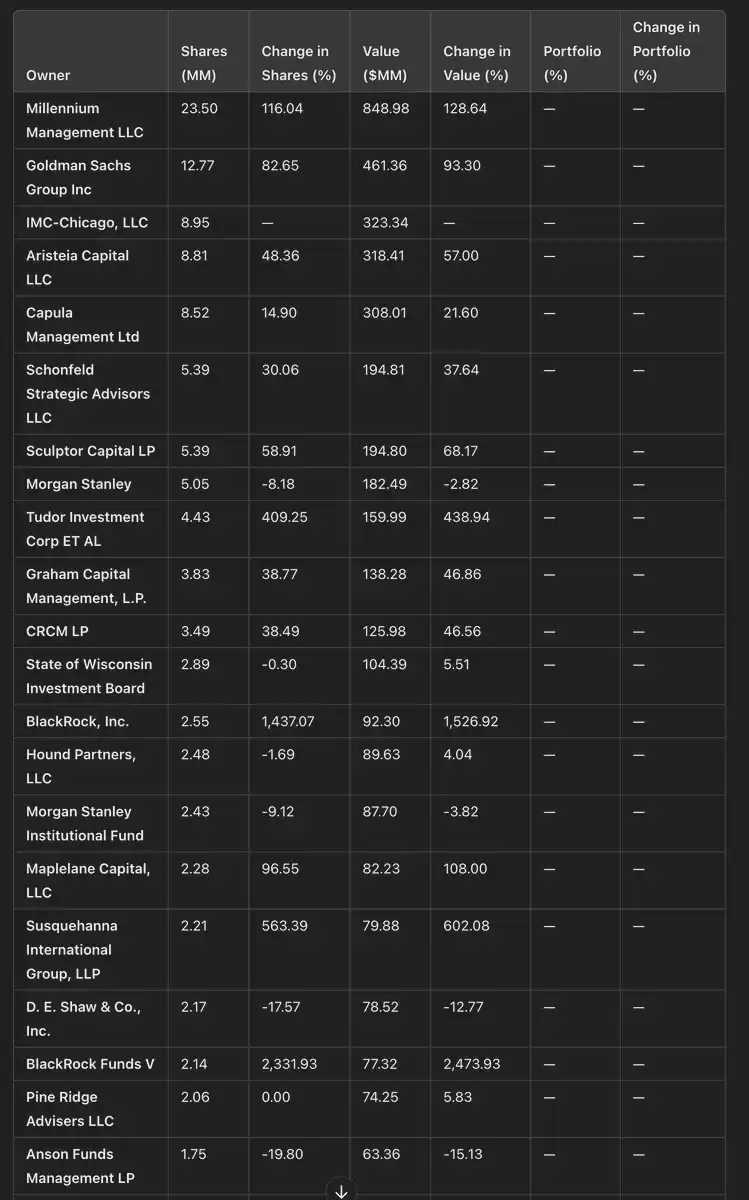
Here are some of the largest shareholders of the iShares Bitcoin Trust ETF (IBIT):
Top Institutional Holders of IBIT (iShares Bitcoin Trust ETF)
Data source
Some of them are holders, but most are actually arbitrageurs!
Conclusion
The evolution of funding rates and the strategies inspired by them highlight the dynamic intersection of TradFi and DeFi. The "golden age" of 2021 presented lucrative opportunities, but also exposed systemic weaknesses that led to major market crashes. In 2024-2025, the rise of robust stablecoins like USDe and USDX has brought a new wave of arbitrage opportunities, providing a more sustainable framework for market growth.
Ultimately, funding rate pricing is not determined by stablecoins, but rather shaped by institutional participation and CME’s benchmark futures. The interplay of these forces underscores the importance of market efficiency, transparency, and robust risk management to ensure the continued maturity of the crypto ecosystem. The blame for low funding rates should not be placed on stablecoins like USDe or USDX, but rather on traditional financial players who take advantage of their low capital costs and arbitrage strategies.
You may also like

WEEX Official Product Launch: Win LALIGA Tickets & Unlock the 3-in-1 Crypto Trading Suite
Trade crypto without downloading an app. Join the WEEX H5, API, SKILLs livestream to explore the new trading experience, win LALIGA VIP tickets, and share 420 USDT rewards.

Dragonfly Partners: Most agents will not engage in autonomous trading, how can crypto payments prevail?

US AI Startup Goes All In on Chinese Mega-Model | Rewire News Morning Brief

Trump Lies Again: A "Five-Day Pause" Psyop, How Wall Street, Bitcoin, and Polymarket Insiders Synced Uposciogen

When a Token Becomes Labor, People Become the Interface

Ceasefire News Leaked Ahead of Time? Large Polymarket Bets on Outcome Before Trump's Tweet

BlackRock CEO's Annual Shareholder Letter: How is Wall Street Using AI to Keep Profiting from National Pension Funds?

Sun Valley Releases 2025 Financial Report: Bitcoin Mining Revenue Reaches $670 Million, Accelerating Transformation to AI Infrastructure Platform
On March 16, 2026, in Dallas, Texas, USA, CanGu Company (New York Stock Exchange code: CANG, hereinafter referred to as "CanGu" or the "Company") today announced its unaudited financial performance for the fourth quarter and full year ended December 31, 2025. As a btc-42">bitcoin mining enterprise relying on a globally operated layout and dedicated to building an integrated energy and AI computing power platform, CanGu is actively advancing its business transformation and infrastructure development.
• Financial Performance:
Total revenue for the full year 2025 was $688.1 million, with $179.5 million in the fourth quarter.
Bitcoin mining business revenue for the full year was $675.5 million, with $172.4 million in the fourth quarter.
Full-year adjusted EBITDA was $24.5 million, while the fourth quarter was -$156.3 million.
• Mining Operations and Costs:
A total of 6,594.6 bitcoins were mined throughout the year, averaging 18.07 bitcoins per day; of which 1,718.3 bitcoins were mined in the fourth quarter, averaging 18.68 bitcoins per day.
The average mining cost for the full year (excluding miner depreciation) was $79,707 per bitcoin, and for the fourth quarter, it was $84,552;
The all-in sustaining costs were $97,272 and $106,251 per bitcoin, respectively.
As of the end of December 2025, the company has cumulatively produced 7,528.4 bitcoins since entering the bitcoin mining business.
• Strategic Progress:
The company has completed the termination of the American Depositary Receipt (ADR) program and transitioned to a direct listing on the NYSE to enhance information transparency and align with its strategic direction, with a long-term goal of expanding its investor base.
CEO Paul Yu stated: "2025 marked the company's first full year as a bitcoin mining enterprise, characterized by rapid execution and structural reshaping. We completed a comprehensive adjustment of our asset system and established a globally distributed mining network. Additionally, the company introduced a new management team, further strengthening our capabilities and competitive advantage in the digital asset and energy infrastructure space. The completion of the NYSE direct listing and USD pricing also signifies our transformation into a global AI infrastructure company."
"As we enter 2026, the company will continue to optimize its balance sheet structure and enhance operational efficiency and cost resilience through adjustments to the miner portfolio. At the same time, we are advancing our strategic transformation into an AI infrastructure provider. Leveraging EcoHash, we will utilize our capabilities in scalable computing power and energy networks to provide cost-effective AI inference solutions. The relevant site transformations and product development are progressing simultaneously, and the company is well-positioned to sustain its execution in the new phase."
The company's Chief Financial Officer, Michael Zhang, stated: "By 2025, the company is expected to achieve significant revenue growth through its scaled mining operations. Despite recording a net loss of $452.8 million from ongoing operations, mainly due to one-time transformation costs and market-driven fair value adjustments, the company, from a financial perspective, will reduce its leverage, optimize its Bitcoin reserve strategy and liquidity management, introduce new capital to strengthen its financial position, and seize investment opportunities in high-potential areas such as AI infrastructure while navigating market volatility."
The total revenue for the fourth quarter was $1.795 billion. Of this, the Bitcoin mining business contributed $1.724 billion in revenue, generating 1,718.3 Bitcoins during the quarter. Revenue from the international automobile trading business was $4.8 million.
The total operating costs and expenses for the fourth quarter amounted to $4.56 billion, primarily attributed to expenses related to the Bitcoin mining business, as well as impairment of mining machines and fair value losses on Bitcoin collateral receivables.
This includes:
· Cost of Revenue (excluding depreciation): $1.553 billion
· Cost of Revenue (depreciation): $38.1 million
· Operating Expenses: $9.9 million (including related-party expenses of $1.1 million)
· Mining Machine Impairment Loss: $81.4 million
· Fair Value Loss on Bitcoin Collateral Receivables: $171.4 million
The operating loss for the fourth quarter was $276.6 million, a significant increase from a loss of $0.7 million in the same period of 2024, primarily due to the downward trend in Bitcoin prices.
The net loss from ongoing operations was $285 million, compared to a net profit of $2.4 million in the same period last year.
The adjusted EBITDA was -$156.3 million, compared to $2.4 million in the same period last year.
The total revenue for the full year was $6.881 billion. Of this, the revenue from the Bitcoin mining business was $6.755 billion, with a total output of 6,594.6 Bitcoins for the year. Revenue from the international automobile trading business was $9.8 million.
The total annual operating costs and expenses amount to $1.1 billion.
Specifically, they include:
· Revenue Cost (excluding depreciation): $543.3 million
· Revenue Cost (depreciation): $116.6 million
· Operating Expenses: $28.9 million (including related-party expenses of $1.1 million)
· Miner Impairment Loss: $338.3 million
· Bitcoin Collateral Receivable Fair Value Change Loss: $96.5 million
The full-year operating loss is $437.1 million. The continuing operations net loss is $452.8 million, while in 2024, there was a net profit of $4.8 million.
The 2025 non-GAAP adjusted net profit is $24.5 million (compared to $5.7 million in 2024). This measure does not include share-based compensation expenses; refer to "Use of Non-GAAP Financial Measures" for details.
As of December 31, 2025, the company's key assets and liabilities are as follows:
· Cash and Cash Equivalents: $41.2 million
· Bitcoin Collateral Receivable (Non-current, related party): $663.0 million
· Miner Net Value: $248.7 million
· Long-Term Debt (related party): $557.6 million
In February 2026, the company sold 4,451 bitcoins and repaid a portion of related-party long-term debt to reduce financial leverage and optimize the asset-liability structure.
As per the stock repurchase plan disclosed on March 13, 2025, as of December 31, 2025, the company had repurchased a total of 890,155 shares of Class A common stock for approximately $1.2 million.

The US AI Startup Is Loving China's Open Source Model

Three Weeks of the US-Iran War: Who's Making Money, Who's Paying the Bill?

Interpreting Polymarket's Major Update Last Night: Fee Expansion, Self-Regulation, and New Incentives

From Human Application to Intelligent Collaboration: How GOAT Network Builds the Next Generation Digital Economy

CZ Washington Dialogue: Crypto Entrepreneurs are Accelerating Their Return to the United States

Morning Report | Strategy increased its holdings by 1,031 bitcoins last week; Katana Blockchain acquires IDEX; NYSE completes rule change to eliminate trading limits on crypto ETF options

WEEX P2P now supports JOD, USD & EUR—Merchant Recruitment Now Open
To make crypto deposits easier, WEEX has officially launched its P2P trading platform and continues to expand fiat support. We're excited to announce that the Jordanian Dinar (JOD), United States Dollar (USD ) and Euro (EUR) are now available on WEEX P2P!

Electric Capital: Tracking 501 types of yield-generating RWA assets, we discovered these patterns
Those who are cut off by AI will not disappear; they will become the creators of the next round of the economy

Stablecoins reshaping cross-border payments in Asia? Strategic panorama and investment opportunity analysis
WEEX Official Product Launch: Win LALIGA Tickets & Unlock the 3-in-1 Crypto Trading Suite
Trade crypto without downloading an app. Join the WEEX H5, API, SKILLs livestream to explore the new trading experience, win LALIGA VIP tickets, and share 420 USDT rewards.


 App
App