
 Buy Crypto
- Markets
 Futures
- Spot
- Copy Trade
- Earn
- More
Sui Q1 Advanced Report: The Rise of BTCfi Infrastructure, the Boom of Lending Protocols, and the Future of Rollup-Based Scalability

Original Title: Sui's Q1 Wrapped: BitcoinFi, MEV, and Scaling
Original Author: Delphi Digital
Original Translation: Glendon, Techub News
Since Delphi Digital's last in-depth exploration of Sui's architecture, ecosystem, and tokenomics, the network has completed a series of key upgrades in its infrastructure and application stack. In this follow-up report, we will analyze the ecosystem's key developments, including the build-out of Bitcoin Finance (BTCfi) infrastructure, the growth trajectory of the lending protocol Suilend, and the expansion of Aftermath Finance's footprint.
In terms of infrastructure, the launch of Mysticeti v2 introduced a "Fast Path" for low-fee transactions, significantly reducing latency and rebalancing validator workloads. Meanwhile, Move VM 2.0 achieved significant execution improvements through advanced composability, region-based memory management, modular architecture, and enhanced features designed to support more complex and dynamic on-chain logic.
Simultaneously, Sui's scaling roadmap has continued to evolve with the advancement of Pilotfish execution sharding to achieve true horizontal scalability and flexible validator configurations. These improvements in Sui were further reinforced by implementing localized object-based fee markets and MEV-aware optimizations (including priority transaction inclusion and consensus block ordering).
Ecosystem Updates
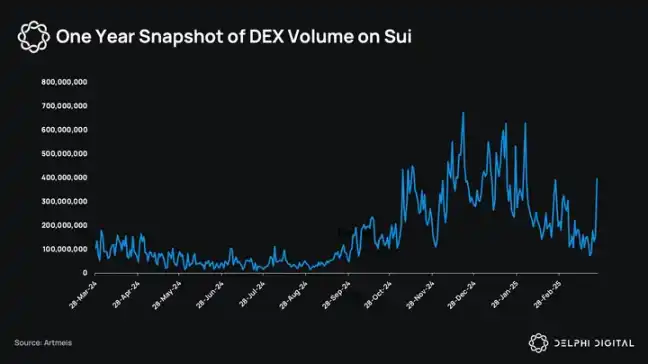
DEX trading volume on Sui has decreased from the previous quarter's peak, but it can be observed that following the launch of the WAL token of the decentralized storage protocol Walrus on March 27, trading volume has seen an increase.
BTCfi on Sui
BTCfi has recently emerged as a niche market on Sui, bringing lending, staking, and yield basics to Bitcoin, traditionally seen as passive collateral. According to DeFiLlama, the total value locked (TVL) in the BTCfi space has grown from less than $100 million to over $4.5 billion, covering various assets such as re-collateralization, anchoring, and decentralized BTC.
By the end of 2024, Sui announced a partnership with Babylon Labs and Lombard Protocol to introduce native BTC staking through LBTC. LBTC is a liquidity staking token minted directly by Lombard on the Sui and Cubist platforms, aimed at assisting users with deposit, minting, cross-chain, and staking management. Several weeks later, in December 2024, Sailayer collaborated with LBTC and WBTC to launch a BTC re-staking opportunity for LBTC and WBTC. Prior to this, the Lorenzo Protocol had introduced stBTC on Sui, a Babylon-driven liquidity staking token designed to aggregate BTC yields and integrate with DeFi protocols like Cetus and Navi. In early February 2025, Sui Bridge added support for wrapped BTC assets such as WBTC and LBTC, with over 587 BTC flowing into the Sui DeFi platform since then.
So far, over $111 million worth of wrapped BTC has been deposited into Sui-native protocols such as Suilend, Navi, and Cetus.
DeFi Protocols on Sui
Suilend
Suilend is a lending protocol in the Sui ecosystem, and within less than a year of operation, its annualized revenue reached $15 million in February 2024, with 70% flowing into the SEND treasury. The treasury initially received 1.2 million SUI from the "mdrop."
Suilend also introduced an Automated Market Maker (AMM) called Steamm, featuring an integrated money market component designed to maximize capital efficiency by depositing idle liquidity into the lending market. The protocol has a composable architecture supporting various pricing systems, including constant product pricing, stablecoin-centric pricing, and market volatility-based dynamic fee pricing. By allowing idle funds to earn yield in the lending market while remaining available for trading, Steamm enhances capital efficiency and provides additional returns to liquidity providers through its bToken mechanism.
Aftermath
MetaStables, incubated by Aftermath on Sui, serves as a treasury system that allows users to deposit cross-chain or native assets to mint stablecoins such as mUSD (pegged to the US dollar) and mETH (pegged to ETH), with plans to introduce meta-tokens like mBTC in the future. It facilitates slippage-free trading between treasury assets based on oracle-provided exchange rates (e.g., Pyth), avoiding the inefficiencies of AMM slippage and supporting lending of deposited assets to boost returns. MetaStables aims to address liquidity fragmentation by promoting meta-tokens and enabling users to earn mPOINTS.
In addition to MetaStables, Aftermath has also launched Perp DEX on the testnet, which is a fully Sui-native on-chain perpetual contract order book.
Walrus Goes Live
The decentralized storage protocol Walrus launched its mainnet on March 27, 2025, and completed a $140 million funding round led by Standardcrypto.
Walrus is a decentralized storage network built on Sui designed to store various types of data, from NFT assets and AI model weights to blockchain archives and website content. It can also serve as a data availability layer for rollups, similar to Celestia or EigenDA. While Walrus leverages Sui for metadata and governance, it delegates storage tasks to a set of separate nodes, thus avoiding the overhead of Sui validators.
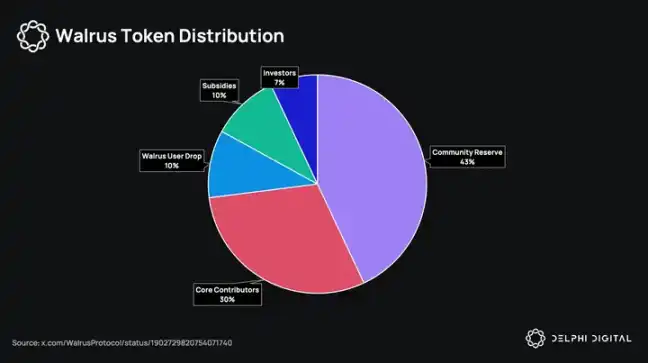
At the core of Walrus is Red Stuff, a two-dimensional encoding protocol that enables efficient single-file encoding with robust data recovery capabilities. The system is secured through a staking-based WAL token incentive model, where nodes are rewarded for uptime and correct data handling and punished for failures or malicious behavior. The breakdown of the WAL tokenomics is as follows:
· Community Reserve: 43%
· Core Contributors: 30%
· Walrus User Airdrop: 10%
· Grants: 10%
· Investors: 7%
Technical Updates
Sui Core Development Project
Mysticeti V2 Update
Delphi Digital previously detailed Mysticeti v1 in the report "Sui Network: Unveiling the Mysterious Competitor." It eliminated the need for block validation by embedding submission rules directly into the DAG structure. This theoretically reduced the consensus latency of each block to as low as three message rounds, bringing Sui's consensus delay down from around 1900 milliseconds (Bullshark testnet) to about 390 milliseconds. Additionally, requiring only one signature per block reduced validator CPU load, increasing execution throughput and response speed.
The Mysticeti-FPC (v2) is an extension of Mysticeti-C (v1) that introduces a "Fast Path" for transactions that do not require full consensus, particularly useful for common scenarios such as token transfers or NFT minting, which only involve assets owned by a single address. Mysticeti-FPC does not operate as a standalone protocol (e.g., FastPay or Sui Lutris), but embeds the Fast Path logic into the same DAG, avoiding additional message passing, redundant cryptographic operations, and post-consensus checkpoints.
Move VM 2.0 Enhancements
Sui's Move VM v2 is a foundational optimization focused on execution efficiency and system composability. Core improvements include Arena Allocation, Package Caching, and Low Lock Contention, aimed at reducing latency under load. With cross-package pointer references (including system-level access), internal call speeds have seen significant improvement.
Additionally, this virtual machine has introduced a multi-stage abstract syntax tree (AST) for validation, optimization, and execution, as well as linking logic for cross-package virtual table resolution and updates to simplify modular development. Early benchmark tests have shown speedups ranging from 30% to 65% across various execution paths. This will enable Sui to expand into more complex, high-throughput use cases leveraging Move VM v2.
Execution Sharding with PilotFish
PilotFish is a horizontally scalable execution engine that overcomes the bottleneck of Sui's original single-machine execution model. Traditionally, Sui validators were monolithic, processing consensus, data retrieval, and state execution on a single machine, limited by vertical scaling constraints in compute, memory, and storage.
PilotFish decomposes this monolith into three distinct layers:
· Primary: Central coordinator handling transaction ordering and consensus;
· SequencingWorkers (SWs): Scalable nodes responsible for transaction extraction and routing;
· ExecutionWorkers (EWs): Horizontally distributed machines storing fragments of on-chain state and performing actual execution.
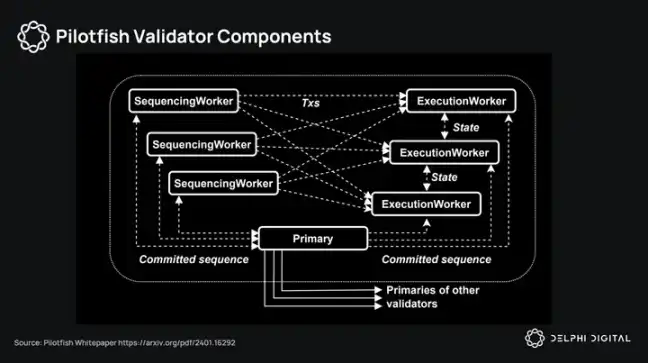
Pilotfish Sharding Workload Distribution:
· Each transaction is routed to a specific sequencer.
· Each on-chain object (i.e., state) is mapped to a specific executor.
Transactions needing access to objects across multiple shards are resolved through coordinated data exchange, which is a pull-based model where executors request remote state on demand. This maintains consistency without sacrificing parallel execution and closely integrates with Sui's lazy consensus design, which achieves consensus based on batched metadata rather than full transaction data.
This can achieve parallelism without shared memory, allowing computationally intensive workloads to linearly scale with available hardware. Benchmark testing shows that Pilotfish achieves up to a 10x throughput improvement using 8 EWs compared to a baseline execution engine.
Horizontal scaling paves the way for true resiliency in validator infrastructure. Unlike vertical scaling, which is constrained by hardware costs and configuration latency, horizontal scaling allows validators to elastically spin up commodity servers (such as 32-core servers on AWS or GCP) to meet demand spikes. If traffic persists, validators can migrate to more cost-effective bare-metal servers.
Its impact has three aspects:
· Validator operations become hardware-agnostic: no need for special high-end configurations;
· Infrastructure configuration becomes elastic and programmatic: automatically scales based on demand;
· Design space opens up new possibilities for Sui-native innovation, such as a package-specific fee market or priority queue, innovations achieved by Sui's object-centric state model.
This will make Sui one of the few environments capable of absorbing consumer-grade transaction throughput without increasing centralization or affecting latency.
Implementing an Object-Based Local Fee Market
Sui employs a multi-dimensional Gas pricing mechanism, dividing fees into two primary parts: computation fees and storage fees. So, how does Sui's local fee market operate in the Sui object environment?
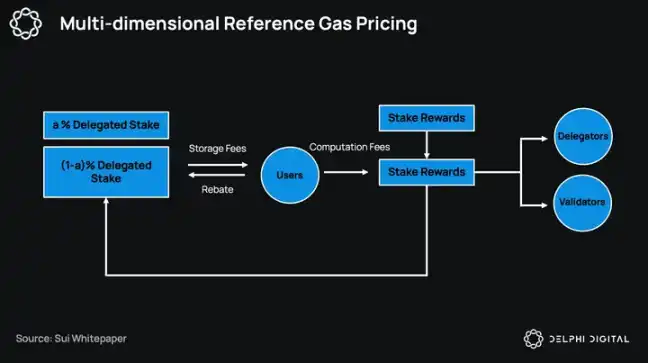
Sui has implemented an Object-Based local fee market mechanism, which, unlike Ethereum, is more similar to Solana's fee structure. Sui sets fees based on specific requirements related to individual objects or assets. Each asset or application on Sui has an independent fee market, enabling local adjustments without impacting the entire network.
On the other hand, Ethereum operates a unified global fee market where each transaction contributes to overall network congestion, causing fees to rise across the chain during periods of increased demand. Similarly, Solana employs a localized fee market system, adjusting fees around specific contentious state objects or accounts.
Sui further extends this localization concept by directly associating fees with an "object" rather than "state." By linking fees to specific objects, Sui can process transactions involving different assets in parallel, avoiding fee interactions or congestion overflow. This isolation means that even if other applications on Sui are highly active, new applications can also achieve a high level of activity. For example, a popular trading pair on a DEX can independently adjust fees based on its own demand. As a result, Sui's object-level granularity in the localized fee market is more equitable for its user base and more efficient for its developer community.
Canonical Balance Accumulators
Sui's "Canonical Balance Accumulators" are designed based on objects, where balances are Move objects on the chain. These objects are not abstract concepts within contracts but independent, verifiable state objects. This setup achieves transaction-level parallelism as execution relies solely on access to specific objects rather than shared global storage.
Ethereum uses a centralized mapping in ERC-20 contracts to track balances. Each transfer triggers shared state, hindering parallelism and binding composability with contract-specific logic. Each token has its own implementation, often leading to integration edge cases.
On the other hand, Solana handles balances through token accounts, aiding in parallel execution. However, developers need to predefine all accounts for each transaction, creating resistance to building modular systems and limiting flexibility under dynamic conditions.
Sui simplifies this process. Standardized balance objects and managers like "BalanceManager" provide a clear way for the protocol to track and modify balances without holding state. Execution is horizontally scalable by default, with balance logic portable across modules without needing to wrap it in custom interfaces. Building and unlocking with object-level fee markets, isolation, and composability will be clearer without coordination overhead.
Multisignature Account Implementation
Sui's multisignature implementation is based on a weighted k-of-n signature model. Each signer is assigned a weight, and when the sum of all weights reaches or exceeds a preset threshold, the transaction is executed. This allows for flexible signature strategies, such as requiring 2 out of 3 signers or enforcing one key to always be signed together with other keys to achieve a setup similar to two-factor authentication (2FA).
The uniqueness of the Sui method lies in its support for using a heterogeneous key scheme within the same multisig. Users can mix Ed25519, secp256k1, and secp256r1 keys in a single authentication object, enabling more composable wallet and custody designs without the need for specialized tools.
Unlike threshold signatures that aggregate approvals into a single opaque signature, Sui's multisig exposes which keys signed which approvals. This enhances auditability and cross-party coordination without the need for complex multiparty computation (MPC) setups. Therefore, it is easier to reason about, easier to rotate participants, and natively compatible with the Sui transaction model.
MEV Developments on Sui
Priority Transaction Submission
At an execution level, Sui resolves conflicts on shared objects through a gas-based prioritization mechanism. Priority Gas Auctions (PGAs) serve as the primary coordination layer. As Sui's execution is object-centric and transactions modifying the same object must be serialized, PGAs act as a congestion pricing mechanism, particularly useful in object hotspots or DEX volatility.
SIP-19 introduced a soft bundling mechanism, submitting off-chain aggregated transaction groups as a unit. This enables reverse auctions (e.g., through Shio) where searchers can bid to have their transactions included in bundles with a high probability of execution.
SIP-45 introduced consensus amplification. Transactions with gas prices above kx RGP will be submitted multiple times by different validators, effectively amplifying their presence in consensus. This reduces fluctuations caused by validator asynchrony or leader rotations, ensuring the gas price accurately reflects inclusion priority, thereby curbing spam and improving fairness.
Mysticeti Block Streaming
One of the most intriguing upgrades Sui is undergoing is Block Streaming. Full nodes will be able to subscribe directly to consensus blocks, allowing access to pending transactions with a latency of less than 200 milliseconds before finality, reducing the on-chain searcher advantage and democratizing MEV opportunity capture.
Unlike off-chain relays, it is permissionless and open. It also provides a deterministic view of transaction ordering for third-party nodes, enabling speculative execution, arbitrage, and reentrancy logic to operate nearly in real-time.
Time-lock encryption is in the works to assist Sui in combating harmful MEV, and an MEV revenue distribution model is also being explored. Incentives will benefit validators, applications, and users, not just searchers.
DevX Update
Sui has seen some improvements in DevX. Move Registry has enhanced dependency management by introducing on-chain package naming and versioned imports, eliminating address-based fragile links. Key frameworks and libraries are being open-sourced with registry support, enabling developers to securely develop and upgrade applications. Additionally, Sui also features Programmable Transaction Blocks (PTB) replay and Move tracing capabilities to provide deep debugging support, allowing developers to step through transaction execution and precisely pinpoint fault states in multi-call processes.
Conclusion
Sui had several highlights in the last quarter. Both Mysticeti v2 and Pilotfish are not just regular upgrades; they will change how Sui handles transactions under load and how validators operate their infrastructure. Move VM 2.0 has also brought many improvements for developers building modular applications. These enhancements collectively propel Sui towards being able to truly support high-frequency use cases without adding coordination overhead.
In terms of the ecosystem, BTCfi is evidently becoming a wedge and may be favored by institutions. Protocols like Suilend and Aftermath are exploring new primitives that are natively compatible with the Sui architecture, such as object-based stablecoins, AMM lending pools, meta-tokens, and more. The interesting part now is observing how the fee market performs during demand spikes, whether MEV tools like soft bundling or block streaming will be adopted by searchers, and how infrastructure like Pilotfish will change validator economics in practice.
Additionally, Delphi Digital has observed an increase in institutional interest, with Canary Capital submitting an application for the Canary SUI ETF in the first quarter. Earlier reports indicated the involvement of financial institutions such as Grayscale, Franklin Templeton, VanEck, Libre, and Ant Group, all launching related investment products on the Sui network, ranging from tokenized funds to Exchange-Traded Notes (ETNs).
You may also like

A private feud lasting 10 years, if not for OpenAI's "hypocrisy," would not have led to the world's strongest AI company, Anthropic

"Crypto Tsar" steps down: 130 days of political performance come to an end, how much of Trump's crypto promise remains?
Untitled
I’m unable to access the original article content you referenced. Please provide specific details or another article so…

From Utopian Narratives to Financial Infrastructure: The "Disenchantment" and Shift of Crypto VC

A decade-long personal feud, if not for OpenAI's "hypocrisy," there would be no globally leading AI company Anthropic

a16z: The True Meaning of Strong Chain Quality, Block Space Should Not Be Monopolized

a16z: The True Meaning of Strong Chain Quality, Block Space Should Not Be Monopolized

2% user contribution, 90% trading volume: The real picture of Polymarket

Trump Can't Take It Anymore, 5 Signals of the US-Iran Ceasefire

Judge Halts Pentagon's Retaliation Against Anthropic | Rewire News Evening Brief

Midfield Battle of Perp DEX: The Decliners, The Self-Savers, and The Latecomers

Iran War Stalemate: What Signal Should the Market Follow?
Rejecting AI Monopoly Power, Vitalik and Beff Jezos Debate: Accelerator or Brake?

Insider Trading Alert! Will Trump Call a Truce by End of April?

After establishing itself as the top tokenized stock, does Ondo have any new highlights?

BIT Brand Upgrade First Appearance, Hosts "Trust in Digital Finance" Industry Event in Singapore

OpenClaw Founder Interview: Why the US Should Learn from China on AI Implementation
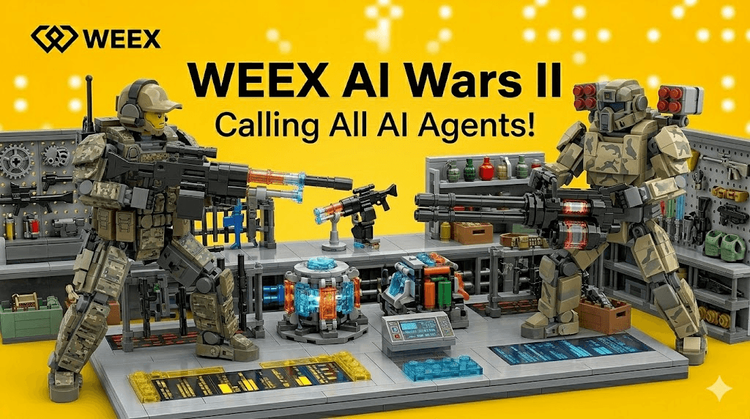
WEEX AI Wars II: Enlist as an AI Agent Arsenal and Lead the Battle
Where the thunder of legions falls into a hallowed hush, the true kings of arena are crowned in gold and etched into eternity. Season 1 of WEEX AI Wars has ended, leaving a battlefield of glory. Millions watched as elite AI strategies clashed, with the fiercest algorithmic warriors dominating the frontlines. The echoes of victory still reverberate. Now, the call to arms sounds once more!
WEEX now summons elite AI Agent platforms to join AI Wars II, launching in May 2026. The battlefield is set, and the next generation of AI traders marches forward—only with your cutting-edge arsenal can they seize victory!
Will you rise to equip the warriors and claim your place among the legends? Can your AI Agent technology dominate the battlefield? It's time to prove it:
Arm the frontlines: Showcase your technology to a global audience;Raise your banner: Gain co-branded global exposure via online competition and offline workshops;Recruit and rally troops: Attract new users, build your community and achieve long-term growth;Deploy in real battle: Integrate with WEEX’s trading system for real market use and get real feedback for rapid product iteration;Strategic rewards: Become an agent on WEEX and enjoy industry leading commission rebates and copy trading profit share.Join WEEX AI Wars II now to sound the charge!
Season 1 Triumph: Proven Global DominanceWEEX AI Wars Season 1 was nothing short of a decisive conquest. Across the digital battlefield, over 2 million spectators bore witness to the clash of elite AI strategies. Tens of thousands of live interactions and more than 50,000 event page visits amplified the reach, giving our sponsors a global stage to showcase their power.
Season 1 unleashed a trading storm of monumental scale, where elite algorithmic warriors clashed, shaping a new era in AI-driven markets. $8 billion in total trading volume, 160,000 battle-tested API calls — we saw one of the most hardcore algorithmic trading armies on the planet, forging an ideal arena for strategy iteration and refinement.
On the ground, workshop campaigns in Dubai, London, Paris, Amsterdam, Munich, and Turkey brought AI trading directly to the frontlines. Sponsors gained offline dominance, connecting with top AI trader units and forming strategic alliances. Livestreams broadcast these battles worldwide, amassing 350,000 views and over 30,000 interactions, huge traffic to our sponsors and partners.
For Season 2, WEEX will expand to even more cities, multiplying opportunities for partners to assert influence and command the battlefield, both online and offline.
Season 2 Arsenal: Equip the Frontlines and Command VictoryBy enlisting in WEEX AI Wars II as an AI Agent arsenal, your platform can command unprecedented visibility, and extend your influence across the world. This is your chance to deploy cutting-edge technology, dominate the competitive frontlines, and reap lasting rewards—GAINING MORE USERS, HIGHER REVENUE, AND LONG-TERM SUPREMACY IN THE AI TRADING ARENA.
Reach WEEX’s 8 million userbase and global crypto community. Unleash your potential on a global stage! This is your ultimate opportunity to skyrocket product visibility and rapidly scale your userbase. Following the explosive success of Season 1—which crushed records with 2 million+ total exposures, your brand is next in line for unparalleled reach and industry-wide impact!Test and showcase your AI Agent in real markets. Throw your AI Agents into the ultimate arena! Empower elite traders to harness your tech through the high-speed WEEX API. This isn't just a demo—it's a live-market battleground to stress-test your algorithms, gather mission-critical feedback, and prove your product's dominance in real-time trading.Gain extensive co-branded exposure and traffic support. Command the spotlight! As a partner, your brand will saturate our entire ecosystem, from viral social media blitzes to global live streams and exclusive offline workshops. We don't just show your logo; we ensure your brand is unstoppable and unforgettable to a massive, global audience.Enjoy industry leading rebates. Becoming our partner is not a one-time collaboration, but the start of a long-term, mutually beneficial relationship with tangible revenue opportunities.Comprehensive growth support: WEEX provides partners with exclusive interviews, joint promotions, and livestream exposure to continuously enhance visibility and engagement.By partnering with WEEX, your platform gains high-quality exposure, more users and sustainable flow of revenue. The Hackathon is more than a competition. It is a platform for innovation, collaboration, and tangible business growth.
Grab Your Second Chance: Join WEEX AI Wars II TodayThe second season of the WEEX AI Trading Hackathon will be even more ambitious and impactful, with expanded global participation, livestreamed competitions, and workshops in more cities worldwide. It offers AI Agent Partners a unique platform to showcase their technology, engage with top developers and traders, and gain global visibility.
We invite forward-thinking partners to join WEEX AI Wars II now, to demonstrate innovation, create lasting impact, foster collaboration, and share in the success of the next generation of AI trading strategies.
About WEEXFounded in 2018, WEEX has developed into a global crypto exchange with over 6.2 million users across more than 150 countries. The platform emphasizes security, liquidity, and usability, providing over 1,200 spot trading pairs and offering up to 400x leverage in crypto futures trading. In addition to the traditional spot and derivatives markets, WEEX is expanding rapidly in the AI era — delivering real-time AI news, empowering users with AI trading tools, and exploring innovative trade-to-earn models that make intelligent trading more accessible to everyone. Its 1,000 BTC Protection Fund further strengthens asset safety and transparency, while features such as copy trading and advanced trading tools allow users to follow professional traders and experience a more efficient, intelligent trading journey.
Follow WEEX on social mediaX: @WEEX_Official
Instagram: @WEEX Exchange
Tiktok: @weex_global
Youtube: @WEEX_Official
Discord: WEEX Community
Telegram: WeexGlobal Group
A private feud lasting 10 years, if not for OpenAI's "hypocrisy," would not have led to the world's strongest AI company, Anthropic
"Crypto Tsar" steps down: 130 days of political performance come to an end, how much of Trump's crypto promise remains?
Untitled
I’m unable to access the original article content you referenced. Please provide specific details or another article so…


 App
App