
 Buy Crypto
- Markets
 Futures
- Spot
- Copy Trade
- Earn
- More
Strive to buy Strategy stock, Bitcoin Treasury company starts nesting dolls with each other

Original Article Title: "Strive Buys Strategy Stock, Bitcoin Treasury Companies Start Nesting Dolls with Each Other"
Original Article Author: Kuri, Deep Tide TechFlow
On March 11, a company called Strive announced several things.
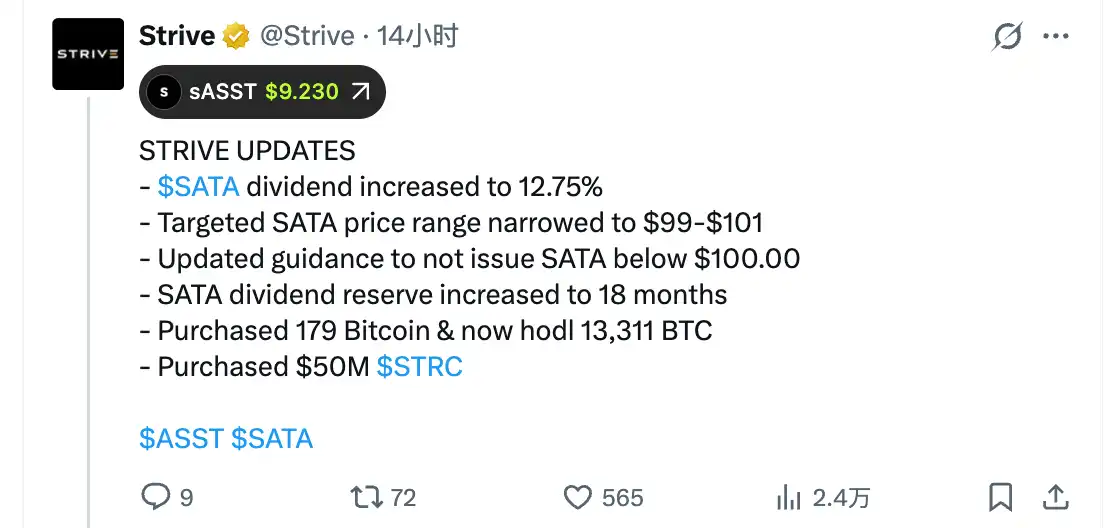
It increased its Bitcoin holdings by 179 coins, bringing the total to 13,311 coins, valued at approximately $9.3 billion. It raised the dividend rate of its preferred stock, SATA, to 12.75%. And it spent $50 million to buy Strategy's preferred stock, STRC.
The $50 million represents over a third of Strive's corporate treasury.
What is Strive doing? Hoarding Bitcoin. What is Strategy doing? Also hoarding Bitcoin.
This has turned into: a Bitcoin-hoarding company using a third of its own money to buy shares issued by another Bitcoin-hoarding company.
Strive's Chief Risk Officer, Jeff Walton, tweeted that STRC is a "high-quality credit product with good liquidity, offering a risk-return ratio superior to traditional fixed income." In translation: We think this is better than government bonds.
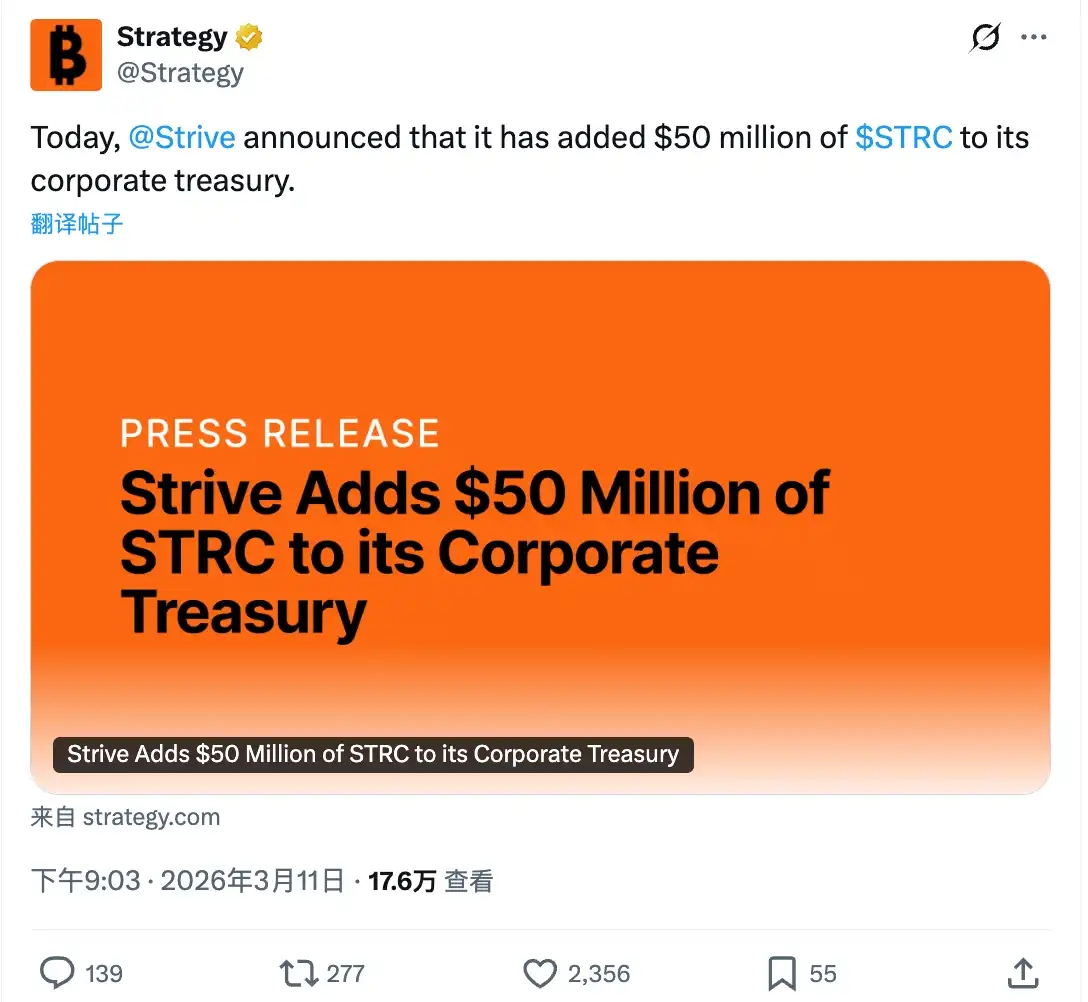
He also did some math, saying that if this $50 million were used to buy U.S. Treasury bonds, the annual interest would be around a few million dollars. By buying STRC, the annualized return could be $3.9 million higher.
It sounds like a good deal.
But think about it, where did MicroStrategy's money to issue STRC come from?
Strategy issues STRC as financing, takes the money to buy Bitcoin. STRC can pay you interest, provided that Strategy's Bitcoin doesn't drop too drastically.
So the underlying logic of Strive's investment is: the Bitcoin I hoard will rise, the Bitcoin they hoard will also rise, and only when the Bitcoin they hoard rises can they pay me interest, which I will then use to hoard more Bitcoin.
This is not diversification; this is a nesting doll game.
In Case You Didn't Know About Strive
Many people know about Strategy (formerly MicroStrategy), but few know about Strive.
However, this company now holds 13,311 bitcoins worth approximately $9.3 billion, just surpassing Tesla's holdings, raking around the tenth spot among publicly traded companies globally.
Strive's founder is Vivek Ramaswamy, a second-generation Indian immigrant, Harvard undergraduate, Yale Law School graduate. In 2022, he and his high school friend founded Strive in Ohio to do asset management and launch ETF funds.
Early investors include PayPal co-founder Peter Thiel and hedge fund manager Bill Ackman.
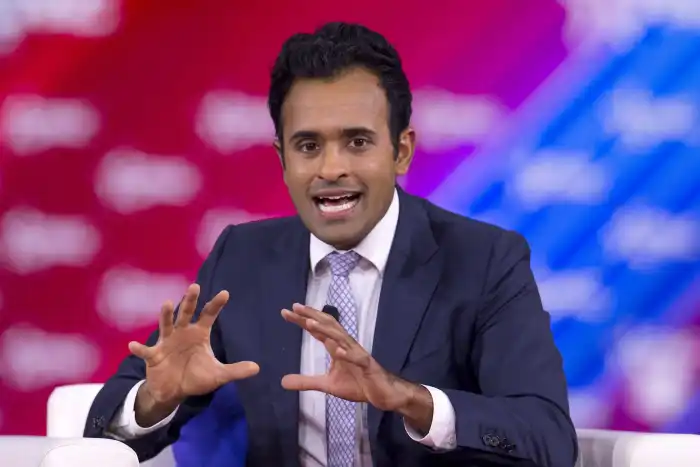
Within a year and a half of its launch, the fund's assets under management surpassed $1 billion. But Vivek didn't stay long; in early 2023, he resigned to run for President of the United States. He didn't compete in the Republican primary against Trump and has now switched to running for governor of Ohio. Interestingly, both Trump and Musk have endorsed him...
After Vivek left, the new CEO, Matt Cole, previously managed $70 billion for a California public employee pension fund, coming from a traditional finance background. However, last year he made a somewhat unconventional decision.
In September 2025, Cole announced Strive's transformation from a fund company to a "Bitcoin Treasury Company." In a single move, he spent $675 million to buy over 5,800 bitcoins at an average price of $116,000. The same month, he announced the acquisition of another publicly traded company, Semler Scientific. After the merger, the combined bitcoin holdings exceeded 10,000 coins.
Today, six months later, the holdings have grown to 13,311 coins.
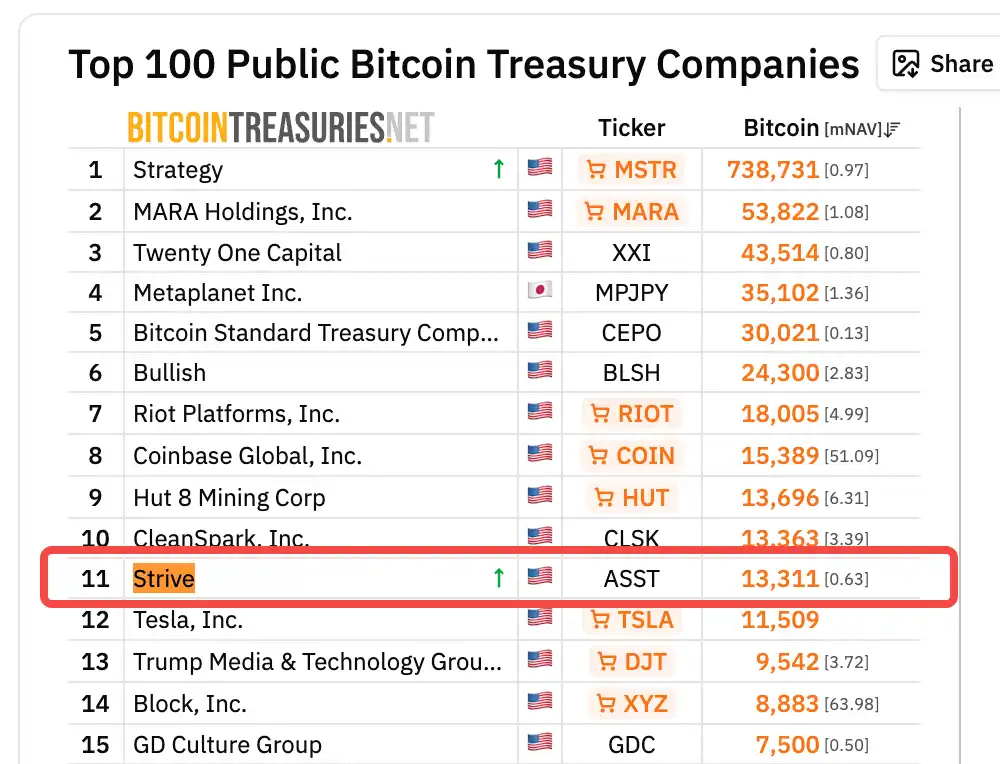
A fund company established in 2022 has transformed into one of the top ten global corporate bitcoin holders within three years. The speed of this transformation is so fast that it raises one question:
Where did the money to buy these bitcoins come from? Stock issuance.
Stock Issuance Loop
Where did Strive get the money to buy bitcoin? Through stock issuance.
Back in November last year, Strive issued a preferred stock called SATA. Investors bought in, and Strive pays interest quarterly, currently at an annualized rate of 12.75%. The money raised was used by Strive to buy Bitcoin.
This strategy was not invented by Strive. The originator was Michael Saylor.
Saylor's company, Strategy, holds over 730,000 bitcoins, making it the world's largest corporate Bitcoin holder. Last year, he introduced a similar product called STRC. Investors bought in, and Strategy pays interest, currently at an annualized rate of 11.5%. The money raised was also used by Strategy to buy Bitcoin.
Up to this point, each company was doing its own thing, following the same logic, and they were not related to each other.
However, on March 11, this transaction connected the two lines. Strive used $50 million to buy STRC.
Here's how the chain looks now:
Strategy issues STRC, borrows money to buy Bitcoin, Strive buys their STRC to earn interest, Strive then issues its own SATA to borrow money, continuing to buy Bitcoin and STRC.
Layer upon layer, each layer paying double-digit interest to investors, and the confidence to pay interest in each layer comes from the same thing: Bitcoin must not undergo a major drop.
Bitcoin goes up, everyone makes money. Bitcoin goes down, everyone's interest is in jeopardy, but no layer can independently stop the bleeding because your asset is someone else's liability.
Three layers of products, three layers of interest, three layers of investors. At the bottom lies an asset that must not fall: BTC.
Meanwhile, Strive's own stock, ASST, reached a high of $268 in the past 52 weeks, but it's now trading at under $9, marking a 97% drop. On the day the purchase of STRC was announced (March 11), the stock price only increased by 5.52%.
By the end of October last year, ASST had briefly fallen to below $0.80, which was nearly 50% below the net asset value of its held bitcoins.
So here's the scenario: a company holding $9.3 billion worth of Bitcoin with a market cap of just over $5 billion. The stock price has dropped 97% from its peak. But the management team is doubling down—buying more Bitcoin, buying STRC, and increasing SATA's interest rate.
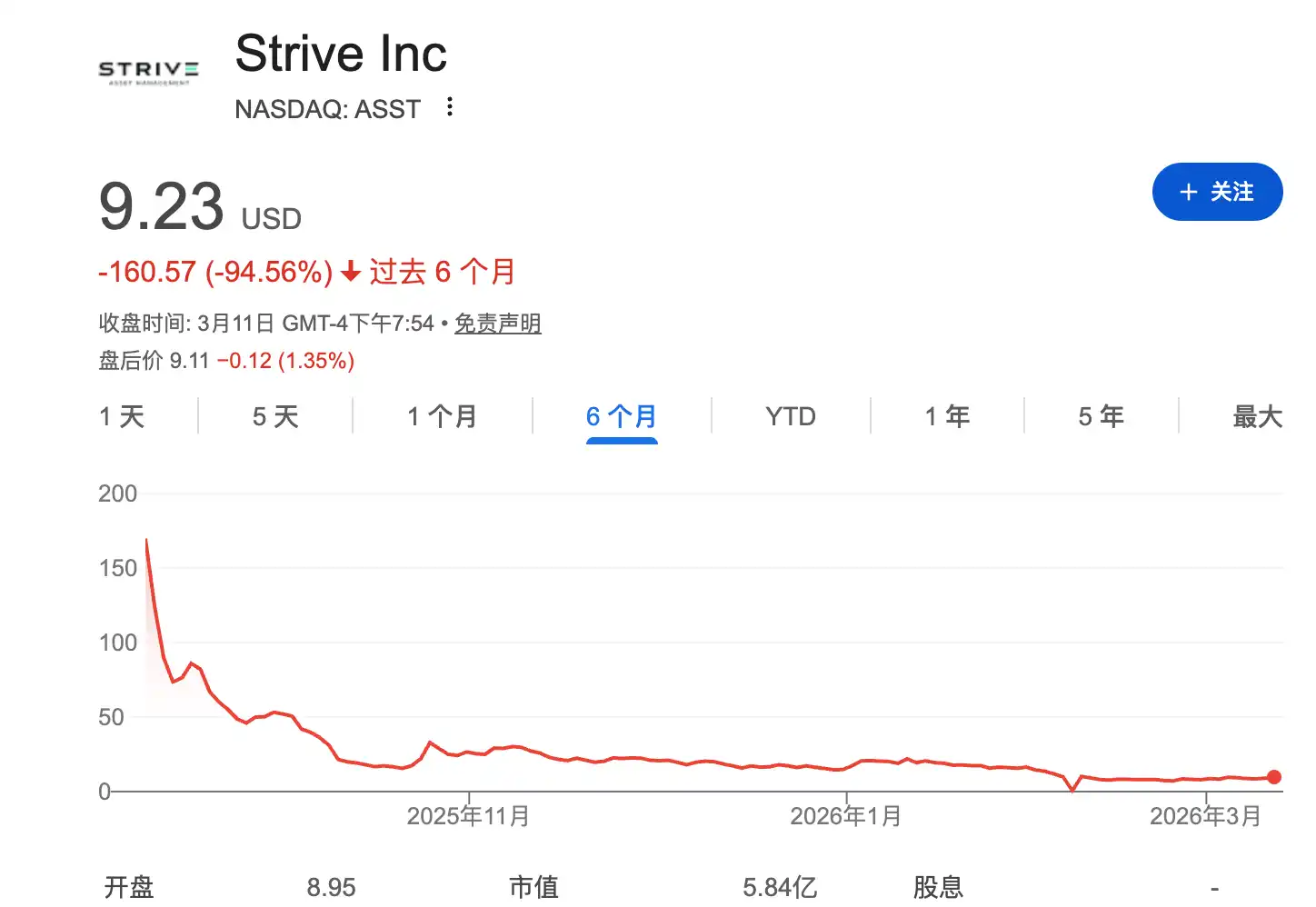
However, Strategy's own stock MSTR has been on a continuous decline for eight months this year. Bitcoin has retraced significantly from last year's peak.
But everyone on this blockchain is doubling down.
Strategy acquired 66,000 more Bitcoins in the first two months of this year, more than any full year before. Strive increased its Bitcoin holdings and also spent $50 million to buy STRC. SATA's dividend yield has risen from 10% at the IPO to 12.75%. STRC's dividend yield has also increased from 10% to 11.5%.
As interest rates climb higher, it means investors are finding it harder to hold on and must pay more.
Data shows that there are now over 200 publicly traded companies worldwide that have announced adopting a "Bitcoin Treasury Strategy." By 2025, this number was projected to be less than 30.
Saylor came up with a new playbook, and 200 companies copied his homework. Now, they are starting to buy each other's issued products.
When everyone's chips are on the same table, the difference between "structured finance" and "concentrated bet" may just be a few extra arrows drawn on a PowerPoint slide.
You may also like

From x402 to MPP: Cloudflare's crucial vote, will it go to Coinbase or Stripe?

BlackRock CEO issues annual open letter: The wave of tokenization has arrived, and we will lead this trend

When Backpack backstabs the community

When gold is no longer a safe haven, and Bitcoin continues to panic

Trump, the World's Largest Oil Trader

If the US and Iran have not reached an agreement in 5 days, what other cards does Trump have?

Tether Whale Dumps £12 Million, Backing Crypto’s ‘British Trump’
Ethereum Foundation Post: Rethinking the Division of Work Between L1 and L2 to Build the Ultimate Ethereum Ecosystem

Two Major Prediction Market Platforms Unite Rarely, What Is the Story Behind This New Fund?
Dragonfly Partners: Most agents will not engage in autonomous trading, how can crypto payments prevail?

US AI Startup Goes All In on Chinese Mega-Model | Rewire News Morning Brief

Trump Lies Again: A "Five-Day Pause" Psyop, How Wall Street, Bitcoin, and Polymarket Insiders Synced Uposciogen

When a Token Becomes Labor, People Become the Interface

Ceasefire News Leaked Ahead of Time? Large Polymarket Bets on Outcome Before Trump's Tweet
BlackRock CEO's Annual Shareholder Letter: How is Wall Street Using AI to Keep Profiting from National Pension Funds?

Sun Valley Releases 2025 Financial Report: Bitcoin Mining Revenue Reaches $670 Million, Accelerating Transformation to AI Infrastructure Platform
On March 16, 2026, in Dallas, Texas, USA, CanGu Company (New York Stock Exchange code: CANG, hereinafter referred to as "CanGu" or the "Company") today announced its unaudited financial performance for the fourth quarter and full year ended December 31, 2025. As a btc-42">bitcoin mining enterprise relying on a globally operated layout and dedicated to building an integrated energy and AI computing power platform, CanGu is actively advancing its business transformation and infrastructure development.
• Financial Performance:
Total revenue for the full year 2025 was $688.1 million, with $179.5 million in the fourth quarter.
Bitcoin mining business revenue for the full year was $675.5 million, with $172.4 million in the fourth quarter.
Full-year adjusted EBITDA was $24.5 million, while the fourth quarter was -$156.3 million.
• Mining Operations and Costs:
A total of 6,594.6 bitcoins were mined throughout the year, averaging 18.07 bitcoins per day; of which 1,718.3 bitcoins were mined in the fourth quarter, averaging 18.68 bitcoins per day.
The average mining cost for the full year (excluding miner depreciation) was $79,707 per bitcoin, and for the fourth quarter, it was $84,552;
The all-in sustaining costs were $97,272 and $106,251 per bitcoin, respectively.
As of the end of December 2025, the company has cumulatively produced 7,528.4 bitcoins since entering the bitcoin mining business.
• Strategic Progress:
The company has completed the termination of the American Depositary Receipt (ADR) program and transitioned to a direct listing on the NYSE to enhance information transparency and align with its strategic direction, with a long-term goal of expanding its investor base.
CEO Paul Yu stated: "2025 marked the company's first full year as a bitcoin mining enterprise, characterized by rapid execution and structural reshaping. We completed a comprehensive adjustment of our asset system and established a globally distributed mining network. Additionally, the company introduced a new management team, further strengthening our capabilities and competitive advantage in the digital asset and energy infrastructure space. The completion of the NYSE direct listing and USD pricing also signifies our transformation into a global AI infrastructure company."
"As we enter 2026, the company will continue to optimize its balance sheet structure and enhance operational efficiency and cost resilience through adjustments to the miner portfolio. At the same time, we are advancing our strategic transformation into an AI infrastructure provider. Leveraging EcoHash, we will utilize our capabilities in scalable computing power and energy networks to provide cost-effective AI inference solutions. The relevant site transformations and product development are progressing simultaneously, and the company is well-positioned to sustain its execution in the new phase."
The company's Chief Financial Officer, Michael Zhang, stated: "By 2025, the company is expected to achieve significant revenue growth through its scaled mining operations. Despite recording a net loss of $452.8 million from ongoing operations, mainly due to one-time transformation costs and market-driven fair value adjustments, the company, from a financial perspective, will reduce its leverage, optimize its Bitcoin reserve strategy and liquidity management, introduce new capital to strengthen its financial position, and seize investment opportunities in high-potential areas such as AI infrastructure while navigating market volatility."
The total revenue for the fourth quarter was $1.795 billion. Of this, the Bitcoin mining business contributed $1.724 billion in revenue, generating 1,718.3 Bitcoins during the quarter. Revenue from the international automobile trading business was $4.8 million.
The total operating costs and expenses for the fourth quarter amounted to $4.56 billion, primarily attributed to expenses related to the Bitcoin mining business, as well as impairment of mining machines and fair value losses on Bitcoin collateral receivables.
This includes:
· Cost of Revenue (excluding depreciation): $1.553 billion
· Cost of Revenue (depreciation): $38.1 million
· Operating Expenses: $9.9 million (including related-party expenses of $1.1 million)
· Mining Machine Impairment Loss: $81.4 million
· Fair Value Loss on Bitcoin Collateral Receivables: $171.4 million
The operating loss for the fourth quarter was $276.6 million, a significant increase from a loss of $0.7 million in the same period of 2024, primarily due to the downward trend in Bitcoin prices.
The net loss from ongoing operations was $285 million, compared to a net profit of $2.4 million in the same period last year.
The adjusted EBITDA was -$156.3 million, compared to $2.4 million in the same period last year.
The total revenue for the full year was $6.881 billion. Of this, the revenue from the Bitcoin mining business was $6.755 billion, with a total output of 6,594.6 Bitcoins for the year. Revenue from the international automobile trading business was $9.8 million.
The total annual operating costs and expenses amount to $1.1 billion.
Specifically, they include:
· Revenue Cost (excluding depreciation): $543.3 million
· Revenue Cost (depreciation): $116.6 million
· Operating Expenses: $28.9 million (including related-party expenses of $1.1 million)
· Miner Impairment Loss: $338.3 million
· Bitcoin Collateral Receivable Fair Value Change Loss: $96.5 million
The full-year operating loss is $437.1 million. The continuing operations net loss is $452.8 million, while in 2024, there was a net profit of $4.8 million.
The 2025 non-GAAP adjusted net profit is $24.5 million (compared to $5.7 million in 2024). This measure does not include share-based compensation expenses; refer to "Use of Non-GAAP Financial Measures" for details.
As of December 31, 2025, the company's key assets and liabilities are as follows:
· Cash and Cash Equivalents: $41.2 million
· Bitcoin Collateral Receivable (Non-current, related party): $663.0 million
· Miner Net Value: $248.7 million
· Long-Term Debt (related party): $557.6 million
In February 2026, the company sold 4,451 bitcoins and repaid a portion of related-party long-term debt to reduce financial leverage and optimize the asset-liability structure.
As per the stock repurchase plan disclosed on March 13, 2025, as of December 31, 2025, the company had repurchased a total of 890,155 shares of Class A common stock for approximately $1.2 million.

The US AI Startup Is Loving China's Open Source Model



 App
App