
 Buy Crypto
- Markets
 Futures
- Spot
- Copy Trade
- Earn
- More
Stacks has launched sBTC, injecting new impetus into the BTCFi ecosystem

Original source: Stacks
Reminder:
Stacks is the leading Bitcoin L2, unlocking BTC capital with new use cases, leveraging Bitcoin security with 100% Bitcoin finality, and benefiting from fast transactions. Activate the Bitcoin economy with Stacks.
What is sBTC?
Bitcoin is a 1:1 Bitcoin-backed asset on Stacks Bitcoin L2, which will allow developers to create efficient use cases for BTC, opening the door to Bitcoin DeFi, NFTs, and more.
Unlocking BTC liquidity is a key factor, especially considering that Ethereum's DeFi ecosystem has a significantly higher TVL despite only accounting for 25% of Bitcoin's market cap.
sBTC aims to unlock over $2T worth of BTC liquidity for DeFi and dApps through Stacks, paving the way for a thriving Bitcoin economy.
sBTC is operated by multi-signatures, including institutional giants such as BitGo, Asymmetry, Ankr, etc., making it one of the most decentralized versions of BTC on L2. More importantly, transactions on L2 are protected by 100% of Bitcoin's security budget, making BTC transactions on L2 as irreversible as L1.
How does sBTC work?
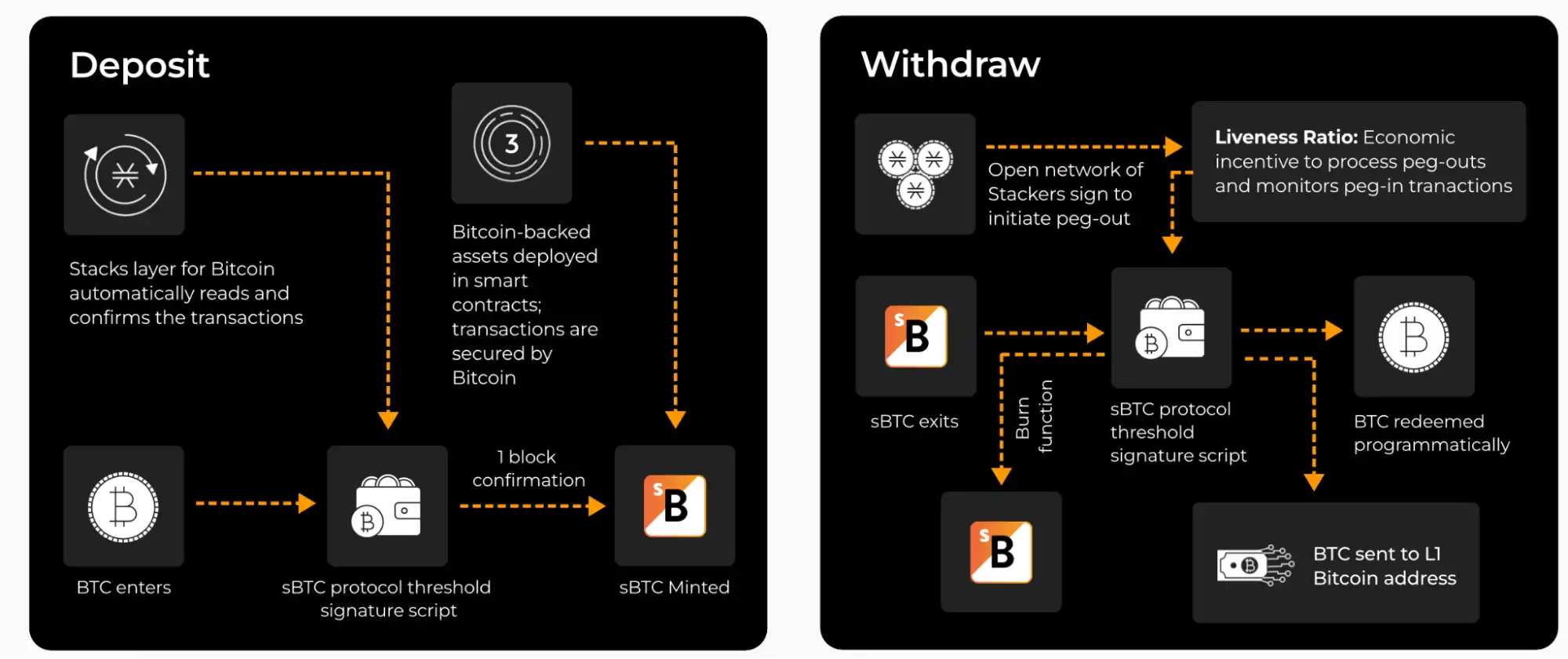
The user journey starts with a Bitcoin mainnet transaction, where BTC is deposited in a multi-signature protocol monitored by a decentralized group of Stacks signers.
Once BTC is deposited, sBTC is minted on Stacks, enabling users to interact with DeFi dApps.
Due to this design, users can access Bitcoin DeFi without even knowing it is on Stacks. For example, Zest Protocol will support mainnet BTC deposits, automatically converted to sBTC. As sBTC has the potential to become a gas token for fees on Stacks in the future, the user experience will be further improved.
Will sBTC be capped?
A 1,000 BTC deposit cap will be implemented during this phase to allow for controlled testing while ongoing security work hardens the protocol as it scales.
Early on, only deposits are supported, withdrawals are not available.
Will sBTC have a yield?
Imagine earning Bitcoin yields just for holding BTC. No staking, no points, no complexity — just Bitcoin rewards in your wallet. Early adopters of sBTC will earn 5% APY when they connect their wallet to Stacks (live Dec 17 at 11am ET).
This is now possible with the sBTC rewards program. Early users can earn BTC rewards (distributed in sBTC) simply by holding sBTC.
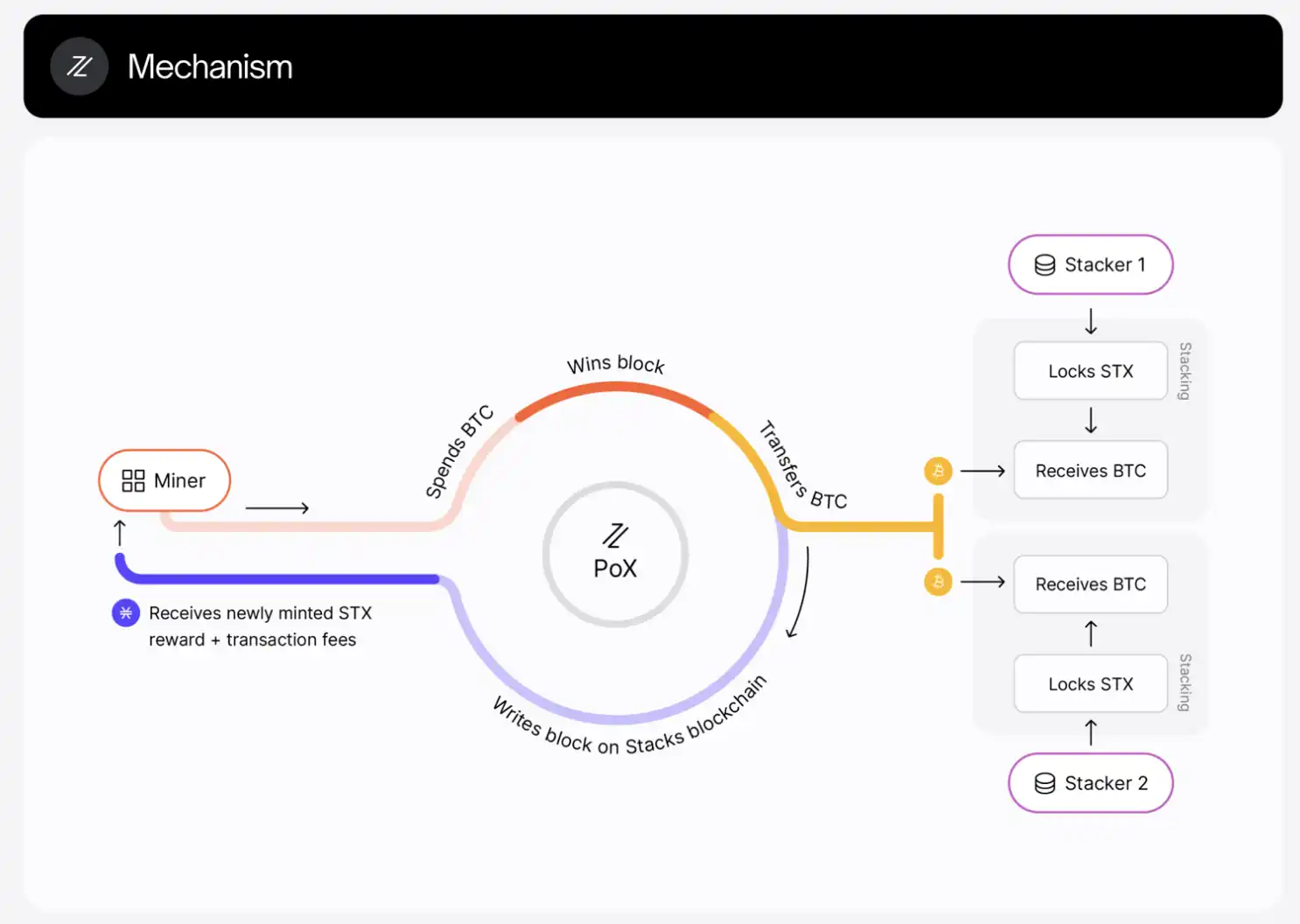
The sBTC rewards program is powered by a group of stackers, “Stacking” STX.
When Stacking STX, Stackers receive BTC through Stack’s consensus mechanism. To enable the sBTC rewards program, these stackers contribute the corresponding proof-of-transfer BTC rewards to the sBTC rewards pool.
BTC in the rewards pool is deposited directly into a smart contract, which deposits BTC into sBTC and distributes the rewards proportionally to sBTC holders. The protocol takes a snapshot of users’ sBTC holdings every day and distributes rewards every two weeks (the length of the PoX cycle).
The current estimated annual Bitcoin reward is 5%, distributed every two weeks.
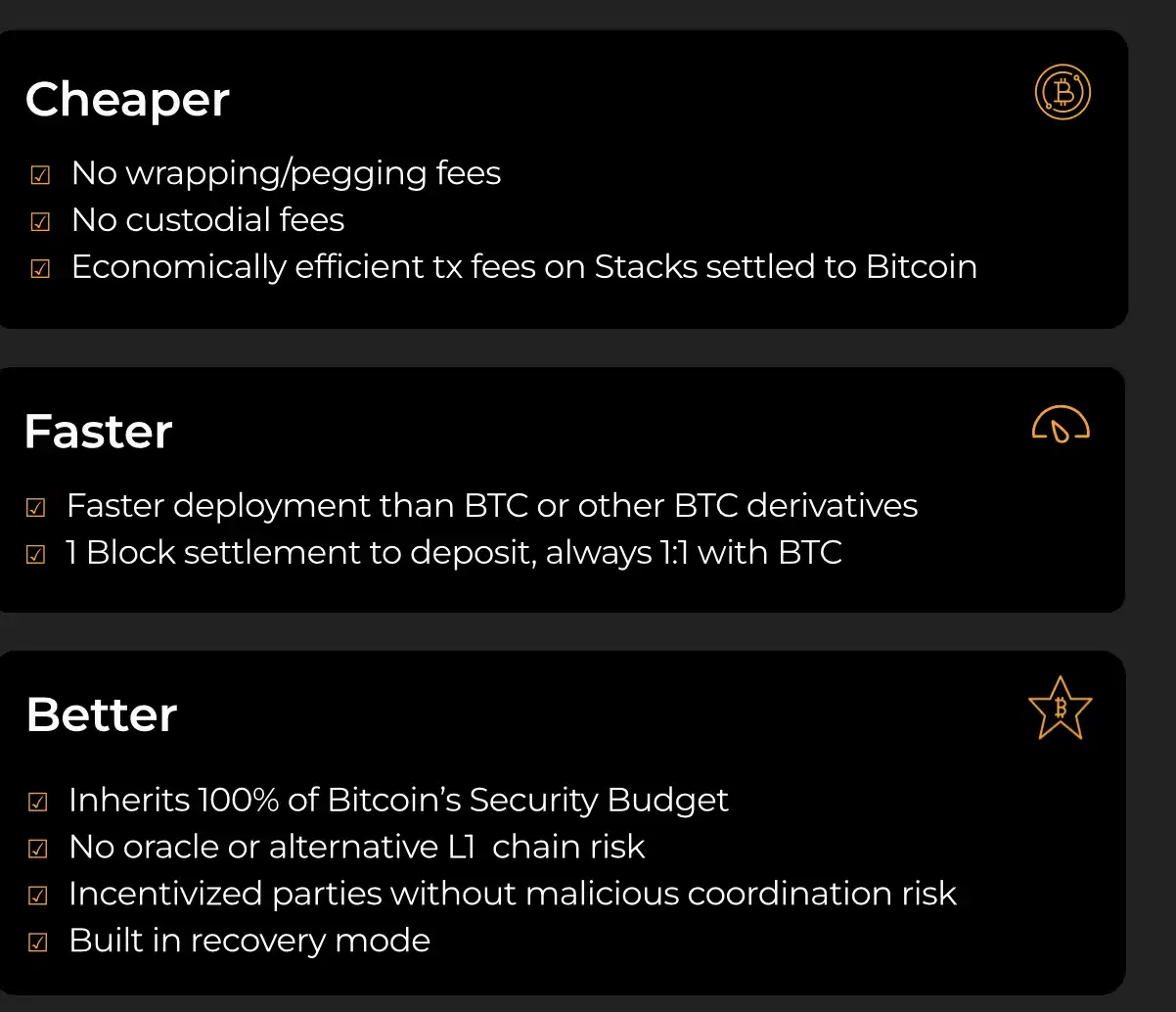
What are the main features of sBTC?
DeFi Use Cases: Additional Yield
Where can sBTC be used?
Multiple DeFi protocols will support sBTC, allowing users to earn additional returns of 5% above the target just by holding sBTC:
1)Bitflow - Bitflow decentralized trading platform
· Liquidity pool: Users can deposit sBTC into Bitflow's liquidity pool, facilitate transactions and earn a certain percentage of transaction fees.
· Liquidity mining: Liquidity providers can stake their LP (liquidity provider) tokens in the liquidity mining program to receive additional rewards, which usually come from trading activities or platform incentives.
· Early predictions that the annual return of deploying sBTC will increase by 10-30%.
· Bitflow Runes AMM: Bitflow has introduced Stacks L2 Runes AMM, you can bring Runes to L2 for a better user experience.
· sBTC will be listed on the Zest Protocol lending market on the first day.
· Zest Protocol will run yield-boosting campaigns on the Zest Protocol lending market from day one, up to 10% BTC yield on sBTC supply
Zest will also unlock more DeFi strategies involving sBTC, such as:
1. Deposit sBTC to earn up to 10% APY on BTC
2. Borrow USDh stablecoins with BTC (or other stablecoins and convert them to USDh)
3. Stake USDh on Hermetica to earn up to 25% APY on stablecoins (25% APY on stablecoin USDh on Stacks).
Reminders:Hermetica’s DeFi protocol offers USDh, the first Bitcoin-backed, yield-bearing stablecoin. Yields are sustainably generated through perpetual funding rate payments on centralized exchanges, and are paid daily.
stSTXbtc is a new liquidity staking token that users can deploy on Stacks DeFi. By holding this token, users will receive stack rewards of up to 10% of the API, paid directly to your wallet in sBTC.
3)Velar Decentralized Exchange
· Liquidity Provision:Users can provide sBTC to Velar’s liquidity pools, facilitate transactions, and earn a portion of the transaction fees generated by the platform.
· Liquidity Mining:By participating in the liquidity mining program, users can stake the liquidity provider (LP) tokens earned by providing sBTC liquidity to receive additional rewards in the form of Velar native tokens or other incentives.
· Staking:If Velar introduces an sBTC staking option, users can lock their sBTC in a staking contract to receive rewards, such as additional tokens or percentage returns, to support network operations.
· Velar will have its own incentive program that allows you to earn Velar’s native token VELAR by deploying sBTC in one of its DEX pools.
Arkadiko will, via a governance vote, allow sBTC to be used as collateral within its protocol, enabling users to borrow USDA or other assets against their Bitcoin holdings.
5) Alex Dex
Users can deposit sBTC into a liquidity pool on ALEX and pair it with another asset, such as STX or a stablecoin. By doing so, they facilitate transactions on the platform and earn a portion of the transaction fees generated by the pool.
ALEX will receive bonus income in the form of native tokens ALEX through the Surge event. This means that in addition to the sBTC reward program 5% APY, you can also earn income by pooling sBTC, as well as additional ALEX token rewards.
6) Granite (Not yet launched) - Lending protocol
Borrowers can obtain stablecoin loans by pledging Bitcoin, while liquidity providers earn returns by providing stablecoins to the protocol
· Lending:Users can deposit sBTC as collateral to borrow stablecoins, and then deploy stablecoins to various DeFi strategies to earn returns.
· Participate in liquidation:Users can act as liquidators and repay part of undercollateralized loans in exchange for collateral and rewards, thereby earning returns through the liquidation process
Granite currently has a waitlist, allowing those who register in advance to enter early. Eventually, a points system will provide additional benefits, with early access registered users receiving significant advantages.
How does sBTC differ from other Bitcoin assets such as wBTC, cbBTC, ecc?
These BTC assets typically require sending BTC to an intermediary or rely on a trusted consortium of signers/small multi-signers.
sBTC will initially rely on a team of 15 signers, including enterprise-level institutions such as BlockDaemon, Figment, Luganodes, and Kiln, to handle pegs and hooks. Over time, this responsibility will be transferred to all Stacks signers, allowing anyone to participate in the security and decentralization of the network. BitGo, Aptos Foundation, and others are also expected to join this effort.
In addition, thanks to the design of Stacks, sBTC will benefit from 100% Bitcoin finality, meaning that transactions on the Stacks layer will be irreversible like Bitcoin.
Reminder: Signers are responsible for verifying and approving each produced block; anyone can become a signer, provided that there are enough STX piled up to become a single signer - similar to the concept of a validator
Extra:
1) sBTC Additional Materials:
sBTC Website|sBTC Documentation|sBTC Deck
2) Nakamoto Upgrade Information:
Satoshi Website | Documentation
The Nakamoto Upgrade is critical because it provides:
· Fast blocks (down from 10 minutes currently to less than 1 minute, with optimizations ongoing)
· 100% Bitcoin finality
Fast Blocks: Fast blocks bring a Solana-like experience to transactions and Bitcoin DeFi interactions, greatly improving the overall user experience of interacting with Stacks L2.
The Stacks DeFi ecosystem has grown a lot this year, and applying DeFi strategies now takes seconds, facilitating onboarding and retention.
Before the Satoshi hard fork, Stacks blocks were in sync with Bitcoin blocks (10 minutes on average), making the chain slow and inadequate for DeFi activities. This limitation no longer exists. Instead, Stacks blocks now take just seconds, with performance improving regularly. Once a Bitcoin block is settled, it is still possible to leverage the security of Bitcoin.
100% Bitcoin Finality: With the Satoshi upgrade, transactions occurring on Stacks L2 will utilize 100% of the Bitcoin security budget, meaning that Stacks transactions become irreversible like Bitcoin once consecutive Bitcoin blocks settle.
A Bitcoin block is no longer tied to a single Bitcoin block, but to a miner term, during which they mine several Stacks blocks that settle within seconds.
There are already 50 signers, including enterprise-grade institutions such as BitGo, Aptos, Luganodes, Kiln, etc., responsible for verifying and approving every block produced during a miner's term.
The fast block times with Bitcoin finality make Stacks the most secure Bitcoin L2 that scales, running with a decentralized network of signers, which will allow BTC to move decentralization to L2 in the future through the upcoming sBTC upgrade.
3) Stack Analysis Platform:
Signal 21|DefiLlama|Stack Explorer
This article comes from a contribution and does not represent the views of BlockBeats
You may also like

From x402 to MPP: Cloudflare's crucial vote, will it go to Coinbase or Stripe?

BlackRock CEO issues annual open letter: The wave of tokenization has arrived, and we will lead this trend

When Backpack backstabs the community

When gold is no longer a safe haven, and Bitcoin continues to panic

Trump, the World's Largest Oil Trader

If the US and Iran have not reached an agreement in 5 days, what other cards does Trump have?

Tether Whale Dumps £12 Million, Backing Crypto’s ‘British Trump’
Ethereum Foundation Post: Rethinking the Division of Work Between L1 and L2 to Build the Ultimate Ethereum Ecosystem

Two Major Prediction Market Platforms Unite Rarely, What Is the Story Behind This New Fund?
Dragonfly Partners: Most agents will not engage in autonomous trading, how can crypto payments prevail?

US AI Startup Goes All In on Chinese Mega-Model | Rewire News Morning Brief

Trump Lies Again: A "Five-Day Pause" Psyop, How Wall Street, Bitcoin, and Polymarket Insiders Synced Uposciogen

When a Token Becomes Labor, People Become the Interface

Ceasefire News Leaked Ahead of Time? Large Polymarket Bets on Outcome Before Trump's Tweet
BlackRock CEO's Annual Shareholder Letter: How is Wall Street Using AI to Keep Profiting from National Pension Funds?

Sun Valley Releases 2025 Financial Report: Bitcoin Mining Revenue Reaches $670 Million, Accelerating Transformation to AI Infrastructure Platform
On March 16, 2026, in Dallas, Texas, USA, CanGu Company (New York Stock Exchange code: CANG, hereinafter referred to as "CanGu" or the "Company") today announced its unaudited financial performance for the fourth quarter and full year ended December 31, 2025. As a btc-42">bitcoin mining enterprise relying on a globally operated layout and dedicated to building an integrated energy and AI computing power platform, CanGu is actively advancing its business transformation and infrastructure development.
• Financial Performance:
Total revenue for the full year 2025 was $688.1 million, with $179.5 million in the fourth quarter.
Bitcoin mining business revenue for the full year was $675.5 million, with $172.4 million in the fourth quarter.
Full-year adjusted EBITDA was $24.5 million, while the fourth quarter was -$156.3 million.
• Mining Operations and Costs:
A total of 6,594.6 bitcoins were mined throughout the year, averaging 18.07 bitcoins per day; of which 1,718.3 bitcoins were mined in the fourth quarter, averaging 18.68 bitcoins per day.
The average mining cost for the full year (excluding miner depreciation) was $79,707 per bitcoin, and for the fourth quarter, it was $84,552;
The all-in sustaining costs were $97,272 and $106,251 per bitcoin, respectively.
As of the end of December 2025, the company has cumulatively produced 7,528.4 bitcoins since entering the bitcoin mining business.
• Strategic Progress:
The company has completed the termination of the American Depositary Receipt (ADR) program and transitioned to a direct listing on the NYSE to enhance information transparency and align with its strategic direction, with a long-term goal of expanding its investor base.
CEO Paul Yu stated: "2025 marked the company's first full year as a bitcoin mining enterprise, characterized by rapid execution and structural reshaping. We completed a comprehensive adjustment of our asset system and established a globally distributed mining network. Additionally, the company introduced a new management team, further strengthening our capabilities and competitive advantage in the digital asset and energy infrastructure space. The completion of the NYSE direct listing and USD pricing also signifies our transformation into a global AI infrastructure company."
"As we enter 2026, the company will continue to optimize its balance sheet structure and enhance operational efficiency and cost resilience through adjustments to the miner portfolio. At the same time, we are advancing our strategic transformation into an AI infrastructure provider. Leveraging EcoHash, we will utilize our capabilities in scalable computing power and energy networks to provide cost-effective AI inference solutions. The relevant site transformations and product development are progressing simultaneously, and the company is well-positioned to sustain its execution in the new phase."
The company's Chief Financial Officer, Michael Zhang, stated: "By 2025, the company is expected to achieve significant revenue growth through its scaled mining operations. Despite recording a net loss of $452.8 million from ongoing operations, mainly due to one-time transformation costs and market-driven fair value adjustments, the company, from a financial perspective, will reduce its leverage, optimize its Bitcoin reserve strategy and liquidity management, introduce new capital to strengthen its financial position, and seize investment opportunities in high-potential areas such as AI infrastructure while navigating market volatility."
The total revenue for the fourth quarter was $1.795 billion. Of this, the Bitcoin mining business contributed $1.724 billion in revenue, generating 1,718.3 Bitcoins during the quarter. Revenue from the international automobile trading business was $4.8 million.
The total operating costs and expenses for the fourth quarter amounted to $4.56 billion, primarily attributed to expenses related to the Bitcoin mining business, as well as impairment of mining machines and fair value losses on Bitcoin collateral receivables.
This includes:
· Cost of Revenue (excluding depreciation): $1.553 billion
· Cost of Revenue (depreciation): $38.1 million
· Operating Expenses: $9.9 million (including related-party expenses of $1.1 million)
· Mining Machine Impairment Loss: $81.4 million
· Fair Value Loss on Bitcoin Collateral Receivables: $171.4 million
The operating loss for the fourth quarter was $276.6 million, a significant increase from a loss of $0.7 million in the same period of 2024, primarily due to the downward trend in Bitcoin prices.
The net loss from ongoing operations was $285 million, compared to a net profit of $2.4 million in the same period last year.
The adjusted EBITDA was -$156.3 million, compared to $2.4 million in the same period last year.
The total revenue for the full year was $6.881 billion. Of this, the revenue from the Bitcoin mining business was $6.755 billion, with a total output of 6,594.6 Bitcoins for the year. Revenue from the international automobile trading business was $9.8 million.
The total annual operating costs and expenses amount to $1.1 billion.
Specifically, they include:
· Revenue Cost (excluding depreciation): $543.3 million
· Revenue Cost (depreciation): $116.6 million
· Operating Expenses: $28.9 million (including related-party expenses of $1.1 million)
· Miner Impairment Loss: $338.3 million
· Bitcoin Collateral Receivable Fair Value Change Loss: $96.5 million
The full-year operating loss is $437.1 million. The continuing operations net loss is $452.8 million, while in 2024, there was a net profit of $4.8 million.
The 2025 non-GAAP adjusted net profit is $24.5 million (compared to $5.7 million in 2024). This measure does not include share-based compensation expenses; refer to "Use of Non-GAAP Financial Measures" for details.
As of December 31, 2025, the company's key assets and liabilities are as follows:
· Cash and Cash Equivalents: $41.2 million
· Bitcoin Collateral Receivable (Non-current, related party): $663.0 million
· Miner Net Value: $248.7 million
· Long-Term Debt (related party): $557.6 million
In February 2026, the company sold 4,451 bitcoins and repaid a portion of related-party long-term debt to reduce financial leverage and optimize the asset-liability structure.
As per the stock repurchase plan disclosed on March 13, 2025, as of December 31, 2025, the company had repurchased a total of 890,155 shares of Class A common stock for approximately $1.2 million.

The US AI Startup Is Loving China's Open Source Model



 App
App