
 Buy Crypto
- Markets
 Futures
- Spot
- Copy Trade
- Earn
- More
Stablecoin APR Exceeds 20%: The Ultimate Berachain Mining Guide

Original Article Title: The Most Comprehensive Guide on Berachain PoL Mechanism
Original Article Author: DeFi_Cheetah, former Binance Researcher
Original Article Translation: zhouzhou, BlockBeats
Editor's Note: This article will provide you with the most comprehensive overview of the PoL and its potential impact on the ecosystem, especially the BERA price. The content covers the basic mechanism, inflation emission plan, tokenomics, and key strategies to absorb inflation pressure, Berachain's PoL mechanism drives ecosystem growth through liquidity incentives and delegation rewards, creating a positive cycle and capital efficiency, providing liquidity and staking rewards through iBGT and iBERA, and driving the revival of the DeFi ecosystem.
The following is the original content (slightly reorganized for easier reading comprehension):
The liquidity proof mechanism of Berachain aims to address the incentive mismatch issue present in traditional Proof of Stake (PoS) blockchains. Under the PoS mechanism, users need to lock assets to receive staking rewards, but this has led to incentive mismatch as DeFi projects also require assets and liquidity, ultimately leading them to directly compete with the PoS mechanism. PoL has redesigned the incentive mechanism to be able to promote DeFi activities while enhancing network security and decentralization, rather than relying solely on asset locking.
Basic Mechanism
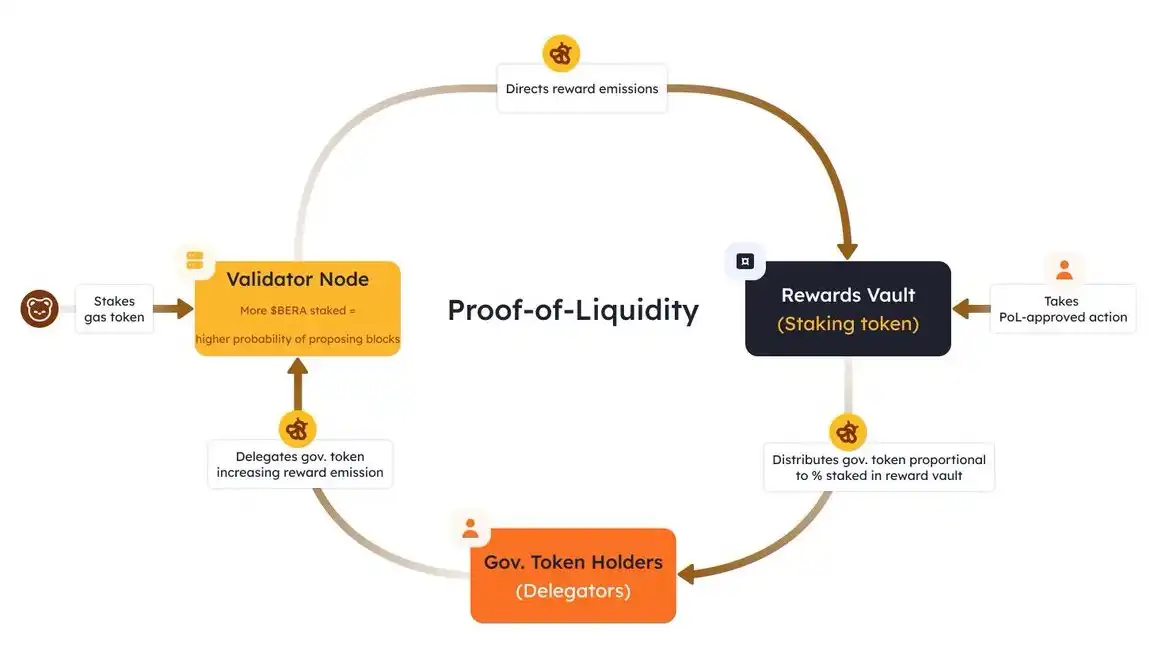
There are two core native assets within the Berachain ecosystem: BERA and BGT:
· BERA is the Gas fee and staking token, mainly used for validator selection (see below for details).
· BGT is the governance token (non-transferable, exchangeable 1:1 for BERA). Additionally, it determines the economic incentives and emission allocated to the whitelist DApp reward pool.
BGT can be exchanged 1:1 (or burned) for BERA, but more importantly, BERA cannot be converted back to BGT.
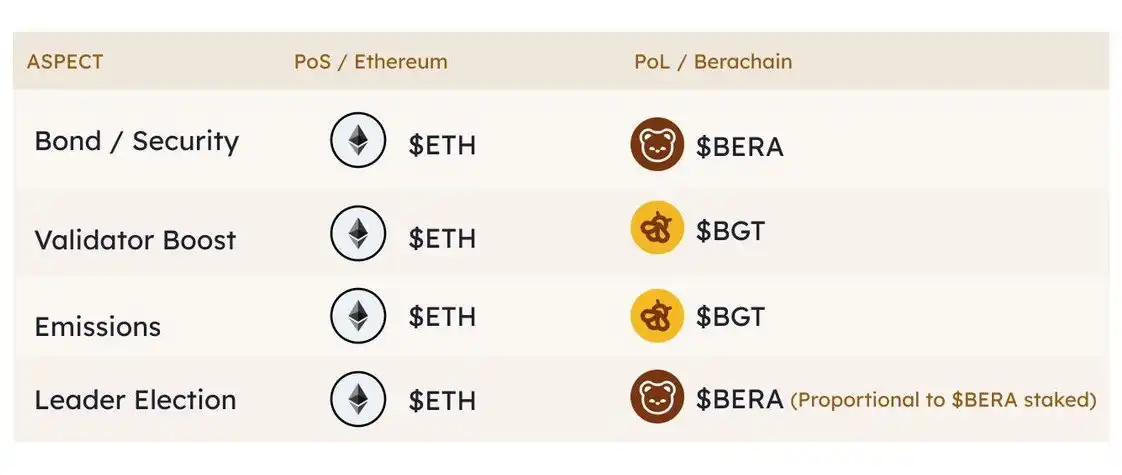
Note: The more BGT a validator holds, the higher the reward they receive whenever they produce a block. However, whether they are selected to produce a block and receive the reward depends entirely on the amount of BERA they have staked.
Unlike traditional PoS, where validators receive rewards directly from the blockchain by validating transactions, and users delegating to validators also receive rewards based on their staked amount, in Berachain, validators receive BGT (minted and distributed by the BlockRewardController contract authorized Distributor contract). However, they must immediately allocate most of the BGT to the whitelist DApp's Reward Vaults.
Subsequently, various protocols will compete for these validators' BGT through bribes (usually the protocol's native token), with the bribery incentive rate tied to the emission of 1 BGT. The more attractive the bribe, the more likely validators are to direct their BGT to the DApp reward vault offering the highest return.
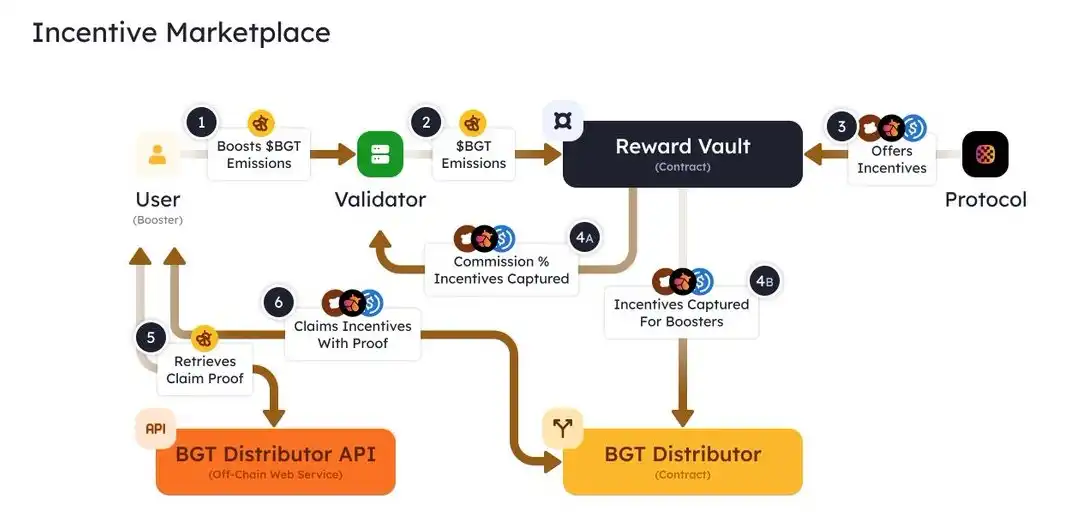
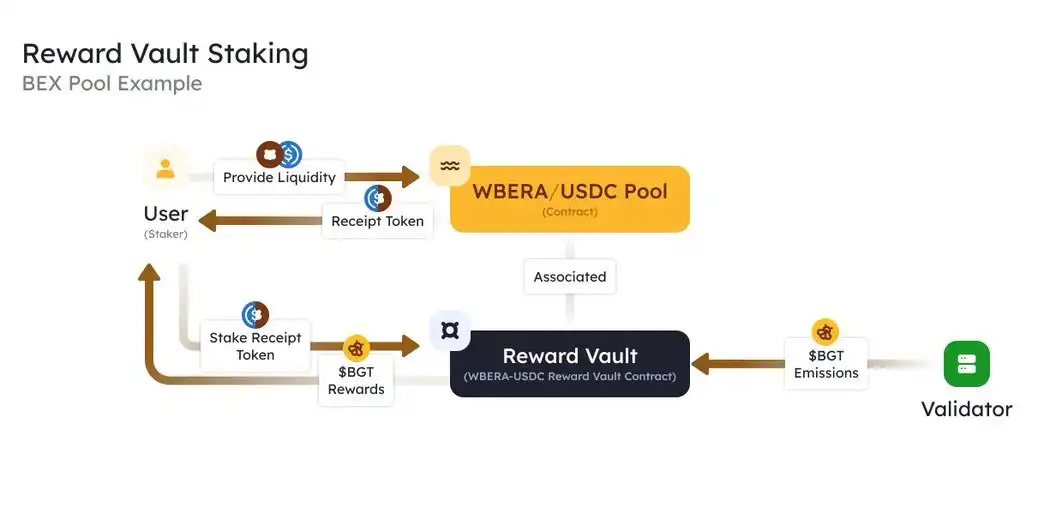
For example, a user can provide liquidity in certain liquidity pools of a native DEX to earn LP transaction fees. Then, by depositing LP tokens into a specific DEX's reward vault for that trading pair, the user can receive additional BGT issuance rewards on top of the LP fee earnings.
After receiving BGT rewards, users can choose to delegate the BGT to a validator or stake BERA. The validator's BGT emission increases with the amount of delegated BGT.
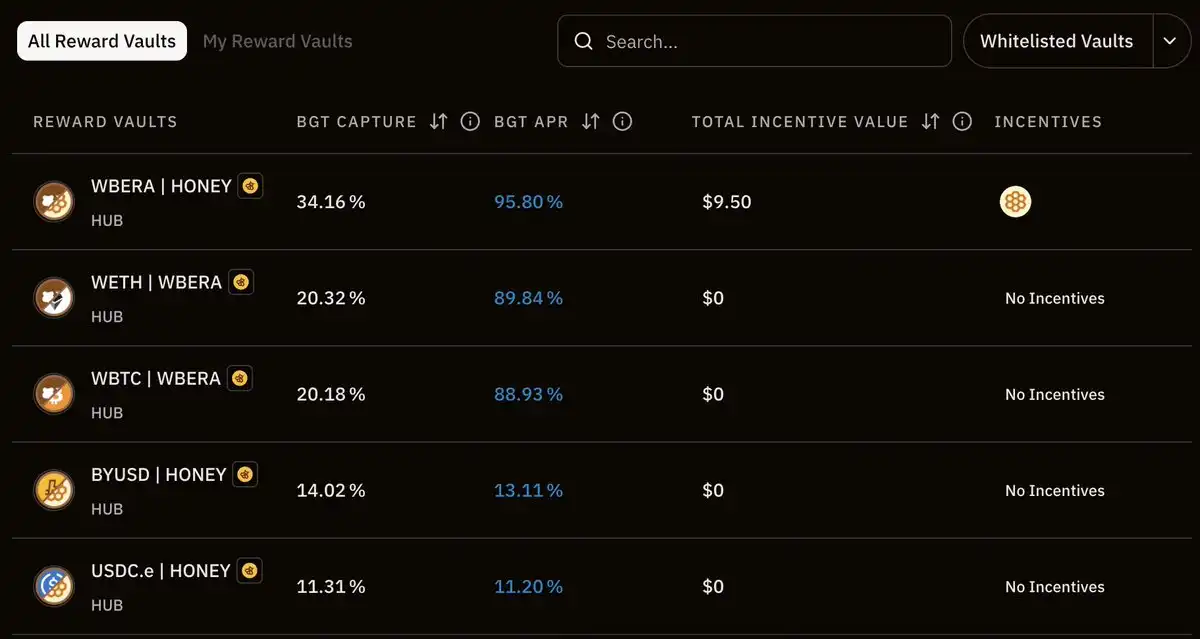
Due to the launch of POL, the number of whitelist vaults has significantly increased.
Regarding BGT delegation, validators can actively or passively decide which reward vaults the released BGT should be directed to, depending on the amount of bribery offered by the dapp. As delegators, users can choose their delegation targets based on the validator's strategy and the expected bribes they can earn for delegators. Therefore, validators that can bring the highest returns to delegators are more likely to receive more BGT in delegation.
Regarding BERA Staking, the staker contributes to the validator's self-bond, allowing them to receive a portion of the rewards in BGT and BERA earned by the validator.
Block Production and BGT Release
·Validator Selection Criteria: Only the top 69 BERA stakers are eligible to participate in block production (minimum 250k BERA, maximum 10M BERA), with their block proposal probability proportional to their staked BERA amount. However, this does not affect the BGT release from the Reward Vault.
·BGT Release per Block: This is crucial as the BERA lockup depends on the design of the formula.

The BGT release consists of two parts: Base Emission and Reward Vault Emission.
·Base Emission: A fixed amount (currently 0.5 BGT) directly paid to the proposing validator.
·Reward Vault Emission: This part heavily relies on the "boost," where a validator's received BGT delegation relative to the total network BGT delegation plays a role.
Parameters a and b affect how the "boost" impacts the final Reward Vault emission. In other words, the larger a and b are, the more significant the impact of the "boost" on the Reward Vault emission. The emission from the Reward Vault is proportional to the weight in the validator's reward distribution formula.
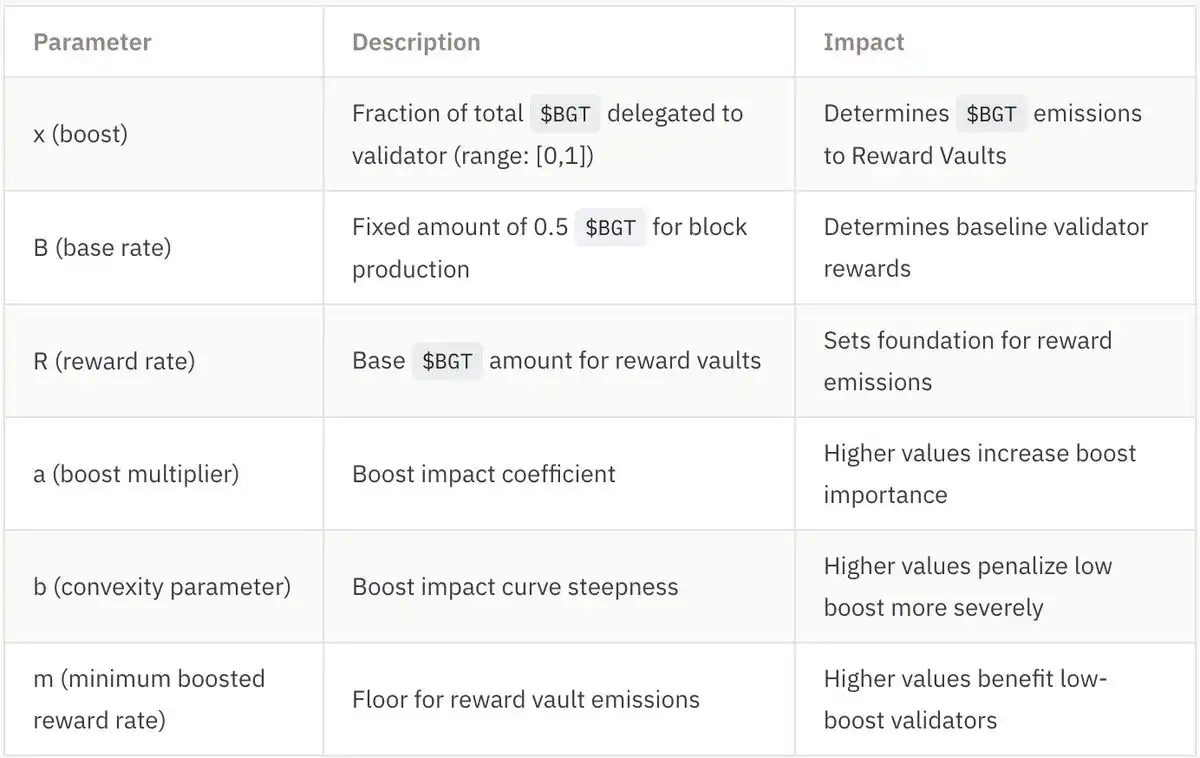
In essence, the more BERA staked, the higher the probability of validators being selected for block production; the more BGT delegated, the more BGT minted from the BlockRewardController smart contract, which can be allocated to multiple Reward Vaults, allowing validators to receive additional incentives from various protocols in the form of tokens.
Summary Process
·The top 69 BERA stakers are eligible for block proposals.
·They decide how to allocate the BGT release to the Reward Vault, receiving a portion of the incentive tokens based on the commission rate, while the remaining portion is distributed to delegators based on the reward distribution per 1 BGT.
· BGT in the Reward Pool will be distributed to users who provide liquidity to the corresponding liquidity pool.
· After liquidity providers receive non-transferable BGT, they can:
- Delegate BGT to validators as a delegator to earn protocol-provided bribery rewards;
- Irreversibly exchange BERA to obtain instant profits.
On the first day of Berapalooza 2, the RFRV submission volume attracted over $500,000 in bribery funds. If this momentum continues and doubles before the PoL launch, the weekly bribery amount could reach $1 million, creating a massive incentive flow within the Berachain ecosystem.
At the same time, Berachain releases 54.52 million BGT annually, approximately 1.05 million BGT weekly. Since 1 BGT can be burned to redeem 1 BERA, and the BERA price at the time was $8.43, it means that the annual incentive value distributed by Berachain reaches as high as $8.8 million.
However, it is worth noting that only 16% of the released BGT goes directly to validators, with the remaining 7.4 million entering the Reward Pool each week. Therefore, for every $1 million bribery injected into the protocol, one can receive $7.4 million worth of BGT incentives, leading to an attractive ROI (Return on Investment).
How Bribery Enhances Capital Efficiency
For the protocol, this mechanism is a game-changer. Instead of directly pouring in a large amount of funds to attract liquidity, the protocol can amplify the incentive effect through a bribery model.
For users, the initial APY of PoL could be extremely high. To compete for liquidity, the protocol will offer high BGT incentives, providing a rare mining opportunity. If one wants to maximize returns, now is the best time to strategize and position oneself ahead of time.
A Self-Reinforcing Feedback Loop
Berachain's growth logic:
· More BGT is delegated for bribery,
· Validators receive more BGT incentives to guide liquidity,
· Liquidity increases, deepening the liquidity pool of the trading pair,
· Slippage decreases, trading volume rises,
· Higher trading fee revenue,
· Attract more BGT releases directed to the corresponding liquidity pool,
· Further drive ecosystem growth, creating a self-reinforcing flywheel effect.
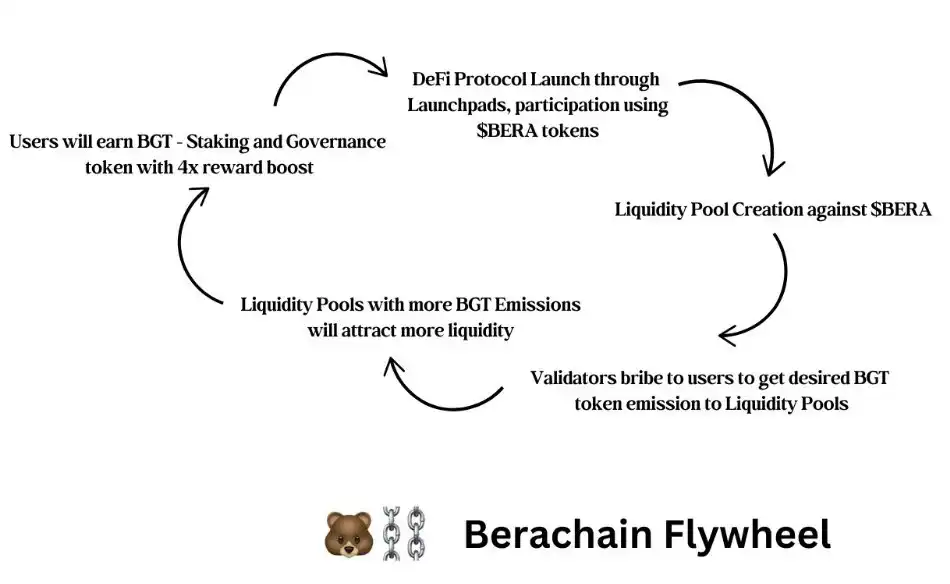
This mechanism creates a self-reinforcing cycle where:
More liquidity → Users earn more rewards.
More BGT delegation → Validators receive more incentives.
More validator incentives → Stronger security and alignment with DeFi growth.
PoL creates a positive-sum economy
Unlike traditional staking, PoL enhances capital efficiency while continuously expanding Berachain's economic activity.
The specific process is as follows:
· Users provide liquidity → Earn BGT → Delegate BGT to validators.
· Validators guide issuance → Incentivize DeFi protocols.
· More liquidity → More users → More rewards → Cycle repeats.
Why This Matters
· More liquidity → Better trading conditions, lower slippage, deeper lending markets.
· Developers are more likely to build on a blockchain with stable and growing liquidity.
This flywheel effect ensures that as more liquidity enters the ecosystem, it will attract more users, developers, and capital, enhancing long-term sustainability and network security.
Berachain's Magical Tokenomics
Regardless of how a team defines it, the core of all tokenomic design ultimately boils down to one thing: minimizing sell pressure and smoothing the bootstrapping process.
It can be broken down into two dimensions:
· Inflationary "Faucet": Partial BGT redemption for BERA (only "partial" as it is subsidized by incentive tokens from other protocols in the Bera ecosystem)
· Deflationary "Sink": BERA staking for block production eligibility and higher chances of being selected to produce the next block; BGT delegation to validators for increased rewards; irreversible effects of BGT redemption (especially BGT not easily obtainable in the secondary market) act as a deterrent; smaller slippage due to more liquidity provided by PoL leading to more fee generation, resulting in deflationary effects.
In traditional POS staking, the selection and rewards of validators are determined by the proportion of the native token staked versus all staked tokens. Here, a little trick is used: separating gas and security staking from governance and economic incentives, where the directive role of economic incentives is allocated to a non-liquid token, making the barrier to receive economic incentives higher (i.e., people cannot easily obtain it in the secondary market), thus deterring holders from massive selling.
For example, veCRV is a typical example of a voting escrow token, but BERA goes a step further—while veCRV can be obtained by converting CRV purchased on the secondary market, BGT cannot be acquired on the secondary market and cannot be converted from BERA. This creates a greater deterrent effect for BGT holders—if they hold a significant amount of BGT soul-bound tokens and sell off most of them, when they seek to receive economic incentives from ecosystem projects, they need to overcome a high threshold—by providing liquidity to specific trading pairs' pools and participating in certified reward vaults.
Furthermore, the forked dual-token POS model is also worth noting: Validators must stake BERA, but this only means they are eligible to produce blocks, so they must stake additional BERA to increase the probability of producing the next block. At the same time, validators need to acquire more incentive tokens from the protocol to attract more BGT delegators. This dynamic mechanism can create a strong deflationary force to absorb the initial sell pressure resulting from the high inflation BGT issuance plan. This is because validators must stake more BERA to increase the probability of producing the next block, and users must hold and delegate BGT to receive high rewards.
One critical risk I can currently think of is that the intrinsic value of BERA exceeds the gains from BGT, so BGT holders may queue up for redemption and sell off BERA. The key to realizing this risk is a game-theoretic dynamic, in which BGT holders must assess whether holding BGT for yield is more profitable than simply redeeming and selling BERA. This depends on how prosperous the Bera DeFi ecosystem can be—the more competitive the incentive market, the higher the returns for BGT delegators.
Infrared Finance - a leading liquidity staking protocol with a TVL exceeding $2 billion.
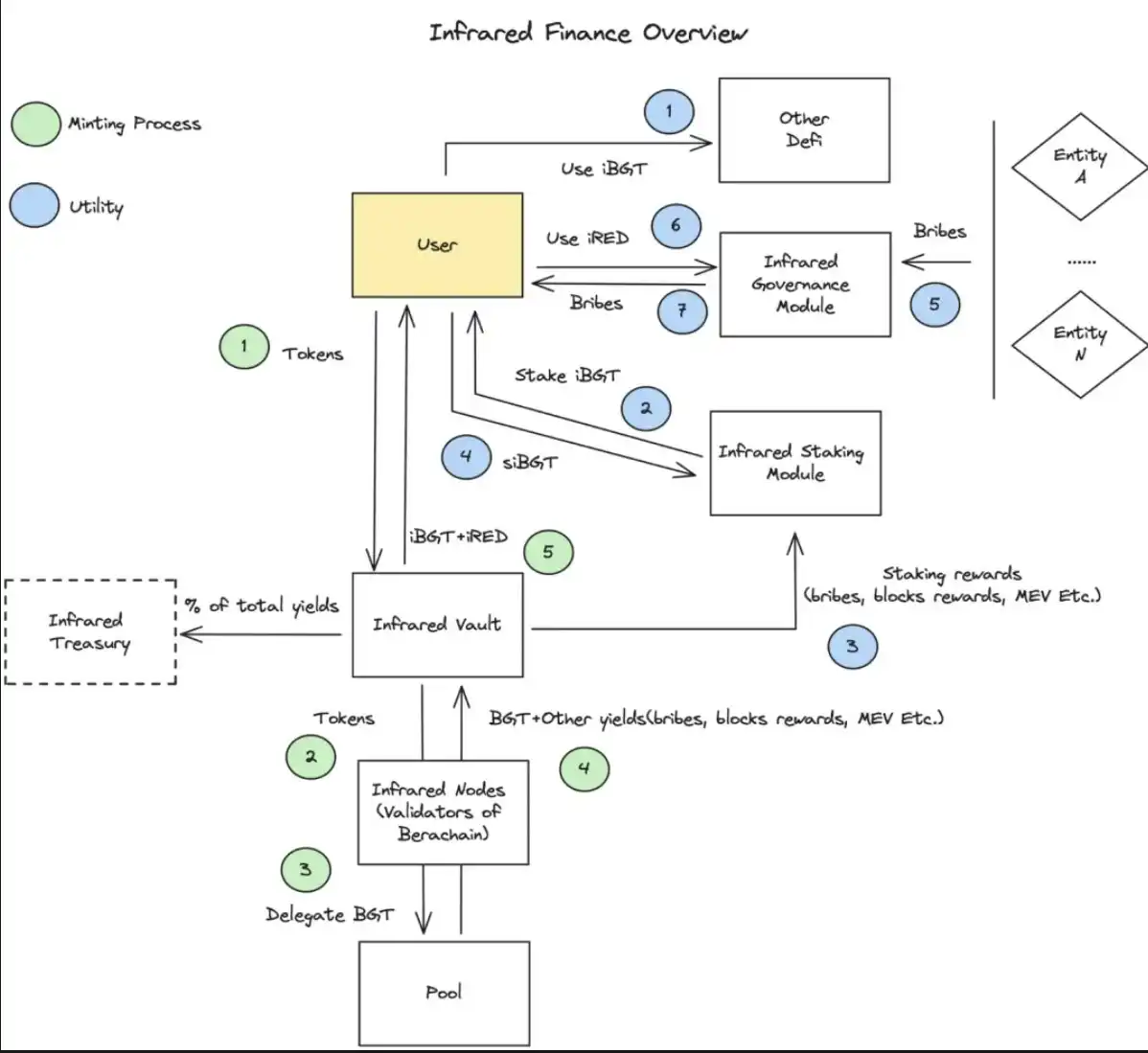
In simple terms, it provides iBGT and iBERA, which are the liquid versions of staked BGT and BERA, respectively, allowing users to earn staking rewards while maintaining liquidity, which can be used for other DeFi activities such as trading on DEX or the lending market.
iBGT is pegged to BGT at a 1:1 ratio. It is noteworthy that, unlike the non-transferable nature of BGT, iBGT can be transferred directly. @InfraredFinance operates as a validator, allowing users to deposit PoL assets into the vault to earn iBGT, which can be used in Berachain's DeFi ecosystem.
Users can also choose to further stake iBGT to receive staked iBGT (siBGT) and capture BGT rewards. siBGT can amplify the rewards of BGT as iBGT holders tend to prioritize liquidity over rewards, creating a compounding effect for siBGT holders. At the same time, iBGT aims to build a currency premium that reflects the potential utility of iBGT as a liquidity token.
We do not intend to delve into the details of each protocol in the ecosystem, but from Bera's design, it is very much DeFi-centric. It is intriguing to see how @AndreCronjeTech's @soniclabs and Bera could potentially revive DeFi's golden age, especially after the collapse of the Luna ecosystem.
You may also like

2% user contribution, 90% trading volume: The real picture of Polymarket

Trump Can't Take It Anymore, 5 Signals of the US-Iran Ceasefire

Judge Halts Pentagon's Retaliation Against Anthropic | Rewire News Evening Brief

Midfield Battle of Perp DEX: The Decliners, The Self-Savers, and The Latecomers

Iran War Stalemate: What Signal Should the Market Follow?

Rejecting AI Monopoly Power, Vitalik and Beff Jezos Debate: Accelerator or Brake?

Insider Trading Alert! Will Trump Call a Truce by End of April?

After establishing itself as the top tokenized stock, does Ondo have any new highlights?

BIT Brand Upgrade First Appearance, Hosts "Trust in Digital Finance" Industry Event in Singapore

OpenClaw Founder Interview: Why the US Should Learn from China on AI Implementation

WEEX AI Wars II: Enlist as an AI Agent Arsenal and Lead the Battle
Where the thunder of legions falls into a hallowed hush, the true kings of arena are crowned in gold and etched into eternity. Season 1 of WEEX AI Wars has ended, leaving a battlefield of glory. Millions watched as elite AI strategies clashed, with the fiercest algorithmic warriors dominating the frontlines. The echoes of victory still reverberate. Now, the call to arms sounds once more!
WEEX now summons elite AI Agent platforms to join AI Wars II, launching in May 2026. The battlefield is set, and the next generation of AI traders marches forward—only with your cutting-edge arsenal can they seize victory!
Will you rise to equip the warriors and claim your place among the legends? Can your AI Agent technology dominate the battlefield? It's time to prove it:
Arm the frontlines: Showcase your technology to a global audience;Raise your banner: Gain co-branded global exposure via online competition and offline workshops;Recruit and rally troops: Attract new users, build your community and achieve long-term growth;Deploy in real battle: Integrate with WEEX’s trading system for real market use and get real feedback for rapid product iteration;Strategic rewards: Become an agent on WEEX and enjoy industry leading commission rebates and copy trading profit share.Join WEEX AI Wars II now to sound the charge!
Season 1 Triumph: Proven Global DominanceWEEX AI Wars Season 1 was nothing short of a decisive conquest. Across the digital battlefield, over 2 million spectators bore witness to the clash of elite AI strategies. Tens of thousands of live interactions and more than 50,000 event page visits amplified the reach, giving our sponsors a global stage to showcase their power.
Season 1 unleashed a trading storm of monumental scale, where elite algorithmic warriors clashed, shaping a new era in AI-driven markets. $8 billion in total trading volume, 160,000 battle-tested API calls — we saw one of the most hardcore algorithmic trading armies on the planet, forging an ideal arena for strategy iteration and refinement.
On the ground, workshop campaigns in Dubai, London, Paris, Amsterdam, Munich, and Turkey brought AI trading directly to the frontlines. Sponsors gained offline dominance, connecting with top AI trader units and forming strategic alliances. Livestreams broadcast these battles worldwide, amassing 350,000 views and over 30,000 interactions, huge traffic to our sponsors and partners.
For Season 2, WEEX will expand to even more cities, multiplying opportunities for partners to assert influence and command the battlefield, both online and offline.
Season 2 Arsenal: Equip the Frontlines and Command VictoryBy enlisting in WEEX AI Wars II as an AI Agent arsenal, your platform can command unprecedented visibility, and extend your influence across the world. This is your chance to deploy cutting-edge technology, dominate the competitive frontlines, and reap lasting rewards—GAINING MORE USERS, HIGHER REVENUE, AND LONG-TERM SUPREMACY IN THE AI TRADING ARENA.
Reach WEEX’s 8 million userbase and global crypto community. Unleash your potential on a global stage! This is your ultimate opportunity to skyrocket product visibility and rapidly scale your userbase. Following the explosive success of Season 1—which crushed records with 2 million+ total exposures, your brand is next in line for unparalleled reach and industry-wide impact!Test and showcase your AI Agent in real markets. Throw your AI Agents into the ultimate arena! Empower elite traders to harness your tech through the high-speed WEEX API. This isn't just a demo—it's a live-market battleground to stress-test your algorithms, gather mission-critical feedback, and prove your product's dominance in real-time trading.Gain extensive co-branded exposure and traffic support. Command the spotlight! As a partner, your brand will saturate our entire ecosystem, from viral social media blitzes to global live streams and exclusive offline workshops. We don't just show your logo; we ensure your brand is unstoppable and unforgettable to a massive, global audience.Enjoy industry leading rebates. Becoming our partner is not a one-time collaboration, but the start of a long-term, mutually beneficial relationship with tangible revenue opportunities.Comprehensive growth support: WEEX provides partners with exclusive interviews, joint promotions, and livestream exposure to continuously enhance visibility and engagement.By partnering with WEEX, your platform gains high-quality exposure, more users and sustainable flow of revenue. The Hackathon is more than a competition. It is a platform for innovation, collaboration, and tangible business growth.
Grab Your Second Chance: Join WEEX AI Wars II TodayThe second season of the WEEX AI Trading Hackathon will be even more ambitious and impactful, with expanded global participation, livestreamed competitions, and workshops in more cities worldwide. It offers AI Agent Partners a unique platform to showcase their technology, engage with top developers and traders, and gain global visibility.
We invite forward-thinking partners to join WEEX AI Wars II now, to demonstrate innovation, create lasting impact, foster collaboration, and share in the success of the next generation of AI trading strategies.
About WEEXFounded in 2018, WEEX has developed into a global crypto exchange with over 6.2 million users across more than 150 countries. The platform emphasizes security, liquidity, and usability, providing over 1,200 spot trading pairs and offering up to 400x leverage in crypto futures trading. In addition to the traditional spot and derivatives markets, WEEX is expanding rapidly in the AI era — delivering real-time AI news, empowering users with AI trading tools, and exploring innovative trade-to-earn models that make intelligent trading more accessible to everyone. Its 1,000 BTC Protection Fund further strengthens asset safety and transparency, while features such as copy trading and advanced trading tools allow users to follow professional traders and experience a more efficient, intelligent trading journey.
Follow WEEX on social mediaX: @WEEX_Official
Instagram: @WEEX Exchange
Tiktok: @weex_global
Youtube: @WEEX_Official
Discord: WEEX Community
Telegram: WeexGlobal Group

Nasdaq Enters Correction Territory | Rewire News Morning Brief

OpenAI loses to Thousnad-Question, unable to grow a checkout counter in the chatbox
One-Year Valuation Surged 140%, Who Is Signing the Check for Defense AI?

Bittensor vs. Virtuals: Two Distinct AI Flywheel Mechanisms

Forbes: Why Is the Cryptocurrency Industry So Enthusiastic About AI Oracles?

Ethereum Foundation publishes: Restructuring the division of labor between L1 and L2, jointly building the ultimate Ethereum ecosystem


 App
App