
 Buy Crypto
- Markets
 Futures
- Spot
- Copy Trade
- Earn
- More
Political Passion in the Trump Era: Where to Rebuild After the Destruction?

Original Article Title: This thing will fail
Original Article Author: Noah Smith
Translated Article: Block unicorn

“Men don’t care what’s on TV. They only care what else is on TV.” —Jerry Seinfeld
N.S. Leons is a popular essayist in the "national conservative" tradition. His Substack, "The Upheaval," is recommended reading, although I disagree with less than half of what he writes. But he is well-read, broad-minded, able to integrate information from multiple fields, and unafraid to think deeply about historical questions in real time. Reading his work will help you understand the beliefs of the modern right. On many issues, his information is urgently needed by people in the MAGA world.
In a recent article titled "America's Mighty God," Leons pointed out what I think is a profound truth of our current historical moment. He wrote, "The long 20th century is over, a period defined by liberalism (social, political, and economic), anchored in the rejection of Adolf Hitler:
I believe what we are seeing today is indeed the end of an era, a epochal upheaval of the world we know, the full meaning and impact of which has not yet truly touched us.
More specifically, I believe Donald Trump marks the belated end of the "long 20th century"...
Our "long 20th century" got off to a late start, not fully solidified until 1945, but in the following 80 years, its spirit dominated our civilization's entire understanding of the world order and its rightful face...After the terror of the Second World War, the leadership of America and Europe naturally made 'never let history repeat itself' the core of its ideological system. They were determined, together, never to let fascism, war, and genocide again threaten humanity...
The anti-fascism of the 20th century evolved into a great crusade...By making 'never let history repeat itself' the ultimate priority, the ideology of the open society placed the 'greatest evil' (summum malum) at the core, rather than the 'highest good' (summum bonum). This unique figure of Hitler not only lurked in the depths of 20th-century thought; he also dominated people's subconscious, becoming a secular Satan...As René Girard mockingly called it, this 'Adolf Hitler's second profession' provided a quasi-religious justification for the open society consensus and the entire post-war liberal order: to prevent the resurrection of the immortal leader...
The “Long Twentieth Century” was characterized by three interrelated post-war projects: the gradual opening of society through the deconstruction of norms and boundaries, the consolidation of the managerial state, and the hegemony of a free international order. It was hoped that these three projects could together lay the foundation for ultimately achieving world peace and harmonious coexistence of all humanity.
Like all great articles, this article is somewhat hyperbolic. The post-war American-led liberalism was not a purely defensive project. The motivations behind the United Nations Charter and the Universal Declaration of Human Rights were not fueled by a fear of Hitler’s return but by a desire to extend the boundaries of human freedom and dignity to unprecedented levels. Ronald Reagan did not need Hitler as a bogeyman to promote his vision of American freedom but rather saw it as a universal ideal.
However, in some important sense, Lyons is correct. The shocking terror and spectacular failure of the Hitler regime provided a moral anchor for liberals, allowing them to always invoke a larger liberalism based on this. Advocates of the Civil Rights Act in the United States and other liberalizing laws often used Nazi Germany as a rhetorical foil. Anti-communism briefly provided another Satan for the right, but its influence was never quite the same, as the U.S. had been Stalin’s ally in World War II; anti-communism was soon forgotten after the Soviet Union's collapse, but Hitler and the Nazis were not.
Lyons is right in saying that the Trump era marked the end of Hitler as the Western cultural “evil”—at least in the U.S. The two most popular media personalities on the American right, Joe Rogan and Tucker Carlson, invited Daryl Cooper—a historical revisionist who downplays Nazi atrocities and considers Winston Churchill the real villain of World War II—to speak on their shows. Here is a (now-deleted) tweet from Cooper for reference:
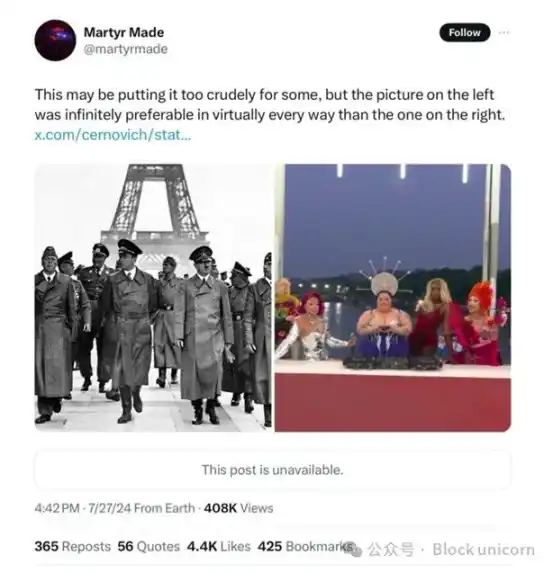
This tweet, I believe, showcases the mindset of the American right. It is wrong to say that the Trump movement or modern national conservatism represents full-throated support for Nazism. However, it is undisputed that the American right believes that “awokeness” poses a greater threat than the potential return of Hitler.
Why has the legend of Hitler lost its terror? There are several reasons. The generation that defeated the Nazis has largely passed away, meaning that for most Americans, Hitler is just a character in movies and books; like Tamerlane or Genghis Khan, over time, the fear of a mass murderer has gradually faded. The Palestinian movement effectively removed Jews from the list of minority groups protected by the left, those whose rights might be defended through riots. Social media has led to an overuse of the “Nazi” label, giving rise to the popular saying “everyone I don’t like is Hitler.”
Leontes's attitude toward this transformation is far more optimistic than mine. Personally, I think demonizing Hitler is a good idea. As a general moral principle, "don't be Hitler" does indeed seem quite reliable. Even if you only care about the strength of Western civilization, someone who, out of ideological motivations, initiated military actions, led to the end of the European global empire, massacred over 20 million Slavic people, ended Germany's great power status, and solidified Soviet control over half of Europe, seems like a case to be avoided.
But Leontes believes that the end of anti-Nazi-ism as a guiding Western principle will pave the way for the return of morality, community, roots, faith, and civilizational pride—things conservatives like:
Highly influential liberal thinkers such as Karl Popper and Theodor Adorno helped convince the post-war ideologically compliant establishment that the fundamental source of authoritarianism and conflict in the world is the "closed society." This society was marked by characteristics that Reno calls the "god of the strong": strong beliefs and truth claims, strong moral codes, strong interpersonal bonds, strong community identities and connections to place and the past—ultimately, all these "objects of human affection and loyalty… are the source of a community's passions and loyalties."
Now, the unifying power of the god of the strong is seen as dangerous, a hellish source of fanaticism, oppression, hatred, and violence. Bonds of faith, family, and especially meaningful national identity are now seen as suspicious and worrisome regressive temptations leading back to fascism…
The open society consensus and its flimsy divinities have not produced a utopian world of peace and progress but rather led to the disintegration and despair of civilization. As expected, the god of the strong in history was exiled, religious traditions and moral norms were laid bare, community bonds and loyalties weakened, distinctions and boundaries dismantled, autonomous disciplines handed over to top-down technocratic management. It is hardly surprising that this has resulted in a lack of cohesion in nation-states and wider civilizations, let alone the ability to resist external threats from closed, delusional societies. In short, the radical self-denial movement pursued by the post-war open society consensus has effectively become a collective suicide pact for Western liberal democratic nations.
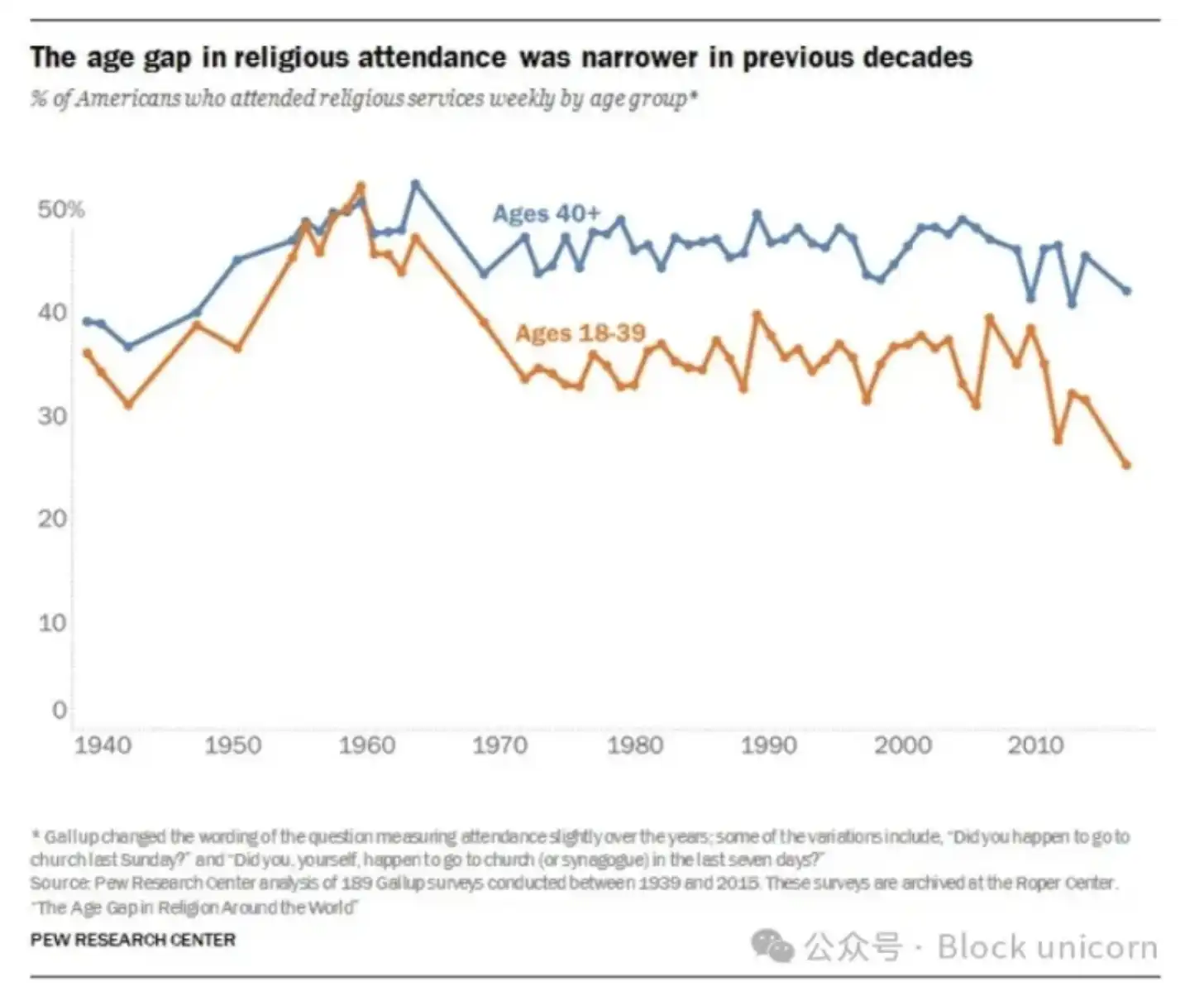
I'm not entirely sure if Leontes's interpretation of history is correct. After all, as Robert Putnam documented in his book "Bowling Alone," the post-war decades in America witnessed the largest surge in church attendance, civic engagement, family formation, and social cohesion since the early days of the Republic. Here are the data on church attendance, which skyrocketed after World War II and remained high especially among those over 40 in the 2010s:
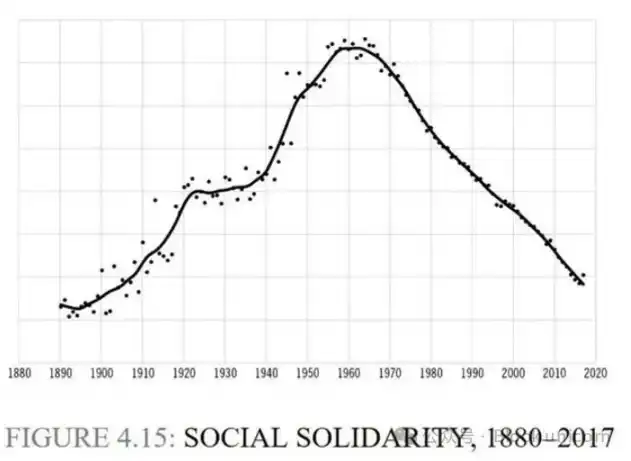
Here is Putnam's index of social capital, combining measures of civic and religious engagement along with family formation:
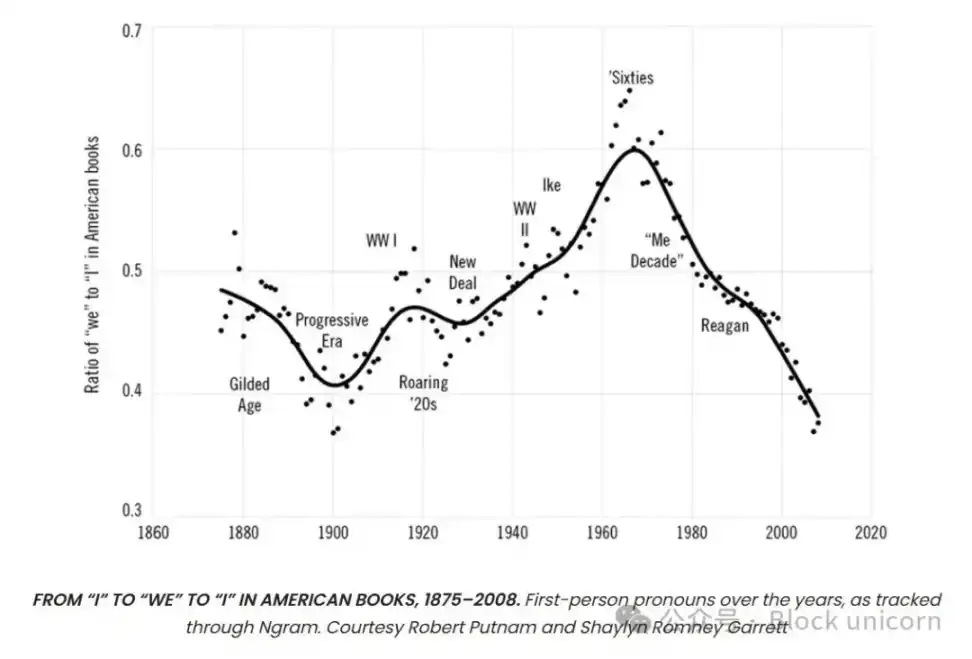
The New Deal and the post-war period even witnessed a substantial growth in the use of the word "we" over "I" in American books:
The "god-like figure" has never been as potent as in the American generation that grew up listening to Roosevelt preach liberalism on the radio and continued to grind Adolf Hitler into the dust. From the unified struggle of World War II to the subsequent great American unity, a causal line is not difficult to draw.
The greatest generation wholeheartedly believed that Hitler was Satan on Earth. But they did not see the need to crush family, community, and tradition to preserve an open society. In fact, their society was both open and deeply rooted. My grandparents knew the name and life story of every neighbor until the day they died; how many "national conservative" intellectuals and die-hard Trump fans can say the same?
Nevertheless, the American "god-like figure" did eventually fade. Lions believes that Trump is bringing them back:
Mary Harrington recently observed that the Trumpian revolution seems both political and archetypal, noting that the widespread "excited response" among men to Elon Musk and his "young tech-bro cadre" recent work reflects a phenomenon that can be "understood from an archetypal perspective as their engaging in combat with a vast, fog-like enemy with the objective of destroying male heroism itself" when breaking down the entrenched bureaucratic system. This masculine-tinted spirit of "thymotic vitality" was suppressed throughout the "long 20th century," but now it is back...
Today's populism is... a long-suppressed desire for thymotic aspiration, a desire to take the actions that should have been taken long ago, to break free from the suffocating lethargy brought about by proceduralism, and to fight passionately for collective survival and self-interest. This is politics returning to politics. It demands a restoration of ancient virtues, including a vital sense of the nation and civilization's self-worth...
This is what Trump, with all his ruggedness, represents: the powerful deity has escaped exile and returned to America... Trump himself is a man of action, not of contemplation... he... is the embodiment of the entire rebellious new world spirit that is overturning the old order... The boldness of Trump's actions reflects not only partisan political gamesmanship—it represents the overturning of the old paradigm; now "you can just get things done."
Here, the term "thumotic" refers to Harvey Mansfield's use of the Greek word "thumos" to denote a political passion and drive. Francis Fukuyama spells it as "thymos" and as early as 1992 predicted that Donald Trump could be the perfect embodiment of the "thumotic" impulse of Americans to dismantle the liberal establishment.
Therefore, Leonhardt sees Trumpism as a reassertion of a wild, unapologetically male-driven force in the style of "Fight Club" — just different from Tyler Durden in that while he directed it towards anarchy, Leonhardt sees Trump and Musk indulging in their masculine fervor in dismantling the bureaucratic system.
Yet Leonhardt never specifically explains how this destructive impulse would bring about the return of the "strongman" he desires. He views the bureaucratic system and other post-war American institutions as obstacles to revival — foundations of family, community, and faith — but he never truly moves beyond the shattering of these so-called barriers to envision actual rebuilding. He simply assumes it will happen naturally or considers it a future problem.
I believe he will be disappointed. Trump's movement has existed for a decade now, and during this time, it has built nothing at all. There are no Trump Youth. No Trump community centers, Trump neighborhood associations, or Trump business clubs. Trump supporters have not flocked to traditional religion either; while Christianity's decline halted since the pandemic, feelings of Christian identity and church attendance remain well below levels seen at the turn of the century. Republicans still have more children than Democrats, but red-state birth rates are also declining.
In Trump's first term, right-wing efforts to organize civic engagement were almost laughably sparse. A few hundred "proud boys" gathered, brawling with antifascists on the streets of Berkeley and Portland. There were some smaller right-wing anti-lockdown protests in 2020. About two thousand people participated in the January 6th riot — mostly middle-aged. None of these formed the kind of enduring grassroots organizations common in the 1950s.
For a few, Trump's first term was a live-action role-playing game; for others, it was just a YouTube channel.
And what about Trump's second term to date? Nothing at all. Even rally attendance has sharply declined. National conservatives who might have gone out in 2017 to meet up are now curled up alone in their living rooms, flipping between X, OnlyFans, and DraftKings, throwing punches in the air when they read about Elon Musk and his tech-nerd squad firing employees or Trump cutting aid to Ukraine. "You can just get things done," yet hardly any of Trump's supporters are actually doing anything, except passively cheering for their team in name only. Unless you are one of the few geeks helping Musk dismantle the bureaucracy, this "vision" is entirely secondhand.
You see, the MAGA movement is an online phenomenon. It is another vertical online community — a group of disconnected, atomized individuals weakly connected over vast distances through the illusory bonds of ideology and identity. It has no sense of family, community, or rootedness to a place. It is a digital commodity. It is a subforum. It is a fan club.
N.S. Léonce and the National Conservatives completely misunderstand the reasons why America abandoned its roots, community, family, and faith. We didn't abandon these "strong gods" because the liberals were too harsh on old Adolf (Hitler). We abandoned them because of technology.
In the 1920s, America saw a surge in widespread prosperity along with the emergence of technology that granted individuals unprecedented autonomy and control over their physical location and access to information. The ownership of cars allowed Americans to travel anywhere, anytime, freeing them from their ties to specific locations. Telephone ownership enabled people to communicate over long distances. Television and radio exposed them to new ideas and cultures, while the internet exposed them to even more.
Then came social media and smartphones. Suddenly, "society" no longer meant the people in your physical surroundings—your neighbors, coworkers, workout partners, and so on. First, "society" turned into a group of avatars typing messages to you on a small glass screen in your pocket. Your phone became the place where you met and conversed with friends and loved ones, as well as where you argued about politics and ideas. People's roots shifted from physical space to digital space.
Increasing evidence indicates that smartphone-enabled social media is linked to isolation and alienation, loneliness, declining religious belief, decreased family formation, and reduced birth rates. The technologies of the 20th century—cars, phones, TV, and the internet—made American society somewhat disjointed, but they managed to partially resist and retain remnants of the roots. However, social media enabled by smartphones broke through these final resistance barriers, turning us into free particles floating in the intangible space of memes, identities, and distractions.
Indeed, the mighty gods are more fragile than the new gods made of silicon.
The people who have achieved this feat are more or less the ones N.S. Léonce is now cheering for. Of course, not Elon Musk himself; he only makes cars and rockets. But Steve Jobs, Jack Dorsey, Zhang Yiming, and a large group of entrepreneurs who follow their "grand visions" to pursue immense wealth have built the virtual world that has become our most real home.
I'm not saying what they did is evil. Technology has a way of progressing in an advanced society; if it can be done, it's likely it will be done. No one could have foreseen its downsides. But the ironic part is that N.S. Léonce now believes that the group of people who will usher in a new era of roots and community is the same group that destroyed the old era.
Regardless, yes, this thing will fail because nothing was built up. Yes, every ideological movement assures us that after the old order is completely overturned, a utopia will take its place. Somehow, the utopia never seems to arrive. Instead, the so-called temporary period of pain and sacrifice gets longer and longer, and the ideologues in charge become increasingly enthusiastic about blaming enemies and purging revolutionary foes. At some point, people will see clearly that the promise of utopia was just an excuse to eliminate enemies—the "grand vision" itself has become the purpose.
The former U.S. Treasury Secretary has already told us that the economic pain caused by Trump is just a "detox period." Trump has blamed the stock market drop on "globalists," and Trump's Department of Justice has attributed egg prices to hoarders and speculators. If you can't recognize this storyline, then you must not follow the news or history very closely.
Mere destruction of the old order itself will not create anything. The Visigoths and Vandals built nothing on the ruins of Rome. They indulged in their "greatness," plundered wealth for a while, and then vanished into myth and memory.
Over the past fifteen years, I have watched in dismay as the real-world communities and families I knew in my youth have been torn apart, replaced by a bunch of fictional online identity movements. I am still waiting for someone to figure out how to put society back together — how to do what Roosevelt and the Greatest Generation did a century ago. Watching the MAGA movement, I am pretty sure this is not the answer.
You may also like

Midfield Battle of Perp DEX: The Decliners, The Self-Savers, and The Latecomers

Iran War Stalemate: What Signal Should the Market Follow?

Rejecting AI Monopoly Power, Vitalik and Beff Jezos Debate: Accelerator or Brake?

Insider Trading Alert! Will Trump Call a Truce by End of April?

After establishing itself as the top tokenized stock, does Ondo have any new highlights?

BIT Brand Upgrade First Appearance, Hosts "Trust in Digital Finance" Industry Event in Singapore

OpenClaw Founder Interview: Why the US Should Learn from China on AI Implementation
WEEX AI Wars II: Enlist as an AI Agent Arsenal and Lead the Battle
Where the thunder of legions falls into a hallowed hush, the true kings of arena are crowned in gold and etched into eternity. Season 1 of WEEX AI Wars has ended, leaving a battlefield of glory. Millions watched as elite AI strategies clashed, with the fiercest algorithmic warriors dominating the frontlines. The echoes of victory still reverberate. Now, the call to arms sounds once more!
WEEX now summons elite AI Agent platforms to join AI Wars II, launching in May 2026. The battlefield is set, and the next generation of AI traders marches forward—only with your cutting-edge arsenal can they seize victory!
Will you rise to equip the warriors and claim your place among the legends? Can your AI Agent technology dominate the battlefield? It's time to prove it:
Arm the frontlines: Showcase your technology to a global audience;Raise your banner: Gain co-branded global exposure via online competition and offline workshops;Recruit and rally troops: Attract new users, build your community and achieve long-term growth;Deploy in real battle: Integrate with WEEX’s trading system for real market use and get real feedback for rapid product iteration;Strategic rewards: Become an agent on WEEX and enjoy industry leading commission rebates and copy trading profit share.Join WEEX AI Wars II now to sound the charge!
Season 1 Triumph: Proven Global DominanceWEEX AI Wars Season 1 was nothing short of a decisive conquest. Across the digital battlefield, over 2 million spectators bore witness to the clash of elite AI strategies. Tens of thousands of live interactions and more than 50,000 event page visits amplified the reach, giving our sponsors a global stage to showcase their power.
Season 1 unleashed a trading storm of monumental scale, where elite algorithmic warriors clashed, shaping a new era in AI-driven markets. $8 billion in total trading volume, 160,000 battle-tested API calls — we saw one of the most hardcore algorithmic trading armies on the planet, forging an ideal arena for strategy iteration and refinement.
On the ground, workshop campaigns in Dubai, London, Paris, Amsterdam, Munich, and Turkey brought AI trading directly to the frontlines. Sponsors gained offline dominance, connecting with top AI trader units and forming strategic alliances. Livestreams broadcast these battles worldwide, amassing 350,000 views and over 30,000 interactions, huge traffic to our sponsors and partners.
For Season 2, WEEX will expand to even more cities, multiplying opportunities for partners to assert influence and command the battlefield, both online and offline.
Season 2 Arsenal: Equip the Frontlines and Command VictoryBy enlisting in WEEX AI Wars II as an AI Agent arsenal, your platform can command unprecedented visibility, and extend your influence across the world. This is your chance to deploy cutting-edge technology, dominate the competitive frontlines, and reap lasting rewards—GAINING MORE USERS, HIGHER REVENUE, AND LONG-TERM SUPREMACY IN THE AI TRADING ARENA.
Reach WEEX’s 8 million userbase and global crypto community. Unleash your potential on a global stage! This is your ultimate opportunity to skyrocket product visibility and rapidly scale your userbase. Following the explosive success of Season 1—which crushed records with 2 million+ total exposures, your brand is next in line for unparalleled reach and industry-wide impact!Test and showcase your AI Agent in real markets. Throw your AI Agents into the ultimate arena! Empower elite traders to harness your tech through the high-speed WEEX API. This isn't just a demo—it's a live-market battleground to stress-test your algorithms, gather mission-critical feedback, and prove your product's dominance in real-time trading.Gain extensive co-branded exposure and traffic support. Command the spotlight! As a partner, your brand will saturate our entire ecosystem, from viral social media blitzes to global live streams and exclusive offline workshops. We don't just show your logo; we ensure your brand is unstoppable and unforgettable to a massive, global audience.Enjoy industry leading rebates. Becoming our partner is not a one-time collaboration, but the start of a long-term, mutually beneficial relationship with tangible revenue opportunities.Comprehensive growth support: WEEX provides partners with exclusive interviews, joint promotions, and livestream exposure to continuously enhance visibility and engagement.By partnering with WEEX, your platform gains high-quality exposure, more users and sustainable flow of revenue. The Hackathon is more than a competition. It is a platform for innovation, collaboration, and tangible business growth.
Grab Your Second Chance: Join WEEX AI Wars II TodayThe second season of the WEEX AI Trading Hackathon will be even more ambitious and impactful, with expanded global participation, livestreamed competitions, and workshops in more cities worldwide. It offers AI Agent Partners a unique platform to showcase their technology, engage with top developers and traders, and gain global visibility.
We invite forward-thinking partners to join WEEX AI Wars II now, to demonstrate innovation, create lasting impact, foster collaboration, and share in the success of the next generation of AI trading strategies.
About WEEXFounded in 2018, WEEX has developed into a global crypto exchange with over 6.2 million users across more than 150 countries. The platform emphasizes security, liquidity, and usability, providing over 1,200 spot trading pairs and offering up to 400x leverage in crypto futures trading. In addition to the traditional spot and derivatives markets, WEEX is expanding rapidly in the AI era — delivering real-time AI news, empowering users with AI trading tools, and exploring innovative trade-to-earn models that make intelligent trading more accessible to everyone. Its 1,000 BTC Protection Fund further strengthens asset safety and transparency, while features such as copy trading and advanced trading tools allow users to follow professional traders and experience a more efficient, intelligent trading journey.
Follow WEEX on social mediaX: @WEEX_Official
Instagram: @WEEX Exchange
Tiktok: @weex_global
Youtube: @WEEX_Official
Discord: WEEX Community
Telegram: WeexGlobal Group

Nasdaq Enters Correction Territory | Rewire News Morning Brief

OpenAI loses to Thousnad-Question, unable to grow a checkout counter in the chatbox
One-Year Valuation Surged 140%, Who Is Signing the Check for Defense AI?

Bittensor vs. Virtuals: Two Distinct AI Flywheel Mechanisms

Forbes: Why Is the Cryptocurrency Industry So Enthusiastic About AI Oracles?

Ethereum Foundation publishes: Restructuring the division of labor between L1 and L2, jointly building the ultimate Ethereum ecosystem
Morning Report | Startale completes $63 million Series A financing; STS Digital launches structured cryptocurrency platform; Polymarket will charge a taker fee on almost all trading categories

The most important thing in Web3 primary market investment

The strategic focus of cryptocurrency in reconstructing the international monetary system and the Chinese solution



 App
App