
 Buy Crypto
- Markets
 Futures
- Spot
- Copy Trade
- Earn
- More
OpenClaw thrusts crypto project Venice.ai into the spotlight as its token VVV surges over 500% in a single month

Original Title: "OpenClaw Supports Venice.ai, Token VVV Surges Over 500% in January"
Original Author: Ding Dang, Odaily Planet Daily
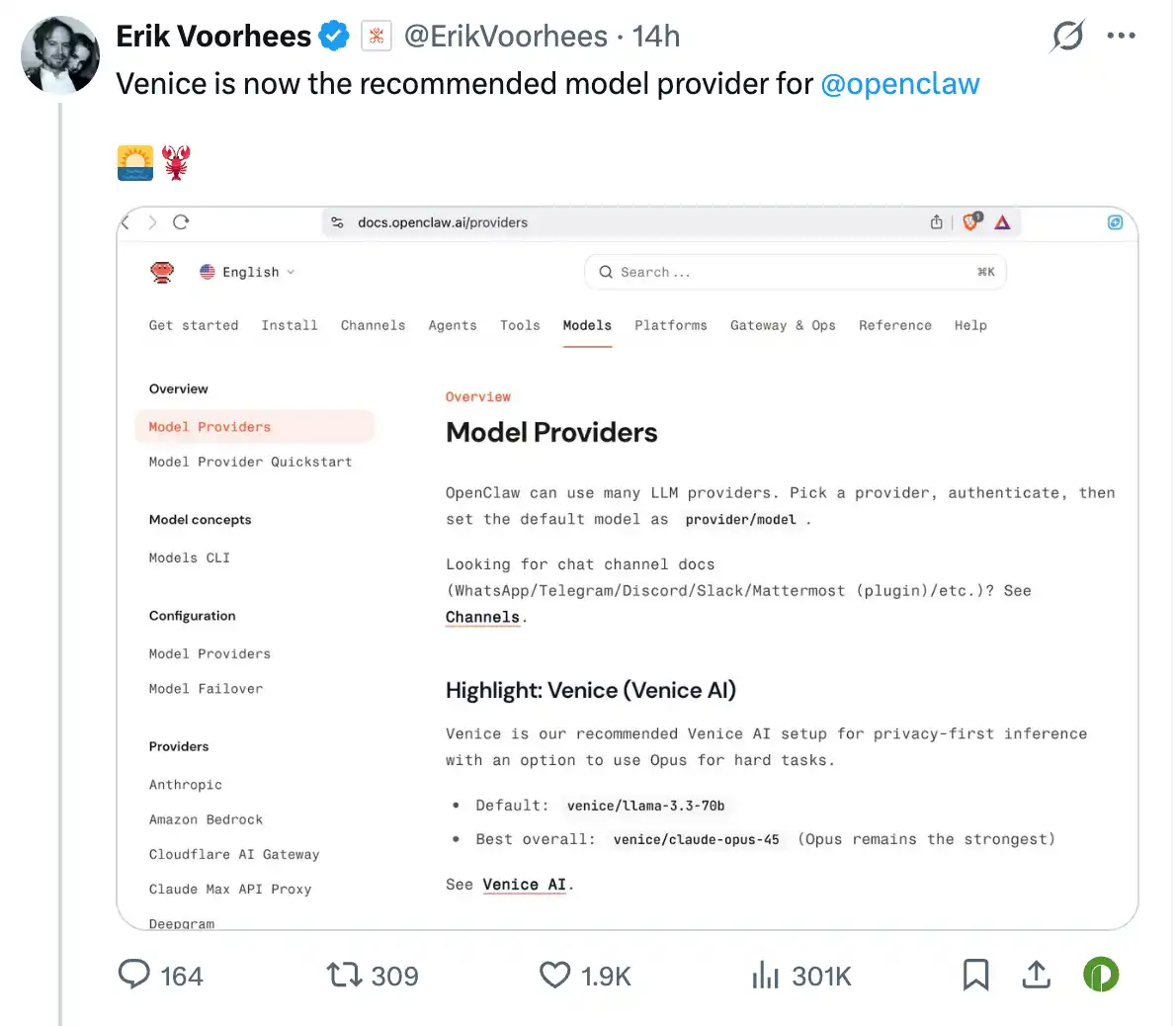
Last week, OpenClaw's founder's speech advising young people "not to waste time on cryptocurrency" sent a shockwave through the crypto industry. This week, however, a subtle reversal took place. In the official OpenClaw documentation, a crypto project with a native token, Venice.ai, was quietly listed as a recommended model provider. Over the past month, the price of Venice's native token, VVV, has risen from around $1.5 to a high near $8.4, marking a maximum increase of over 500%.
While on one hand discouraging, on the other hand integrating, why did OpenClaw specifically push a project with a cryptocurrency tokenomic structure to the forefront?
Venice's Background: A Crypto OG Doing AI, What Will It Become?
To understand Venice, one must first understand OpenClaw's positioning. It is an open-source self-hosted AI agent platform that can integrate with chat software to become a user's 24/7 private assistant, helping with tasks such as email communication and calendar management, but OpenClaw itself does not provide AI Large Language Model (LLM) capabilities, serving merely as an "execution and routing layer". True intelligence (thinking, planning, generating responses) must come from external model providers.
Venice is a privacy-focused, censorship-resistant generative AI platform, positioned as a decentralized version of ChatGPT. The project was launched in May 2024 without any fundraising, no VC rounds, entirely self-funded by founder Erik Voorhees.
Erik Voorhees himself is a crypto OG, entering the crypto industry in 2011. After the Mt. Gox collapse in 2014, he founded one of the earliest batches of exchange platforms emphasizing non-custodial and privacy-first principles, ShapeShift. In 2021, he chose to transition ShapeShift to DAO governance, completing its decentralization. His career trajectory seems to revolve around "reducing reliance on centralized structures."
Another key figure in the team is Teana Baker-Taylor, with an impressive background having served as an executive at HSBC, Circle, Binance, Crypto.com, overseeing operations and compliance. Most other team members remain anonymous or low-key. Based on current publicly available data, the Venice team consists of roughly around 20 members.
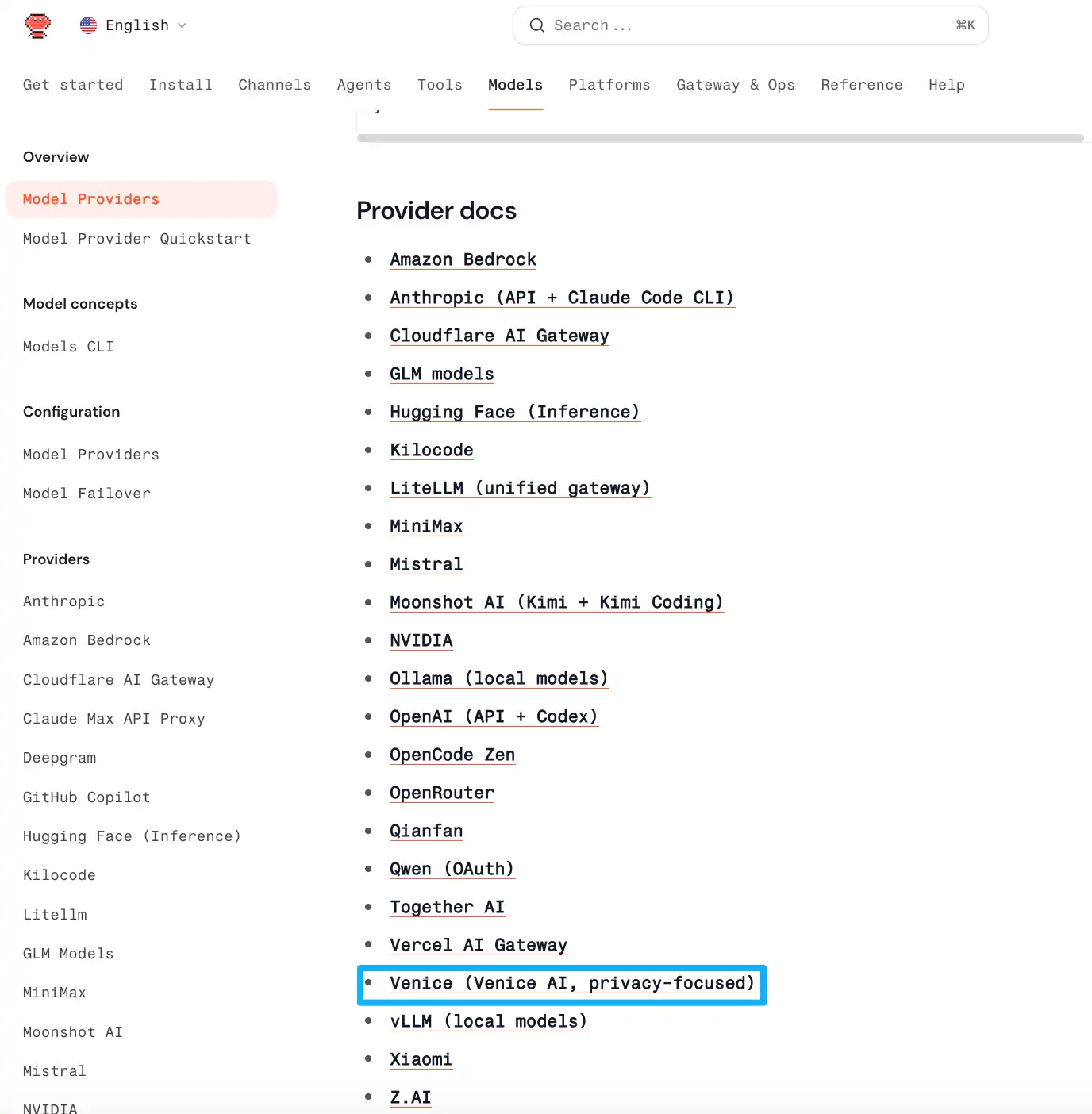
The current OpenClaw model provider lineup includes 22 companies, including major tech giants such as Amazon, Anthropic, and Cloudflare. In terms of scale and branding, Venice is clearly not the most prominent, and can even be said to be the least eye-catching. However, it was previously highlighted and recommended in the official documentation as a model provider with a native Tokenomics system. Nevertheless, it is possible that this highlighting was a documentation merge error, as the highlight has now been removed. However, Venice had already been listed as a model provider in OpenClaw's lineup at an earlier time.
However, why did OpenClaw choose such an inconspicuous small company? The answer is simple: privacy.
After all, while AI has seen great success, controversies surrounding data leaks and model training in the AI field have been steadily accumulating. Users are beginning to realize that the real risk lies not in whether the model is "smart" or not, but in whether the data or information will be leaked.
So, how did Venice achieve its privacy? Its core philosophy is "You don't have to protect what you do not have." In simple terms, Venice does not store any of the user's content—prompts, replies, generated images, uploaded documents—on any of Venice's servers. This data is only encrypted and stored locally in the user's own browser (or device). Once you clear your browser data or manually delete chat records, this content will be permanently gone.
Venice also explicitly states that it does not use user data for model training, does not log, and does not analyze behavior. This is a stark contrast to mainstream platforms (such as OpenAI, Anthropic), which often store conversations long-term for model improvement or regulatory review.
Furthermore, Venice distinguishes between two different privacy modes: Private and Anonymized. The former provides the highest privacy, using open-source models that run on decentralized GPUs without any identity-related information during processing. Even if the underlying computing nodes briefly see plaintext prompts, Venice itself does not see or have access to user history. The latter allows the underlying vendors to see the prompt content, but Venice strips away all metadata (IP, account fingerprints, historical associations), making it impossible for them to trace back to user information.
So, even though Venice may not be the most prominent on the provider list, its privacy architecture has made it the "privacy-first choice" highlighted in the OpenClaw documentation. Currently, OpenClaw's default model is Llama 3.3, but Erik himself suggests in a reply to users to switch to the more intelligent GLM 4.6.
What does this mean for Venice itself?
OpenClaw is now experiencing viral growth, with its call volume entering an exponential growth phase. With the official endorsement of OpenClaw, Venice's inference capacity demand may be raised to a new level. This means that Venice is undergoing a qualitative change. It will no longer just be "a crypto-backed AI project" but will be attempting to become the default privacy backend for the mainstream open-source agent ecosystem.
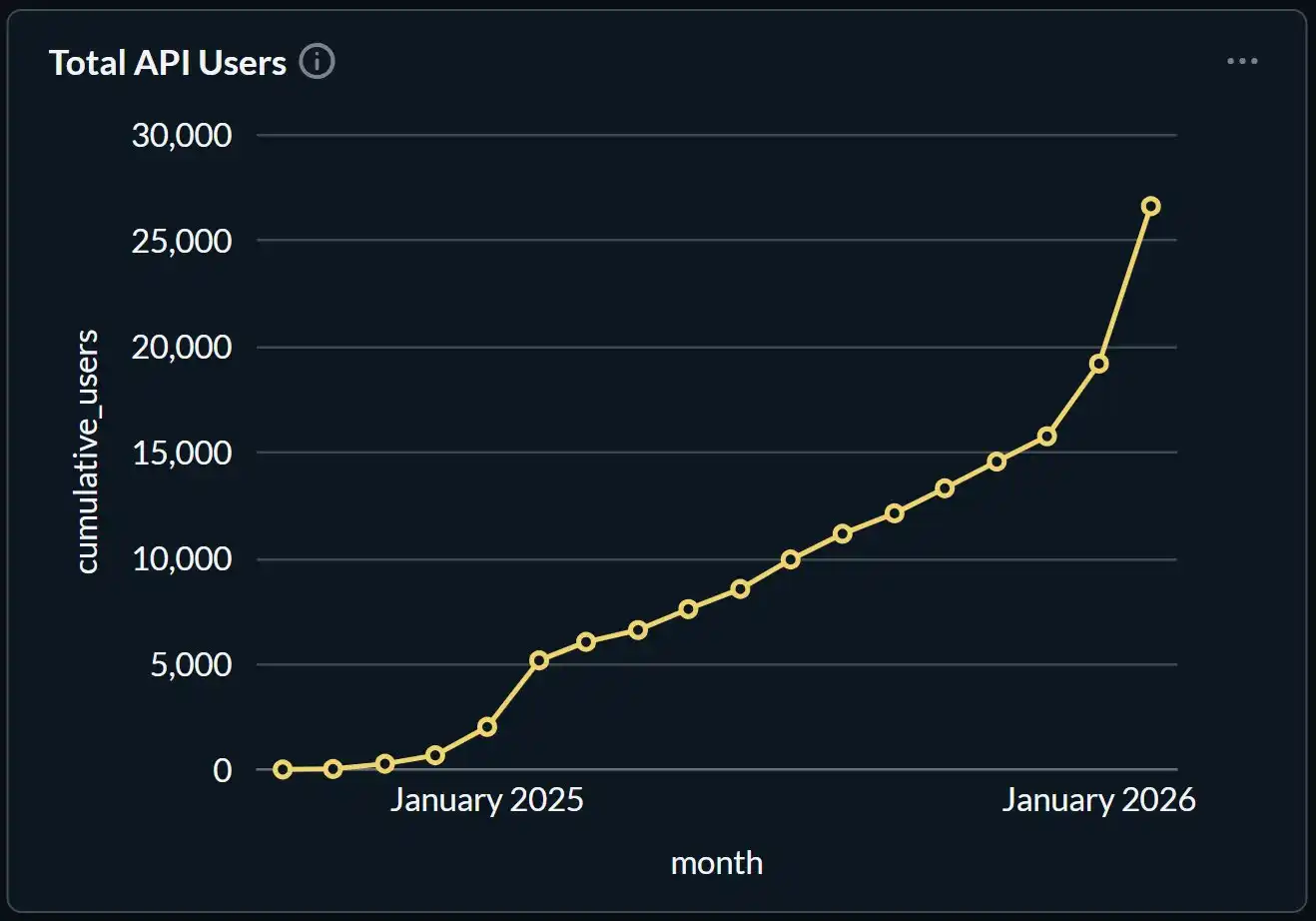
Based on the latest data announced by Erik on March 1st, since entering 2026, Venice's API user base has begun to grow rapidly, with over 25,000 users currently.
Tokenomics: One-time Investment, Lifetime Compute Power
As a crypto project, can its tokenomics withstand this level of traffic growth?
In the Venice ecosystem, there are two core Tokens: VVV and DIEM. They are closely linked through a "one-way mint + reversible redemption" mechanism, forming a two-tier economic structure.
VVV is the capital asset of the entire ecosystem, which can be held directly or staked. Staking VVV can continuously generate staking rewards, currently around 19% APY. Another key role of VVV is to mint IDEM and is the only way to generate DIEM.
After minting, DIEM can be taken to the secondary market for trading, such as on Aerodrome, Uniswap, and other DEXs. Or it can be staked to activate consumption credits. DIEM represents a permanently ownable AI computing asset, where 1 DIEM = $1 worth of Venice API credit per day, used for calling all of Venice's models (text generation, image/video generation, code, etc.), including the highest privacy non-reviewed models in Private mode, and this credit is permanently valid for you during your staking period, automatically renewed daily, equivalent to a permanent AI subscription voucher.
The $1 credit is quite abstract in the Venice ecosystem, as it is not a fixed "amount of tokens," but a reasoning resource that can consume $1 worth of value. The more expensive the model, the less content it generates; the cheaper the model, the more content it generates. This abstract pricing makes DIEM a "compute unit voucher." I had Venice's AI quantify the $1 credit for me:

Since traditional AI APIs are pay-as-you-go, for high-frequency, long-term, automated tasks (such as hundreds to thousands of AI Agent calls per day), costs can exponentially explode. However, Venice, through DIEM, completely overturns this into a one-time investment in exchange for a long-term fixed quota. Currently, 1 DIEM is worth approximately $670, and after staking, you automatically receive $1 worth of API credit per day. To easily compare whether purchasing IDEM is more cost-effective than traditional pay-as-you-go, I generated a rough table using Grok:
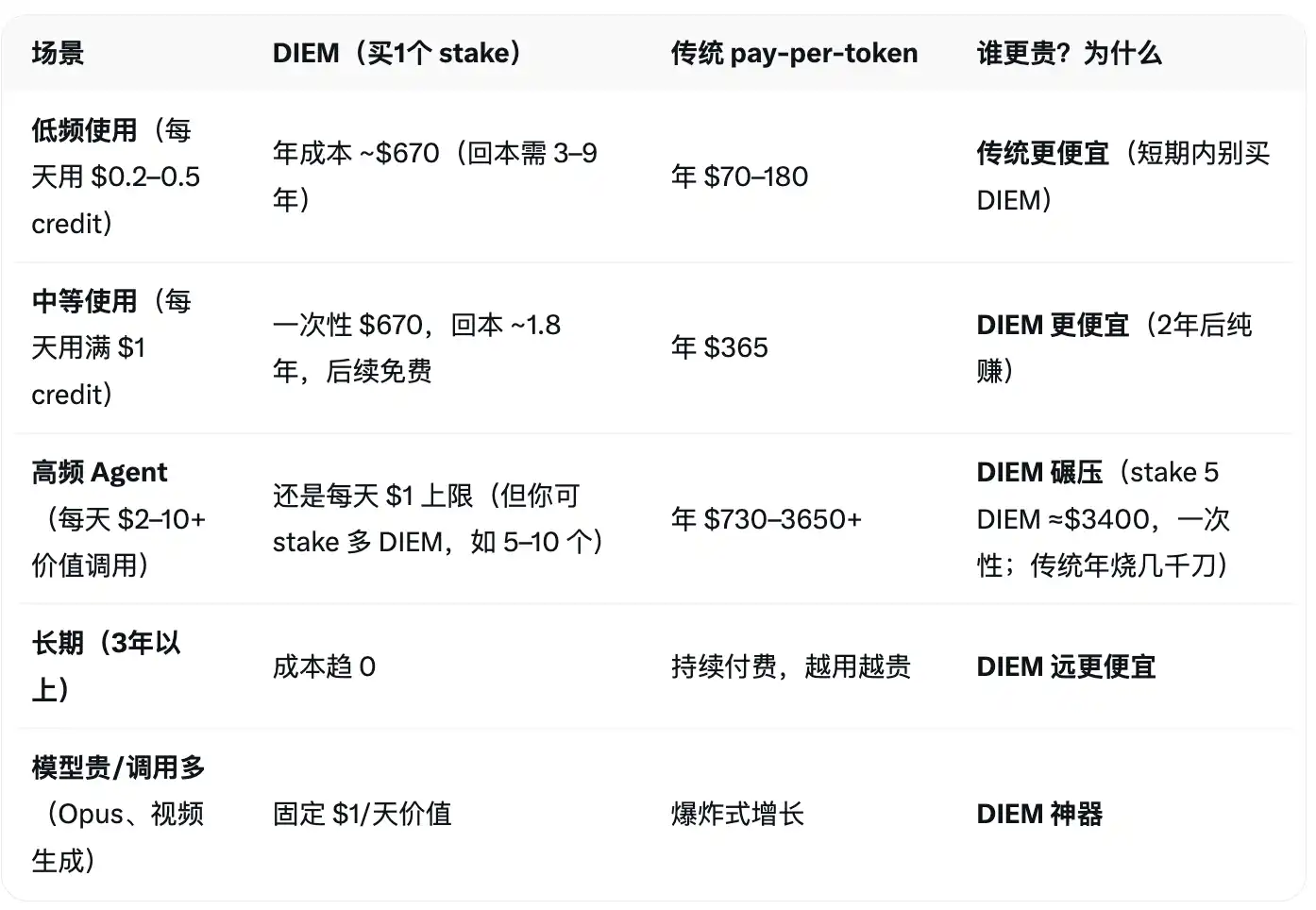
From the data above, for low-frequency users, there is no need to purchase DIEM at all. For medium to high-frequency users who need to run the agent daily, generate large amounts of content, the long-term marginal cost will continue to decrease, giving IDEM a clear advantage.
Some users have come forward, stating that by staking 56 DIEM, they can use the Claude Opus 4.6 model all day, with the principal being less than $10,000.
Moreover, community users have already developed a credit leasing market, where freely idle credits can be put up for sale: cheaptokens.ai. The computational power ecosystem market around Venice is sprouting.
Overall, the core of Venice's economic model lies in separating the "growth logic" from the "usage logic." VVV, as a pure growth asset, carries the overall platform valuation narrative, directly benefiting from user growth, network effects, ecosystem expansion, and other positive flywheels; DIEM, as a permanent subscription-type functional asset, truly serves product usage and value consumption, undertaking the consumption logic of daily interactions and task execution.
From the current data performance, DIEM demonstrates a significant advantage in long-term, high-frequency, and continuous task scenarios, aligning well with the current agent-driven intensive usage pattern. This strong real demand can, in turn, effectively stimulate users' willingness to stake VVV, forming a positive loop from the user end to the growth end.
Supply and Deflation: The True Background of Price Surge
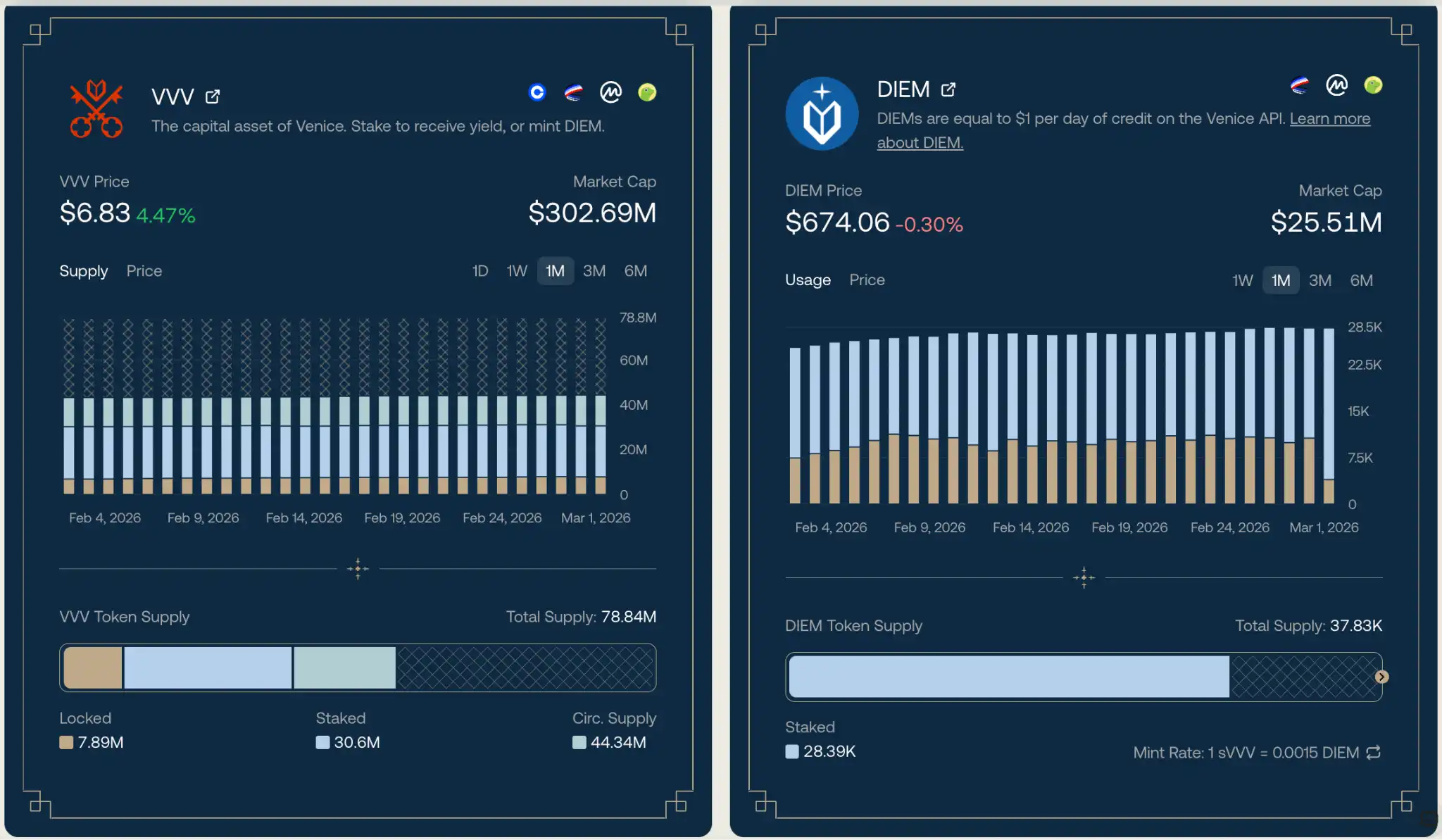
According to data from the Venice official website, the current total token supply is 78.84 million, with 7.89 million locked, 30.6 million staked, resulting in a staking ratio of 38.8%, and a circulating supply of only 44.34 million. In the initial economic model, the total supply of VVV tokens was 100 million, with 50% allocated for community airdrops targeting early Venice users, AI projects, etc. The airdrop distribution window lasted for about 45 days, with over 40,000 people ultimately claiming 17.4 million VVV, approximately 35% of the community allocation. The remaining unclaimed portion was about 32.68 million VVV, valued at around 100 million USD at the time. The team ultimately decided to permanently burn this portion to reduce the circulating supply and enhance scarcity.
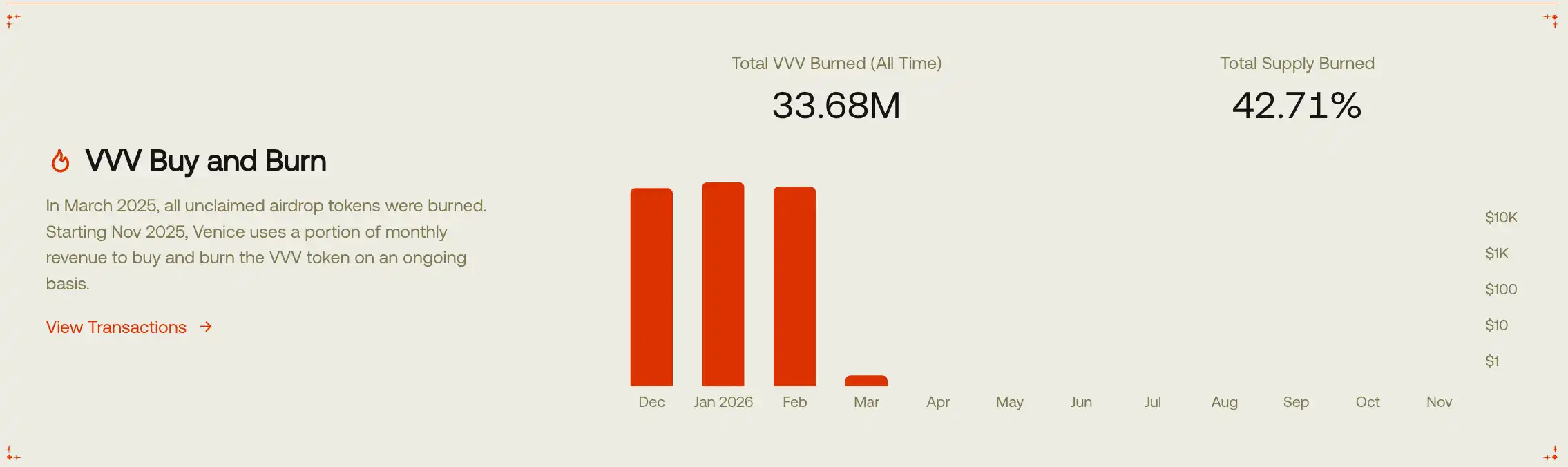
Starting from October 2025, Venice announced a reduction in the original emission plan from 10 million VVV/year to 8 million VVV/year, while also initiating a monthly revenue buyback and burn mechanism. The current monthly burn capacity ranges from 30,000 to 50,000 tokens, valued at approximately 60,000 to 90,000 USD. Currently, 42.71% of the token supply has been burned. In early February 2026, the official announcement once again proposed an emission reduction plan, reducing the annual emission to 6 million VVV/year from 8 million VVV/year. These series of adjustments directly altered the supply expectations. Judging from the token's price performance, this was also the starting point for VVV's price surge.
Therefore, the rise of VVV is not merely narrative-driven but a combination of changes in the supply structure and growing demand.
Conclusion
As AI becomes the center of the narrative of our times, is Crypto really exiting? Venice is trying to provide its own answer. If future intelligent agent systems require a privacy back end, if Agents need a long-term stable computing power structure, then perhaps cryptographic logic has not disappeared.
You may also like

22x Subsidy to 1 USD Revenue: How Long Can the TAO Growth Myth Last?

Use the Claude Wisely, One Piece is Enough

Netflix is Set to Bring FTX's Story to the Screen: Portraying History or Glamorizing a Scam?

People unable to buy Anthropic have driven its shadow stock up 16x

LALIGA Match Report: Vinícius scores as 10-man Real Madrid secure a 3-2 comeback victory in Madrid derby
In the early hours of March 23, 2026, Round 29 of LALIGA delivered a headline clash at the Santiago Bernabéu. Real Madrid hosted their local rivals, Atlético de Madrid, in a high-stakes encounter. Under referee José Munuera, the match unfolded at a fierce pace, packed with physical duels and momentum swings. After a five-goal thriller, Real Madrid held firm for a 3–2 home win, taking all three points. They remain second on 69 points, now four behind leaders Barcelona.
From a numbers standpoint, Real Madrid stayed composed under pressure, completing 526 passes with a 52.4% share of possession. Atlético struck first in the 33rd minute through Lookman. After the break, Real Madrid flipped the game: Vinícius converted a penalty to level, then Valverde fired them ahead. Molina pulled Atlético back on level terms, but Vinícius stepped up again in the 72nd minute to seal the win. Late drama followed as Valverde saw red, forcing Real Madrid to defend deep with ten men through the final stretch. Atlético's aggressive approach—12 fouls and 4 yellow cards—kept the pressure on, but they couldn’t stop the comeback.
WEEX Insights: As the official LALIGA partner in the Hong Kong and Taiwan regions, WEEX sees this win as a masterclass in control under pressure. Even after a red card and constant attacks, Real Madrid stayed sharp and executed with precision. That same discipline—staying calm in volatile moments and acting with clarity—reflects the core trading mindset WEEX stands for. LALIGA fan campaigns are coming soon—celebrate the game with WEEX.
About WEEX
Founded in 2018, WEEX has developed into a global crypto exchange with over 6.2 million users across more than 150 countries. The platform emphasizes security, liquidity, and usability, providing over 1,200 spot trading pairs and offering up to 400x leverage in crypto futures trading. In addition to the traditional spot and derivatives markets, WEEX is expanding rapidly in the AI era — delivering real-time AI news, empowering users with AI trading tools, and exploring innovative trade-to-earn models that make intelligent trading more accessible to everyone. Its 1,000 BTC Protection Fund further strengthens asset safety and transparency, while features such as copy trading and advanced trading tools allow users to follow professional traders and experience a more efficient, intelligent trading journey.
Follow WEEX on social media
X: @WEEX_Official
Instagram: @WEEX Exchange
Tiktok: @weex_global
Youtube: @WEEX_Official
Discord: WEEX Community
Telegram: WeexGlobalGroup

LALIGA Match Report: Araujo seals 1–0 win as Barça tighten grip on top spot
In the early hours of March 22 (Beijing Time), Barça edged Rayo Vallecano 1–0 at Camp Nou in a key Round 29 clash. The hard-earned win lifts Barça to 73 points, strengthening their hold on first place.
Barça controlled the game with 61% possession and a sharp 89% passing accuracy (460 passes). Rayo pushed back with intensity, earning 9 corners, but Barça's defense stayed solid. Yellow cards for Raphinha, Yamal, and Cubarsí highlighted the physical edge of the match. Second-half subs like Rashford and Olmo added fresh energy to help see out the result. Rayo remain 14th on 32 points.
WEEX Insights: As the Official LALIGA Partner in HK & TW, WEEX sees Barça’s 89% passing accuracy as a clear example of high execution with minimal error. Staying precise under pressure and finding the breakthrough reflects the same disciplined approach used in rational trading.
LALIGA interactive campaigns are coming soon—stay tuned with WEEX ⚽️
About WEEX
Founded in 2018, WEEX has developed into a global crypto exchange with over 6.2 million users across more than 150 countries. The platform emphasizes security, liquidity, and usability, providing over 1,200 spot trading pairs and offering up to 400x leverage in crypto futures trading. In addition to the traditional spot and derivatives markets, WEEX is expanding rapidly in the AI era — delivering real-time AI news, empowering users with AI trading tools, and exploring innovative trade-to-earn models that make intelligent trading more accessible to everyone. Its 1,000 BTC Protection Fund further strengthens asset safety and transparency, while features such as copy trading and advanced trading tools allow users to follow professional traders and experience a more efficient, intelligent trading journey.
Follow WEEX on social media
X: @WEEX_Official
Instagram: @WEEX Exchange
Tiktok: @weex_global
Youtube: @WEEX_Official
Discord: WEEX Community
Telegram: WeexGlobalGroup
These days, even hackers are losing money
Arm Chips In-House: Rewire News Brief

IOSG: Stablecoin Reshaping Asia Cross-Border Payments? Strategic Landscape and Investment Opportunities Analysis

\$73 Billion OpenAI Aims for IPO: Drops Sora, Snubs Disney, Puts Microsoft in Risk Factors

The Chip Industry's Most Secure Middleman Just Took a Very Risky Turn

CZ's Latest Interview: My Experience is Replicable, Writing a Book to Inspire Young Entrepreneurs

Morning News | Invesco acquires a $900 million on-chain fund from Superstate; ParaFi has raised $125 million for its new fund; Solana Foundation launches developer platform SDP

What is the background of this new fund that the two major prediction market platforms have rarely joined forces to create?

SIREN, another leveraged scam

Token has become extremely popular, and the blockchain is very sad

Tether's major shareholder invests £12 million to support the "British version of Trump" in the cryptocurrency sector

Huang Renxun's Latest Podcast: Will NVIDIA Reach $1 Trillion? Will the Number of Programmers Increase Instead of Decrease? How to Deal with AI Anxiety?
22x Subsidy to 1 USD Revenue: How Long Can the TAO Growth Myth Last?
Use the Claude Wisely, One Piece is Enough
Netflix is Set to Bring FTX's Story to the Screen: Portraying History or Glamorizing a Scam?
People unable to buy Anthropic have driven its shadow stock up 16x
LALIGA Match Report: Vinícius scores as 10-man Real Madrid secure a 3-2 comeback victory in Madrid derby
In the early hours of March 23, 2026, Round 29 of LALIGA delivered a headline clash at the Santiago Bernabéu. Real Madrid hosted their local rivals, Atlético de Madrid, in a high-stakes encounter. Under referee José Munuera, the match unfolded at a fierce pace, packed with physical duels and momentum swings. After a five-goal thriller, Real Madrid held firm for a 3–2 home win, taking all three points. They remain second on 69 points, now four behind leaders Barcelona.
From a numbers standpoint, Real Madrid stayed composed under pressure, completing 526 passes with a 52.4% share of possession. Atlético struck first in the 33rd minute through Lookman. After the break, Real Madrid flipped the game: Vinícius converted a penalty to level, then Valverde fired them ahead. Molina pulled Atlético back on level terms, but Vinícius stepped up again in the 72nd minute to seal the win. Late drama followed as Valverde saw red, forcing Real Madrid to defend deep with ten men through the final stretch. Atlético's aggressive approach—12 fouls and 4 yellow cards—kept the pressure on, but they couldn’t stop the comeback.
WEEX Insights: As the official LALIGA partner in the Hong Kong and Taiwan regions, WEEX sees this win as a masterclass in control under pressure. Even after a red card and constant attacks, Real Madrid stayed sharp and executed with precision. That same discipline—staying calm in volatile moments and acting with clarity—reflects the core trading mindset WEEX stands for. LALIGA fan campaigns are coming soon—celebrate the game with WEEX.
About WEEX
Founded in 2018, WEEX has developed into a global crypto exchange with over 6.2 million users across more than 150 countries. The platform emphasizes security, liquidity, and usability, providing over 1,200 spot trading pairs and offering up to 400x leverage in crypto futures trading. In addition to the traditional spot and derivatives markets, WEEX is expanding rapidly in the AI era — delivering real-time AI news, empowering users with AI trading tools, and exploring innovative trade-to-earn models that make intelligent trading more accessible to everyone. Its 1,000 BTC Protection Fund further strengthens asset safety and transparency, while features such as copy trading and advanced trading tools allow users to follow professional traders and experience a more efficient, intelligent trading journey.
Follow WEEX on social media
X: @WEEX_Official
Instagram: @WEEX Exchange
Tiktok: @weex_global
Youtube: @WEEX_Official
Discord: WEEX Community
Telegram: WeexGlobalGroup
LALIGA Match Report: Araujo seals 1–0 win as Barça tighten grip on top spot
In the early hours of March 22 (Beijing Time), Barça edged Rayo Vallecano 1–0 at Camp Nou in a key Round 29 clash. The hard-earned win lifts Barça to 73 points, strengthening their hold on first place.
Barça controlled the game with 61% possession and a sharp 89% passing accuracy (460 passes). Rayo pushed back with intensity, earning 9 corners, but Barça's defense stayed solid. Yellow cards for Raphinha, Yamal, and Cubarsí highlighted the physical edge of the match. Second-half subs like Rashford and Olmo added fresh energy to help see out the result. Rayo remain 14th on 32 points.
WEEX Insights: As the Official LALIGA Partner in HK & TW, WEEX sees Barça’s 89% passing accuracy as a clear example of high execution with minimal error. Staying precise under pressure and finding the breakthrough reflects the same disciplined approach used in rational trading.
LALIGA interactive campaigns are coming soon—stay tuned with WEEX ⚽️
About WEEX
Founded in 2018, WEEX has developed into a global crypto exchange with over 6.2 million users across more than 150 countries. The platform emphasizes security, liquidity, and usability, providing over 1,200 spot trading pairs and offering up to 400x leverage in crypto futures trading. In addition to the traditional spot and derivatives markets, WEEX is expanding rapidly in the AI era — delivering real-time AI news, empowering users with AI trading tools, and exploring innovative trade-to-earn models that make intelligent trading more accessible to everyone. Its 1,000 BTC Protection Fund further strengthens asset safety and transparency, while features such as copy trading and advanced trading tools allow users to follow professional traders and experience a more efficient, intelligent trading journey.
Follow WEEX on social media
X: @WEEX_Official
Instagram: @WEEX Exchange
Tiktok: @weex_global
Youtube: @WEEX_Official
Discord: WEEX Community
Telegram: WeexGlobalGroup


 App
App