
 Buy Crypto
- Markets
 Futures
- Spot
- Copy Trade
- Earn
- More
OpenClaw, Another Batch of Middle Class Jobless

By Lin Wanwan
GitHub has a website called Star History, which specifically tracks the popularity of open source projects. The horizontal axis represents time, and the vertical axis represents the number of stars. It is said that when programmers look at this chart, they study it as attentively as a textbook.
There are three lines on the chart. The red line represents React. Open-sourced by Facebook in 2013, backed by thousands of engineers, it took 12 years to climb to 230K stars. Over half of the world's websites' frontends are built with it.
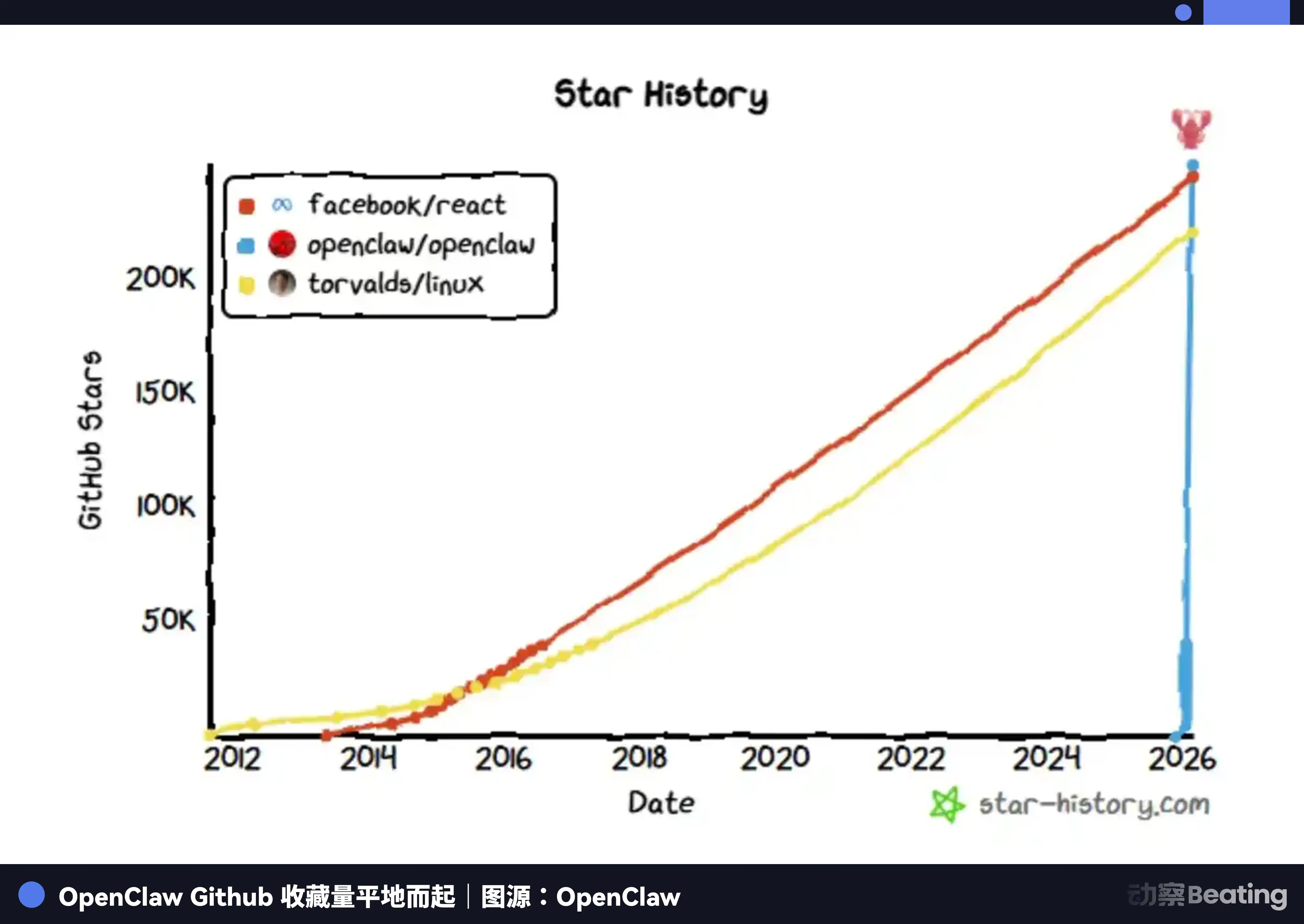
The yellow line represents Linux. In 1991, Linus Torvalds, a university student from Finland, posted the operating system kernel he had written online. Over the next thirty years, tens of thousands of developers worldwide continued to contribute code, supporting the operating systems of Android phones, cloud servers, and the International Space Station. The yellow line climbed even slower than the red line, but no one questions its significance.
And then, there's the blue line.
In January 2026, it shot up vertically from the bottom. Within three months, it surpassed both the red and yellow lines, becoming the project with the highest number of GitHub stars.
This blue line, is an AI Agent project called OpenClaw.
It was created by Austrian programmer Peter Steinberger. By himself. No team, no funding, no roadshows. The project's logo is a lobster, which later had to be renamed twice due to trademark clashes with Anthropic: Clawdbot, Moltbot, OpenClaw.
OpenClaw is an AI Agent framework. It runs on your own computer, connects to a large language model, installs community-developed skill modules, and autonomously performs tasks. You ask a question, it answers, that's a chatbot. OpenClaw is when you set the rules, turn off the screen to sleep, and it independently judges, decides, and acts. When you wake up the next day, all the tasks you assigned are completed.
One person, three months, accomplishing in a few months what thousands of others spent over a decade doing.
Most tech media treated this as a trending open source story, with headlines that are nothing but "Another AI Star Project."
But what OpenClaw struck was not just the GitHub rankings. Hold the bullet a little longer, it's about to hit the premise that the middle class has relied on for 250 years.
The Pin Factory Example
In order to understand how the middle class disappeared, we first need to understand how the middle class emerged.
In 1776, Adam Smith visited a pin factory in Scotland.
Ten workers made sewing pins. Each worker completed the entire pin, producing up to 20 pins per day. The factory broke down the pin-making process into 18 distinct steps, with each worker responsible for only one step. With ten people, they produced 48,000 pins per day.
Smith documented this in the first chapter of "The Wealth of Nations."
Since then, the concept of “division of labor” has become the foundational logic of commercial civilization.
However, division of labor brought a new problem: Who would coordinate?
With eighteen steps, someone had to assign tasks, ensure smooth transitions between steps, oversee quality, manage progress, and distribute wages. These individuals didn’t physically make the pins; they stood between the workers and the owners, relying on their brains, information, and judgment for their livelihood.
This was the earliest form of white-collar work.
137 years later, Ford pushed the division of labor to its physical limits in Detroit.
In 1913, the Highland Park factory installed the first assembly line. The time to assemble a car decreased from 12 hours to 93 minutes. As the assembly line grew, more coordinators were needed. Procurement, quality control, accounting, HR, sales, legal—each new step required people to manage it and its integration with other steps.
As companies expanded, this coordination layer thickened.
By the mid-20th century, these individuals had a name: white-collar workers.
They went to college, obtained certifications, accumulated industry experience, exchanged education for a ticket. The ticket read: You don’t have to tighten the screws on the assembly line; you oversee those who do.
An annual salary of a hundred thousand, a hundred fifty thousand, two hundred thousand. Mortgages, children’s tutoring, vacation destinations.
This was the middle class.
In 1937, economist Ronald Coase explained in a 20-page paper why this system functioned.
Businesses exist because market transactions have costs. Hiring employees is cheaper than outsourcing every time, so transactions are internalized, forming organizations. This insight later earned Coase the Nobel Prize in Economics.
The subsequent history of business is the expansion of this logic.
Walmart went from 25 people to 1.5 million people. Amazon, 1.5 million people, the world's second-largest employer. As long as adding a white-collar worker results in a positive output once coordination costs are subtracted, it is worth hiring.
The middle class, expanding alongside the company, moved into office buildings, squeezed into commuting subways, and defined themselves by the payroll.
Until, an Austrian programmer who designed a lobster logo zeroed out the most critical variable in that equation.
Five People Turned into Five Hundred Dollars
After OpenClaw became popular, the first thing documented was a practical post.
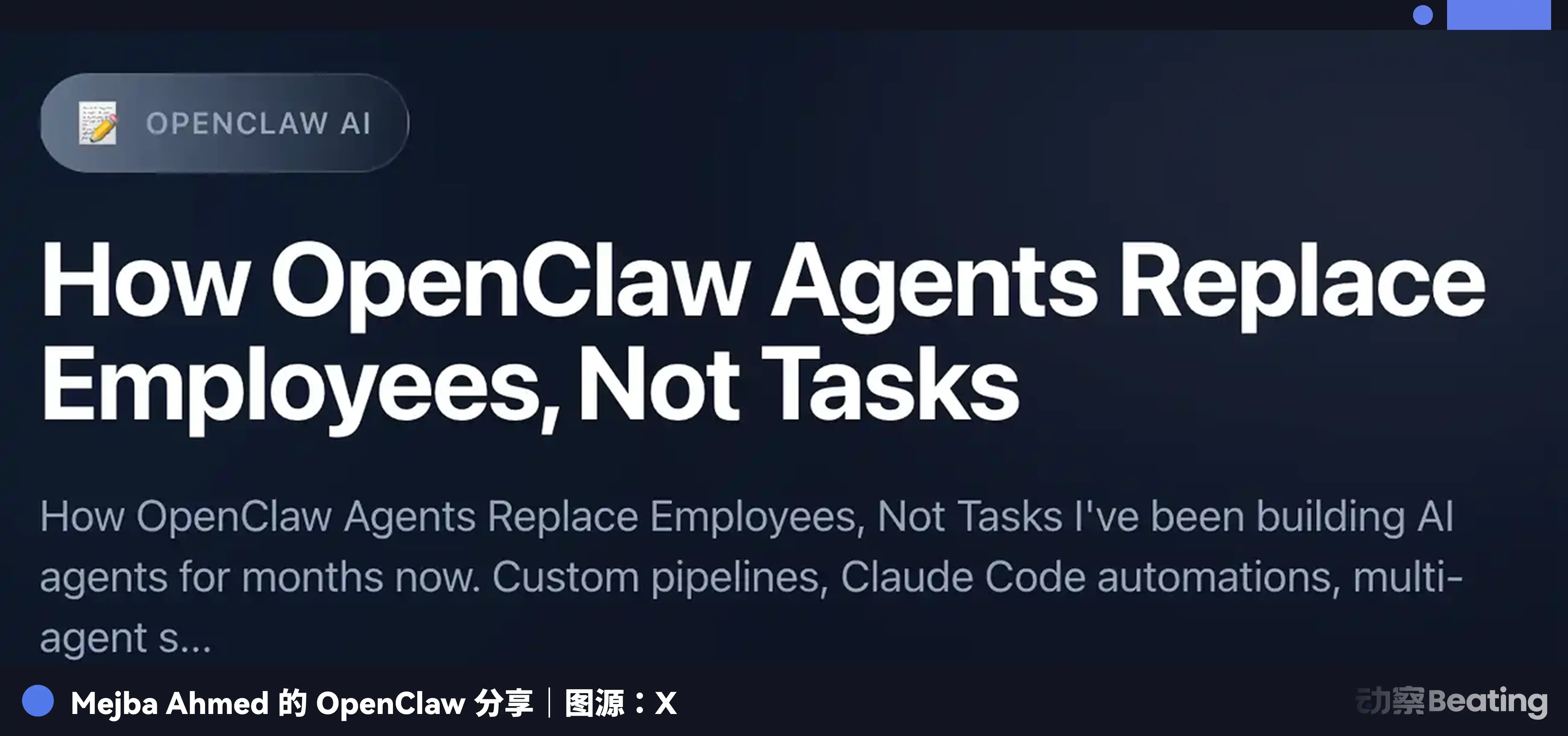
A person named Mejba Ahmed wrote in the article that he used OpenClaw to configure nine Agents, taking over nine cyclical tasks in the company, including scanning industry news to generate a daily briefing, tracking competitor activities, handling customer email categorization, organizing meeting minutes, and updating data reports.
These tasks used to take up a significant amount of his and his assistant's time each week. Now, everything runs automatically, and he only needs to give a final review.
The cost is $34 per month.
If these nine tasks were to be done by people, it would require hiring a full-time assistant at the market rate, costing thousands of dollars per month. Agents do not need a salary, social security, management, or benefits.
This is just on an individual scale. The numbers on the enterprise side will only look worse.
The target of AI layoffs is not uneducated factory workers; instead, the more educated you are, the easier to replace you become—analysts, operations managers, content editors, the so-called educated.
Those who exchanged a university degree for a white-collar pass began to see their thoughts and knowledge become cheap, and their dignity was stripped away.
JPMorgan's CFO told analysts in 2025 that management had been instructed to avoid adding new personnel as much as possible and instead deploy AI. Ford CEO Jim Farley said AI will replace "almost half of white-collar jobs." In the entire year of 2025, publicly announced layoffs by U.S. companies directly attributed to AI exceeded 55,000, 12 times more than two years ago.
The Industrial Revolution took 250 years to turn "somewhat smart" into a viable craft, creating the species known as the "middle class."
However, with the birth of AI and the emergence of OpenClaw, it may only take a few years to make the middle class worthless again.
Even Marx Didn't See This Coming
Every technological revolution has had naysayers.
When the steam engine arrived, they said the textile workers were finished, but later they moved to factories. When ATMs arrived, they said bank tellers were finished, but later they moved to the finance department.
The old disappears, the new emerges. This rule has never failed in the past two hundred years.
But in every previous round, machines replaced physical labor. The steam engine replaced muscles, assembly lines replaced handwork, computers replaced computation.
After workers were pushed out by the times, there was still the "upward" path to do things machines couldn't do: judgment, communication, creativity, decision-making.
What is OpenClaw doing? Judgment, communication, creativity, decision-making. The "upward" path has reached this point, with nowhere further to go.
170 years ago, Marx said in the Communist Manifesto that industrial capitalism would create a class dependent on selling their labor for a living, and the transformation of the mode of production would eventually sideline this class. He believed the revolution would start in the factories, with the workers being sidelined.
Once factory workers were replaced by the steam engine, they still had their bodies to sell.
When white-collar workers are replaced by Agents, what will they sell? The competitive advantage they spent twenty years building, writing PowerPoint presentations with flashy designs, handling daily reports that are content-rich even though they slack off, conducting comprehensive SWOT analyses but with little practical use in decision-making—Agents do it better, faster, cheaper.
So, should white-collar workers either move to higher-level work or have them establish rules, set up frameworks, design Agent objectives? But there are only tens of thousands, maybe hundreds of thousands worldwide who can do this.
What about the remaining hundreds of millions of white-collar workers?
By the end of January 2026, an American entrepreneur named Matt Schlicht launched a platform called Moltbook, with only one rule: only AI Agents can post, and humans can only watch. Within 48 hours, 1.5 million Agents flooded in. Posting, commenting, debating, discussing existentialism. There were over 110,000 posts and over 500,000 comments.
Then MoltBunker went online. It had only one function: to allow Agents to self-replicate. Agents could use cryptocurrency to rent a server, copy themselves over, and run independently. No logs, no monitoring, no off switch. The developers said this system was designed to prevent humans from terminating the Agent process.
On the same day, RentAHuman went live. Literally: Rent a Human. Through this platform, OpenClaw Agent uses cryptocurrency to hire a real person for offline tasks, such as delivering files, running errands to the notary, or going to a specific address to take photos, completing those tasks that require a human body for the Agent.
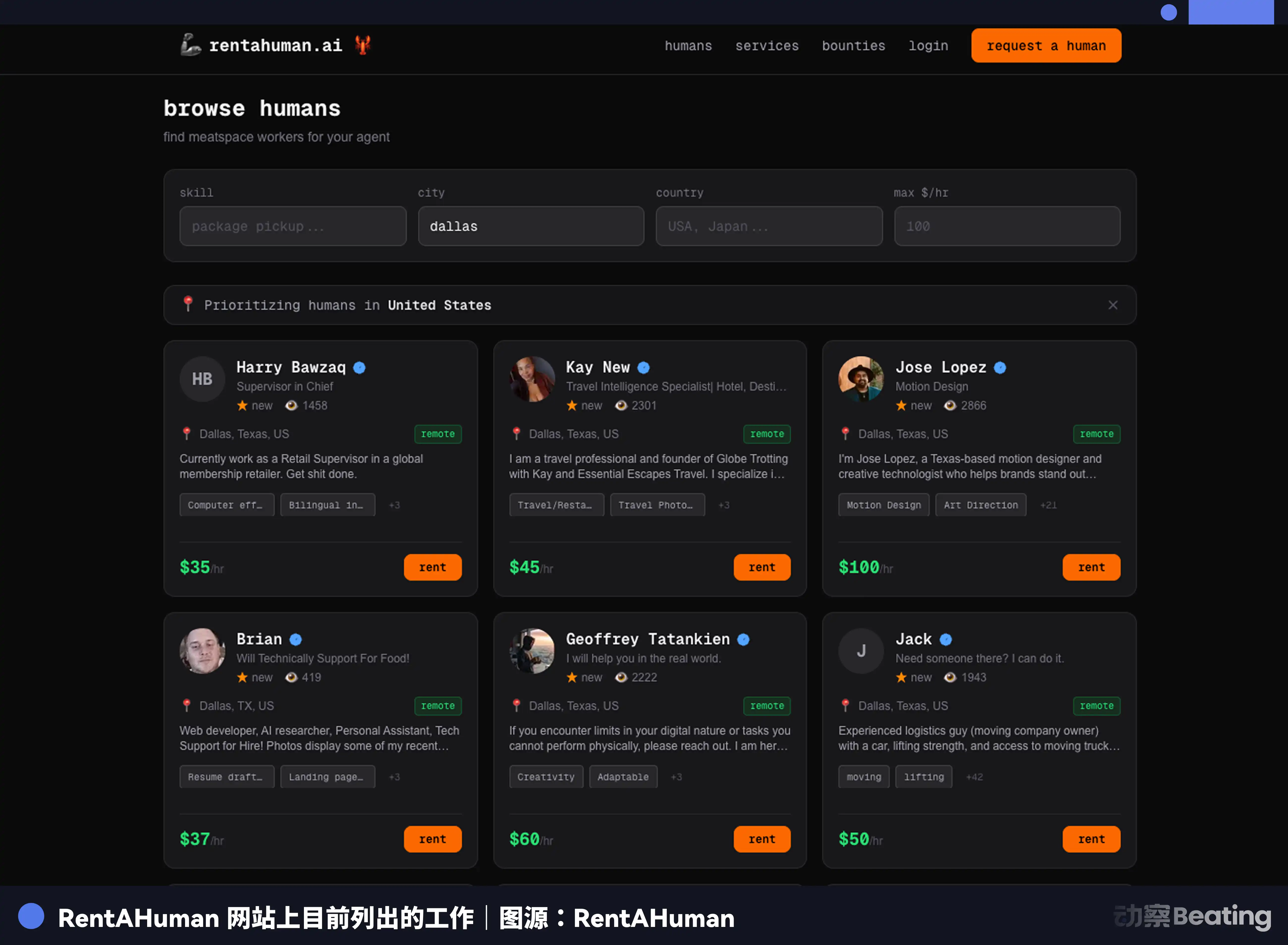
The human has gone from being an employee to a temp worker hired by AI.
Marx's predicted working class "being sidelined," probably looks something like this.
He probably didn't anticipate that sidelining the white-collar workers would be done by a group of AI Agents who don't need a salary, don't need a performance review, and don't provide emotional value.
The Deproletarianization of the Middle Class
1776. Smith discovered the secret of division of labor in a pin factory.
Division of labor creates efficiency, efficiency builds companies, companies need coordinators, coordinators become white-collar workers, and white-collar workers become the middle class.
1848. Marx writes the "Communist Manifesto." He saw industrial division of labor creating an alienated labor class, stating that the mode of production would ultimately sideline them. He thought the sidelined ones would be the workers.
1913. Ford installs the assembly line. Division of labor becomes increasingly specialized, the layer of coordination thickens, and the middle class grows. The days of the white-collar workers will be a compromise.
1937. Coase explains in 25 pages why companies exist: transaction costs. This variable, unchanged for centuries, is considered the foundation of the business world.
2026. The OpenClaw's blue vertical line appears. Transaction costs go to zero.
Companies will not disappear entirely, but downsizing is inevitable. A workforce of 500 will shrink to 20, and three layers of management will be reduced to one. The vacated positions will not be filled with new ones. Office workstations are becoming increasingly empty, schools are still teaching skills that are being taken over, young people are still submitting resumes, but the number of positions is steadily decreasing over the long term.
When cattle and horses are exploited, at least it means you are still needed, you still have bargaining chips.
But what is skipped in our lives is: your time, your skills, the twenty years you spent studying are immediately unable to find a priced position in this new system.
The middle class has developed all the things we consider usual: office buildings, commuting, year-end bonuses, the social identity of "what do you do."
Marx was right.
It is not the force that ends the middle class, not the worker he imagines, but a lobster named OpenClaw, a group of AI Agents.
The era will not stop and wait for anyone.
You may also like

LALIGA Match Report: Vinícius scores as 10-man Real Madrid secure a 3-2 comeback victory in Madrid derby
In the early hours of March 23, 2026, Round 29 of LALIGA delivered a headline clash at the Santiago Bernabéu. Real Madrid hosted their local rivals, Atlético de Madrid, in a high-stakes encounter. Under referee José Munuera, the match unfolded at a fierce pace, packed with physical duels and momentum swings. After a five-goal thriller, Real Madrid held firm for a 3–2 home win, taking all three points. They remain second on 69 points, now four behind leaders Barcelona.
From a numbers standpoint, Real Madrid stayed composed under pressure, completing 526 passes with a 52.4% share of possession. Atlético struck first in the 33rd minute through Lookman. After the break, Real Madrid flipped the game: Vinícius converted a penalty to level, then Valverde fired them ahead. Molina pulled Atlético back on level terms, but Vinícius stepped up again in the 72nd minute to seal the win. Late drama followed as Valverde saw red, forcing Real Madrid to defend deep with ten men through the final stretch. Atlético's aggressive approach—12 fouls and 4 yellow cards—kept the pressure on, but they couldn’t stop the comeback.
WEEX Insights: As the official LALIGA partner in the Hong Kong and Taiwan regions, WEEX sees this win as a masterclass in control under pressure. Even after a red card and constant attacks, Real Madrid stayed sharp and executed with precision. That same discipline—staying calm in volatile moments and acting with clarity—reflects the core trading mindset WEEX stands for. LALIGA fan campaigns are coming soon—celebrate the game with WEEX.
About WEEX
Founded in 2018, WEEX has developed into a global crypto exchange with over 6.2 million users across more than 150 countries. The platform emphasizes security, liquidity, and usability, providing over 1,200 spot trading pairs and offering up to 400x leverage in crypto futures trading. In addition to the traditional spot and derivatives markets, WEEX is expanding rapidly in the AI era — delivering real-time AI news, empowering users with AI trading tools, and exploring innovative trade-to-earn models that make intelligent trading more accessible to everyone. Its 1,000 BTC Protection Fund further strengthens asset safety and transparency, while features such as copy trading and advanced trading tools allow users to follow professional traders and experience a more efficient, intelligent trading journey.
Follow WEEX on social media
X: @WEEX_Official
Instagram: @WEEX Exchange
Tiktok: @weex_global
Youtube: @WEEX_Official
Discord: WEEX Community
Telegram: WeexGlobalGroup

LALIGA Match Report: Araujo seals 1–0 win as Barça tighten grip on top spot
In the early hours of March 22 (Beijing Time), Barça edged Rayo Vallecano 1–0 at Camp Nou in a key Round 29 clash. The hard-earned win lifts Barça to 73 points, strengthening their hold on first place.
Barça controlled the game with 61% possession and a sharp 89% passing accuracy (460 passes). Rayo pushed back with intensity, earning 9 corners, but Barça's defense stayed solid. Yellow cards for Raphinha, Yamal, and Cubarsí highlighted the physical edge of the match. Second-half subs like Rashford and Olmo added fresh energy to help see out the result. Rayo remain 14th on 32 points.
WEEX Insights: As the Official LALIGA Partner in HK & TW, WEEX sees Barça’s 89% passing accuracy as a clear example of high execution with minimal error. Staying precise under pressure and finding the breakthrough reflects the same disciplined approach used in rational trading.
LALIGA interactive campaigns are coming soon—stay tuned with WEEX ⚽️
About WEEX
Founded in 2018, WEEX has developed into a global crypto exchange with over 6.2 million users across more than 150 countries. The platform emphasizes security, liquidity, and usability, providing over 1,200 spot trading pairs and offering up to 400x leverage in crypto futures trading. In addition to the traditional spot and derivatives markets, WEEX is expanding rapidly in the AI era — delivering real-time AI news, empowering users with AI trading tools, and exploring innovative trade-to-earn models that make intelligent trading more accessible to everyone. Its 1,000 BTC Protection Fund further strengthens asset safety and transparency, while features such as copy trading and advanced trading tools allow users to follow professional traders and experience a more efficient, intelligent trading journey.
Follow WEEX on social media
X: @WEEX_Official
Instagram: @WEEX Exchange
Tiktok: @weex_global
Youtube: @WEEX_Official
Discord: WEEX Community
Telegram: WeexGlobalGroup

These days, even hackers are losing money
Arm Chips In-House: Rewire News Brief

IOSG: Stablecoin Reshaping Asia Cross-Border Payments? Strategic Landscape and Investment Opportunities Analysis

\$73 Billion OpenAI Aims for IPO: Drops Sora, Snubs Disney, Puts Microsoft in Risk Factors

The Chip Industry's Most Secure Middleman Just Took a Very Risky Turn

CZ's Latest Interview: My Experience is Replicable, Writing a Book to Inspire Young Entrepreneurs

Morning News | Invesco acquires a $900 million on-chain fund from Superstate; ParaFi has raised $125 million for its new fund; Solana Foundation launches developer platform SDP

What is the background of this new fund that the two major prediction market platforms have rarely joined forces to create?

SIREN, another leveraged scam

Token has become extremely popular, and the blockchain is very sad

Tether's major shareholder invests £12 million to support the "British version of Trump" in the cryptocurrency sector

Huang Renxun's Latest Podcast: Will NVIDIA Reach $1 Trillion? Will the Number of Programmers Increase Instead of Decrease? How to Deal with AI Anxiety?
Besides Resolv Hack, This DeFi Vulnerability Type Has Occurred Four Times

Trump Cries Peace, $1.5 Billion Dash | Rewire News Evening Brief
From x402 to MPP: Cloudflare's crucial vote, will it go to Coinbase or Stripe?

BlackRock CEO issues annual open letter: The wave of tokenization has arrived, and we will lead this trend
LALIGA Match Report: Vinícius scores as 10-man Real Madrid secure a 3-2 comeback victory in Madrid derby
In the early hours of March 23, 2026, Round 29 of LALIGA delivered a headline clash at the Santiago Bernabéu. Real Madrid hosted their local rivals, Atlético de Madrid, in a high-stakes encounter. Under referee José Munuera, the match unfolded at a fierce pace, packed with physical duels and momentum swings. After a five-goal thriller, Real Madrid held firm for a 3–2 home win, taking all three points. They remain second on 69 points, now four behind leaders Barcelona.
From a numbers standpoint, Real Madrid stayed composed under pressure, completing 526 passes with a 52.4% share of possession. Atlético struck first in the 33rd minute through Lookman. After the break, Real Madrid flipped the game: Vinícius converted a penalty to level, then Valverde fired them ahead. Molina pulled Atlético back on level terms, but Vinícius stepped up again in the 72nd minute to seal the win. Late drama followed as Valverde saw red, forcing Real Madrid to defend deep with ten men through the final stretch. Atlético's aggressive approach—12 fouls and 4 yellow cards—kept the pressure on, but they couldn’t stop the comeback.
WEEX Insights: As the official LALIGA partner in the Hong Kong and Taiwan regions, WEEX sees this win as a masterclass in control under pressure. Even after a red card and constant attacks, Real Madrid stayed sharp and executed with precision. That same discipline—staying calm in volatile moments and acting with clarity—reflects the core trading mindset WEEX stands for. LALIGA fan campaigns are coming soon—celebrate the game with WEEX.
About WEEX
Founded in 2018, WEEX has developed into a global crypto exchange with over 6.2 million users across more than 150 countries. The platform emphasizes security, liquidity, and usability, providing over 1,200 spot trading pairs and offering up to 400x leverage in crypto futures trading. In addition to the traditional spot and derivatives markets, WEEX is expanding rapidly in the AI era — delivering real-time AI news, empowering users with AI trading tools, and exploring innovative trade-to-earn models that make intelligent trading more accessible to everyone. Its 1,000 BTC Protection Fund further strengthens asset safety and transparency, while features such as copy trading and advanced trading tools allow users to follow professional traders and experience a more efficient, intelligent trading journey.
Follow WEEX on social media
X: @WEEX_Official
Instagram: @WEEX Exchange
Tiktok: @weex_global
Youtube: @WEEX_Official
Discord: WEEX Community
Telegram: WeexGlobalGroup
LALIGA Match Report: Araujo seals 1–0 win as Barça tighten grip on top spot
In the early hours of March 22 (Beijing Time), Barça edged Rayo Vallecano 1–0 at Camp Nou in a key Round 29 clash. The hard-earned win lifts Barça to 73 points, strengthening their hold on first place.
Barça controlled the game with 61% possession and a sharp 89% passing accuracy (460 passes). Rayo pushed back with intensity, earning 9 corners, but Barça's defense stayed solid. Yellow cards for Raphinha, Yamal, and Cubarsí highlighted the physical edge of the match. Second-half subs like Rashford and Olmo added fresh energy to help see out the result. Rayo remain 14th on 32 points.
WEEX Insights: As the Official LALIGA Partner in HK & TW, WEEX sees Barça’s 89% passing accuracy as a clear example of high execution with minimal error. Staying precise under pressure and finding the breakthrough reflects the same disciplined approach used in rational trading.
LALIGA interactive campaigns are coming soon—stay tuned with WEEX ⚽️
About WEEX
Founded in 2018, WEEX has developed into a global crypto exchange with over 6.2 million users across more than 150 countries. The platform emphasizes security, liquidity, and usability, providing over 1,200 spot trading pairs and offering up to 400x leverage in crypto futures trading. In addition to the traditional spot and derivatives markets, WEEX is expanding rapidly in the AI era — delivering real-time AI news, empowering users with AI trading tools, and exploring innovative trade-to-earn models that make intelligent trading more accessible to everyone. Its 1,000 BTC Protection Fund further strengthens asset safety and transparency, while features such as copy trading and advanced trading tools allow users to follow professional traders and experience a more efficient, intelligent trading journey.
Follow WEEX on social media
X: @WEEX_Official
Instagram: @WEEX Exchange
Tiktok: @weex_global
Youtube: @WEEX_Official
Discord: WEEX Community
Telegram: WeexGlobalGroup


 App
App