
One Balance to Rule Them All: Gravitas' On-Chain Prime Broker Ambition

 Prefer us on Google


Forty years ago, the world of financial transactions was forever changed by a technological revolution.
Back then, transactions still relied on physical spaces. But soon, computer terminals began to replace the yelling on the trading floor. In 1981, a trader named Michael Bloomberg was fired from Salomon Brothers, and with a $10 million severance package, he founded a company aimed at making financial data transparent and real-time. He succeeded.
The Bloomberg Terminal allowed traders to sit in their offices for the first time, seeing real-time streaming market quotes. Finance, once a privilege of the few, transformed into a standardized flow of information.
By the 1990s, the widespread use of the internet brought this revolution to its peak, dramatically lowering the cost of serving customers. Companies like E*Trade and Charles Schwab allowed ordinary people to place stock orders from their homes for the first time, reducing trading commissions from tens of dollars per trade to single digits. The barrier to entry in finance was drastically lowered.
Fast forward forty years, the once tech pioneer has also become a massive traditional force. And a new disruptor is transitioning from the crypto world to the traditional world. This time, it aims to change something more fundamental than the transactions themselves—capital efficiency.
The Trilemma of a Trillion-Dollar Casino
By 2025, global cryptocurrency derivatives trading volume reached $85.7 trillion. The Perp DEX market alone generated $7.9 trillion in trading. 15% of the total revenue generated in the entire cryptocurrency market in a year comes from this fast-spinning roulette wheel. Perpetual contracts are one of the most profitable businesses in this industry.
Grvt emerged in this casino. Launched in January 2025, in just a few months, the total trading volume reached $177 billion, steadily ranking between fifth and tenth globally in Perp DEX trading volume. Monthly trading volume growth rates once reached 352%, while open interest growth rates surged to 1601%.
At the capital table, it has secured $34 million investments from top institutions like Hack VC, Delphi Ventures, Further Ventures, ZKSync, and EigenLayer.
However, the casino itself is facing a crisis.
As the saying goes, the house always wins. On-chain data shows that on Hyperliquid, as high as 86% of traders are at a loss. A few winners eat up the majority of people's capital; this is not a sustainable situation.
A product that consistently causes the vast majority of users to lose money will inevitably face ongoing user attrition. Casinos need new narratives, beyond speculation, there must be a real value anchor.
So, everyone's attention turned to the tokenization of real-world assets. By moving assets such as US Treasury bonds, stocks, and commodities—things that everyone understands and can touch—onto the blockchain, they become 24/7 tradable digital tokens. Wall Street giants like BlackRock and Franklin Templeton have also joined the race. By the end of 2025, the total size of on-chain RWAs had already exceeded $35 billion. According to Boston Consulting Group's forecast, this number will reach $160 trillion by 2030.
This migration has also changed the rules of the perpetual contract game.
In October 2025, Hyperliquid introduced the HIP-3 standard, allowing anyone to deploy perpetual contract markets for any asset on its platform. Assets like gold, oil, stocks, and even geopolitical indices could theoretically become tradable instruments.
In February 2026, Ondo Finance announced the launch of Ondo Perps, enabling global non-US users to directly trade perpetual contracts of stocks like Apple, Nvidia, and Tesla. Kraken also announced in the same month the launch of the world's first regulated tokenized stock perpetual contract.
This is a major trend, with perpetual contracts evolving from a "crypto casino" into a true global asset allocation tool.
But there is a contradiction here that almost everyone is avoiding.
Existing perpetual contract platforms have a fatal capital efficiency flaw: they only accept stablecoins as collateral. This means that if you hold tokenized Apple stock and want to hedge risk or leverage your position, you still need to prepare another sum of stablecoins as collateral.
So, who will provide the underlying account system that can link all assets together?
From Goldman Sachs to On-Chain: The Answer of a Group of "Rebels"
Grvt's founder and CEO, Hong Yea, is one of those who defected from the old world.
Prior to founding Grvt, he spent over a decade as an executive director at Goldman Sachs and also worked as a trader at Credit Suisse. Someone with this background can see through the intricacies of traditional finance. Around him are also a group of similarly backgrounded rebels: CTO Aaron Ong, from Meta, who was responsible for the architecture design of a data privacy framework; COO Matthew Quek, coming from DBS Bank in Singapore and the government's tech sector, with deep experience in blockchain and payment systems.
This group of people coming together is not to create another Binance or Coinbase. What they want to do is bring something that has been in Wall Street for decades to the crypto space. This thing is called the "Prime Broker".
The Prime Broker is the general logistics department for hedge funds. Top-tier investment banks like Goldman Sachs and Morgan Stanley provide a full range of services to large clients such as Bridgewater and Renaissance Technologies, including trade execution, financing, securities clearing, risk management, etc. Hedge funds only need one account to go long, short, leverage in the global market seamlessly. Every cent of their money operates efficiently.
Yet today's crypto world is extremely fragmented. Your Bitcoin is on Exchange A, Ethereum is in Wallet B, stablecoins are in Protocol C for yield farming. You want to use Bitcoin as collateral to trade Ethereum perpetual contracts while also not missing out on stablecoin yield. Sorry, not possible. You have to hop back and forth between three platforms, and each switch is a capital loss, eating away at fees, time costs, and intangible profits.
Grvt calls this loss "Capital Drag". This is precisely the core pain point they aim to solve.
To put it more bluntly, Charles Schwab used the Internet to break down Wall Street's information barrier, allowing ordinary people to buy stocks for the first time; Robinhood eliminated trading thresholds with zero commission, allowing retail investors to trade options. And Grvt aims to be the new generation brokerage in the on-chain world, replicating Goldman Sachs and Morgan Stanley's Prime Broker business on-chain, moving that capital efficiency tool that only top hedge funds could enjoy to the chain, open to everyone. This is something that has never truly been achieved by anyone.
Their solution, condensed into one word, is "On-Chain Prime Broker". And the core weapon to achieve this goal is called "Unified Margin".
It is a concept that sounds simple but is extremely complex to implement. It means that all your assets in Grvt, whether it's Bitcoin, stablecoins, or future tokenized US Treasuries and stocks, exist in a unified balance. The money in this balance can do several things at once, serve as trading margin, open both long and short perpetual contracts; through integration with DeFi lending protocols, automatically generate up to an 11% annualized return; at the same time, if your collateral Bitcoin appreciates, you can still benefit from the price increase.
Your money has finally learned 'Multiplicity'.
Grvt aims to consolidate the originally fragmented actions of trading, asset management, and investment into one account, one balance, and one interface. However, here lies a challenge because Grvt is not just aiming to build a better exchange; its ambition is to create a full-stack financial platform for institutional-grade users. This means it needs to satisfy institutional-level risk control and audit rigor, as well as a seamless user experience, which seems somewhat contradictory.
The solution proposed by Grvt is to embed "institutional-grade" into the product's underlying architecture rather than as a standalone barrier. Its risk management system operates on a dual-track basis: there is a real-time risk engine off-chain and an on-chain smart contract automatic clearing mechanism. The flagship strategy provided by its strategy marketplace boasts an impressive Sharpe ratio of up to 11.97, a figure that even most traditional hedge funds find hard to achieve.
Now, this all sounds very promising, but is it truly feasible from a technological standpoint? How does it address the trust issue that looms over all centralized exchanges?
Making Trust Computable
Grvt's answer is a hybrid mode combined with zero-knowledge proofs. You can think of it as a bank that operates at lightning speed in the frontend and is absolutely secure in the backend. Your trade orders are matched on Grvt's proprietary off-chain servers. Here, there is no blockchain congestion or high Gas fees; the speed can reach sub-millisecond levels, similar to placing an order on the NYSE. This is the experience of a CEX.
However, all processes involving asset transfers and settlement must revert to on-chain, completed within a zero-knowledge proof system called Validium. This functions as a safe based on ZKsync technology. Through zero-knowledge proofs, Grvt will mathematically prove to the world that every settlement is accurate and secure without revealing any transaction details. Your funds always remain in your own wallet, untouchable by anyone else.
This combination of institutional-grade compliance and on-chain self-custody is extremely rare in the entire Perp DEX space. Most DEXs either take a purely on-chain approach, forsaking compliance, or follow the CEX route, sacrificing self-custody. Grvt has chosen a more challenging yet broader path.
On the compliance front, it holds itself to regulatory-grade standards, undergoes regular professional audits, ensures the platform achieves the same level of transparency and security as regulated entities, and actively keeps up with compliance developments in major global jurisdictions to be well-prepared for the future.
-- Price
Flywheel Launch: Aave Partnership and 2026 Roadmap
By the end of February 2026, Grvt announced a partnership with Aave. As the largest lending protocol in the DeFi world, Aave has a net deposit size exceeding $400 billion, capturing about 60% of the DeFi lending market share. The core of this collaboration is to embed Aave's lending yield directly into Grvt users' trading collateral. The stablecoin you hold in Grvt will automatically be routed to Aave while waiting for trading opportunities, earning up to an 11% annualized yield. When you need to open a position, this money will be immediately withdrawn from Aave and become your collateral. The entire process is completely transparent to the user, requiring no manual operation.
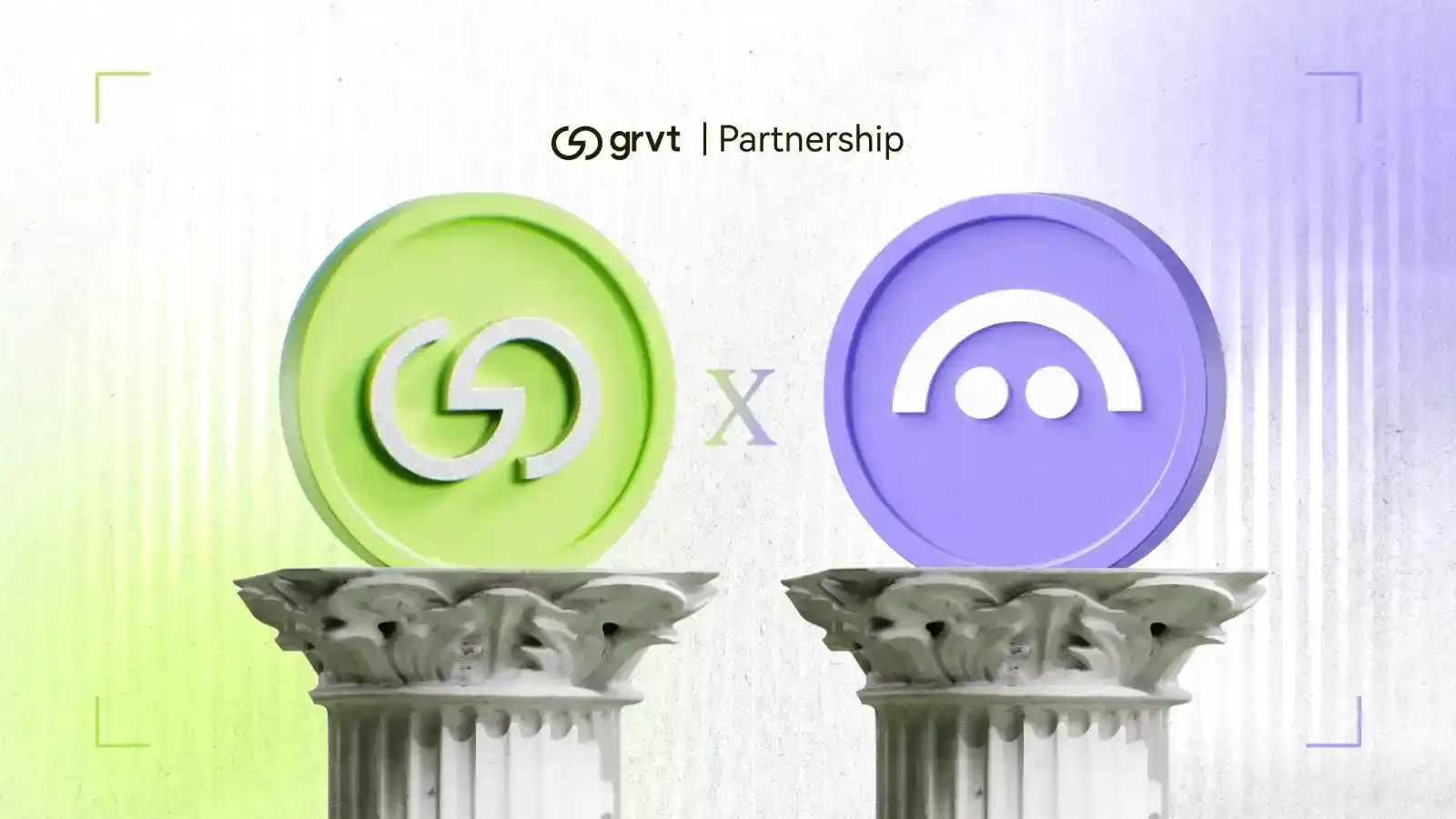
In this partnership announcement, Aave's founder Stani Kulechov stated, "Stablecoins that do not earn yield represent an opportunity cost for traders." This collaboration aims to reduce this opportunity cost to zero.
This is the first key gear of Grvt's 2026 roadmap. The roadmap is divided into four layers, resembling a compounding flywheel:
The first layer is Earn. At its core is unified collateral and prime broker borrowing, where Grvt has built a bridge connecting liquidity providers and traders. The platform allows traders to use 20% of their own funds to leverage 80% of platform borrowing. Simultaneously, the system sets the trader's own funds as a safety cushion so that in case of a loss, the trader's own money is lost first. This mechanism allows Earn and Trade to form a positive feedback loop, where more traders create more borrowing demand, bringing higher returns to depositors.
The second layer is Trade. Grvt will expand the underlying assets of perpetual contracts from cryptocurrencies to global stocks, forex, and commodities. Additionally, it will launch a spot market, initially provided by professional market makers for deep liquidity, and later transition to a community-driven listing mechanism where anyone can stake funds to propose new trading pairs, with the community voting on whether to list them.
The third layer is Invest. Grvt will expand its strats market, allowing institutional fund managers, professional traders, and even AI algorithms to become financial advisors on the platform. Users can entrust their funds to these strategies and enjoy the returns.
The fourth layer is Pay. Bridging P2P payments and fiat on/off-ramps, allowing users to use their crypto assets as conveniently as money in a regular bank account.
These four layers form an interconnected system. Grvt describes this logic by saying that unified collateral makes lending more efficient, lending makes deposits more productive, more productive deposits attract more capital, more capital deepens liquidity, deeper liquidity improves execution quality, better execution attracts more traders, more traders create more borrowing demand.
On March 12, 2026, Grvt disclosed the key details of the tokenomics, including the allocation, use cases, and distribution mechanism of the $GRVT token. Holders of $GRVT will benefit from lower fees in perpetual contracts, spot markets, and the payment layer, receive higher DeFi rewards, as well as platform revenue sharing and priority access to new markets.
The End
Forty years ago, a technological revolution shattered the island of information and reshaped Wall Street. Forty years later, Grvt aims to break the island of capital using an on-chain prime brokerage model.
Starting from the highest frequency and most brutal battleground of perpetual contracts, solving the efficiency problem of capital with cross-margin, then addressing trust issues with zero-knowledge proofs and self-custody, and finally expanding into stocks, forex, and commodities, these broader real-world assets.
This is no longer a story about speculation but a narrative about assets. The future of finance does not belong to those building more islands but to those who can connect all islands into a single continent as bridgers.
This content is provided for general informational purposes only and doesn't constitute financial, investment, legal, or tax advice. Any events, rewards, online promotions, or related information mentioned herein should not be considered a recommendation, solicitation, or invitation to purchase, sell, trade, or otherwise deal in any crypto assets. Crypto assets are highly volatile and may result in loss. The availability of WEEX services, products, and related events may vary by region. You are responsible for ensuring that your participation is in accordance with applicable local laws and regulations.
You may also like

Cryptocurrency venture capital firm Ethereal Ventures has disclosed for the first time that the total size of its two funds is approximately $150 million
Morning Report | Visa includes Polygon in its global stablecoin settlement program; MoonPay invests $100 million to acquire security company Sodot; Digital wallet platform Belo completes $14 million Series A financing

An Obscure Open Source AI Tool Alerted on Kelp DAO's $292 million Bug 12 Days Ago

46 minutes, $292 million stolen, DeFi faces development dilemma again

When Openclaw Founder Advises Young People to Stay Away from Crypto
On-Chain Options: The Crossroads of DeFi Miners and Traders

Sentient Reveals Tokenomics, How Will the Market Price It?
Eigen Foundation Proposes Adjusting EIGEN Token Incentives to Provide Higher Rewards for Active Users
a16z crypto Promotes Guy Wuollet to General Partner
SharpLink is planning to deploy $200 million worth of ETH on the Linea network
Ripple and SBI Team Up for RLUSD Stablecoin Launch in Japan by Early 2026
Latest Crypto Market Snapshot as of August 22, 2025 BTC Soars to $115,250.00 ETH Hits $4,450.75 XRP Climbs…
aPriori Coin Airdrop: How to Claim $500+ Free Tokens by August 2025
I’ve been diving into cryptocurrency airdrops for years, and I can tell you from personal experience that the…

ChainOpera AI has officially partnered with EigenLayer to jointly build a trustable on-chain AI Agent network, with a daily transaction volume exceeding 600,000 times.
Is the fixed term worth it? How much does $1,000,000 generate in 30 days
$215 Billion Surge in Altcoin Market Value; Has Altseason Begun?
Hacker Who Leaked GTA 6 Created a Coin, Soared 20 Times in a Day

Illinois crypto groups seek injunction against new tax
Delays in Germanium Customs Pressure Delivery Times for Taiwanese Equipment
CVM Brings Tokenization Agenda to NYSE, Nasdaq, and SEC

Unstable Pix in 7 Banks: What Failures Reveal About the System
Term Labs vault exploit drains estimated $8.5M
Clarity Act: How the U.S. is Trying to Regulate the Cryptocurrency Market
Ethereum: Vitalik Buterin Wants to Import Utreexo, the Anti-Storage Gambit of Bitcoin
Legalization of Cryptocurrency: State Duma Approves Law on Digital Currencies

As foreign investors dump $29 billion in Treasury bills, Washington pivots to stablecoin issuers to back US debt

Supermicro Denies Executive Knowledge of Chip Diversion
VanEck Targets $500,000 for Bitcoin by 2029, a Forecast That Suits Its Own Balance Sheet

America is creating a new class of crypto banks – but they aren’t really banks
Cardano Development Transitions to External Teams: Input Output Reduces Its Role in the Network

What to Watch for at Next Week's Jackson Hole Conference?
Cryptocurrency venture capital firm Ethereal Ventures has disclosed for the first time that the total size of its two funds is approximately $150 million
Morning Report | Visa includes Polygon in its global stablecoin settlement program; MoonPay invests $100 million to acquire security company Sodot; Digital wallet platform Belo completes $14 million Series A financing
An Obscure Open Source AI Tool Alerted on Kelp DAO's $292 million Bug 12 Days Ago
46 minutes, $292 million stolen, DeFi faces development dilemma again
When Openclaw Founder Advises Young People to Stay Away from Crypto
On-Chain Options: The Crossroads of DeFi Miners and Traders

Contents
Latest articles


Latest coin listings on WEEX


