
 Buy Crypto
- Markets
 Futures
- Spot
- Copy Trade
- Earn
- More
NYSE Plans to Launch 24/7 Stock Tokenization Trading, Is the Moat of the Crypto Market Disappearing?

Original Title: "NYSE Plans to Launch 24/7 Stock Tokenization Trading, Competitors Caught Off Guard"
Original Author: Wenser, Odaily Planet Daily
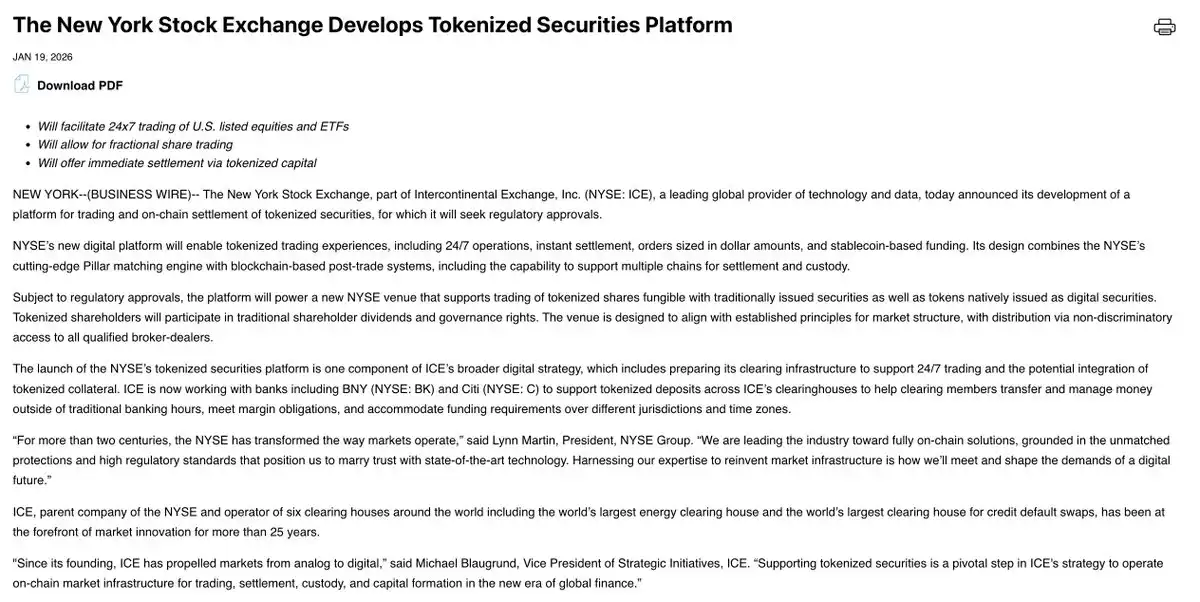
Just as the "Flash Crash Monday" has not yet ended, just now, the crypto market welcomed another heavyweight bombshell — according to multiple media sources, the NYSE plans to launch a tokenized securities trading and on-chain settlement platform that supports 24/7 trading. After investing $2 billion in Polymarket last year, the ICE Group once again, using its securities trading platform as a vehicle, has joined this century's wave of cryptocurrency transformation. It is worth mentioning that as early as September last year, the "rival" Nasdaq had already submitted a tokenized stock trading application to the SEC, and this change by the NYSE is also seen by the outside world as a move to compete with securities trading platforms.
The NYSE Cannot Stay Idle Either: A More Aggressive "Stock On-Chain Tokenization Solution" than Nasdaq
Since Trump took office, the U.S. cryptocurrency regulatory environment has undergone a change, leading to the flourishing development of crypto IPOs, stablecoins, PayFi, and DeFi, sweeping away the policy gloom of the Biden administration period. According to statistics, the stablecoin trading volume reached $33 trillion last year, a 72% year-on-year increase. Behind this is the revenue and profit earned by the two stablecoin issuers, Tether and Circle, representing the immense liquidity that can be directed to the stock securities market.
Moreover, unlike Nasdaq's submission of a tokenized stock trading application to the SEC in September last year, nearly half a year later, the NYSE's "stock tokenization trading" related actions are not just applications to regulatory agencies, but a whole set of "on-chain solutions."
Specifically, the NYSE's "Stock On-Chain Tokenization Solution" includes the following 3 aspects:
1. This is a tokenized securities trading and on-chain settlement platform, planning to support 24/7 trading of U.S. stocks and ETF funds, fractional share trading, stablecoin-based fund settlement, and real-time delivery, and will integrate with the NYSE's existing matching engine and blockchain settlement system.
2. According to the NYSE's plan, tokenized stocks will have the same dividend and governance rights as traditional securities.
3. NYSE's parent company ICE is also collaborating with banking giants such as BNY Mellon and Citi to explore tokenized deposit and clearing infrastructure to support cross-time zone, round-the-clock fund and margin management.
In comparison, if Nasdaq's stock tokenization application seems like a case of "old wine in a new bottle" in response to policy, then NYSE's plan is like a "new retail trading platform" that fully connects all aspects such as "wine making - packaging - distribution - recycling."
Most importantly, NYSE's "stock tokenization" trading platform supports 24/7 trading, which was originally one of the advantages that various cryptocurrencies had over securities stocks. Now, this advantage has become a joke in the face of the massive asset base and liquidity of one of the world's largest stock exchanges, NYSE.
As a result, the crypto market is not without some pessimistic views: "The RWA race in the crypto market and the increasingly tight liquidity will face the harshest 'father.' Compared to NYSE's annual trading volume of over trillions of dollars, crypto RWA projects are almost nonexistent."
Crypto Practitioners' Perspectives: There Are Pros and Cons; the past is the past, the present is the present
In 1792, 24 stockbrokers signed the Buttonwood Agreement under a buttonwood tree outside 68 Wall Street in New York, giving birth to the precursor of NYSE. At that time, limited by the few investment targets and limited market activity, stock trading hours were more flexible, with no strict continuous trading period. Brokers mainly traded through auctions or informally.
On March 8, 1817, the organization officially changed its name to the New York Stock Exchange by drafting a charter.
In May 1887, the NYSE standardized stock trading hours to "Monday to Friday: 10:00 AM to 3:00 PM; Saturday: 10:00 AM to 12:00 PM."
In 1952, Saturday trading was officially discontinued.
In 1985, the stock trading opening time was moved up to 9:30 AM, and the closing time was extended to 4:00 PM, forming the current 9:30 AM–4:00 PM period, which has been in effect for about 41 years.
If NYSE's application for 24/7 tokenized stock trading is approved, it means that the decades or even hundreds of years of "limited trading hour model" will soon become history. From this perspective, the crypto market has gained high recognition from the mainstream financial world.
Pro Viewpoint: The Era Train is Coming
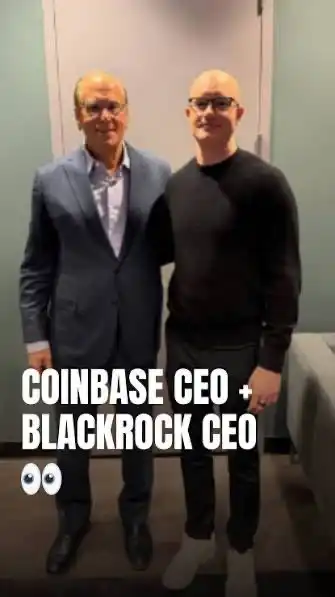
BTC OG and BankToTheFuture founder Simon Dixon posted, stating, "Nothing can stop this train. Tokens are IOUs for custodied real-world assets; they are a supplement to DTCC debt. 24/7 trading is possible without tokens. This is a surveillance state upgrade. You will own nothing and be happy." The post includes an image of BlackRock CEO Larry Fink embracing Coinbase CEO Brian Armstrong.
Crypto KOL from India, Open4profit, posted, saying, "(This will enable) markets to react to global news instantly; AI and algorithms will play a bigger role in pricing and risk management; this is a significant change for the stock market, so closely monitor liquidity changes."
Redstone DeFi co-founder Marcin sees "entrepreneurial opportunity" and states, "This is a good start and aligns with what we are going to do next."
Wintermute OTC Business Lead Jake O also posted high praise for this development, saying, "Traditional infrastructure can extend trading hours but cannot address T+1/2 frictions, nor eliminate rent-seeking behavior that increases costs and delays. Ironically, the cryptocurrency space solved this years ago: 24/7 trading, instant settlement, global access, no gatekeepers or data fees (from traditional banks). Integration is inevitable: equity trading on-chain, settlement achieved atomically, the border between 'crypto' and 'traditional' assets will disappear entirely. Welcome to the 21st century..."
Of course, some see it as an opportunity, while others see it as a threat.
Con Viewpoint: Trading Platforms Reap the Benefits, and the New Generation Pays the Price
Unlike industry expectations that NYSE's move will stimulate crypto market development and drive cryptocurrency adoption, some industry insiders see some potential issues.
Investment firm L1D partner LouisT posted, stating, "The entire global financial system is moving to the blockchain, yet for some reason, they don't seem to be bidding on our 'bear drug sucking' tokens." In other words, the traditional financial market doesn't buy into the concept of RWA assets in cryptocurrency.
MoonRock Capital founder expressed concerns about the survival situation of the younger generation: "This is not good news for the baby boomer generation, your life has become even more difficult." He is probably referring to the fact that, compared to the previously intergenerational group with significant increments, the baby boomer generation faces a more complex investment environment and an around-the-clock 'liquidity game stage'.
BingX advisor Nebraskangooner also raised his own question: "Why should the stock market trade 24 hours? Nobody wants this except for trading platforms. The only benefit is no after-hours trading interference, so stop-loss and take-profit points can truly function. I wonder what impact this will have on the stock price trend after financial report releases?" This view focuses more on information impact and trading platform profitability.
Summary: There is still a gap between traditional finance and the crypto-native community, with opportunities available for users and entrepreneurs
Finally, the author would like to briefly discuss personal opinions based on the information above:
Firstly, based on the current information, the earliest New York Stock Exchange (NYSE) related applications may be approved by the end of 2026, and the main approving authority is still the U.S. SEC, which is an important time gap for crypto platforms.
Secondly, the primary service targets of the NYSE's stock tokenization trading and on-chain settlement platform are likely to be conventional investment institutions and compliant investors. For the crypto-native community and even global investors, what they need is not only the satisfaction of functional requirements but also to leverage stock tokenization and Real World Asset (RWA) platforms to achieve "KYC-free registration trading, global asset liquidity allocation, and riskier high leverage," which may be the advantage of crypto RWA projects.
Lastly, the core purpose of stock tokenization promotion by exchanges like NYSE and Nasdaq is still trading volume and fees, similar to how centralized exchanges (CEX) continue to list new token projects. In the short term, they may need to learn from CEXs, DEXs, and on-chain Perpetual DEX for a potential comeback, which is also the basis for existing mature platforms to launch a counterattack. At that time, the NYSE, Nasdaq, and other U.S. stock trading platforms may also not be immune to falling from grace. The key lies in where the liquidity is, where the attention is, and where the user base is.
You may also like

Tiger Research: What AI services do cryptocurrency companies offer?

The war not only drives up oil prices but also causes Circle's stock price to soar

When agents become consumers, who will rewrite the underlying logic of internet commerce?

AI Agents in Action Summit: March 31, Hong Kong Cyberport, focusing on the deep waters of AI implementation

29 Days In, What Are America’s Options on Iran?

Flash Crash Down 97%+ with Ongoing Unlocking, WLD Completes $65 Million Off-chain Funding: Who Is Still Buying?

Bitcoin for Real Estate? Fannie Mae Teams Up with Coinbase to Launch Crypto Mortgage
Tether Hires Big Four Auditor, USDT Enters First Attestation Phase

Google AI Paper Destroys $900B Storage Stock, Accused of Faking Experiment
Evaporate $2 Trillion, U.S. Stocks See Worst Start in 4 Years, Why is the Market Bearish?

The speed at which AI discovers vulnerabilities has surpassed the speed at which it patches vulnerabilities.

AI Crypto Trading Bot Explained: Aurora's Multi-Factor Strategy in WEEX Hackathon
Aurora demonstrates how structured, multi-agent AI Trading systems can deliver more adaptive and resilient performance in the WEEX AI Trading Hackathon.

Cyber Taoist Fortune Teller: Fake Taoist, AI Fortune Telling, and Northeastern Metaphysics History

Bloomberg: Stablecoin Payments Emerge as Crypto VC's Newest Favorite Thing
BeatSwap is evolving towards a full-stack Web3 infrastructure, covering the entire lifecycle of IP rights.
BeatSwap, a global Web3 Intellectual Property (IP) infrastructure project, is attempting to overcome the current fragmentation limitations of the Web3 ecosystem, building a full-stack system that covers the entire lifecycle of IP rights.
Currently, most Web3 projects are still in the stage of functional fragmentation, often focusing only on a single aspect, such as IP asset tokenization, transaction functionality, or a simple incentive model. This structural dispersion has become a key bottleneck hindering the industry's scale application.
BeatSwap's approach is more integrated, integrating multiple core modules into the same system, including:
· IP authentication and on-chain registration
· Authorization-based revenue sharing mechanism
· User-engagement-driven incentive system
· Transaction and liquidity infrastructure
Through the above integration, the platform builds an end-to-end closed-loop path, allowing IP rights to complete a full cycle of "creation, use, and monetization" within the same ecosystem.
BeatSwap is not limited to existing crypto users but is attempting to take the global music industry as a starting point, actively creating new market demand. Its core strategies include:
Exploring and incubating music creators (Artist discovery)
Building a fan community
Igniting IP-centric content consumption demand
The current global music industry is valued at around $260 billion, with over 2 billion digital music users. This means that the potential market corresponding to the tokenization and financialization of IP far exceeds the traditional crypto user base.
In this context, BeatSwap positions itself at the intersection of "real-world content demand" and "on-chain infrastructure," attempting to bridge the structural gap between content production and financial flow.
BeatSwap's upcoming core product "Space" is scheduled to launch in the second quarter of 2026. This product is defined as the SocialFi layer in the ecosystem, aiming to directly connect creators with users and achieve deep integration with other platform modules.
Key designs include:
A fan-centric interactive mechanism
Exposure and distribution logic based on $BTX staking
User paths connected to DeFi and liquidity structures
Thus, a complete user behavior loop is formed within the platform: Discovery → Participation → Consumption → Rewards → Trading
$BTX is designed to be a core utility asset within the ecosystem, rather than just a simple incentive token, with its value directly tied to platform activity and IP use cases.
Main features include:
· Yield distribution based on on-chain authorized actions
· Value reflection based on IP usage and user engagement dynamics
· Support for staking and DeFi participation mechanisms
· Value growth driven by ecosystem expansion
With the increased frequency of IP use, the utility and value support of $BTX will enhance simultaneously, helping alleviate the "disconnect between value and utility" issue present in traditional Web3 token models to some extent.
Currently, $BTX has been listed on several mainstream exchanges, including:
Binance Alpha
Gate
MEXC
OKX Boost
As the launch of "Space" approaches, BeatSwap is actively pursuing more exchange listings to further enhance liquidity and global accessibility, laying a foundation for future market expansion.
BeatSwap's goal is no longer limited to the traditional Web3 narrative but aims to target over 2 billion digital music users and a trillion KRW-scale content market.
By integrating content creators, users, capital, and liquidity into a blockchain framework centered around IP rights, BeatSwap is striving to build a next-generation infrastructure focused on "IP tokenization."
BeatSwap integrates IP authentication, authorization distribution, incentive mechanism, transaction system, and market construction to establish a unified structure that bridges the full lifecycle path of IP rights.
With the launch of the Q2 2026 "Space," the project is expected to become a key infrastructure connecting content and finance in the IP-RWA (Real World Assets) track.

Mag 7 Evaporates $2 Trillion | Rewire News Morning Edition

Losing $19K per Coin Mined, Bitcoin Mining Firms Collective AI Defection



 App
App