
Liquidity Provider "Black Box" Revealed: Did VCs Pull an Exit Scam on Liquidity Provision, Turning Projects into "Rug Pull" Victims?



Original Title: "Top 10 Questions and Answers to Clarify the Market Maker 'Black Box': Why Did VCs Get Involved in Market Making? Is it Really Easy for Projects to Get 'Backstabbed'?"
Original Author: flowie, Nianqing, ChainCatcher
Last week, Binance suddenly issued a strict order to seal off market makers, shifting the conflict from VCs and exchanges to market makers. However, for most people, market makers are like a black box, difficult to understand, and often misunderstood. This article sorts out some of the common questions and reference answers that everyone is concerned about regarding cryptocurrency market makers (mainly referring to market makers serving projects on CEX).
1. Which cryptocurrency market makers are there?
RootData currently lists around 60 cryptocurrency market makers. However, the actual market participants may be far more than this, as many market makers operate incognito behind the scenes.
Among the publicly disclosed 60 market makers, only a few are active in the public eye. For most ordinary users, which market makers participate in market making projects is also a black box.
It is difficult to clearly classify or rank market makers, but based on on-chain holdings, major market makers with large fund sizes include Jump Trading, Wintermute, QCP Capital, GSR Markets, B2C2 Group, Cumberland DRW, Amber Group, and Flow Traders, which are also well-known in the market.
2. Which type of market maker could be a market manipulation whale?
From an insider's perspective, market makers are usually divided into active market makers and passive market makers. Maxxx, Head of Ecosystem at @MetalphaPro Market Making, has detailed this in his tweet. Recommended reading: "Confessions of a Market Maker Frontline Practitioner: Dark Forest Survival Guide for Project Teams."
In short, active market makers are generally what people call "whales," colluding with project teams or backstabbing them to manipulate market prices and harvest retail investors. Many active market makers may only surface after being investigated and prosecuted by regulatory authorities.
Passive market makers, on the other hand, mainly place maker orders on the order book of centralized exchanges, providing market liquidity, remaining neutral, and not influencing coin prices. The strategies and technologies they provide are also more standardized.
Due to significant compliance risks, most active market makers prefer to remain anonymous.
Some active market makers may also operate under the guise of investment firms, incubators, and the like.
The market maker Web3port, which was recently exposed and banned by Binance, appeared as an incubator, participating in 26 investments over the past year, with at least 6 of them being for newly launched projects.

To some extent, the profitability of a market maker can reveal whether they are active or passive. According to crypto influencer @octopusycc, market-making institutions that are "profitable" are likely engaged in market manipulation rather than true market-making activities.
An ideal market maker business should provide quotes to both buyers and sellers, maintaining market liquidity and relative price stability. In this model, the profit margin is not substantial, often requiring incentives from the trading platform.
3. Which crypto market makers have been sued or investigated by regulatory authorities?
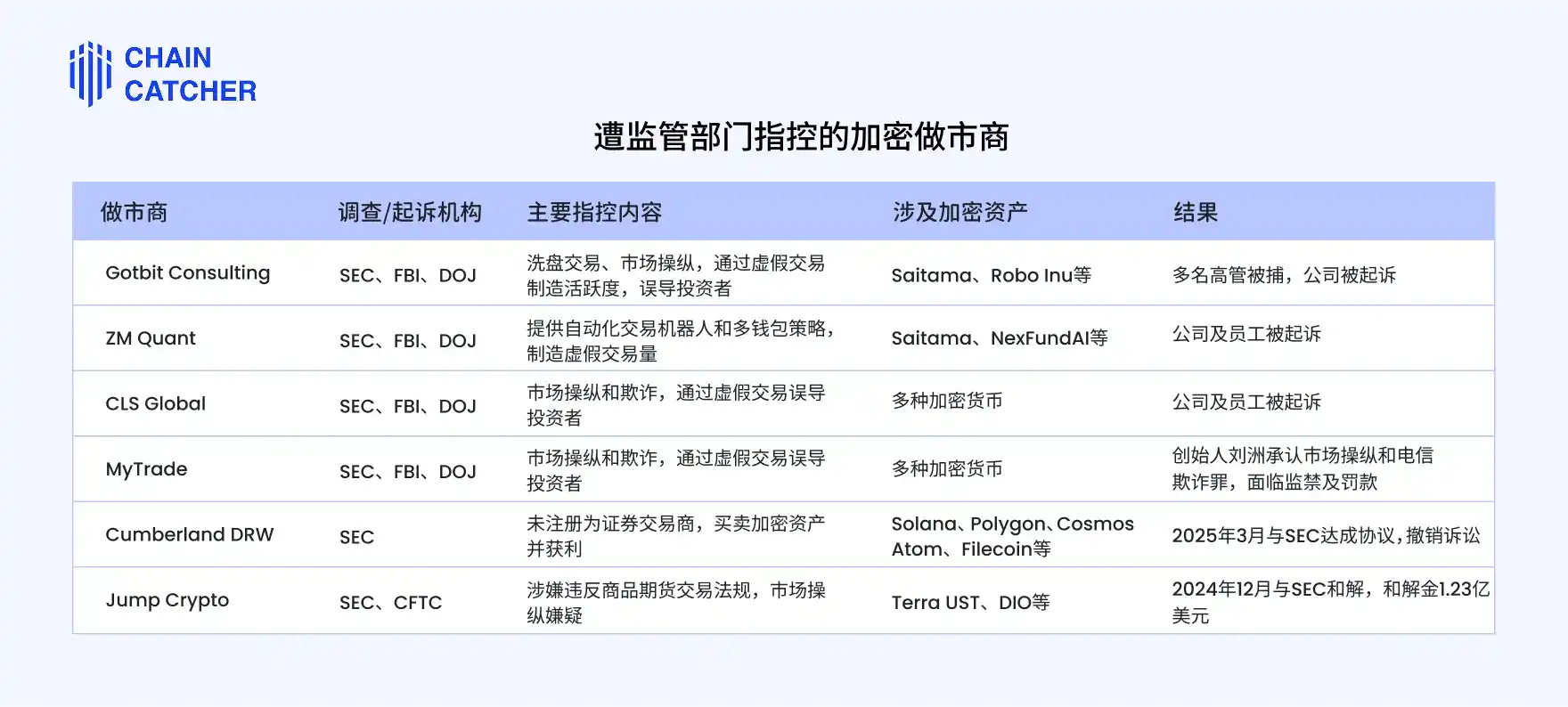
Following the crypto market crash in 2022, crypto market makers became a key focus of regulatory scrutiny. However, under the regulatory environment after Trump took office, some lawsuits have gradually been withdrawn or settled.
The first market maker to come under intense regulatory scrutiny was Jump Crypto. In 2023, a collective lawsuit in the United States revealed that during the 2022 Terra UST stablecoin crash, Jump Crypto's subsidiary, Tai Mo Shan Limited, colluded with Terra to manipulate the UST coin price, resulting in a profit of nearly $1.3 billion. As a result, they were sued by the SEC for market manipulation and acting as an unregistered securities dealer. However, in December 2024, Tai Mo Shan agreed to pay a $123 million settlement to the SEC, and recently expanded its team to resume crypto operations.
In addition to the SEC's charges, on June 20, 2024, CFTC reportedly initiated an investigation into Jump Crypto, as reported by Fortune, but CFTC has not yet filed formal charges.
Recommended Reading: "Tainted History Haunts Jump as It Awkwardly Resumes Full Crypto Operations"
Another major market maker, Cumberland DRW, was also accused by the SEC of acting as an unregistered securities dealer, and Cumberland allegedly obtained millions of dollars in illegal gains through transactions with investors. However, these charges were recently dropped.
Compared to the two major market makers mentioned above, in October 2024, an investigation launched by the SEC in collaboration with the FBI and DOJ accused eighteen individuals and entities of large-scale fraud and manipulation in the crypto market. This investigation brought some market makers to light, including Gotbit Consulting, ZM Quant Investment, and CLS Global. These market makers were primarily labeled as meme market makers.
In addition to facing regulatory charges, DWF Labs, a highly active crypto market maker in the past two years, has been exposed multiple times for market manipulation details by CoinDesk, The Block, and other media outlets.
For example, The Block stated that one key reason DWF was able to collaborate with 35% of tokens in the top 1000 by market capitalization in its short 16-month history was that DWF Labs promised "pump" to clients during negotiations. For instance, shortly after its establishment in September 2022, DWF's promotional materials extensively mentioned price action. In a section titled "Price Management," DWF claimed it could synchronize with potential clients' marketing teams to help the token's price react to relevant events, commonly known as "coordinated pump on positive news."
Recommended reading: "The Block Uncovers DWF Labs: The Operational Secrets Behind Investing in 470 Projects"
4. What are some common manipulation behaviors of market makers?
Market makers' misconduct usually manifests as market manipulation and mistreatment of project teams. Some common manipulation behaviors include:
1. Wash Trading. Creating artificial trading activity by simultaneously buying and selling assets to increase trading volume and liquidity.
2. Spoofing. Placing large buy or sell orders but having no intention to execute them. The purpose is to deceive other traders and impact asset prices.
3. Pump and Dump. These schemes involve coordination with other market participants to artificially drive up the asset's price through active buying. Then, the market maker sells at a higher price, causing a price crash.
Examples of market manipulation are not uncommon. For instance, Jump Crypto, fined $123 million for colluding with Terra to manipulate UST's price, and Alameda Research, which caused the collapse of the previous bull market.
Let's look at another example of a project team being malicious:
In October 2024, crypto game developer Fracture Labs sued Jump Trading, accusing Jump of using its DIO game token to conduct a "pump and dump" scheme.
In the lawsuit, Fracture Labs stated that in 2021, they had entered into an agreement with Jump to assist in the initial issuance of the DIO token on the cryptocurrency exchange platform Huobi (now HTX).
Fracture Labs lent 10 million DIO tokens to Jump, valued at $500,000, and additionally sent 6 million tokens to HTX, valued at $300,000. The token price subsequently surged to a high of $0.98, with Jump's borrowed value reaching $9.8 million. Jump then sold all holdings at the peak.
A "massive liquidation" caused DIO to plummet to $0.005, following which Jump repurchased 10 million tokens at a lower price (around $53,000) and returned them to Fracture Labs, terminating the agreement thereafter.
In this event, the collaboration model between Fracture Labs and Jump was a common Token loan structure. Despite being prevalent, cases where project teams are "rekt" are not uncommon.
5. What are the collaboration models between Market Makers and project teams?
As mentioned earlier, Market Makers are divided into active and passive categories.
Active Market Makers often do not have standard practices. Maxxx mentioned in a tweet that the terms of collaboration vary widely, involving scenarios such as token borrowing, API integration, leveraging, revenue sharing, and other different models. There are even rogue whale incidents where no communication is made with the project team, and the whale uses their own funds to snatch chips, manipulate the market once enough chips are acquired.
So how do Market Makers operate? Canoe founder Guangwu once shared common ways institutional Market Makers manipulate tokens in his article.
One is strong manipulation to control the stock, meaning that under the premise of passing the project's fundamentals, they choose a target to start manipulating (the project team may or may not know, which is irrelevant)
· The first stage is fundraising: the typical scenario is a sustained low-price fundraising.
· The second stage is the consensus phase of the Market Maker institution. The main indicator at this stage is the trading volume, first pumping a wave, then trading with other Market Makers in the oscillation (recovering costs, increasing capital utilization, establishing a risk control model)
· Phase Three, the Rug Pull Phase. Continuing to drive up the price, institutions will both sell off their holdings to recoup funds and promote the project, with some institutions even voluntarily assisting the project team in fundamental development.
The second is to anchor the value of the asset, rapidly enhancing the project's fundamentals through means such as lending and derivatives to boost both funds and trading volume. Former FTX head of trade @octopuuus mentioned a lending model where FTT is used as collateral to borrow BTC/ETH. In this model, the value anchor for FTT becomes BTC and ETH, creating a cycle of lending and leverage, potentially even using the borrowed BTC/ETH to buy more FTT.
Recommended reading: "Market Maker Manipulation: The Love-Hate Relationship Between Market Makers, Project Teams, and Exchanges"
More benign passive market maker services are relatively more standard. In terms of service models, they are divided into Token Loan and Subscription Fee models. The Token Loan model is currently the most widely used and adopted cooperative model. Recommended reading: "Confessions of a Frontline Market Maker: A Dark Forest Survival Guide for Project Teams"
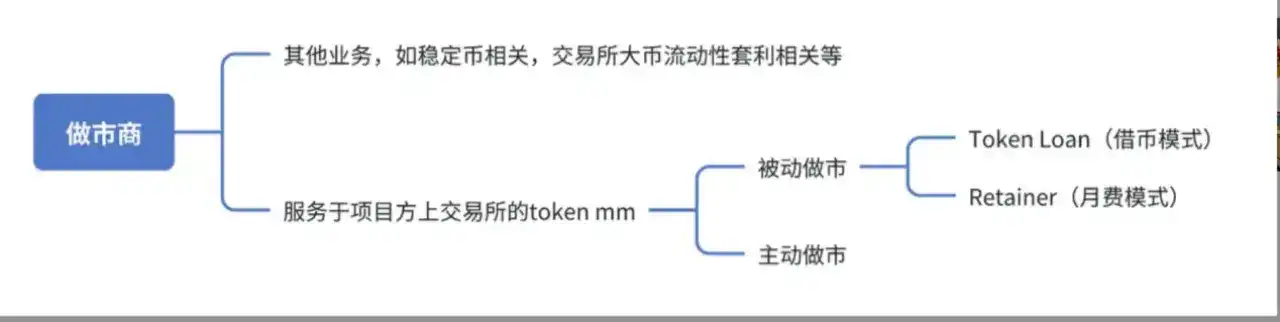
Source: Maxxx Tweet
In the Token Loan model, the project team needs to lend a certain percentage of tokens to market makers to provide liquidity.
At the end of the service period, the project team needs to repay the tokens but will be settled based on the pre-agreed option value. (The option value refers to the economic value that the option contract holds at a specific point in time.) For example, if 100kU of tokens are borrowed, and the option value accounts for 3% of the borrowed assets, the project team can earn 3kU in collaboration revenue upon repayment. This is also the main source of income for market makers.
The advantage for the project team in choosing the Token Loan model is to quickly establish liquidity through the professional capabilities of market makers and mitigate the risks of self-trading.
The Subscription Fee model, on the other hand, is relatively easier to understand. In this model, the project team does not lend coins to market makers; instead, market makers provide liquidity through API access. The project team does not worry about malicious behavior from market makers, but they are responsible for gains and losses during the order placement process. The project team also needs to pay a monthly service fee.
6. How Deeply Internalized Are Market Makers? Why Do VCs Want to Build Their Own Market Making Teams?
In his tweet, Maxxx mentioned that not only are market makers becoming more internalized, but many VCs and project teams are also setting up temporary teams to start market making. Some teams may not even have basic trading capabilities, but they first acquire the coins anyway, as they end up at zero anyway, so there is no risk of being unable to redeem.
And the reason is also very clear. In a situation where the token price has become the primary product of most projects, the liquidity unlocked at listing is the most valuable part.
For instance, in the past, although VCs received token allocations early, they still had to wait for the project team to list the token and follow the unlocking rules step by step. On the other hand, market makers can unlock liquidity at listing, providing them with significant operational flexibility.
7. Why Do Crypto Market Makers Also Invest?
According to a perspective provided by industry insiders, good project teams are usually surrounded by market makers. Through investment, market makers can interact with project teams in the early stages, transforming from passive liquidity providers to proactive parties. Post-investment, they can legitimately follow up on the project's progress, seize key projects and milestones, and gain an advantage in market making.
For project teams, besides receiving actual funds, they also, to some extent, gain a sense of security by becoming part of the market maker's vested interest community. During the listing phase, market makers can indeed be very helpful. Trading platforms often have certain market maker requirements for listed projects.
However, this is not entirely beneficial. The investment that project teams receive from market makers may come with undisclosed strings attached. Even if market makers invest in a project, they may choose to dump the price after unlocking liquidity at listing to make a profit.
Furthermore, market makers' investments may not always be genuine. As per The Block's report on DWF, many industry insiders believe that DWF's multimillion-dollar investment in crypto startups is more appropriately termed over-the-counter (OTC) trades. These OTC trades allow startups to convert their tokens into stablecoins instead of DWF injecting cash upfront and then transferring the tokens to the exchange.
At one point, some market makers' investment activities became a pump signal for ordinary investors.
In addition to investments, crypto market makers also provide other forms of support to cooperate with project teams.
For example, liquidity support. If it is a DeFi project, market makers can commit to providing liquidity support to the project team.
They also act as intermediaries for VC firms, trading platforms, and other resources. For example, they can introduce more VC investors, help project teams manage relationships with exchanges. Especially in the Korean market, where the buy-side is strong, having a market maker can provide what is known as comprehensive liquidity planning.
8. Why Do Most Project Teams Choose Multiple Market Makers?
Realizing that they shouldn't put all their eggs in one basket, project teams opt for three or four market makers to diversify the listing liquidity held by market makers and reduce the risk of malicious behavior.
However, the "three monks have no water to drink" approach may also have risks. According to industry insiders, for example, some market makers may shirk their responsibilities and not actively participate. It is difficult for the project team to detect the market maker's market-making behavior, making it challenging to supervise and hold them accountable.
9. Does the Market Maker Have Such a Strong Ability to Engage in Wrongdoing?
A study by Forbes in 2022 of 157 cryptocurrency exchanges found that more than half of all reported Bitcoin trading volume consisted of fake or non-economic wash trades.
As early as 2019, a whitepaper submitted to the U.S. SEC by Bitwise Asset Management pointed out that, among the 83 cryptocurrency exchanges analyzed at that time, 95% of the Bitcoin trading volume was fake or non-economic. This discovery sparked widespread industry attention to market maker behavior.
The market maker may not be the mastermind, but they are indeed the primary tool for carrying out operations.
As a service provider, the market maker is more often a tool rather than the driving force. The starting point is the demand of the trading platform and the project team.
During a bull market, the entire system collaborates to generate enormous profits, allowing all stakeholders to maintain a minimal level of harmony. However, in a bear market, this entire chain accelerates the onset of a liquidity crisis, leading to a reenactment of the drama of tearing off masks and mutual accusations.
Market makers are not entirely the "scapegoats" for liquidity depletion. The current dilemma in the crypto market is not solely caused by market makers, even though they are the direct creators of "pseudo-prosperity." The entire chain of interests also involves the project team, VCs, KOLs, and pump-and-dump schemes.
10. Why is it Difficult to Constrain Market Makers' Wrongdoing?
The lack of regulation is indeed a core reason for market makers' misconduct, but the inability of market makers' counterparts such as project teams and exchanges to impose effective constraints is also a significant factor.
Due to the covert nature of market makers' behavior, the industry has not yet established a clear, unified standard and norm for them. Project teams themselves find it challenging to supervise and constrain market makers' operations. Once misconduct occurs, project teams mostly rely on post-event accountability, which is often ineffective.
According to industry insiders, apart from on-chain market making, currently only centralized exchanges can monitor market makers' behavior. Although market makers usually agree on a monitoring method with the project team, once they transfer the tokens to a third party, they must heavily rely on their reputation and moral standards.
Of course, project teams can also choose the monthly fee model offered by market makers. The monthly fee model typically involves short-term contracts (settled monthly), allowing project teams to flexibly adjust their partners or strategies based on market performance to avoid long-term commitments to unreliable market makers. Project teams can also negotiate and include KPIs (such as daily minimum trading volume and maximum spread limits) in the monthly fee contract to ensure the quality of the market maker's service. However, the issue with this model is that project teams transfer the risk that was originally spread to market makers back to themselves, needing to bear losses on their own.
In addition, while the project team may be able to agree on details such as liability after a breach in the contract, determining when a liquidity provider has "breached" is also challenging. The project team needs to present sufficient evidence to prove the liquidity provider's breach, but even with trading records, demonstrating a "causal relationship" (i.e., the liquidity provider's actions directly causing a price collapse) requires extensive data analysis, which is costly and time-consuming in legal proceedings. Liquidity providers can still argue that market fluctuations were due to external factors (such as macroeconomic events or investor panic).
The entire process involves different counterparties such as the trading platform, project team, and liquidity provider, making it difficult for liquidity providers to be fully informed about the project and the market.
Furthermore, due to the symbiotic nature of centralized exchanges and liquidity providers, trading platforms find it challenging to take drastic actions against those who benefit the most. Therefore, in the GPS and SHELL events, Binance ultimately chose to freeze the account of the liquidity provider involved in the GPS event-related price crash and publicly disclose detailed evidence of their wrongdoing, which has significant implications. Proactively disclosing evidence and taking action is to some extent a positive response to regulatory pressure and a reflection of industry self-regulation. This may stimulate other trading platforms to follow suit, creating a new trend in the industry to protect users.
You may also like

The AI gamble of mining companies: Valuations enter a phase of differentiation, and it's hard to turn the tide

A letter from Alliance to entrepreneurs: Written on the occasion of Cursor selling for 60 billion dollars

Stablecoins Finally Find Real Returns: On-Chain Reinsurance Re Explained | Interview with Re Founder Karan Saroya

The impossible triangle is simply a pseudo problem

Will MicroStrategy fall into a death spiral? What will the macro trend be in the second half of the year?

Blockchain Capital Partner: The Core Secret of Arbitrage
STRC unanchored by 11%, can the perpetual motion machine of Strategy still operate?

Bitcoin Market Analysis 2026: Can BTC Reach $150K by Year-End?
Bitcoin ETF Outflows Hit a Record $4.4 Billion: What Are Traders Doing With Their Cash?
WEEX App Just Got Smarter – New Tabs for Faster Trades & Easy Asset Management

WEEX All-New Search Features: Find, Trade & Earn Faster Than Ever

Morning Report | Illinois signs the strictest digital asset tax law in the U.S.; RWA tokenization market size surpasses $43 billion, institutions accelerate the migration of on-chain assets
Full version of the debut Q&A! Federal Reserve Chairman Waller: Sticking to the 2% inflation target, establishing five special working groups, individual did not submit the dot plot

From Disruptor to Shadow Market: The Crypto Market is Becoming a Colony of Traditional Finance
Dalio's important long article: How to position in the current market environment?
OKX Star analyzes Binance's competitive advantages: when regulation levels the playing field, competition has just begun

New gameplay for participating in initial offerings on cryptocurrency exchanges
Why Is Bitcoin Down Today? What the Hawkish FOMC Means for SpaceX, Gold and Nasdaq
The AI gamble of mining companies: Valuations enter a phase of differentiation, and it's hard to turn the tide
A letter from Alliance to entrepreneurs: Written on the occasion of Cursor selling for 60 billion dollars
Stablecoins Finally Find Real Returns: On-Chain Reinsurance Re Explained | Interview with Re Founder Karan Saroya
The impossible triangle is simply a pseudo problem
Will MicroStrategy fall into a death spiral? What will the macro trend be in the second half of the year?
Blockchain Capital Partner: The Core Secret of Arbitrage


