
 Buy Crypto
- Markets
 Futures
- Spot
- Copy Trade
- Earn
- More
Kyle Samani Returns to Crypto? Post Discusses How to Efficiently Weed Out CEX

Original Author: Kyle Samani, Co-founder of Multicoin
Original Translator: Azuma, Odaily Planet Daily
Editor's Note: The man known for his shilling of Solana, Multicoin Capital's former co-founder Kyle Samani, who recently made a high-profile return after stepping back, is back at it again!
Yesterday evening, Kyle Samani posted a lengthy thread on his personal X account. In the post, Kyle Samani once again employed his continued shilling (not meant negatively) rhetoric, using "efficiency" as a breakthrough point in the decentralized narrative, elaborating on how the current Solana ecosystem's flagship PropAMM will match or even outperform traditional centralized models in terms of efficiency. He argued that PropAMM is one of the most important innovations in market microstructure in recent years or even decades.
· Related articles: "Kyle Samani's Exit from the Scene, Is There Another Story?", "Kyle Samani's Turnaround, The Person Who Believed Most in Web3 Also Exits the Scene"
Below is the original content by Kyle Samani, translated by Odaily Planet Daily.
Original Content:
PropAMM is one of the most important innovations in market microstructure in recent years, and may even be one of the most important innovations in decades.
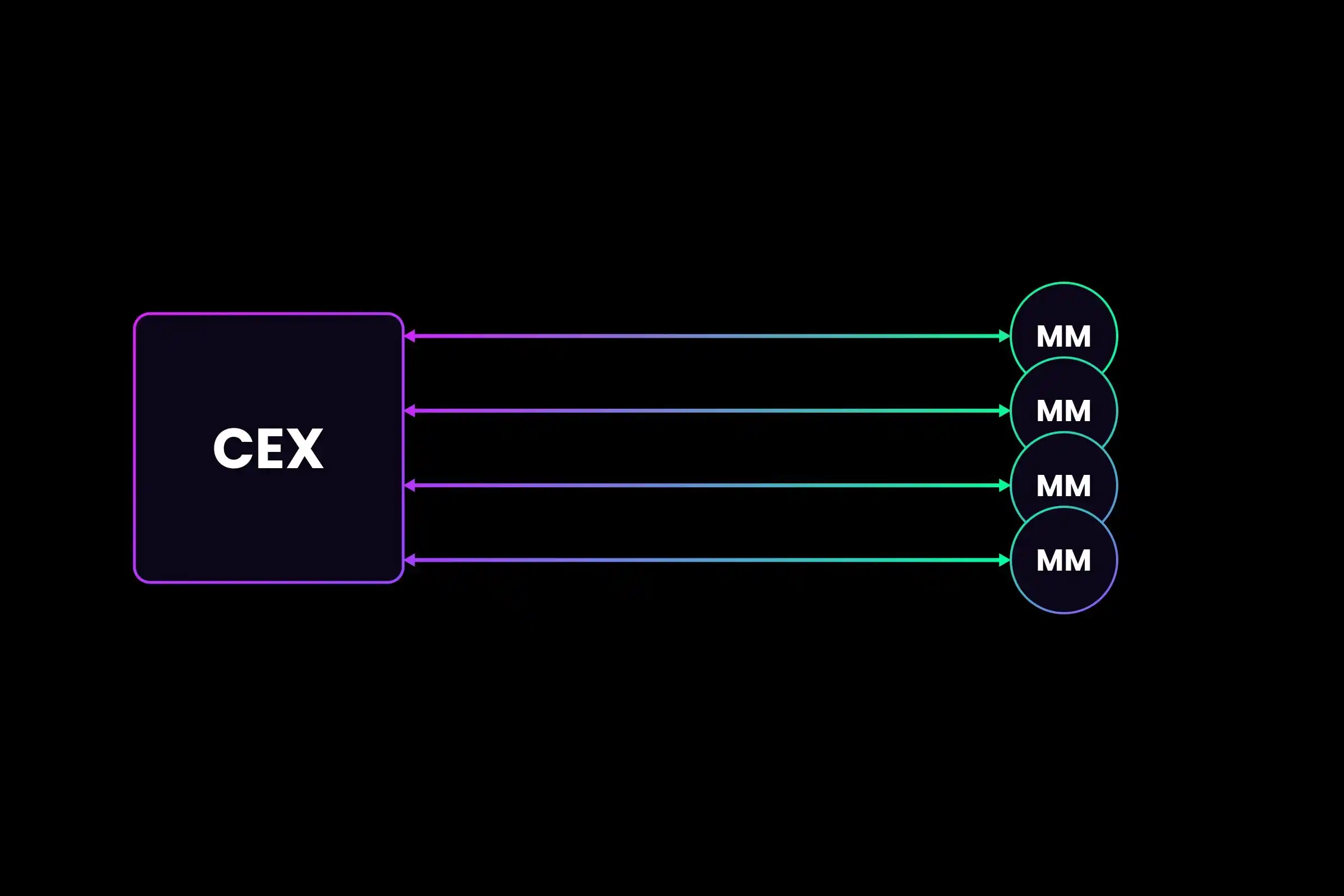
To help everyone understand this conclusion, let's first take a look at how Market Makers (MM) quote on traditional centralized exchanges (CEX).
Market Makers typically engage in physical co-location with the exchange. Each Market Maker runs algorithms on a server and is connected to another server through a standardized length of network cable (e.g., 50 meters), where the exchange's system is running.
There is a constant back-and-forth data flow between market makers and trading platforms. Every time a market maker sends an order to the trading platform—whether it's a limit order, cancel order, or market order—the trading platform needs to broadcast this information to all other market makers; then, other market makers will resend their orders based on the new information; and so the cycle repeats, indefinitely.
Below is a simple schematic.
Now let's take a look at how PropAMM works on the Solana mainnet.
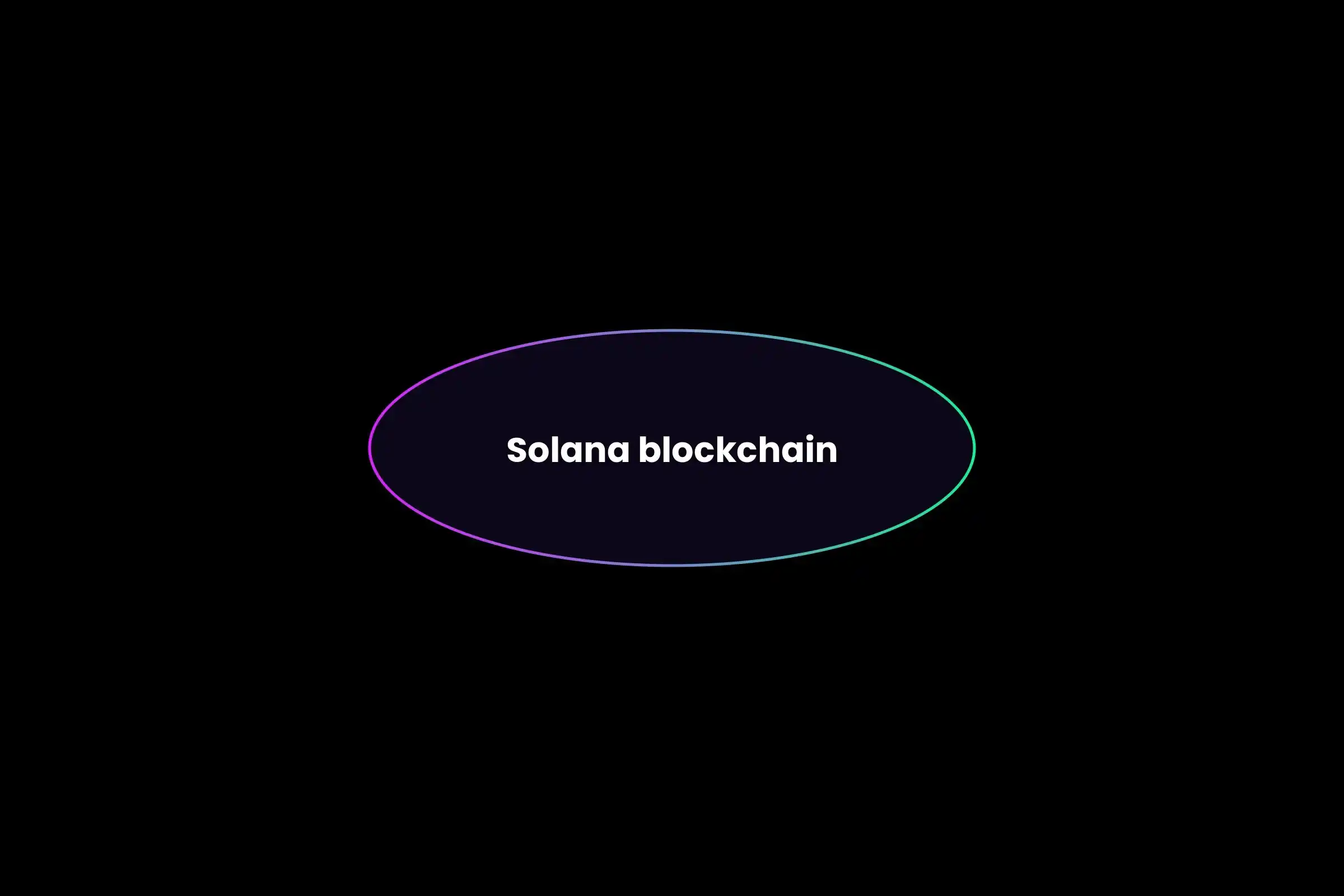
The beauty of PropAMM on Solana is that the blockchain itself directly "hosts" the market maker algorithm. This means the system no longer needs to shuttle billions of messages back and forth between market makers and trading platforms; the market maker algorithm will run directly on the same physical machine as the trading platform.
The new schematic is as follows. (Yes, only the Solana blockchain is needed!)
In the cryptocurrency industry, there has always been a perennial view that, because decentralized systems need to communicate between global nodes, they will surely be slower (have higher latency) than centralized systems.
But if you look at this problem in a different way, on-chain hosted algorithms may actually have lower latency than traditional centralized trading platforms in finance.
Why is this so? The reason is the latency required for PropAMM to update prices only involves electrons moving within the same block of physical silicon. For example, if a previous market order caused a price change for SOL-USD, this information is immediately visible to all PropAMM and used for pricing the next market order. Everything happens within the same block of silicon, eliminating the need for bidirectional communication between servers.
It is worth noting that PropAMM does require frequent oracle updates, but this is not a problem and does not change the overall fact as I described above.
The most critical point remains that when a trading platform—in the case above, the Solana blockchain—directly hosts the PropAMM algorithm, market maker pricing changes in real-time within the same block of physical silicon.
PropAMM has become the dominant mechanism for the SOL-USDC spot price on Solana, with a spread tighter than all major CEXs. I expect this market structure to become the dominant mode of on-chain trading this year, including spot, perpetuals, and even prediction markets.
The biggest challenge for PropAMM is that there is currently no way to guarantee that a taker will always receive the best execution, due to:
· All PropAMM algorithms are not public (which is actually reasonable, as traditional market-making algorithms are also private);
· The outcome of trading routing across multiple PropAMMs is non-deterministic.
However, this issue is solvable. I expect all relevant aggregator teams to introduce solutions this year, such as Jupiter and dFlow on the spot side, and Phoenix on the derivatives side.
Current PropAMMs are still not fully optimized and are subject to various limitations of the Solana blockchain itself. This year, Solana will roll out a series of major upgrades that will significantly improve PropAMM performance, including:
1. Higher CU (Computational Unit) limits per trade and larger trade sizes;
2. Higher CU limits per block;
3. Alpenglow: reducing slot time from 400ms to 100–150ms;
4. DoubleZero: reducing global network latency;
5. Application-controlled execution;
6. Multiple concurrent leaders.
If on the Solana mainnet, PropAMMs are already able to provide quotes tighter than all CEXs without these upgrades, it is conceivable that as these upgrades are gradually rolled out, their performance will become even more powerful.
You may also like

From x402 to MPP: Cloudflare's crucial vote, will it go to Coinbase or Stripe?

BlackRock CEO issues annual open letter: The wave of tokenization has arrived, and we will lead this trend

When Backpack backstabs the community

When gold is no longer a safe haven, and Bitcoin continues to panic

Trump, the World's Largest Oil Trader

If the US and Iran have not reached an agreement in 5 days, what other cards does Trump have?

Tether Whale Dumps £12 Million, Backing Crypto’s ‘British Trump’
Ethereum Foundation Post: Rethinking the Division of Work Between L1 and L2 to Build the Ultimate Ethereum Ecosystem

Two Major Prediction Market Platforms Unite Rarely, What Is the Story Behind This New Fund?
Dragonfly Partners: Most agents will not engage in autonomous trading, how can crypto payments prevail?

US AI Startup Goes All In on Chinese Mega-Model | Rewire News Morning Brief

Trump Lies Again: A "Five-Day Pause" Psyop, How Wall Street, Bitcoin, and Polymarket Insiders Synced Uposciogen

When a Token Becomes Labor, People Become the Interface

Ceasefire News Leaked Ahead of Time? Large Polymarket Bets on Outcome Before Trump's Tweet
BlackRock CEO's Annual Shareholder Letter: How is Wall Street Using AI to Keep Profiting from National Pension Funds?

Sun Valley Releases 2025 Financial Report: Bitcoin Mining Revenue Reaches $670 Million, Accelerating Transformation to AI Infrastructure Platform
On March 16, 2026, in Dallas, Texas, USA, CanGu Company (New York Stock Exchange code: CANG, hereinafter referred to as "CanGu" or the "Company") today announced its unaudited financial performance for the fourth quarter and full year ended December 31, 2025. As a btc-42">bitcoin mining enterprise relying on a globally operated layout and dedicated to building an integrated energy and AI computing power platform, CanGu is actively advancing its business transformation and infrastructure development.
• Financial Performance:
Total revenue for the full year 2025 was $688.1 million, with $179.5 million in the fourth quarter.
Bitcoin mining business revenue for the full year was $675.5 million, with $172.4 million in the fourth quarter.
Full-year adjusted EBITDA was $24.5 million, while the fourth quarter was -$156.3 million.
• Mining Operations and Costs:
A total of 6,594.6 bitcoins were mined throughout the year, averaging 18.07 bitcoins per day; of which 1,718.3 bitcoins were mined in the fourth quarter, averaging 18.68 bitcoins per day.
The average mining cost for the full year (excluding miner depreciation) was $79,707 per bitcoin, and for the fourth quarter, it was $84,552;
The all-in sustaining costs were $97,272 and $106,251 per bitcoin, respectively.
As of the end of December 2025, the company has cumulatively produced 7,528.4 bitcoins since entering the bitcoin mining business.
• Strategic Progress:
The company has completed the termination of the American Depositary Receipt (ADR) program and transitioned to a direct listing on the NYSE to enhance information transparency and align with its strategic direction, with a long-term goal of expanding its investor base.
CEO Paul Yu stated: "2025 marked the company's first full year as a bitcoin mining enterprise, characterized by rapid execution and structural reshaping. We completed a comprehensive adjustment of our asset system and established a globally distributed mining network. Additionally, the company introduced a new management team, further strengthening our capabilities and competitive advantage in the digital asset and energy infrastructure space. The completion of the NYSE direct listing and USD pricing also signifies our transformation into a global AI infrastructure company."
"As we enter 2026, the company will continue to optimize its balance sheet structure and enhance operational efficiency and cost resilience through adjustments to the miner portfolio. At the same time, we are advancing our strategic transformation into an AI infrastructure provider. Leveraging EcoHash, we will utilize our capabilities in scalable computing power and energy networks to provide cost-effective AI inference solutions. The relevant site transformations and product development are progressing simultaneously, and the company is well-positioned to sustain its execution in the new phase."
The company's Chief Financial Officer, Michael Zhang, stated: "By 2025, the company is expected to achieve significant revenue growth through its scaled mining operations. Despite recording a net loss of $452.8 million from ongoing operations, mainly due to one-time transformation costs and market-driven fair value adjustments, the company, from a financial perspective, will reduce its leverage, optimize its Bitcoin reserve strategy and liquidity management, introduce new capital to strengthen its financial position, and seize investment opportunities in high-potential areas such as AI infrastructure while navigating market volatility."
The total revenue for the fourth quarter was $1.795 billion. Of this, the Bitcoin mining business contributed $1.724 billion in revenue, generating 1,718.3 Bitcoins during the quarter. Revenue from the international automobile trading business was $4.8 million.
The total operating costs and expenses for the fourth quarter amounted to $4.56 billion, primarily attributed to expenses related to the Bitcoin mining business, as well as impairment of mining machines and fair value losses on Bitcoin collateral receivables.
This includes:
· Cost of Revenue (excluding depreciation): $1.553 billion
· Cost of Revenue (depreciation): $38.1 million
· Operating Expenses: $9.9 million (including related-party expenses of $1.1 million)
· Mining Machine Impairment Loss: $81.4 million
· Fair Value Loss on Bitcoin Collateral Receivables: $171.4 million
The operating loss for the fourth quarter was $276.6 million, a significant increase from a loss of $0.7 million in the same period of 2024, primarily due to the downward trend in Bitcoin prices.
The net loss from ongoing operations was $285 million, compared to a net profit of $2.4 million in the same period last year.
The adjusted EBITDA was -$156.3 million, compared to $2.4 million in the same period last year.
The total revenue for the full year was $6.881 billion. Of this, the revenue from the Bitcoin mining business was $6.755 billion, with a total output of 6,594.6 Bitcoins for the year. Revenue from the international automobile trading business was $9.8 million.
The total annual operating costs and expenses amount to $1.1 billion.
Specifically, they include:
· Revenue Cost (excluding depreciation): $543.3 million
· Revenue Cost (depreciation): $116.6 million
· Operating Expenses: $28.9 million (including related-party expenses of $1.1 million)
· Miner Impairment Loss: $338.3 million
· Bitcoin Collateral Receivable Fair Value Change Loss: $96.5 million
The full-year operating loss is $437.1 million. The continuing operations net loss is $452.8 million, while in 2024, there was a net profit of $4.8 million.
The 2025 non-GAAP adjusted net profit is $24.5 million (compared to $5.7 million in 2024). This measure does not include share-based compensation expenses; refer to "Use of Non-GAAP Financial Measures" for details.
As of December 31, 2025, the company's key assets and liabilities are as follows:
· Cash and Cash Equivalents: $41.2 million
· Bitcoin Collateral Receivable (Non-current, related party): $663.0 million
· Miner Net Value: $248.7 million
· Long-Term Debt (related party): $557.6 million
In February 2026, the company sold 4,451 bitcoins and repaid a portion of related-party long-term debt to reduce financial leverage and optimize the asset-liability structure.
As per the stock repurchase plan disclosed on March 13, 2025, as of December 31, 2025, the company had repurchased a total of 890,155 shares of Class A common stock for approximately $1.2 million.

The US AI Startup Is Loving China's Open Source Model



 App
App