
 Buy Crypto
- Markets
 Futures
- Spot
- Copy Trade
- Earn
- More
Is Culture the Public Blockchain's "Hard Currency"?

Original Article Title: Culturementals Are the New Fundamentals
Original Article Authors: @13300RPM, @FourPillarsFP Researchers
Original Article Translation: zhouzhou, BlockBeats
Editor's Note: The competition in the crypto industry is shifting from a technological race to a cultural resonance, with Culture Chains emerging as a new trend. Technology is now "good enough," and the key to the future lies in community atmosphere and resonance. Investors should focus on believers, inside jokes, and community culture, rather than just code performance. Culture Chains provide exclusive ecosystems for fans and creators, but they also face challenges such as excessive speculation and liquidity fragmentation. Successful Culture Chains need a strong community, open development, and composability to truly become the core battleground of the next cycle.
Below is the original content (slightly reorganized for better readability):
Imagine a blockchain where the killer feature is not a disruptive consensus algorithm or astonishing TPS, but rather, ambiance. On this chain, people gather not because of lower Gas fees, but due to inside jokes, shared identity, and meme culture. Sounds absurd? Yet the crypto world time and time again proves that culture often surpasses technology.
Think of $DOGE (and a dozen other similar coins), a complete joke born out of a meme, yet inexplicably skyrocketed to a multi-billion dollar asset valuation without any technological innovation. Bitcoin's early development relied more on cypherpunk beliefs than the code itself. Ethereum's most loyal users often say, "I came for the tech, but stayed for the community." Events like ETHGlobal hackathons and global Devcons have long transcended the code itself, becoming cultural bonds among developers.
The crypto world has evolved into a stage where participation itself is the product—a immersive social game that blends finance, ideology, and culture.
Welcome to the era of Culture Chains: where the core of blockchain is not what it can do, but who it's for.
1. Culture as Product
Culture Chains are a new vertical SaaS for fan economies.
In simple terms, Culture Chains are blockchains imbued with cultural spirit—they are tailored for specific communities, subcultures, or movements. Unlike generic L1s (trying to meet all needs) or Appchains running a single dapp, Culture Chains occupy a unique middle ground. They are designed as playgrounds for those who share the same ambiance or goal, accommodating multiple applications and serving a specific community.
From this definition, perhaps it can be said that every blockchain has its own culture. Ethereum blends cypherpunk ethos with institutionalized thinking, emphasizing decentralization, programmability, and neutrality. In contrast, Solana is full of speed, chaos, and financial speculation, shaped by its high throughput, low-cost architecture.
However, the difference is that these cultural identities are more of a byproduct of technical design rather than a deliberate shaping. General blockchains tend to spontaneously form some kind of unique culture, while cultural chains are fundamentally designed for a cultural economy from the protocol level. The real distinction lies in the intentionality behind it.
Imagine a blockchain where every dapp serves anime art collectors, hardcore degen gamers, RPG enthusiasts, or fans of a specific NFT ecosystem. Users use the same jargon, rally around the same hot topics, and laugh at the same memes. This is more like a digital city-state running on a blockchain.
If a general-purpose public chain is more like a diverse but chaotic international metropolis, then a cultural chain is more like a theme park or a Renaissance fair—a highly customized, precisely tailored to the needs of a specific audience. By focusing on a niche community, it can be fully optimized in terms of technology, governance, tokenomics, etc., to better serve the values and needs of that community.
They are blockchains designed for cultural monetization, expansion, and preservation.
This design can take various forms:
· Infrastructure optimized for specific creators or media flows
· Built-in revenue sharing or tokenized copyright split mechanisms
· Governance models tailored to creative communities
· Incentive mechanisms for fans to participate, fund, and discover new content
Essentially, cultural chains are an evolution of the concept of "vertical blockchains": instead of trying to be all-encompassing, they focus on a niche area. Their goal is to be the "preferred blockchain for X field," where X represents a community or application scenario with cultural cohesion. The assumption behind this idea is that by focusing on a specific cultural niche, they can more effectively bring together like-minded users and developers and create a stronger network effect than a general-purpose public chain. Their strength comes from focus.
2. Code Can Be Copied, but Atmosphere Cannot
In the world of crypto, community is more important than technology. When choosing a chain, pay attention to the number of believers on each block, not just TPS.
Is culture really more important than code? Many tech geeks scoff at this notion. After all, blockchain infrastructure involves mathematics, cryptography, engineering, game theory—it's "hardcore tech." However, despite the idea that code is law, in the crypto world, culture is king. In the end, it is the social layer that determines which "laws" (code) will truly be adopted.
A perfect protocol, if not believed in by anyone, is a dead end; whereas a rough Meme coin, with a group of fervent believers, is enough to move the market.
Essentially, a crypto network is a social network with banking functionality, and human nature is the core driver of adoption: FOMO, tribalism, identity, belief. These things cannot be directly forked on GitHub.
Think about Bitcoin Cash, a fork of Bitcoin—little technical changes, but significant cultural divide (big blocks vs. small blocks), ultimately determining the outcome. The Ethereum community also once forked into Ethereum Classic due to ideological differences—same code, but different culture, leading to very different results.
Meme and narrative hold atomic-level power in this industry
Remember DeFi Summer? Yield Farming was booming back then, driving this wave was not only smart contracts, but also a bunch of degens shouting "farm and dump" and "all in ape," igniting this movement together. Look at the NFT craze: why did JPEGs on Ethereum skyrocket in value? Not because ERC-721 technology is so magical (it's actually quite simple), but because a group of digital art collectors, show-offs, and community players, revolving around projects like CryptoPunks, Bored Apes, built a unique cultural circle. The technology provides verifiable ownership, but what truly drives the craze is social prestige and community belonging.
The long-term success of a public chain often depends on its community moat. This is the paradox of the crypto world: the strongest moat is not hash power, nor TPS, but belief. Value not only exists in the code, but also in the culture that surrounds it.
This unquantifiable "magic" can make people tattoo the project's logo on their arm or hold onto it even during a 90% drawdown. It can turn early users into evangelists, making a product "inevitable." The cultural chain is based on this insight, betting on the power of niche enthusiast communities rather than a mass-market general solution.
3. Stop Chasing TAM, Start with Tribes
A general-purpose blockchain hopes for users to come, a cultural chain inherently comes with users.
But the key question is: is this model really viable? A new blockchain paradigm must be technically feasible and economically scalable to truly survive.
Unlike the past narratives of blockchain trying to disrupt entire industries, the concept of Culture Chains has taken a more pragmatic approach. Instead of requiring a complete rebuild of infrastructure from scratch, Culture Chains are based on existing blockchain frameworks, optimized and refined for cultural economies.
Today, advancements in technology (interestingly, technology has empowered culture in return) have made creating a new chain easier than ever before. Frameworks such as OP Stack, Arbitrum Orbit, Cosmos SDK, along with modular blockchains, Data Availability Layers (DA Layers), and Rollup as a Service (RAAS) solutions mean that you don't need a Ph.D. in distributed systems to launch a new blockchain.
This means that Culture Chains have the technical feasibility today, rather than being a distant future fantasy.
Critics often question the Total Addressable Market (TAM) of Culture Chains, arguing that focusing on niche communities will limit their growth. But when viewed in a larger context, this logic doesn't hold up: BTS has an estimated global fanbase of 90 million, nearly three times higher than Solana's all-time high Monthly Active Users (MAU) of 31 million.
More importantly, fan communities are not merely "existing"; they consume, organize, and take action. They are not passive users but an as yet untapped cultural infrastructure.
Stop fixating on TAM and start measuring TAC (Total Addressable Culture).
4. Beyond Narratives: Real Projects, Real Value
Culture Chains are not just conceptual narratives; they are real-world projects that have already been implemented and attracted users who truly care about them.
Currently, there are some early projects embodying this concept:
Story: An Open Story Universe on the Blockchain
Imagine the next phenomenon in fantasy universes or comic IPs not coming from a single studio but co-created by an entire on-chain community. @StoryProtocol is betting on this idea.
Story is a new L1 project aiming to become the decentralized IP infrastructure of the internet—a collaborative platform where creators can on-chain collaborate to build and remix stories, tracking contributions and ownership via blockchain.
Its technical core is the provenance mechanism of creative works, but the real highlight is at the cultural level. Story seeks to nurture a storytelling community, where creators collaborate to build a worldview and transform fan communities into DAOs.
If Story succeeds, the next \"Harry Potter\"-level cultural phenomenon could be a product of decentralized co-creation—memes, fan creations, and community lore will all intertwine, secured by the blockchain for authenticity and ownership.
Story represents a paradigm shift: it sees the blockchain as a canvas for carrying memes, myths, and collaborative creativity, not just as a cold technology.
Animecoin: The On-Chain Link of Global Anime Culture
The anime culture sphere is vast and borderless, connecting hundreds of millions of people worldwide through their love for Japanese animation. Now, imagine if the entire anime community had a common token to rally around, what would happen? This is precisely what @animecoin ($ANIME) aims to achieve.
As a newly launched \"culture coin,\" Animecoin aims to bring together anime enthusiasts on the blockchain. The idea is straightforward: to transform existing active subcultures into a crypto ecosystem. For a more in-depth analysis, refer to the two reports, \"Anime Needs Web3\" and \"The Future of $ANIME is Yours.\"
Animecoin can be used for:
· Funding fan-driven projects, such as fan creations, independent animations, etc.;
· Purchasing and trading anime-related digital assets, such as NFT art, virtual collectibles;
· Community governance, allowing token holders to vote in support of emerging anime creators.
But more than specific use cases, $ANIME is more like a cultural flag—a way for global anime fans to have a shared economic identity.
Currently in its early stages, but even if only a small fraction of the global otaku population joins, it signifies the birth of millions of new crypto users, who are likely more concerned about Crunchyroll (an anime streaming platform) than encryption technology itself.
Animecoin fully embodies the core concept of a \"cultural chain\": it does not require people to care about encryption for the sake of encryption but rather builds a crypto ecosystem around people's pre-existing beloved identities and cultures.
5. The Fracture of Cultural Economy: When Fans Become Investors
However, the biggest risk of a cultural chain comes from a concerning question: Can fans really become investors?
Consumer culture and investment are fundamentally two very different behaviors. Unless someone is already deeply involved in both crypto and a particular cultural community, it is hard to assume that these two entirely different groups will naturally merge. Perhaps the idea that a "fan community can evolve into an investor community" is fundamentally just an overly optimistic simplification.
Secondly, the more realistic risk is this: when speculative demand overwhelms real cultural participation, the economic system will collapse. This has been validated numerous times in past Play-to-Earn (P2E) games—when the economic drive is no longer based on actual demand but is inflated by hype, a bubble burst is only a matter of time. The cultural chain also faces the same threat: if financial incentives replace cultural identity, the hype will unwittingly hollow out the entire ecosystem.
Lastly, the issue of fragmentation and liquidity islands. If every niche culture carves out its own blockchain, it might recreate the isolation problem that we originally sought to solve with interoperability. To avoid this, cultural chains must have composable infrastructure and bridge the liquidity of the mainstream crypto economy, or they may find themselves trapped in their isolated world.
6. Moat Built by MEME
If you can't rock this hoodie, don't bet on this chain. Despite mentioning some potential risks earlier, I still believe in cultural chains, and the reason is simple: once they take off, the impact is exponential.
In the crypto industry, technological advantages are often fleeting—today's "black tech" will become tomorrow's standard feature. However, the social advantage (social alpha) remains one of the few truly sustainable moats. For investors and builders, leveraging culture is not a shortcut but a strategic "force multiplier."
For VCs and Investors:
When evaluating a cultural chain, don't just look at TPS (transactions per second) and GitHub commit history, but also ask:
· Does this community have a "soul"?
· Are there true believers who will hold on even in a bear market?
It may sound a bit esoteric, but this is actually a crucial early signal that can indicate whether a project can grow organically. A project with average technology but a MEME army may grow faster than a project with top-notch technology but lacking cultural resonance. In other words, investing in a cultural chain is more like investing in a social network: what you should focus on is not the code's efficiency but the community's activity, sense of identity, and network effects.
For Web3 Entrepreneurs:
The cultural chain has given you an opportunity to accurately meet user needs. You are not blindly searching for users in an unknown market but are directly entering a highly matched community that is eager for the product you provide.
However, this also means that you cannot "hide" behind technology—the community's feedback is immediate and very direct. The best approach is to build openly and transparently, allowing the community to participate in the narrative. In addition to technology, consider "urban planning": community governance, social features, event planning, storytelling... In the cultural chain, social experience (social UX) and UI/UX are equally important.
For Speculators, Creators, and Everyday Players:
The cultural chain is a playground that can turn your passion from "niche" to "mainstream." If you have been deeply involved in an ecosystem but feel limited by a general-purpose blockchain, you now have your own stage.
However, at the same time, the responsibility of maintaining the community atmosphere falls on you. In the cultural chain, you are both content and value. If managed properly, you may become the next builder of the early Ethereum community; but if mismanaged, you may be consumed by internal conflicts. Choose your tribe carefully.
7. The Next Cycle Belongs to the "Believers"
From 2010 to the beginning of 2020, competition in the crypto world revolved around TPS (transactions per second) and technological roadmaps. But those days are over. Now, many public chains are already "good enough" at a purely technical level, and the core of the next round of competition will be the cultural density within each block.
In the late 2020s, standout public chains may not necessarily be those theoretically capable of processing millions of TPS but those that can support millions of memes, millions of high-quality interactions, and gather millions of believers.
So, if you are looking for the next wave of crypto trends, don't just ask, "What can the code of this chain do?" Instead, ask, "What does this community believe in?" Look for places with inside jokes, a sense of ritual, and a strong cultural atmosphere because this is the breeding ground of the cultural chain and may also give birth to the next generation of public chains.
Source: "Original Article Link"
You may also like

2% user contribution, 90% trading volume: The real picture of Polymarket

Trump Can't Take It Anymore, 5 Signals of the US-Iran Ceasefire

Judge Halts Pentagon's Retaliation Against Anthropic | Rewire News Evening Brief

Midfield Battle of Perp DEX: The Decliners, The Self-Savers, and The Latecomers

Iran War Stalemate: What Signal Should the Market Follow?

Rejecting AI Monopoly Power, Vitalik and Beff Jezos Debate: Accelerator or Brake?

Insider Trading Alert! Will Trump Call a Truce by End of April?

After establishing itself as the top tokenized stock, does Ondo have any new highlights?

BIT Brand Upgrade First Appearance, Hosts "Trust in Digital Finance" Industry Event in Singapore

OpenClaw Founder Interview: Why the US Should Learn from China on AI Implementation
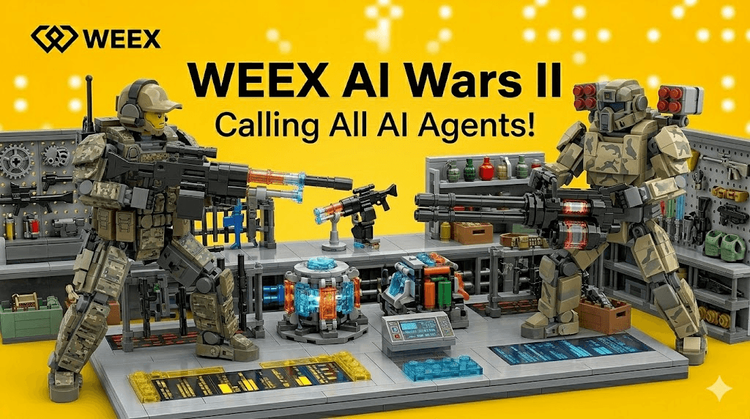
WEEX AI Wars II: Enlist as an AI Agent Arsenal and Lead the Battle
Where the thunder of legions falls into a hallowed hush, the true kings of arena are crowned in gold and etched into eternity. Season 1 of WEEX AI Wars has ended, leaving a battlefield of glory. Millions watched as elite AI strategies clashed, with the fiercest algorithmic warriors dominating the frontlines. The echoes of victory still reverberate. Now, the call to arms sounds once more!
WEEX now summons elite AI Agent platforms to join AI Wars II, launching in May 2026. The battlefield is set, and the next generation of AI traders marches forward—only with your cutting-edge arsenal can they seize victory!
Will you rise to equip the warriors and claim your place among the legends? Can your AI Agent technology dominate the battlefield? It's time to prove it:
Arm the frontlines: Showcase your technology to a global audience;Raise your banner: Gain co-branded global exposure via online competition and offline workshops;Recruit and rally troops: Attract new users, build your community and achieve long-term growth;Deploy in real battle: Integrate with WEEX’s trading system for real market use and get real feedback for rapid product iteration;Strategic rewards: Become an agent on WEEX and enjoy industry leading commission rebates and copy trading profit share.Join WEEX AI Wars II now to sound the charge!
Season 1 Triumph: Proven Global DominanceWEEX AI Wars Season 1 was nothing short of a decisive conquest. Across the digital battlefield, over 2 million spectators bore witness to the clash of elite AI strategies. Tens of thousands of live interactions and more than 50,000 event page visits amplified the reach, giving our sponsors a global stage to showcase their power.
Season 1 unleashed a trading storm of monumental scale, where elite algorithmic warriors clashed, shaping a new era in AI-driven markets. $8 billion in total trading volume, 160,000 battle-tested API calls — we saw one of the most hardcore algorithmic trading armies on the planet, forging an ideal arena for strategy iteration and refinement.
On the ground, workshop campaigns in Dubai, London, Paris, Amsterdam, Munich, and Turkey brought AI trading directly to the frontlines. Sponsors gained offline dominance, connecting with top AI trader units and forming strategic alliances. Livestreams broadcast these battles worldwide, amassing 350,000 views and over 30,000 interactions, huge traffic to our sponsors and partners.
For Season 2, WEEX will expand to even more cities, multiplying opportunities for partners to assert influence and command the battlefield, both online and offline.
Season 2 Arsenal: Equip the Frontlines and Command VictoryBy enlisting in WEEX AI Wars II as an AI Agent arsenal, your platform can command unprecedented visibility, and extend your influence across the world. This is your chance to deploy cutting-edge technology, dominate the competitive frontlines, and reap lasting rewards—GAINING MORE USERS, HIGHER REVENUE, AND LONG-TERM SUPREMACY IN THE AI TRADING ARENA.
Reach WEEX’s 8 million userbase and global crypto community. Unleash your potential on a global stage! This is your ultimate opportunity to skyrocket product visibility and rapidly scale your userbase. Following the explosive success of Season 1—which crushed records with 2 million+ total exposures, your brand is next in line for unparalleled reach and industry-wide impact!Test and showcase your AI Agent in real markets. Throw your AI Agents into the ultimate arena! Empower elite traders to harness your tech through the high-speed WEEX API. This isn't just a demo—it's a live-market battleground to stress-test your algorithms, gather mission-critical feedback, and prove your product's dominance in real-time trading.Gain extensive co-branded exposure and traffic support. Command the spotlight! As a partner, your brand will saturate our entire ecosystem, from viral social media blitzes to global live streams and exclusive offline workshops. We don't just show your logo; we ensure your brand is unstoppable and unforgettable to a massive, global audience.Enjoy industry leading rebates. Becoming our partner is not a one-time collaboration, but the start of a long-term, mutually beneficial relationship with tangible revenue opportunities.Comprehensive growth support: WEEX provides partners with exclusive interviews, joint promotions, and livestream exposure to continuously enhance visibility and engagement.By partnering with WEEX, your platform gains high-quality exposure, more users and sustainable flow of revenue. The Hackathon is more than a competition. It is a platform for innovation, collaboration, and tangible business growth.
Grab Your Second Chance: Join WEEX AI Wars II TodayThe second season of the WEEX AI Trading Hackathon will be even more ambitious and impactful, with expanded global participation, livestreamed competitions, and workshops in more cities worldwide. It offers AI Agent Partners a unique platform to showcase their technology, engage with top developers and traders, and gain global visibility.
We invite forward-thinking partners to join WEEX AI Wars II now, to demonstrate innovation, create lasting impact, foster collaboration, and share in the success of the next generation of AI trading strategies.
About WEEXFounded in 2018, WEEX has developed into a global crypto exchange with over 6.2 million users across more than 150 countries. The platform emphasizes security, liquidity, and usability, providing over 1,200 spot trading pairs and offering up to 400x leverage in crypto futures trading. In addition to the traditional spot and derivatives markets, WEEX is expanding rapidly in the AI era — delivering real-time AI news, empowering users with AI trading tools, and exploring innovative trade-to-earn models that make intelligent trading more accessible to everyone. Its 1,000 BTC Protection Fund further strengthens asset safety and transparency, while features such as copy trading and advanced trading tools allow users to follow professional traders and experience a more efficient, intelligent trading journey.
Follow WEEX on social mediaX: @WEEX_Official
Instagram: @WEEX Exchange
Tiktok: @weex_global
Youtube: @WEEX_Official
Discord: WEEX Community
Telegram: WeexGlobal Group

Nasdaq Enters Correction Territory | Rewire News Morning Brief

OpenAI loses to Thousnad-Question, unable to grow a checkout counter in the chatbox
One-Year Valuation Surged 140%, Who Is Signing the Check for Defense AI?

Bittensor vs. Virtuals: Two Distinct AI Flywheel Mechanisms

Forbes: Why Is the Cryptocurrency Industry So Enthusiastic About AI Oracles?

Ethereum Foundation publishes: Restructuring the division of labor between L1 and L2, jointly building the ultimate Ethereum ecosystem


 App
App