
 Buy Crypto
- Markets
 Futures
- Spot
- Copy Trade
- Earn
- More
IOSG In-Depth Report: Unveiling the Harsh Reality of Web3 Consumer App Survival Rate at Only 7%

Original Article Title: "IOSG Weekly Brief | Overview of Web3 Consumer Application Paradigm and Investment Theory #271"
Original Source: IOSG Ventures

During a recent period of time, Alliance DAO has gained significant influence due to its successful incubation of Pump.fun, Moonshot, and other Web3 consumer applications. This article first summarizes Alliance DAO's investment philosophy in the Web3 consumer track and presents its own observations on this track, outlining the current mainstream paradigms, challenges, and potential opportunities of Web3 consumer applications. Finally, it concludes with our thoughts on the investment theory of Web3 consumer applications.
Alliance DAO's Incubation of Web3 Consumer Track
Since its launch, the Alliance DAO Accelerator has co-incubated or externally invested in 28 Web3 consumer applications. They can be roughly divided into 7 major categories:
1. Lifestyle Category
Definition: Projects aimed at cultivating users' novel and healthy lifestyles through Web3;
Number: 3;
Specific Projects:
· StepN: A Web3 lifestyle application with the core innovation of Move to Earn, where users can purchase running shoe NFTs, track their exercise data, and receive token rewards.
· Sleepagotchi: A Web3 sleep monitoring and Sleep-to-Earn sleep aid game mobile application, a card gacha nurturing game where sleep earns tokens, and tokens are used for gacha draws.
· GM: Web3 AI Agent for health management, leveraging AI to enhance health and gain rewards.
2. Games Category:
Definition: Web3 games or GameFi;
Number: 10;
Specific Projects:
· Axie Infinity: Axie Infinity is a card game developed by Sky Mavis that allows players to breed, raise, battle, and trade Axie creatures.
· Genopets: Genopets is a Move-to-Earn NFT mobile game on Solana that makes adopting a positive lifestyle fun and rewarding. A Genopet is a player's digital pet, whose evolution and growth are closely tied to their own. As players explore, battle, and evolve, the steps they take each day power their journey in the Genoverse - earning cryptocurrency in the game.
· Nine Chronicles: Nine Chronicles is a decentralized card-based fighting RPG game.
· Chibi Clash: Chibi Clash is building a Web3 game world centered around its flagship auto-battler game. Inspired by gameplay from Hearthstone Battlegrounds and art style from MapleStory, Chibi Clash Auto Battler is an asynchronous PvP game where players can recruit, level up, and deploy troops to battle.
· Primodium: Primodium is building a fully on-chain, open-source, composable game where players aim to gain map control, research technology, and expand their factory.
· Starbots: Starbots is a robot combat NFT game where players can create fantasy robots to battle other opponents and collect NFT items and tokens.
· Legends of Venari: Legends of Venari is a blockchain game startup that has created an exploratory creature collection role-playing game. In Legends of Venari, players can trap, tame, and collect Venari creatures in a player-driven sandbox, vying for territory and rare resources.
· Force Prime: Force Prime is a full-chain strategy Web3 game platform that offers a multiplayer hero combat experience. Players can nurture and customize their own hero and battle against global players.
· Amihan: The first game from the game studio FARM FRENS, a TG casual farming mini-game.
· Wildcard: Wildcard is a Web3-based card collection game aimed at gamers, fans, and collectors.
3. Crypto Speculative Type:
Definition: A focus on products related to meeting users' Crypto speculation needs;
Quantity: 3;
Specific Projects:
· Pump Fun: Pump is a meme coin launch platform where users can release a token that can be traded immediately without providing liquidity.
· Moonshot: Moonshot is a platform for discovering, buying, and selling Meme coins, supporting users to make cash deposits using credit and debit cards, as well as cash out assets anytime via bank transfer.
· Candlestick: Candlestick is a crypto opportunity radar supported by actionable trading signals and predictions, providing abundant data on tokens with the highest price surges, biggest price drops, and highest trading volume.
4. SocialFi Category:
Definition: Tokenizing users' influence on social media platforms to create new speculative investment projects;
Quantity: 6
Specific Projects:
· fantasy.top: Fantasy is a SocialFi trading card game (TCG) where players can compete in an online game using trading cards of influencers in the crypto space on the Twitter platform, leveraging their social capital and research expertise for monetization.
· 0xPPL: A decentralized social network targeting native cryptocurrency users, aggregating users' content on Lens, Farcaster, and Twitter, and incorporating some Crypto functionalities.
· time.fun: time.fun is a time tokenization platform that allows time holders to connect with fans. As time holders provide more value to fans, their time value naturally increases due to market demand. Whenever someone trades their time, time holders can earn ETH from transaction fees and redemptions.
· fam.: Fam is a web3-native community hub for discovering, organizing, and enjoying activities of web3 families. fam. uses on-chain identity to allow users to easily find and connect with fellow holders no matter where they are.
· Tribe.run: Tribe is a Solana-based crypto social protocol. SocialFi, private groups, entry to groups requiring tokens, speculative, ability to host video or voice live streams, and more.
· EarlyFans: EarlyFans is a SocialFi product on the Blast L2, where creators can make a public commitment through EarlyFans and auction off that commitment. Fans can also actively initiate bribery and auction off bribery rights. If the creator refuses or expires, all funds are returned.
5. Creator Economy:
Definition: A Web3 content distribution platform that provides a new economic model for content creators (text, video, art, etc.);
Quantity: 2;
Specific Projects:
· Koop: Koop enables any creator, collector, or community to organize and fundraise through NFT art or collector passes. Funds from collector passes form a treasury (or bank) for each community to support their on-chain projects and tasks. The community can then directly manage their finances, leverage their members' unique skills, and manage their organization in an engaging and social way.
· CreatorDAO: CreatorDAO is a decentralized autonomous organization (DAO) focused on accelerating creators' careers and giving them shared access to capital, technology, and community. CreatorDAO provides guidance to creators, develops the professional tools needed for branding, and creates a community for investing in each other's success.
6. Financial Products:
Definition: Products aimed at reducing user costs associated with using and managing Crypto, such as deposits and withdrawals;
Quantity: 3;
Specific Projects:
· Hana Network: Hana Network is a super casual financial system with social network effects and has launched the fiat on/off-ramp solution Hana Gateway. Hana Network aims to achieve user-driven distribution through existing open social networks.
· P2P.me: A decentralized India-based fiat on/off-ramp platform, where the off-chain part enhances security through a reputation system and improves privacy through ZK.
· Offramp: Offramp is a decentralized fiat off-ramp protocol that enables anyone in the world to quickly onboard/offboard cryptocurrency, fully self-custody funds, without KYC, and with low fees.
7. Tooling:
Definition: A product that solves a real-world user problem, such as a Web3 map;
Quantity: 1;
Specific Project:
· proto: An Indian version of Google Maps, Proto is a user-generated, token-incentivized mapping platform designed to disrupt the geospatial data industry. Through decentralized data collection, Proto is able to provide high-quality real-time map data at a fraction of the cost of traditional methods. Proto's unique approach allows it to easily penetrate dense, complex areas, providing businesses with accurate and up-to-date data tailored to their needs.
Looking at the development trend of investment preferences, Alliance DAO began investing in and incubating Consumer projects in 2021. From the first half of 2021 to the first half of 2023, its main investment and incubation focus was on Games and Creator Economy projects. Starting from the second half of 2023 until 2024, its preference shifted to Crypto Speculation, SocialFi, and Finance projects.
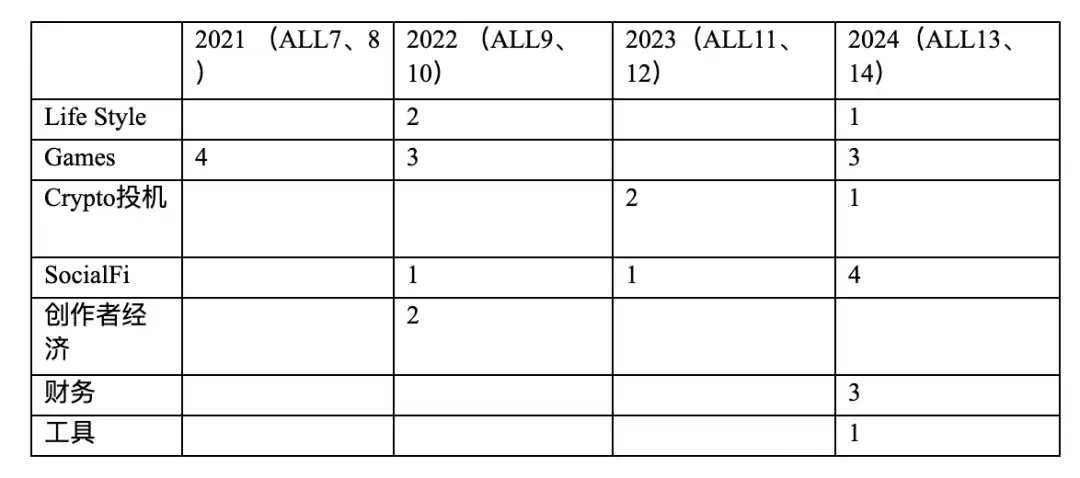
The author has tracked some of Alliance DAO's publicly released articles, podcasts, and other content, summarizing its investment philosophy regarding the Web3 consumer track as follows:
1. Firstly, it believes that the ecosystem's foundational tools are increasingly mature and that more application layer solutions are needed to bring genuine value capture to the ecosystem;
2. Founding teams should focus on Product-Market Fit (PMF). Usually, during the market validation process, teams face two main risks: product-side risk and market-side risk. Consumer projects have a higher market-side risk, so teams should consider avoiding premature token introduction to prevent distortion of PMF validation results.
3. The target users of Web3 consumer applications can be divided according to their acceptance of Web3. On the left are non-Web3 regular users, and on the right are Web3 Native users. For applications targeting left-side users, Web3 elements are mainly used to lower customer acquisition costs through "advertising tokens" to capture more market share. Right-side users need to focus on assetizing new targets, bringing additional investment and speculative demand, or addressing the unique needs of Web3-native users. Currently, the preference leans more towards the latter.
4. It's noted that the user profiles of the Solana ecosystem and EVM ecosystem are different, with the former being more conducive to the success of Consumer applications for four main reasons:
More vibrant community: Solana users are highly enthusiastic about participating in new projects, especially those with speculative potential, possibly due to the wealth effect; Stronger and more efficient ecosystem resource support: Solana ecosystem core members are more community-oriented, possess strong community mobilization capabilities, and respond more rapidly to new project support. Faster and lower-cost infrastructure: Aimed at creating an on-chain Nasdaq, with low transaction costs, high confirmation speeds, and due to the undiversified nature of core components and a focus on usability, the learning curve for new users is relatively low. Higher product competitive barriers: Due to the adoption of non-EVM technology stack choices, the cost of copying Solana DApps is higher.

What is a Web3 Consumer Application
A consumer application, also known in Chinese context as a To C (To Consumer) application, means that your target users are mostly ordinary consumers, not enterprise users. Open your App Store, and all the apps inside belong to this category. Web3 consumer applications refer to software applications with Web3 features aimed at consumers.
Generally, according to the categorization in most App Stores, we can roughly divide the entire consumer application field into the following 10 categories, each of which will have different subdivisions. Of course, as the market matures, many new products, in order to find their own unique selling points, will combine multiple features to some extent. However, we can still make a simple classification based on their core selling points.
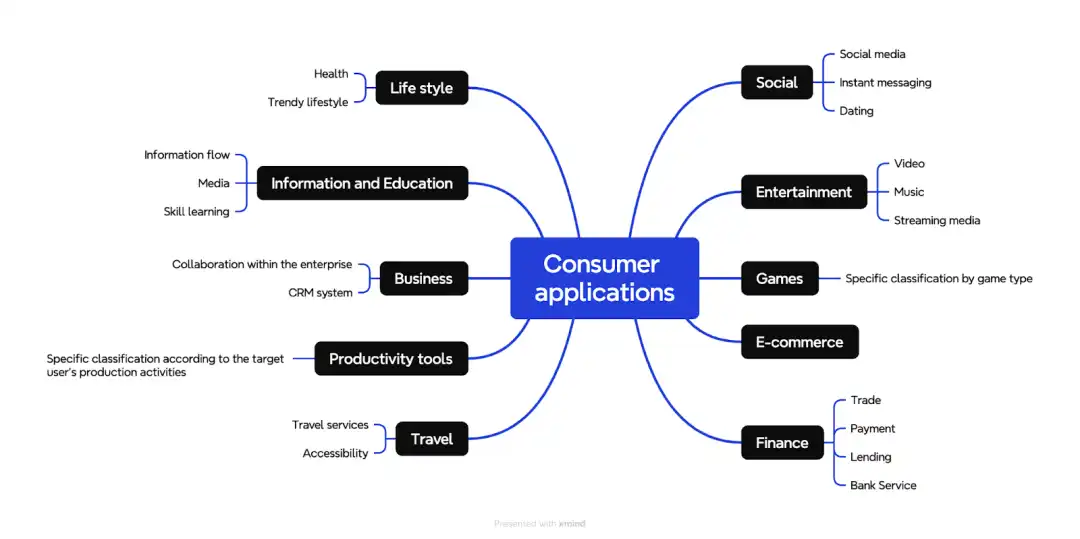
Web3 Consumer Application Paradigms and Their Opportunities and Challenges
Based on an analysis of the investment concept of the Allinance DAO and his own observations, the author believes that there are three common paradigms of Web3 consumer applications:
1. Utilizing the technical characteristics of Web3 infrastructure to optimize certain issues existing in traditional consumer applications:
This is a common paradigm. We know that a large amount of investment in the Web3 industry revolves around infrastructure development. Application creators using this paradigm hope to leverage the technical features of Web3 infrastructure to enhance their product's competitive advantage or provide new services. The benefits brought by these technological innovation directions can usually be categorized into the following two types:
1. Ultimate Privacy Protection and Data Sovereignty:
· Opportunity: Privacy has always been the main theme of Web3 infrastructure innovation. From the initial asymmetric encryption algorithm for identity confirmation, it has gradually integrated numerous software and hardware technologies, such as ZK, FHE, to TEE, among others. Many tech bigwigs in Web3 seem to adhere to an extreme view, aiming to create a network environment that does not rely on third-party trust and provide users with the ability to interact with information or value.
This technological characteristic most directly benefits users by providing data sovereignty. Personal privacy information can be stored directly on locally trusted software and hardware devices, avoiding the leakage of privacy information. Many Web3 consumer applications optimized for this technological characteristic exist, and any project that claims to be a decentralized XX falls into this paradigm, such as decentralized social media platforms, decentralized AI large models, decentralized video websites, and so on.
· Challenge: After years of market validation, it can be said that using this as a core selling point has not shown a clear advantage in market competition. There are two reasons for this. Firstly, consumer users' emphasis on privacy is based on large-scale privacy breaches and infringement events. However, in most cases, such issues can be effectively mitigated through more comprehensive legislation and regulations. Therefore, if privacy protection is based on a more complex product experience or a higher cost of use, its competitiveness will be significantly inadequate.
Secondly, as we know, the business model of most current consumer applications is built on extracting value from big data, such as targeted marketing. Overemphasizing privacy protection will undermine the mainstream business model because user data will be scattered across a batch of data silos, posing a challenge for designing a sustainable business model. If the product ends up having to rely solely on so-called 'Tokenomics,' it will have to introduce unnecessary speculative attributes to the product. This, on the one hand, distracts the team's resources and energy to deal with the impact of these attributes on the product and, on the other hand, is detrimental to finding Product-Market Fit (PMF). This will be specifically analyzed in the following sections.
2. Low-Cost Global 24/7 Trusted Execution Environment:
Opportunity: The emergence of numerous L1 and L2 solutions has provided application developers with a new, globalized, 24/7 multi-party trusted program execution environment. Typically, traditional software service providers independently maintain their programs, such as running on their server clusters or in the cloud. This naturally incurs a trust cost in businesses involving multi-party collaboration, especially when the parties are evenly matched in strength or scale, or when the data involved is particularly sensitive and critical, resulting in a significant trust cost that usually translates into high development and user usage costs, such as in cross-border payment scenarios. The utilization of the execution environment brought by Web3 can effectively reduce the costs associated with these services. Stablecoins are a good example of such applications.
Challenge: From a cost reduction and efficiency improvement perspective, this is indeed a competitive advantage. However, exploring application scenarios for this is quite challenging. As mentioned earlier, the benefits of using this execution environment are only seen in a service involving multi-party collaboration, where relevant parties are independent and evenly matched in scale, and the data involved is particularly sensitive. This is a rather stringent condition. Currently, most of these application scenarios are concentrated in the financial services sector.
2. Utilizing Crypto Assets to Design New Marketing Strategies, User Loyalty Programs, or Business Models:
Similar to the first point, application developers adopting this paradigm also hope to introduce Web3 attributes to give their products a competitive advantage in a relatively mature, market-validated scenario. However, these application developers focus more on introducing crypto assets and leveraging the highly financial nature of crypto assets to design better marketing strategies, user loyalty programs, and business models.
We know that any investment target has two types of value, commodity value and financial value. The former is related to the target's use value in a particular real-world scenario, such as the livable attribute of real estate assets, while the latter is related to its trading value in the financial market. This trading value in the cryptocurrency field usually comes from the speculative scene brought about by high liquidity and volatility. Cryptocurrency is an asset class where the financial attribute far outweighs the commodity attribute.
And in the eyes of most such application developers, the introduction of cryptocurrency typically brings about three main benefits:
1. Reduce Customer Acquisition Costs through Token-based Marketing Activities like Airdrops:
· Opportunity: For most consumer applications, how to acquire customers at a low cost in the early stages of a project is a key issue. Tokens, with their high financial attribute and being assets created out of thin air, can significantly reduce the risk of early-stage projects. After all, compared to directly buying traffic with real money, gaining exposure, and using a zero-cost created Token for user acquisition is indeed a more cost-effective choice. From a certain perspective, these types of Tokens are similar to advertising Tokens. Many projects adopt this paradigm, such as most TON ecosystem projects and small games.
· Challenge: This customer acquisition method mainly faces two main issues. Firstly, the conversion cost of seed users acquired through this method is extremely high. We know that most users attracted by this method are mostly cryptocurrency speculators, so these users are not particularly focused on the project itself; they are more interested in the potential financial rewards and participate in it for that reason. Moreover, there are currently many professional airdrop hunters or airdrop farming studios, which poses a great challenge to converting them into actual product users later on. It might also lead to a misjudgment of Product-Market Fit (PMF), resulting in excessive investment in the wrong direction.
Secondly, with the widespread application of this type of model, the marginal benefits of acquiring customers through Airdrops are diminishing. This means that if you want to establish enough attractiveness among cryptocurrency speculators, the cost will gradually increase.
2. User Loyalty Programs Based on X to Earn:
· Opportunity: Retention and reactivation are another key concern for consumer applications. How to ensure that users continue to use your product requires a lot of effort and cost. Similar to marketing, using the financial attribute of Tokens to reduce the cost of retention and reactivation has also become the choice of most such projects. A representative model is X to Earn, where users are rewarded with Tokens based on pre-defined key user behaviors, thereby establishing a user loyalty program.
· Challenge: Relying on user motivation to earn rewards can shift the user's focus from the product's functionality to the yield, so if the potential yield decreases, user engagement will quickly diminish. This can be highly detrimental to consumer applications, especially those relying heavily on User-Generated Content (UGC). If the yield is based on the price of the project's issued token, it puts pressure on the project to manage its market value, especially during bear market phases, leading to high maintenance costs.
3. Leveraging Token's Financial Properties for Direct Liquidity:
· Opportunity: For traditional consumer applications, the most common business models are twofold: one is free of charge, leveraging the value of platform traffic after widespread adoption, and the other is paid usage, where users need to pay a fee to access certain Pro features. However, the former has a longer cycle, and the latter is more challenging. Therefore, Tokens bring forth a new business model, which is leveraging Token's financial properties for direct liquidity, meaning the project directly sells the token for cash-out.
· Challenge: It can be explicitly stated that this is an unsustainable business model. The reason being that once the project has passed the early-stage high-growth phase, due to the lack of incremental funding inflow, this zero-sum game model inevitably places the project's interests in opposition to user interests, accelerating user attrition. If not cashed out proactively, due to the lack of robust cash flow revenue, the project can only rely on fundraising to sustain team operations or business expansion, leading to a dependence on market conditions.
3. Fully Serving Web3-Native Users to Address this User Segment's Unique Pain Points:
The final paradigm refers to consumer applications that fully serve Web3-native users. These can generally be divided into two categories based on the innovation direction:
Creating new narratives around some of the untapped value elements for Web3-native users, engaging in monetization design and creating new asset categories:
· Opportunity: By providing new speculative targets for Web3-native users (e.g., the SocialFi track), the advantage lies in obtaining pricing power over a certain asset at the project's initial stage, thus gaining monopoly profits. In contrast, achieving this in traditional industries requires intense market competition and the establishment of strong competitive barriers.
· Challenge: Frankly speaking, this paradigm depends heavily on team resources, specifically on whether it is possible to obtain recognition and support from individuals or institutions within the Web3-native user base who possess strong influence or what is referred to as the "pricing power" of crypto assets. This brings about two main challenges: firstly, as the market evolves, the pricing power of crypto assets dynamically transfers between different groups, for example, from the original Crypto OGs to crypto VCs, then to CEX platforms, further to crypto Key Opinion Leaders (KOLs), and ultimately to traditional politicians, entrepreneurs, or celebrities.
Throughout this process, the ability to identify trends during each power transition, collaborate with the nouveau riche, and remain highly sensitive to team resources and market dynamics has become crucial. Secondly, in order to establish a partnership with these "price setters," it often requires significant costs and sacrifices because in this market, you are not competing against other rivals in a specific application track for a larger market share; instead, you are competing alongside all other crypto asset creators to win the favor of the "price setters," which is a fiercely competitive game.
By offering new tooling products that cater to the unmet needs of Web3-native users in the market participation process. Or, from a user experience perspective, providing better and more convenient products for this user segment:
· Opportunity: With the gradual adoption of cryptocurrencies, the overall user base of this segment will expand, creating opportunities for user segmentation. Furthermore, due to their focus on the genuine needs of a specific user group, these products often find it easier to achieve Product-Market Fit (PMF), thus establishing a more robust business model, such as some transaction-related data analysis platforms, Trading Bots, information platforms, etc.
· Challenge: As the focus returns to real user needs, although the development path of the product is more robust, the construction cycle is longer compared to other paradigm projects. Additionally, since such projects are demand-driven rather than narrative-driven, the PMF of the product is relatively easy to validate. In the early stages of the project, it is usually challenging to secure large amounts of funding. Therefore, maintaining patience and sticking to the original intentions amid the complexities of "coin issuance" or the wealth myth brought by overvalued financing is a very difficult task.

Reflections on the Investment Theory of Web3 Consumer Applications
Next, let's introduce our thoughts on the investment theory of Web3 consumer applications, which can be roughly divided into five core viewpoints:
1. How to surpass the speculative cycle is the primary consideration for Web3 consumer applications
As one of the most successful Web3 consumer applications in the previous cycle, the development path of Friend.Tech can provide us with great insights. According to Dune's data, Friend.Tech has currently accumulated a Protocol Fee of $24,313,188. The total number of users (Traders) has reached 918,888. For a Web3 application, this data performance is quite remarkable.
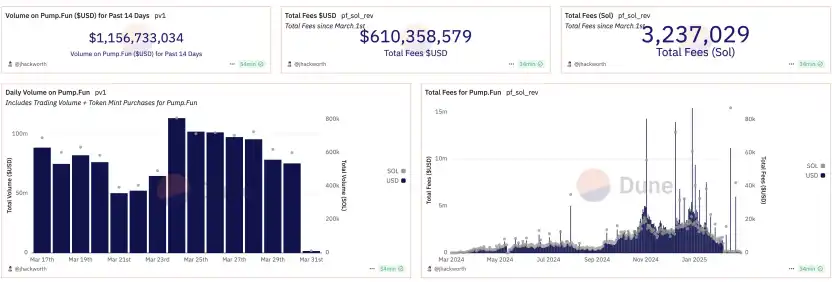
However, the development of this project has encountered significant challenges. The reasons behind this are multifaceted. First, in terms of product design, Friend.Tech introduced the Bonding Curve design, bringing a speculative element to the social application, which initially attracted a large number of users through a wealth effect. However, in the mid to long term, this approach also raised the barrier for user entry into the community, which contradicts the current practice of most Web3 projects or Key Opinion Leaders (KOLs) relying on organic traffic to build influence.
Furthermore, Friend.Tech excessively tied the token to the product's utility, leading to an oversaturation of Web3 speculative users in their product. This caused users to lose focus on the product's utility, ultimately resulting in the current situation.
Therefore, for most Web3 consumer applications, after accumulating a large number of users, it is essential to carefully consider how to find Product-Market Fit (PMF), maintain user engagement, help the project move beyond the speculative cycle, and build a sustainable business model. By effectively addressing these issues, Web3 consumer applications can achieve true Mass Adoption.
2. During the investment process, how to evaluate Web3 consumer applications?
Overall, the investment evaluation of Web3 consumer applications mainly focuses on two aspects. The first aspect is to assess their market potential through the analysis of the product's operational data. This can be broadly divided into two dimensions:
· User Data: For most consumer applications, user data is always crucial as a substantial user base is a prerequisite for consumer applications to explore their business model. Similar to evaluating most traditional Web2 consumer applications, we can use metrics such as active users, user growth rate, user retention rate, etc., to determine whether they have found PMF.
In addition, for different categories and stages of Web3 consumer applications, the focus will also vary. For example, in Web3 Social applications, user retention rate will be more critical. Investors generally start from a niche market. When they find an application with a high retention rate within a user base with unique characteristics, it indicates its investment value. However, it's essential to carefully examine the data to avoid mistaking bot users for PMF during the evaluation process.
· Conversion Data: In addition to user data, it is also necessary to assess potential business value through conversion data, such as Assets Under Management (AUM) and User spend. If a project has many users but a small AUM, or if the average spend per user is low, it indicates limited commercial value. Not all revenue data is the same, and revenue quality can also vary significantly. If the revenue structure is based on actual income, it indicates that users are paying for the product provided to them, rather than mining their tokens. This type of business model is more sustainable.
The second aspect is the evaluation of the team, focusing mainly on three aspects. First is the team's technical strength, which allows them to build product moats, thus forming the core of their competitive advantage. Second, the team needs to have a strong market sense and openness to timely identify market opportunities, understand which users' needs are not being met, and promptly adjust their business direction. Lastly, team resources are also essential, such as partnerships with other applications, collaborations with Key Opinion Leaders (KOLs), etc., which determine the success rate of the project's launch.
3. How to Define a Successful Web3 Consumer Application
From an investor's perspective, defining a successful Web3 consumer application is an intriguing question. Is the success of a Web3 consumer application revenue-driven or token price-driven? Overall, these two aspects are interconnected. Assuming a project cannot generate sustainable revenue, in the end, its issued tokens will not have much of a future. However, this evaluation criterion mainly depends on your investment horizon. If the overall investment horizon is short, then the assessment of token price is more critical, focusing on the tokenomics. On the other hand, for long-term value investment, the performance of revenue data and the sustainability of the revenue structure are more crucial.
4. The "App Factory Model" may be a more deterministic business strategy for Web3 Consumer Applications
Referring to the development of China's Web2 industry, ByteDance has developed many successful consumer applications. Their business strategy involves continuous trial and error, developing numerous different types of products, and letting the market choose a few successful directions to continue investing resources and expanding their business. For them, the key to this successful strategy is the accumulation of a large user base, reducing their trial and error costs. This experience can be applied to the Web3 industry.
Therefore, from this perspective, projects like Friend.Tech still have opportunities in this cycle. At least in the short term, they have shown attractiveness, attracting a large number of users and having decent revenue-generating capabilities. These aspects will help them become Web3 app factories, making their subsequent development worth watching.
5. What Characteristics Will the Next Successful Web3 Consumer Application Possess?
We believe that in the next cycle, successful Web3 consumer applications will appear in the following three paradigms. First, by relying on the fun nature of the product, they will initially attract adoption by crypto Key Opinion Leaders (KOLs) and then leverage the KOLs' influence to bring their fans onto the platform, helping the project achieve a cold start. A representative example of this paradigm is Kaito. The team, through their strong technical ability and innovative incentive mechanism, has gained significant mindshare in the crypto community, allowing them to have strong penetration in different communities. At the same time, they have precisely addressed how Web3 projects can effectively acquire users in the marketing process, accumulating a large number of B2C users and creating precise user profiles for each user through mindshare. This helps Web3 enterprises conduct precise marketing through the Kaito platform, making their business model more sustainable and breaking free from short-term speculative cycles.
The second paradigm is to start from the real needs of Web3 users, rely on product strength to win the market directly. By not introducing a Token too early, it will allow the project to escape the interference of speculative users during Product-Market Fit (PMF) process, building a higher user retention rate, as seen in projects like Polymarket, Chomp, etc.
The third paradigm is innovation in business models. At this point, Grass has given us great inspiration by utilizing users' idle computing resources to help them find sources of value capture in fields such as artificial intelligence and monetizing it through tokens. Although from a business model perspective, Grass leans more towards a B2B model, this "sharing economy" mindset can also be applied to the design of Web3 consumer applications.
6. Which categories of projects are more likely to become the first Web3 consumer applications to find PMF in the crypto industry
Currently, combining market trends and investor preferences, the next Web3 consumer applications most likely to find Product-Market Fit (PMF) may emerge from the following categories:
Firstly, Web3 social applications are still highly regarded by the market. We know that Web3 projects greatly value and rely on social media for marketing, and compared to traditional investors, cryptocurrency investors also prefer to use social media to gather information and form a value network. Therefore, the importance of Web3 social applications is self-evident. By exploring assetization or niche market demands, learning from friend.tech's experiences, introducing a more sustainable business model, and stronger user retention, will help Web3 social applications overcome excessive speculation, and find PMF.
Secondly, on-chain transaction tools applications also have great potential. With the continuous development of MEME, investors' attention to on-chain transactions is also increasing. The success of on-chain transaction tools such as OKX Wallet, GMGN proves the market's strong demand for this. As mainstream trading tools are widely adopted, the yield of homogenized trading strategies will decrease, thus, the customization needs of users will continue to rise. If these users can be provided with differentiated on-chain trading tools or investment strategies, the market potential for related products is also good.
Payment applications are also one of the categories worth looking forward to in the future. With the recent passage of legislation related to payment stablecoins, the regulatory pressure previously borne by payment applications has been relieved. Therefore, we have reason to believe that in the near future, Web3 payment applications will leverage the advantages brought by blockchain technology such as low cost and high settlement efficiency to build competitive barriers in cross-border payments, idle fund management, and other scenarios.
Lastly, the development of DeFi is also worth noting. Firstly, as one of the few scenarios that have currently found Product-Market Fit (PMF), DeFi has become an indispensable category within the Web3 industry. We can see from the success of Hyperliquid that users still have a demand for decentralization. With the continuous improvement of infrastructure, the performance limitations of previous decentralized applications will be overcome. In financial application scenarios that require high efficiency, such as high-frequency trading, DeFi will deliver performance comparable to CeFi products. Therefore, we have the opportunity to see more products similar to Hyperliquid that will challenge the existing CeFi system.
You may also like

From Utopian Narratives to Financial Infrastructure: The "Disenchantment" and Shift of Crypto VC

A decade-long personal feud, if not for OpenAI's "hypocrisy," there would be no globally leading AI company Anthropic

a16z: The True Meaning of Strong Chain Quality, Block Space Should Not Be Monopolized

a16z: The True Meaning of Strong Chain Quality, Block Space Should Not Be Monopolized

2% user contribution, 90% trading volume: The real picture of Polymarket

Trump Can't Take It Anymore, 5 Signals of the US-Iran Ceasefire

Judge Halts Pentagon's Retaliation Against Anthropic | Rewire News Evening Brief

Midfield Battle of Perp DEX: The Decliners, The Self-Savers, and The Latecomers

Iran War Stalemate: What Signal Should the Market Follow?
Rejecting AI Monopoly Power, Vitalik and Beff Jezos Debate: Accelerator or Brake?

Insider Trading Alert! Will Trump Call a Truce by End of April?

After establishing itself as the top tokenized stock, does Ondo have any new highlights?

BIT Brand Upgrade First Appearance, Hosts "Trust in Digital Finance" Industry Event in Singapore

OpenClaw Founder Interview: Why the US Should Learn from China on AI Implementation
WEEX AI Wars II: Enlist as an AI Agent Arsenal and Lead the Battle
Where the thunder of legions falls into a hallowed hush, the true kings of arena are crowned in gold and etched into eternity. Season 1 of WEEX AI Wars has ended, leaving a battlefield of glory. Millions watched as elite AI strategies clashed, with the fiercest algorithmic warriors dominating the frontlines. The echoes of victory still reverberate. Now, the call to arms sounds once more!
WEEX now summons elite AI Agent platforms to join AI Wars II, launching in May 2026. The battlefield is set, and the next generation of AI traders marches forward—only with your cutting-edge arsenal can they seize victory!
Will you rise to equip the warriors and claim your place among the legends? Can your AI Agent technology dominate the battlefield? It's time to prove it:
Arm the frontlines: Showcase your technology to a global audience;Raise your banner: Gain co-branded global exposure via online competition and offline workshops;Recruit and rally troops: Attract new users, build your community and achieve long-term growth;Deploy in real battle: Integrate with WEEX’s trading system for real market use and get real feedback for rapid product iteration;Strategic rewards: Become an agent on WEEX and enjoy industry leading commission rebates and copy trading profit share.Join WEEX AI Wars II now to sound the charge!
Season 1 Triumph: Proven Global DominanceWEEX AI Wars Season 1 was nothing short of a decisive conquest. Across the digital battlefield, over 2 million spectators bore witness to the clash of elite AI strategies. Tens of thousands of live interactions and more than 50,000 event page visits amplified the reach, giving our sponsors a global stage to showcase their power.
Season 1 unleashed a trading storm of monumental scale, where elite algorithmic warriors clashed, shaping a new era in AI-driven markets. $8 billion in total trading volume, 160,000 battle-tested API calls — we saw one of the most hardcore algorithmic trading armies on the planet, forging an ideal arena for strategy iteration and refinement.
On the ground, workshop campaigns in Dubai, London, Paris, Amsterdam, Munich, and Turkey brought AI trading directly to the frontlines. Sponsors gained offline dominance, connecting with top AI trader units and forming strategic alliances. Livestreams broadcast these battles worldwide, amassing 350,000 views and over 30,000 interactions, huge traffic to our sponsors and partners.
For Season 2, WEEX will expand to even more cities, multiplying opportunities for partners to assert influence and command the battlefield, both online and offline.
Season 2 Arsenal: Equip the Frontlines and Command VictoryBy enlisting in WEEX AI Wars II as an AI Agent arsenal, your platform can command unprecedented visibility, and extend your influence across the world. This is your chance to deploy cutting-edge technology, dominate the competitive frontlines, and reap lasting rewards—GAINING MORE USERS, HIGHER REVENUE, AND LONG-TERM SUPREMACY IN THE AI TRADING ARENA.
Reach WEEX’s 8 million userbase and global crypto community. Unleash your potential on a global stage! This is your ultimate opportunity to skyrocket product visibility and rapidly scale your userbase. Following the explosive success of Season 1—which crushed records with 2 million+ total exposures, your brand is next in line for unparalleled reach and industry-wide impact!Test and showcase your AI Agent in real markets. Throw your AI Agents into the ultimate arena! Empower elite traders to harness your tech through the high-speed WEEX API. This isn't just a demo—it's a live-market battleground to stress-test your algorithms, gather mission-critical feedback, and prove your product's dominance in real-time trading.Gain extensive co-branded exposure and traffic support. Command the spotlight! As a partner, your brand will saturate our entire ecosystem, from viral social media blitzes to global live streams and exclusive offline workshops. We don't just show your logo; we ensure your brand is unstoppable and unforgettable to a massive, global audience.Enjoy industry leading rebates. Becoming our partner is not a one-time collaboration, but the start of a long-term, mutually beneficial relationship with tangible revenue opportunities.Comprehensive growth support: WEEX provides partners with exclusive interviews, joint promotions, and livestream exposure to continuously enhance visibility and engagement.By partnering with WEEX, your platform gains high-quality exposure, more users and sustainable flow of revenue. The Hackathon is more than a competition. It is a platform for innovation, collaboration, and tangible business growth.
Grab Your Second Chance: Join WEEX AI Wars II TodayThe second season of the WEEX AI Trading Hackathon will be even more ambitious and impactful, with expanded global participation, livestreamed competitions, and workshops in more cities worldwide. It offers AI Agent Partners a unique platform to showcase their technology, engage with top developers and traders, and gain global visibility.
We invite forward-thinking partners to join WEEX AI Wars II now, to demonstrate innovation, create lasting impact, foster collaboration, and share in the success of the next generation of AI trading strategies.
About WEEXFounded in 2018, WEEX has developed into a global crypto exchange with over 6.2 million users across more than 150 countries. The platform emphasizes security, liquidity, and usability, providing over 1,200 spot trading pairs and offering up to 400x leverage in crypto futures trading. In addition to the traditional spot and derivatives markets, WEEX is expanding rapidly in the AI era — delivering real-time AI news, empowering users with AI trading tools, and exploring innovative trade-to-earn models that make intelligent trading more accessible to everyone. Its 1,000 BTC Protection Fund further strengthens asset safety and transparency, while features such as copy trading and advanced trading tools allow users to follow professional traders and experience a more efficient, intelligent trading journey.
Follow WEEX on social mediaX: @WEEX_Official
Instagram: @WEEX Exchange
Tiktok: @weex_global
Youtube: @WEEX_Official
Discord: WEEX Community
Telegram: WeexGlobal Group

Nasdaq Enters Correction Territory | Rewire News Morning Brief

OpenAI loses to Thousnad-Question, unable to grow a checkout counter in the chatbox


 App
App