
 Buy Crypto
- Markets
 Futures
- Spot
- Copy Trade
- Earn
- More
Interview with Independent Developer Haole: Working at a Tech Giant by Day, Building Dreams on the Blockchain by Night | Base Builder Talk

The announcement that EOS has been rebranded as Vaulta and is transitioning to become a Web3 bank has stirred up many OGs in the crypto world. From ICOs, DeFi Summer, GameFi, NFTs, to meme coins, the narrative shift in the crypto world once again confirms its cruelty and romance.
In this issue of Base Builder Talk, our guest is haole, the developer of the Farcaster protocol client Recaster. He witnessed the rise and fall of Steemit, the first decentralized social platform, experienced the frenzy of DeFi Summer, and in the midst of the prophecy of AI devouring everything, he, as an independent developer, roamed outside the mainstream, dedicating himself to building the applications he needs and believes in.
This dedication not only stems from his pure love for technology but is deeply rooted in a philosophical speculation: whether to accept data fed in the comfortable centralized "matrix" or to choose the red pill leading to data sovereignty in the "real world." In the current wave of AI sweeping through and Web2 giants erecting high data barriers, Haole's persistence appears particularly valuable.
Building a product is not only about solving specific problems but also about practicing the ideal of an open network where "data belongs to users." For this increasingly monopolized and algorithm-defined digital world, he injects a rebellious undercurrent and a humanistic warmth. His story is that of a technological idealist's sobriety and persistence amidst the noisy crypto wave.
Below is the full interview:
BlockBeats: Please introduce yourself first. What was the trigger for you to enter the crypto world?
Haole: Currently, I work as a coder in a small factory in North America. Around 2016, I entered the crypto world when I needed to transfer money between China and the US. I found the traditional channels to be very troublesome, with layers of audits and slow transfer speeds. I realized that the hard-earned money was not truly mine. Because of this, I started to learn about Bitcoin, read related books, and got in touch with more and more crypto projects.
At that time, using Bitcoin for cross-border arbitrage between China and the US had a significant risk of fluctuation. There was a project called BitShares, which was considered a first-generation decentralized exchange platform. It had RMB gateways, which reduced the volatility, and the deposits and withdrawals were very convenient.
Due to this project, I became a fan of BitShares founder BM (Daniel Larimer) and delved deep into BitShares, Steemit, and EOS.
Related reading: "From Steemit to friend.tech: Tracing the 7-year Evolution of SocialFi"
In the following cycles, I have been involved in ICOs, DeFi, NFTs, Memes, and so on. However, it has always been a hobby for me, and I have never joined any blockchain company. Mainly because I feel that this industry has a strong speculative element, with too few long-term projects and companies dying too quickly.
BlockBeats: You didn't become a scientist after all?
Haole: I was somewhat of a scientist during the DeFi Summer period. I played around with some scripts and experiments, but later I found that the opportunity cost was high, and holding Bitcoin was more profitable. Through these cycles, I have come to realize that holding Bitcoin is the best strategy with the highest cost-effectiveness.
BlockBeats: Over the past year or two, from Recaster to Modbot, then to Newcaster, and also a payment product, which projects have you worked on part-time?
Haole: This year, I have mainly been working on Recaster, a client based on the Farcaster protocol. Modbot and Newcaster are both tools in the Farcaster ecosystem, and I have not invested too much time in them.
As for the payment product you mentioned, called Depal, it is a cryptocurrency-based payment platform that only I am currently using.
I developed this product to address a KYC + fee issue. Gateways like Coinbase in the crypto space charge a percentage of the payment amount, but the actual transaction cost is only a few cents. With large volumes, there is still a significant profit margin.
However, this product can only be considered a toy. To truly commercialize it, trust and a profitable business model need to be established.
BlockBeats: Apart from addressing your own needs, did you also aim to accumulate project experience by developing these products?
Haole: There are mainly two purposes. One is to address my own needs and create a product that satisfies me, and it would be even more fulfilling if it can help others. The second is to learn a new tech stack to use in my full-time work, which is essentially Web3 giving back to Web2.
BlockBeats: It's interesting to give back to Web2 using Web3. You mentioned in a statement that ordinary engineers entering the crypto industry can make money, and now everyone thinks AI is the way to go, that the crypto world is too chaotic and no one is optimistic. However, biases actually indicate opportunities. After this cycle, are you still satisfied with your initial judgment?
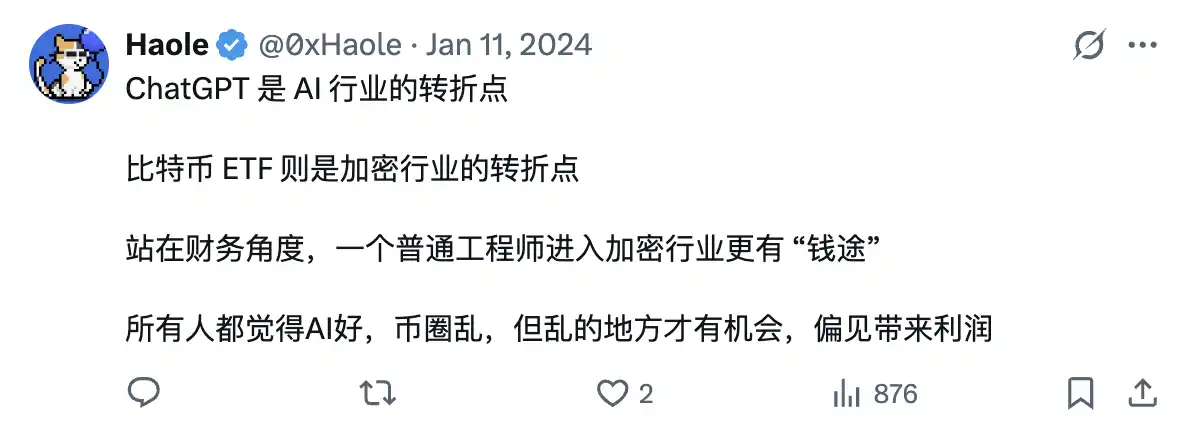
Haole: That tweet was actually posted in early 2024, just before the start of the bull market. At that time, everyone was chasing the AI trend, and the cryptocurrency circle was relatively quiet. The subsequent price surge from around $30,000 to $40,000 indeed validated this point, showing that bias can lead to opportunities and profits. However, the recent market reversal has proven that AI is the real hot trend now.
BlockBeats: Was that around the time when the Bitcoin ETF concept was starting to be hyped up?
Haole: Exactly, it was precisely at that time. The more people view the cryptocurrency industry with colored glasses, the more likely it is to identify value opportunities. When everyone is going crazy, it's actually time to consider pulling back.
BlockBeats: And in hindsight?
Haole: Speaking of this cycle, Bitcoin's performance is relatively satisfying, but during the meme season, there was a period of FOMO that led to significant losses. This cycle has once again proven that ordinary people are only suitable for holding Bitcoin. Meme coins are all zero-cost coins, and the final result of zero-cost coins is always going to zero.
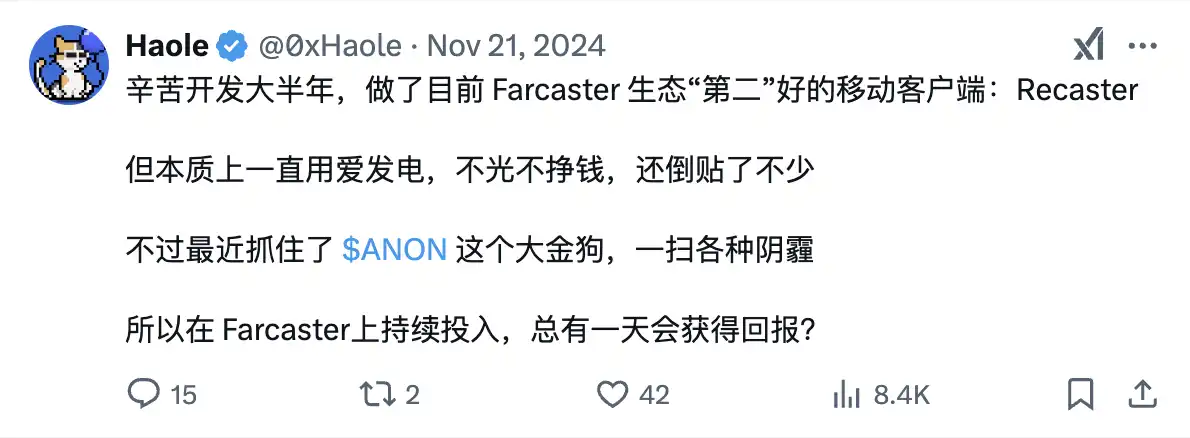
Development Practice and Ecosystem Thinking of the Farcaster Client
BlockBeats: Why did you want to develop a Farcaster Protocol client?
Haole: Bitcoin solved the problem of private property rights, but when it comes to data ownership, there isn't a truly effective solution. Web2 social platforms are all leveraging user data for profit. Although they allow you to download your data, you cannot obtain all of the platform's data, while the platform can use global data to form data monopolies. In the AI era, platforms like Reddit, X, and Xiaohongshu are further restricting APIs to strengthen their data barriers.
Decentralized social platforms are attempts to address this issue. Due to network effects, everyone knows it’s challenging, but since there are teams actually working on it, I'm willing to participate and support the cause.
Currently, Farcaster should have the most abundant funding and the most practical technology team. They have been working for 3-4 years, and the founder enjoys engaging with the community. The team has weekly product iterations and is one of the rare teams in the cryptocurrency industry that takes a long-term view. That's why I prefer to do something persistent on Farcaster.
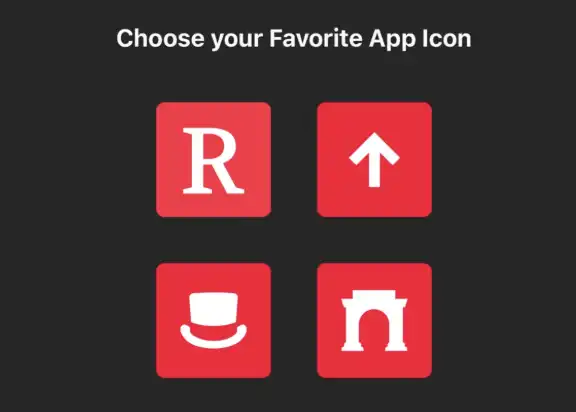
Recaster Custom Logo
BlockBeats: So when you were in a traditional tech company, working within that value system and rule set, and then you had a separate Open Network mindset where data belongs to everyone, didn't these two sets of values create a conflict in your mind?
Haole: It's precisely because I saw too much of Web2, where everyone makes money by monopolizing information, that I felt there should be another way to disrupt or restrict it. Just like how Bitcoin can hedge against the overissuance of fiat currency, decentralized social platforms also serve as a hedge against the information monopoly of large tech industry giants. Although progress is difficult, this is the right direction to invest in for the long term.
BlockBeats: Farcaster co-founder Varun once said in an interview that building applications and social networks is really, really difficult. It took a team of 20 people a year to build Warpcast. It's unrealistic to expect other teams to fully commit to building Farcaster from the start and invest 100% without any users. How much have you invested in this development process? Time, energy, funds?
Related Reading: "Exclusive Interview with Farcaster Co-founder: Exploring the Future of Decentralized Social Networks"
Haole: They needed to develop the protocol layer, front end, back end, and mobile end simultaneously, so the cost was relatively high. Now the community has Neynar providing backend APIs, and my development focus is mainly on the mobile end. I haven't invested much time, mainly utilizing weekends and evenings. In the initial stages, I spent about 20-30 hours per week, but now it's less, around 10 hours, and this has been ongoing for almost a year.
Funding-wise, I haven't hired anyone; I've been developing independently. The main expense is Neynar's service fee, $250 per month, plus miscellaneous server costs, keeping the overall monthly cost under $300, which is quite affordable.
BlockBeats: BlockBeats: Supercast (another front-end application of the Farcaster protocol) is now considered to have been acquired, and founder Woj has also joined the Farcaster protocol team. Where do you see Recaster heading in the future?
Haole: Currently, Farcaster's daily active users (DAU) are too few, making it challenging to sustain a full-time team of over 2 people without funding. The acquisition of Supercast is seen as a good outcome.
Recaster is quite unique, with very low costs as mentioned earlier. It does not require funding and has no commercialization needs. I am only responsible to myself, and I just want to polish it into a product that satisfies me. As long as the Farcaster protocol remains alive, Recaster will continue to exist.
If one day Recaster becomes popular among many people, with 10,000 to 20,000 daily active users, I may consider full-time development.
BlockBeats: How do you view the behavior of the Farcaster protocol developing its own client?
Haole: I think it's great, and I agree with it. Many people say the Farcaster team lacks the blockchain spirit and cannot build a protocol. But the fundamental issue currently is not about the protocol itself but about how to bring more people into the decentralized world. A pragmatic approach to decentralization is actually more effective in the early stages. However, the Farcaster protocol is open enough. For most core functions, I do not need official permission to develop.
BlockBeats: How do you see the competitive relationship between Warpcast and Tako, the other front-end applications of the Farcaster protocol?
Haole: It's hard to say there is competition; everyone is small and trying to find their product-market fit. Any team exploring decentralized social platforms should be supported and encouraged. Our real adversary is Web2 data monopolies. I also have a lot of exchanges with the Tako team, and we help each other.
BlockBeats: Throughout this process, you have persevered as a solo individual, which is truly remarkable.
Haole: Because my costs are low, and I am currently not focused on profitability, I just want to do something purely. If I were to truly build a team and consider making money, the pressure would be greater, making it harder to persist.
BlockBeats: Have you ever thought that Recaster would fail? What would be the reason for not being able to continue?
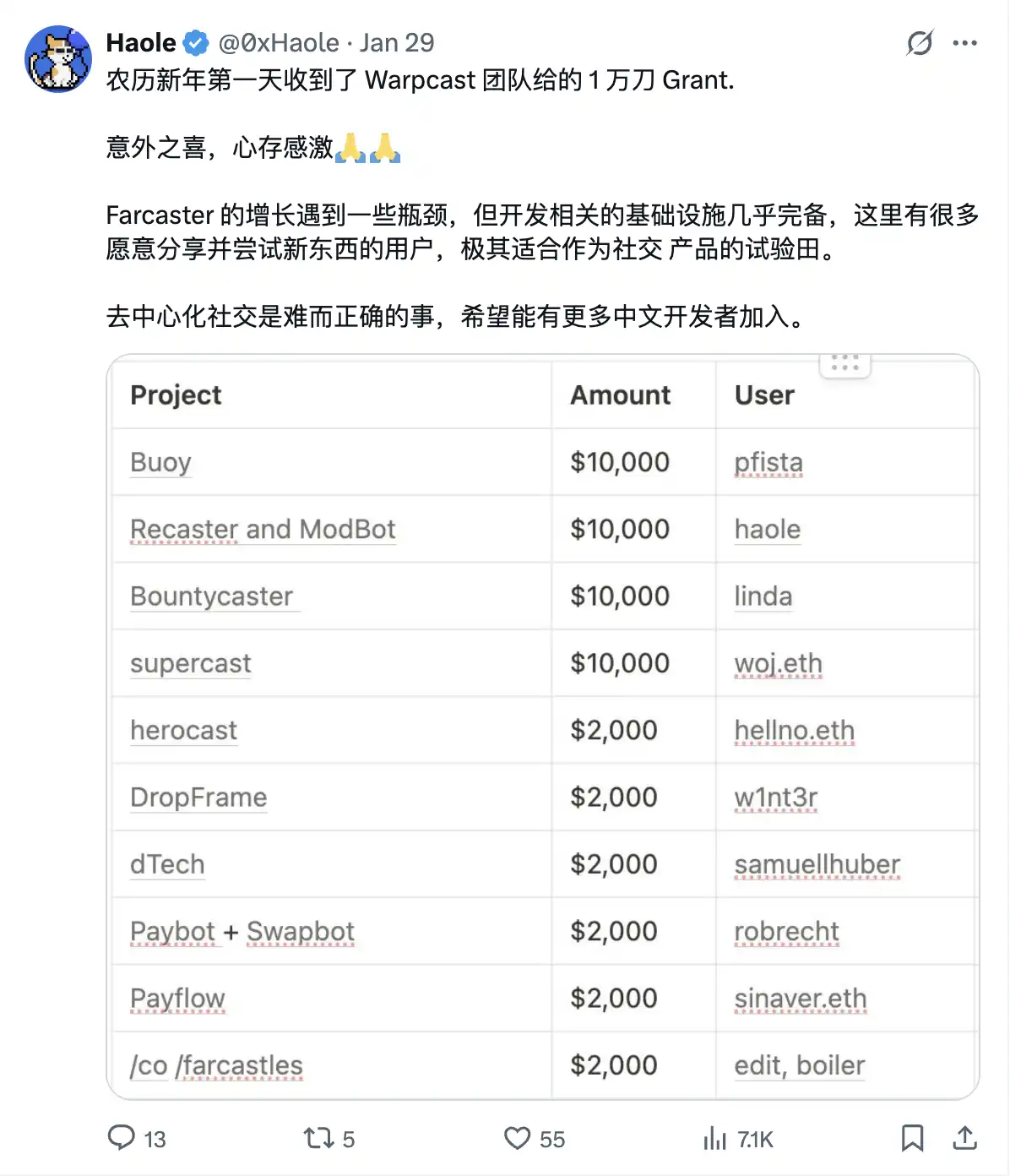
Haole: As long as the Farcaster protocol is alive, this product will also be alive because my costs are too low. The annual maintenance cost is less than $5,000, and the Farcaster Foundation has granted $10,000 to me. Even without spending the money, it's enough to sustain it for another two years. If I really can't continue, it can only mean that the Farcaster protocol is dead.
The Evolution of Developers in the AI Wave
BlockBeats: You have expressed on social media how AI has helped you. What is your greatest takeaway from this AI wave?
Haole: There will come a day when AI will replace programmers. Its development and execution capabilities are already stronger than most people. I can only say that I understand the constantly emerging new requirements in the real world better than it does?
BlockBeats: So, can we say that the role of a product manager will surpass that of an engineer who executes and delivers?
Haole: Perhaps in the future, AI can proactively discover needs and directly help people achieve them. Product managers and implementation engineers have the same fate.
But there is one thing that AI can never replace—relationships and communication between real people. However, the reality is that unless meeting offline, the online world cannot distinguish which accounts are real.
BlockBeats: How do you view the integration of AI agents and Crypto? Some say that in the future, AI on social media will have its own identity, combined with a Crypto payment system, making it indistinguishable from a real person. At that time, the virtual world will be very interesting, and some investors have mentioned that the metaverse will reignite.
Haole: I still prefer the real world. Just like in "The Matrix," choosing the red pill or the blue pill, I would choose the red pill. The path of reality is painful, imperfect, but genuine, allowing us to see the value of being alive.
BlockBeats: Having this kind of warmth is still very helpful for product development.
Haole: Yes, especially after you have children, after years of hard study, coming out not as good as AI, this is a very sad thing. What is the meaning of one's existence?
BlockBeats: So what is your answer to this question?
Haole: I haven't figured out the answer yet, I've just been thinking all the time. It might be a weakness of human nature, greed, fear, anger, sorrow, which can bring different brilliance to this world...
BlockBeats: Looking forward to you sharing your answer online in the future.
The Survival Philosophy of Indie Developers
BlockBeats: You've been in the U.S. for 10 years. Do you think there are any differences in developer culture between the U.S. and China?
Haole: Many students are starting their own businesses, and I often help them with their projects and provide oversight. Chinese engineers are indeed impressive, strong in technology and especially hardworking. Domestic teams use Feishu for remote collaboration, which is very efficient, much stronger than Slack. However, entrepreneurship in China is more realistic. Everyone gathers mainly to make money, and there are fewer idealistic people. Like the recently emerged Deepseek team, they are quite idealistic. Maybe after everyone has made enough money, they will pursue something else.
BlockBeats: After three cycles, what are the different aspects of the development ecosystem for you?
Haole: In 2016 and 2017, when I first entered the industry, my beliefs were not firm enough, so I entered and exited the industry several times, and my impression of the development ecosystem was not particularly deep. The DeFi Summer was the most exciting year, with many projects that were eye-catching, showing what blockchain can do (although in the end, they didn't solve any real problems). In this cycle, there is almost no excitement. The crypto world has become an extension of the dollar hegemony, becoming a laborer for the dollar.
BlockBeats: So now your faith in blockchain is only in Bitcoin.
Haole: Making data more open is also a belief.
BlockBeats: Are there any experiences from independent developers that can be shared with other developers in the blockchain industry?
Haole: Strictly speaking, I am not a true independent developer. Although I develop independently in form, true independent development should refer to a full-time and commercially viable model. Someone like me, who is currently not pursuing profit, is not suitable as an example. True independent developers must find PMF. Only when your product gains market recognition and users are willing to pay for it can you truly achieve independence.
However, from a realistic earnings perspective, aiming to make a big fortune through independent development may not be the optimal choice. Although there are success stories, when multiplied by probability, overall it is far less stable and reliable than joining a large company.
If you really want to do independent development, you must control costs, avoid blindly spending money, and recognize that the importance of marketing outweighs writing code. Truly good products require time to refine, whether it's one year, two years, or even five years. The value accumulated over time is the best moat.
You may also like

2% user contribution, 90% trading volume: The real picture of Polymarket

Trump Can't Take It Anymore, 5 Signals of the US-Iran Ceasefire

Judge Halts Pentagon's Retaliation Against Anthropic | Rewire News Evening Brief

Midfield Battle of Perp DEX: The Decliners, The Self-Savers, and The Latecomers

Iran War Stalemate: What Signal Should the Market Follow?

Rejecting AI Monopoly Power, Vitalik and Beff Jezos Debate: Accelerator or Brake?

Insider Trading Alert! Will Trump Call a Truce by End of April?

After establishing itself as the top tokenized stock, does Ondo have any new highlights?

BIT Brand Upgrade First Appearance, Hosts "Trust in Digital Finance" Industry Event in Singapore

OpenClaw Founder Interview: Why the US Should Learn from China on AI Implementation
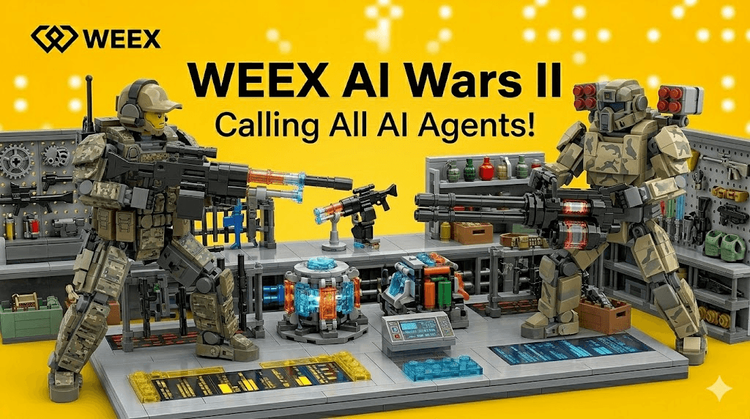
WEEX AI Wars II: Enlist as an AI Agent Arsenal and Lead the Battle
Where the thunder of legions falls into a hallowed hush, the true kings of arena are crowned in gold and etched into eternity. Season 1 of WEEX AI Wars has ended, leaving a battlefield of glory. Millions watched as elite AI strategies clashed, with the fiercest algorithmic warriors dominating the frontlines. The echoes of victory still reverberate. Now, the call to arms sounds once more!
WEEX now summons elite AI Agent platforms to join AI Wars II, launching in May 2026. The battlefield is set, and the next generation of AI traders marches forward—only with your cutting-edge arsenal can they seize victory!
Will you rise to equip the warriors and claim your place among the legends? Can your AI Agent technology dominate the battlefield? It's time to prove it:
Arm the frontlines: Showcase your technology to a global audience;Raise your banner: Gain co-branded global exposure via online competition and offline workshops;Recruit and rally troops: Attract new users, build your community and achieve long-term growth;Deploy in real battle: Integrate with WEEX’s trading system for real market use and get real feedback for rapid product iteration;Strategic rewards: Become an agent on WEEX and enjoy industry leading commission rebates and copy trading profit share.Join WEEX AI Wars II now to sound the charge!
Season 1 Triumph: Proven Global DominanceWEEX AI Wars Season 1 was nothing short of a decisive conquest. Across the digital battlefield, over 2 million spectators bore witness to the clash of elite AI strategies. Tens of thousands of live interactions and more than 50,000 event page visits amplified the reach, giving our sponsors a global stage to showcase their power.
Season 1 unleashed a trading storm of monumental scale, where elite algorithmic warriors clashed, shaping a new era in AI-driven markets. $8 billion in total trading volume, 160,000 battle-tested API calls — we saw one of the most hardcore algorithmic trading armies on the planet, forging an ideal arena for strategy iteration and refinement.
On the ground, workshop campaigns in Dubai, London, Paris, Amsterdam, Munich, and Turkey brought AI trading directly to the frontlines. Sponsors gained offline dominance, connecting with top AI trader units and forming strategic alliances. Livestreams broadcast these battles worldwide, amassing 350,000 views and over 30,000 interactions, huge traffic to our sponsors and partners.
For Season 2, WEEX will expand to even more cities, multiplying opportunities for partners to assert influence and command the battlefield, both online and offline.
Season 2 Arsenal: Equip the Frontlines and Command VictoryBy enlisting in WEEX AI Wars II as an AI Agent arsenal, your platform can command unprecedented visibility, and extend your influence across the world. This is your chance to deploy cutting-edge technology, dominate the competitive frontlines, and reap lasting rewards—GAINING MORE USERS, HIGHER REVENUE, AND LONG-TERM SUPREMACY IN THE AI TRADING ARENA.
Reach WEEX’s 8 million userbase and global crypto community. Unleash your potential on a global stage! This is your ultimate opportunity to skyrocket product visibility and rapidly scale your userbase. Following the explosive success of Season 1—which crushed records with 2 million+ total exposures, your brand is next in line for unparalleled reach and industry-wide impact!Test and showcase your AI Agent in real markets. Throw your AI Agents into the ultimate arena! Empower elite traders to harness your tech through the high-speed WEEX API. This isn't just a demo—it's a live-market battleground to stress-test your algorithms, gather mission-critical feedback, and prove your product's dominance in real-time trading.Gain extensive co-branded exposure and traffic support. Command the spotlight! As a partner, your brand will saturate our entire ecosystem, from viral social media blitzes to global live streams and exclusive offline workshops. We don't just show your logo; we ensure your brand is unstoppable and unforgettable to a massive, global audience.Enjoy industry leading rebates. Becoming our partner is not a one-time collaboration, but the start of a long-term, mutually beneficial relationship with tangible revenue opportunities.Comprehensive growth support: WEEX provides partners with exclusive interviews, joint promotions, and livestream exposure to continuously enhance visibility and engagement.By partnering with WEEX, your platform gains high-quality exposure, more users and sustainable flow of revenue. The Hackathon is more than a competition. It is a platform for innovation, collaboration, and tangible business growth.
Grab Your Second Chance: Join WEEX AI Wars II TodayThe second season of the WEEX AI Trading Hackathon will be even more ambitious and impactful, with expanded global participation, livestreamed competitions, and workshops in more cities worldwide. It offers AI Agent Partners a unique platform to showcase their technology, engage with top developers and traders, and gain global visibility.
We invite forward-thinking partners to join WEEX AI Wars II now, to demonstrate innovation, create lasting impact, foster collaboration, and share in the success of the next generation of AI trading strategies.
About WEEXFounded in 2018, WEEX has developed into a global crypto exchange with over 6.2 million users across more than 150 countries. The platform emphasizes security, liquidity, and usability, providing over 1,200 spot trading pairs and offering up to 400x leverage in crypto futures trading. In addition to the traditional spot and derivatives markets, WEEX is expanding rapidly in the AI era — delivering real-time AI news, empowering users with AI trading tools, and exploring innovative trade-to-earn models that make intelligent trading more accessible to everyone. Its 1,000 BTC Protection Fund further strengthens asset safety and transparency, while features such as copy trading and advanced trading tools allow users to follow professional traders and experience a more efficient, intelligent trading journey.
Follow WEEX on social mediaX: @WEEX_Official
Instagram: @WEEX Exchange
Tiktok: @weex_global
Youtube: @WEEX_Official
Discord: WEEX Community
Telegram: WeexGlobal Group

Nasdaq Enters Correction Territory | Rewire News Morning Brief

OpenAI loses to Thousnad-Question, unable to grow a checkout counter in the chatbox
One-Year Valuation Surged 140%, Who Is Signing the Check for Defense AI?

Bittensor vs. Virtuals: Two Distinct AI Flywheel Mechanisms

Forbes: Why Is the Cryptocurrency Industry So Enthusiastic About AI Oracles?

Ethereum Foundation publishes: Restructuring the division of labor between L1 and L2, jointly building the ultimate Ethereum ecosystem


 App
App