
From New York to Washington, the anti-crypto forces in the United States are facing a comprehensive crackdown


Original Title: "From New York to Washington, the Anti-Crypto Force in the U.S. is Being Fully Liquidated"
Original Author: jk, Odaily Planet Daily
With the advent of the Trump administration, regulatory senior officials who once led the U.S. anti-crypto policy are now facing a comprehensive liquidation. Major financial regulatory agencies such as the U.S. Securities and Exchange Commission (SEC), the Federal Deposit Insurance Corporation (FDIC), and the Commodity Futures Trading Commission (CFTC) are undergoing large-scale personnel changes and policy shifts. It can be seen that the regulatory attitude in Washington is undergoing a fundamental change. Below, Odaily Planet Daily will show you what these changes and liquidations have specifically brought to the industry.
SEC: Gary Gensler's Team Entirely Leaves, Pro-Crypto Individuals Step In, Enforcement Procedures Change
SEC, New Broom Sweeps Clean
Inside the SEC headquarters at 100 F Street in Washington, D.C., the atmosphere is quietly changing. With the arrival of the Trump administration, Gary Gensler resigned on the same day, and pro-crypto Mark Uyeda became the acting chairman, temporarily assuming the chairman's duties until the nomination confirmation of the new chairman, Paul Atkins. This building with its beautiful glass curtain wall is no longer the enemy of the crypto industry but has become a truly friendly regulatory body.
For Mark Uyeda's personal profile and pro-crypto stance, you can read this article "Uncovering the New Leadership of U.S. Crypto Regulation: How Much Longer Until Implementation?".
On February 5, local time in the U.S., two informants revealed that the U.S. SEC currently requires its lawyers to obtain senior-level approval before formally initiating an investigation. The new requirement stipulates that enforcement officers must obtain permission from political appointee commissioners before issuing subpoenas, requesting documents, and compelling testimony. Currently, there are three commissioners in total: Acting Chairman Mark Uyeda, Hester Peirce (Crypto Mom), and Caroline Crenshaw (Democratic commissioner). During the previous government's tenure, the SEC only needed approval from two enforcement heads to formally launch an investigation, while enforcement officers could continue informal investigations without commissioner approval, including sending information requests.
At the same time, many readers are likely aware that SEC Acting Chairman Mark Uyeda has established a new cryptocurrency working group led by crypto-friendly commissioner Hester Peirce, also known as the "Crypto Mom," with the ultimate goal of providing regulatory clarity, proposing a clear cryptocurrency regulatory framework (similar to the EU's MiCA). The follow-up news is that Acting Chairman Mark Uyeda has appointed Landon Zinda, former policy director of the cryptocurrency advocacy group Coin Center, as his legal advisor and senior advisor to the cryptocurrency working group.
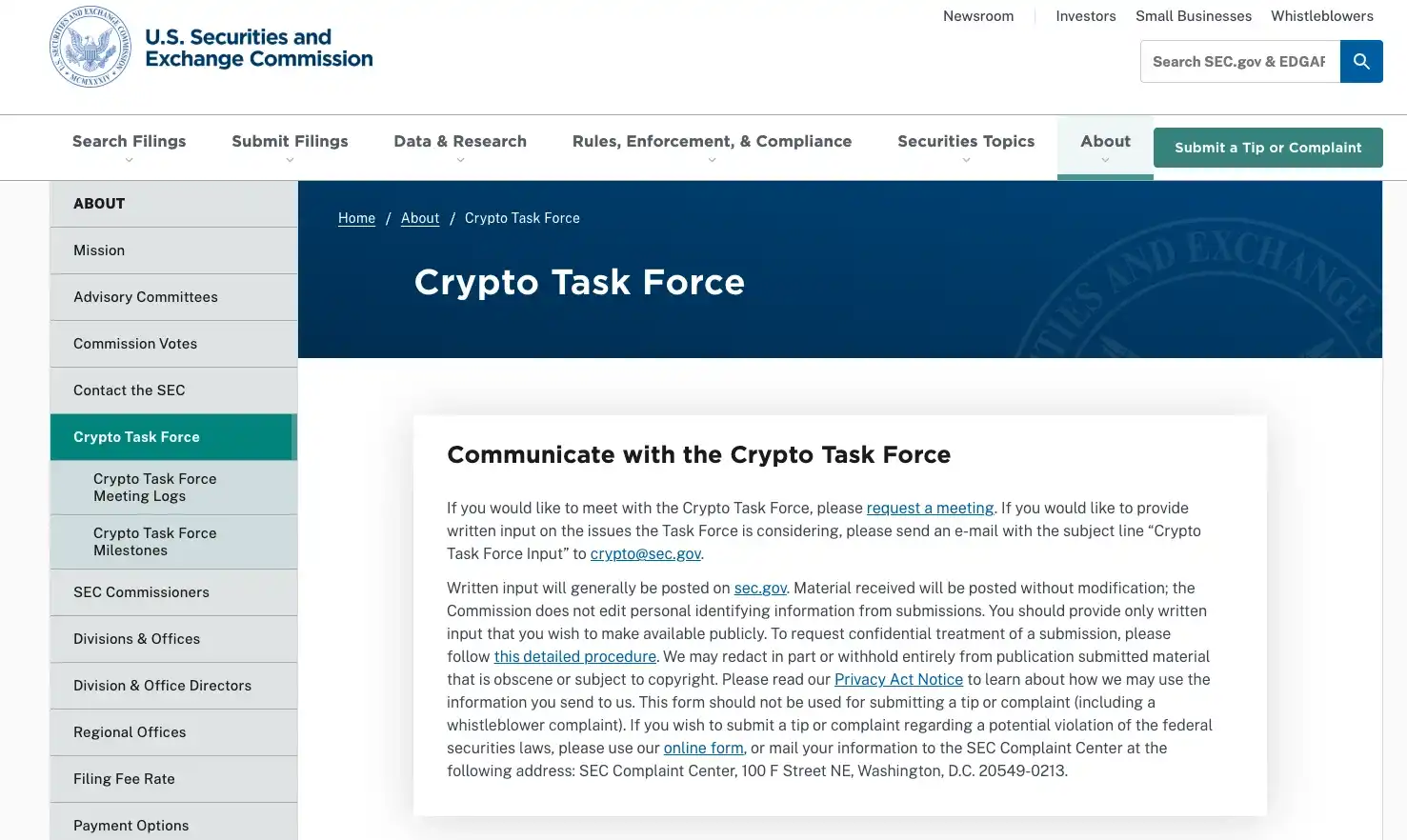
On the SEC Cryptocurrency Working Group's website, the SEC's supportive attitude is very clear, even providing a direct email for crypto enthusiasts to contact the SEC. Source: SEC Official Website
Hester Peirce stated: "The cryptocurrency working group is considering recommending that the SEC take action to provide temporary forward-looking and retrospective relief for token issuance (as opposed to the SEC's previous retrospective enforcement), where the issuing entity or other willing entity provides certain specific information and commits to keeping it up to date, and agrees not to challenge the SEC's jurisdiction in cases alleging fraud in connection with the purchase and sale of assets."
Settlement Approaching? Anti-Crypto Forces Marginalized
Odaily previously reported that almost all senior legal officials working under Gary Gensler, including personnel from the enforcement division and the office of the general counsel, have resigned, suggesting that his entire team has already left. Former SEC Chief Economist Jessica Wachter, Chief Accountant Paul Munter, and General Counsel Megan Barbero have also resigned.
But what about those who didn't leave?
It is reported that the SEC has reassigned former Deputy Director of the Division of Cryptocurrencies and Networks and crypto litigator Jorge Tenreiro to its Information Technology (IT) division. Tenreiro worked at the SEC for over 11 years, and according to his LinkedIn profile, he initially served as an enforcement attorney, later becoming the head of the agency's cryptocurrency enforcement division from October 2022 to November 2024.
Tenreiro has been involved in multiple SEC enforcement cases against cryptocurrency companies, such as lawsuits against Ripple and Coinbase. Since the inauguration of President Trump, the SEC's position has undergone a significant shift, leading to a reduction in the size of its cryptocurrency enforcement division.
FDIC: Regulatory Hostility Completely Disappears, Crypto Banking Services May Return
What Is the FDIC?
The FDIC (Federal Deposit Insurance Corporation) is an independent agency in the United States responsible for providing deposit insurance for bank deposits, ensuring that depositors can be compensated for up to $250,000 in the event of bank failure. The FDIC regularly examines banks' balance sheets, assesses risks, prevents misconduct, and takes corrective actions when issues are identified, including closing banks with severe violations or insolvency. Additionally, the FDIC is responsible for managing and liquidating banks in the event of bankruptcy, safeguarding depositors' interests and maintaining the safety and stability of the financial system. In the event of a bank failure, the FDIC typically arranges for another bank to take over the deposits or directly reimburses depositors, making the banking system more secure and reliable.
In simple terms, FDIC is the United States' national bank insurance that ensures consumers' deposit safety in banks. Previously, when Silicon Valley Bank went bankrupt, it was FDIC that was responsible for the cleanup work and subsequent arrangements.
Why is National Bank Insurance Relevant to the Crypto Industry?
Because of FDIC's regulatory role, previously FDIC actually wasn't a good name in the crypto industry; FDIC restricted the crypto industry's access to banks, leading to complaints from the entire crypto industry.
Imagine that, if you started a crypto company or project, you couldn't open an account at any major U.S. bank, and you couldn't even get a loan, you couldn't enjoy the banking services that a commercial project should have access to. This is Operation Choke Point 2.0, a policy that prohibits crypto projects from accessing banking services, with FDIC being the key regulatory enforcer of this policy. We'll discuss this policy below shortly.
This is not unfounded. Anchorage Digital CEO Nathan McCauley stated at the U.S. Senate "de-banking" hearing that despite Anchorage Digital being a federally chartered crypto bank, it was still refused service by banks, resulting in business damage and even a 20% workforce reduction. McCauley pointed out that between 2021 and 2023, U.S. regulatory agencies gradually pressured banks to steer clear of the crypto industry, including multiple policies jointly issued by the OCC, FDIC, SEC, the Fed, etc., making banks generally unwilling to work with crypto companies, causing many crypto businesses to be unable to obtain basic banking services, with some even forced to shut down.
Consensys CEO Joseph Lubin stated that the company had twice been the target of U.S. authorities attempting to cut off access to the financial system, falling victim to Operation Chokepoint 2.0. In the most recent incident, a large U.S. bank (reportedly JPMorgan Chase) ultimately closed Consensys' account under regulatory pressure. Lubin revealed that the bank initially attempted to delay the execution and expressed support for Consensys, but ultimately couldn't resist the pressure. Additionally, Lubin himself was targeted in this recent clearing operation.
How is Today's FDIC Different?
With the inauguration of Trump, the FDIC also saw a change.
The Federal Deposit Insurance Corporation (FDIC) recently announced that it is actively reassessing its regulatory approach to cryptocurrency-related activities, including withdrawing and replacing the Financial Institution Letter (FIL) 16-2022, to provide banking institutions with a compliant path to engage in cryptocurrency and blockchain activities while adhering to safety and soundness principles. The FDIC plans to collaborate with the Digital Asset Market Working Group established by the Trump administration to optimize the regulatory framework.
FDIC Acting Chairman Travis Hill had criticized the FDIC's stance for hindering banks from exploring blockchain and digital assets, stating: "I have long been critical of the FDIC's stance on crypto assets and blockchain. As I said in March of last year, the FDIC's approach 'has led people to widely believe that if an institution is interested in anything related to blockchain or distributed ledger technology, that institution can't be in business.' Since taking office, Hill initiated a review of all regulatory communications related to crypto banking, stating, "Upon becoming Acting Chairman, I directed staff to conduct a comprehensive review of all regulatory communications related to banks attempting to provide crypto-related products or services."
For increased transparency, the FDIC recently released 175 documents detailing its regulatory stance on banks engaging in crypto-related businesses. All these changes imply that banks can custody customers' cryptocurrency and it will be insured by the FDIC.
Operation Choke Point 2.0: Coming to an End, Participants to be Held Accountable
How Severe is Operation Choke Point 2.0?
As we just mentioned, Operation Choke Point 2.0 is a policy that prohibits crypto projects from enjoying banking services. In fact, the scale of this operation may be much larger than readers imagine.
Blockworks describes it as follows: If FTX is the butterfly flapping its wings in the Amazon rainforest, then 'Operation Choke Point 2.0' is the torrential rain currently pouring down on the U.S. cryptocurrency industry.
This operation is led by the Biden White House, Federal Reserve, Office of the Comptroller of the Currency (OCC), Federal Deposit Insurance Corporation (FDIC), and the Department of Justice (DOJ), along with 'influential figures in Congress,' dedicated to depriving the cryptocurrency industry of fiat channels, aiming to completely stifle this sector.
Senator Roger Marshall, Elizabeth Warren, and John Kennedy previously pressured Silvergate, leading Signature Bank to significantly reduce cryptocurrency-related deposits in December 2023. In January 2024, the FDIC, OCC, and Federal Reserve issued a joint statement "strongly discouraging" banks from supporting crypto businesses, followed by Metropolitan Commercial Bank completely shutting down its cryptocurrency business.
Meanwhile, cryptocurrency companies attempting to establish their fiat channels also faced resistance, as the Federal Reserve formally rejected Custodia's (formerly Avanti) application to join the Fed system at the end of January, a process that had been delayed for over two years. Although Anchorage became the first nationally chartered trust bank conditionally approved in 2021, Paxos and Protego are still pending approval. Designating cryptocurrency banks as "high-risk" will have four major negative impacts, including increased FDIC insurance rates, reduced Federal Reserve capital ratios (limiting overdraft capabilities), restricted business activities, and lowered regulatory review scores (affecting merger and acquisition capabilities), further deepening the isolation between banks and the crypto industry.
Moreover, most of the above actions have been conducted discreetly. In other words, cryptocurrency companies not only cannot litigate, but may not even find evidence at all. Many of those driving this are hidden behind the scenes, exerting covert pressure.
All of this has shifted course since Trump took office.
What is the current attitude of US regulatory agencies?
The US Congress first held a hearing on Operation Choke Point 2.0, inviting members of the crypto industry to testify on how they have been "choked." Rep. Meuser stated during the hearing that the Biden administration's Operation Choke Point 2.0 is being carried out by regulatory agencies, specifically targeting and de-banking the digital asset ecosystem.
"The FDIC, through private conversations and formal regulatory threats, pressured banks to refuse service to digital asset companies, their employees, and even their customers.
This is an egregious abuse of power that not only stifles innovation but directly harms consumers, preventing them from accessing new, potentially beneficial financial products...Just yesterday, Federal Deposit Insurance Corporation Acting Chairman Travis Hill publicly exposed the Biden administration's Operation Choke Point activities, leading to nationwide de-banking of cryptocurrency firms...The FDIC has pledged to address this issue in the future, and I will continue to monitor its remedial progress and explore legislative solutions to ensure such events do not recur."
「The free market can only thrive when innovation is allowed to flourish. Regulatory bodies are tasked with safeguarding our financial system—but this should not come at the expense of legitimate businesses, such as energy companies and cryptocurrency firms.」
The official congressional hearing in the United States acknowledged the existence of Operation Choke Point 2.0. Source: YouTube
Readers can now ponder the current official characterization.
Meanwhile, U.S. Federal Judge Ana C. Reyes criticized the Federal Deposit Insurance Corporation (FDIC) in the Coinbase v. FDIC case. This lawsuit stems from Coinbase's attempt to obtain a "cessation letter" sent by the FDIC to banks to restrict cryptocurrency-related activities, which serves as evidence of Operation Choke Point 2.0. Judge Reyes noted that the FDIC failed to produce a substantial number of documents related to Coinbase's previous Freedom of Information Act (FOIA) request and may have destroyed some case information.
At the hearing, Ana C. Reyes directly questioned the FDIC: "Can you explain why you are interpreting the FOIA request in such a narrow manner? Its content is quite clear and not restrictive as you seem to understand." A portion of the dialogue is as follows:
「Andrew Dober (FDIC Representative Attorney): Yes, Your Honor, I can—
The Court: No, you will answer my question directly.
Andrew Dober: With respect to these questions, I do have a statement, Your Honor. The FDIC respectfully requests a three-week stay on this case—
The Court: No, that will not be granted. I'm asking you to answer my question now.
Andrew Dober: Due to changes in leadership—
The Court: I want you to answer my question now.
Andrew Dober: Yes, Your Honor. Can you please repeat those questions?
The Court: Who took such a narrow and illogical interpretation of the FOIA request?
Andrew Dober: Your Honor, I believe that was the understanding at the time—
The Court: I did not ask how you understood it, I asked who did this. This interpretation is so narrow it's almost comical. Who was it?
According to The Block, VBCapital's partner Scott Johnsson stated: "Seeing a federal judge rebuke a federal agency's attorney in such a manner is truly shocking."
Judge Reyes not only plans to subpoena FDIC employees' testimony in mid-February but also warns that if FDIC does not cooperate, "life will become very, very unpleasant for the FDIC." She further questions whether FDIC has implemented the required legal document retention measures and notes that Andrew Dober may face "serious sanctions."
And the reckoning is also on the horizon. U.S. Senator Cynthia Lummis stated, "Today the U.S. Senate Banking Committee found the first concrete evidence of Operation Chokepoint 2.0." She said, "Rest assured, the Digital Assets Subcommittee will find those responsible and hold them accountable."
CFTC: Restructuring Enforcement Division
On February 5, 2025, Acting Chair of the U.S. Commodity Futures Trading Commission (CFTC) Caroline Pham announced that the agency has restructured its enforcement division to more effectively focus on combating fraudulent activities and cease using enforcement actions as a substitute for regulatory functions. This reform aims to optimize resource allocation, enhance enforcement efficiency, and ensure market integrity.
Under former Chairman Rostin Behnam's leadership, the CFTC's enforcement division established multiple working groups responsible for areas such as insider trading, cybersecurity and emerging technologies, and environmental fraud. Following this reorganization, the CFTC has reduced the number of enforcement division's working groups from several to two, namely the Complex Fraud Task Force and the Retail Fraud and General Enforcement Task Force.
Here, the Complex Fraud Task Force will be responsible for handling complex fraud and market manipulation cases involving all asset classes, covering the entire process from investigation to litigation. The Retail Fraud and General Enforcement Task Force, on the other hand, will focus on combating retail market fraud and other general enforcement matters.
Acting Chairman Pham stated in a declaration that this adjustment is aimed at halting "Regulation by Enforcement" and improving agency operational efficiency, allowing the CFTC to more precisely combat market fraud and misconduct without overly burdening compliance. The CFTC announcement further emphasized that the new structure will more effectively prevent fraud, manipulation, and market abuse, ensure market fairness, while also strengthening oversight of enforcement actions to prevent regulatory overreach, and enhancing adherence to standards of enforcement consistency and due process.
Why is this declaration important? First, it is important to know that the CFTC has been involved in cases involving exchanges such as Binance and Coinbase and is one of the more active U.S. crypto regulatory agencies. Due to the commodity-like nature of cryptocurrencies (e.g., being used as gas fees), the CFTC believes that the crypto industry may fall under its purview. Additionally, Regulation by Enforcement has been a common strategy employed by the SEC in the past, which is a strategy of "you can do as you please, but if an issue arises, you will be penalized."
However, this strategy often does not provide any regulatory clarity: a typical example is Coinbase, where initially during Coinbase's IPO, the SEC swiftly approved it and did not provide any definition for cryptocurrency attributes. However, a few years later, the SEC filed a lawsuit against Coinbase, claiming that cryptocurrency is an unregistered security, and Coinbase provided a trading platform for unregistered securities. This inconsistent regulatory approach has brought significant uncertainty to the U.S. crypto industry, which is why CFTC's clear stance against Regulation by Enforcement is a huge positive for the crypto industry.
David Sacks: The Actions of the New Crypto Tsar
David Sacks, as the White House's cryptocurrency and AI czar, emphasized in a recent press conference the drive to make the U.S. a leader in the digital asset space and called for the swift establishment of a clear regulatory framework. He announced that the Senate and House of Representatives will collaborate to draft cryptocurrency legislation to address the long-standing industry uncertainties. Senator Bill Hagerty introduced the GENIUS Stablecoin Act, aiming to regulate the stablecoin issuance process and provide legal support for this market. Sacks believes that stablecoins can not only strengthen the dollar's dominance in the international market but also potentially generate trillions of dollars in demand for U.S. debt, thereby lowering long-term interest rates and enhancing the stability of the U.S. financial system.
During a press conference, Senator Tim Scott, Chairman of the Senate Banking Committee, proposed that the goal is to pass the stablecoin and digital asset bill through Congress within 100 days and submit it to the President for signing. Congressman French Hill, Chairman of the House Financial Services Committee, stated that the new version of the digital asset bill will be modified based on the FIT 21 Act to address previous loopholes, such as the SEC's feasibility classification of tokens within 60 days. The Senate also plans to coordinate on the FIT 21 Act to ensure that the final version of the bill can be signed into law by the President.
According to CNBC's report and interview, Sacks also emphasized the negative impact of de-banking on the crypto industry. He pointed out that keeping cryptocurrency-related businesses in the United States would be more favorable for consumer protection, as when these companies are located within the U.S., regulatory agencies can more effectively supervise market activities. He believed that regulatory loopholes in the Bahamas led to the world's largest cryptocurrency fraud (referring to FTX), and the U.S. should avoid repeating the same mistakes.
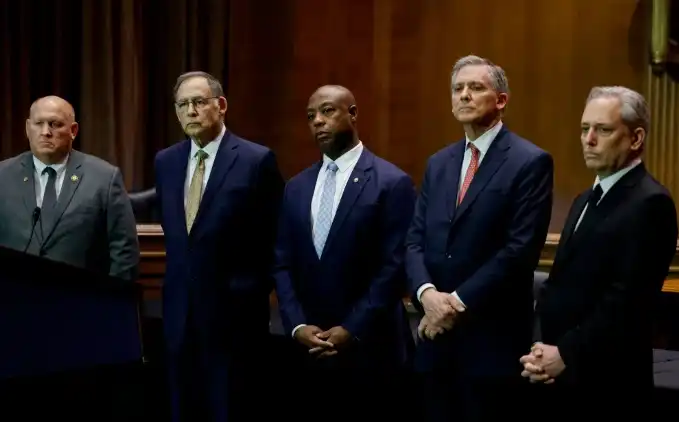
At David Sacks' (far right) first press conference, he stood with senators and congressmen. Source: Bloomberg
Sacks confirmed that the Bitcoin Reserve will be included in the White House's Digital Asset Working Group's research agenda and may include seized assets. However, he stated that the concept of a Sovereign Wealth Fund is different from the Bitcoin Reserve, and the specific policy will be overseen by the incoming Treasury Secretary, Howard Lutnick. The Trump administration is exploring the potential role of Bitcoin in the national financial system, but the specific plan is still in the discussion stage.
David Sacks summed up the U.S. regulatory stance in one sentence: "The crypto war is over. I look forward to working with you all to create the golden age of digital assets."
You may also like

The other side of Musk's trillion-dollar fortune: 85% cannot be sold

The U.S. government prohibits foreigners from using Fable 5, Anthropic issues a rebuttal

Citibank releases "2030 Asset Tokenization Market Outlook": 6 major trends may create a $8.2 trillion market

The trillion-dollar valuation test: Are the three major super IPOs a celebration for tech stocks or a nightmare for the crypto market?

Morning Report | Digital Asset completes $355 million financing led by a16z Crypto; Meta completes operational separation from Manus

a16z Crypto Partner: Cash flow is the moat

Cryptocurrency market makers collectively seek change as it becomes increasingly difficult to make money

How TradeXYZ, xStocks, and Alpaca break down the SpaceX IPO into three different strategies
$75 billion in risk asset redistribution: How will SpaceX's IPO affect U.S. stocks and Bitcoin?

Why Is BlackRock Investing $5 Billion in the SpaceX IPO?
Morning News | CME Group launches Nasdaq Cryptocurrency Index futures; Asset management giant Janus Henderson strategically invests in Ethena

Bitcoin Layer 2 Network Botanix: Why Did We Choose to Dissolve?

Why did Oracle deliver the strongest financial report in history, yet its stock price fell?
When the P2P illicit funds from ten years ago turned into 60,000 bitcoins
Dialogue with OmenX Founder: Why does the prediction market need an evolution from "spot" to "derivatives"?
Galaxy in-depth report: Is Solana still worth paying attention to?
Young people in South Korea make a "final effort" in the epic bull market
The pricing controversy of Trade.xyz exposes the fatal weakness of Pre-IPO perpetual contracts
The other side of Musk's trillion-dollar fortune: 85% cannot be sold
The U.S. government prohibits foreigners from using Fable 5, Anthropic issues a rebuttal
Citibank releases "2030 Asset Tokenization Market Outlook": 6 major trends may create a $8.2 trillion market
The trillion-dollar valuation test: Are the three major super IPOs a celebration for tech stocks or a nightmare for the crypto market?
Morning Report | Digital Asset completes $355 million financing led by a16z Crypto; Meta completes operational separation from Manus
a16z Crypto Partner: Cash flow is the moat


