
 Buy Crypto
- Markets
 Futures
- Spot
- Copy Trade
- Earn
- More
From Cantor to Securitize, Crypto Industry Buys Up Washington

Last week, the Financial Times reported a major piece of news that Wall Street veteran Cantor Fitzgerald is joining forces with SoftBank, Tether, and Bitfinex to plan the formation of a Bitcoin investment alliance exceeding $3 billion in scale. Notably, the helm of this financial giant, Brandon Lutnick, is the son of U.S. Secretary of Commerce Howard Lutnick. Against the backdrop of the Trump administration's push for cryptocurrency-friendly policies, this newly formed investment alliance has sparked considerable speculation in the market about the nexus between government and business.
Tether's Behind-the-Scenes Player, Cantor: Straddling Both Politics and Business
Cantor Fitzgerald, a Wall Street stalwart established in 1945, is renowned for government securities trading, investment banking services, and bond brokerage. As one of the Treasury Department's 24 primary dealers, Cantor directly participates in the issuance and trading of government bonds, maintaining close business ties with the Federal Reserve and the Treasury Department. With operations spanning over 20 countries worldwide, the company boasts a workforce of over 12,500 employees.
What truly brought Cantor into the spotlight is its relationship with Tether. For Cantor, a midsize investment bank located in Midtown Manhattan, Tether has become its most lucrative client. Cantor serves as the primary custodian of Tether's U.S. dollar reserves, managing 99% of its U.S. Treasury bond reserves, amounting to billions of dollars.
The relationship between Cantor and Tether is mutually beneficial. Tether struggled to be profitable in the past, but now earns billions of dollars in interest annually from its government debt holdings at Cantor. According to Forbes, Cantor not only provides highly secure custody but also leverages its expertise in the bond market to assist Tether in converting high-risk commercial paper into low-risk U.S. Treasury bonds, significantly reducing systemic risk. An insider revealed that Cantor purchased short-term Treasury bonds with a maturity of 3-6 months for Tether, ensuring high liquidity. By adjusting the bond-to-cash ratio through a dynamic asset management system, Cantor generated approximately $2 billion in interest income for Tether in 2023, nearly one-third of its $5.6 billion profit that year.
One of the key figures who facilitated the collaboration between these two companies was Howard Lutnick. This 63-year-old billionaire, former CEO of Cantor, made his bank the backbone of the Tether system. Following a 2020 federal regulatory decision that made it easier for banks to hold digital assets, he sought a way to enter the cryptocurrency industry and learned about Tether. Cantor manages Tether's up to $390 billion U.S. Treasury portfolio, making it the U.S. dollar asset custodian for the Tether stablecoin USDT. Currently, the market capitalization of Tether tokens exceeds $1.3 trillion, with Cantor holding most of the U.S. Treasuries backing these tokens.
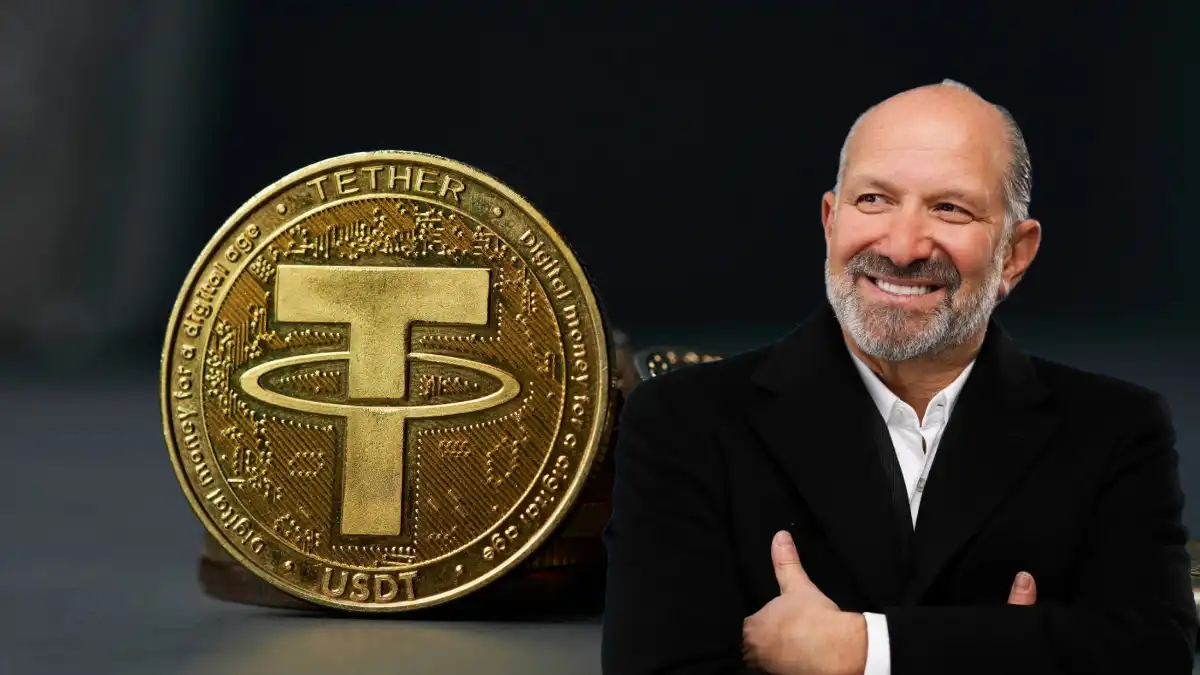
Cantor Former CEO Howard Lutnick
The connection between these two companies dates back to 2021. At that time, Tether had already issued over 500 billion tokens, but there were always doubts from the outside world about whether it really had an equivalent $500 billion reserve. In February of the same year, the company's owners agreed to pay a $18.5 million fine to the New York Attorney General to settle charges of making false statements about its reserves. Due to multiple U.S. banks refusing to process the company's transactions, coupled with concerns from major U.S. regulators that Tether could collapse in a bank run, the company was in crisis. At a critical moment, Howard stepped in to provide support for Tether. According to sources familiar with the matter, in return, Tether paid Cantor tens of millions of dollars, and Cantor thereby acquired a minority stake in Tether.
Previously, Tether had most of its funds deposited in an account at a Bahamian bank and invested part of its reserve in risky assets such as Chinese commercial paper to generate returns. This operating model made it heavily dependent on the ability of the Bahamian bank to connect with U.S. banks on its behalf. However, when in October 2021 Tether paid a $41 million fine to the U.S. Commodity Futures Trading Commission for false reserve statements, this channel came under serious threat.
After obtaining sufficient evidence to confirm that Tether did indeed hold all reserves, Howard proposed a solution. As a major dealer of U.S. Treasury bonds, Cantor could easily acquire a large amount of secure U.S. Treasury bond assets. He pledged that as long as Tether converted its held assets into U.S. Treasury securities, Cantor was willing to become its client.
On Tether's side, the Chief Financial Officer and largest shareholder, Devasini, was in contact with Howard. According to The Wall Street Journal, their interaction was highly secretive, with Howard "only letting very few employees know that Cantor was in contact with Tether, limited to a few top executives." He often personally handled this relationship with Devasini and would take private planes to meet him.
This Italian entrepreneur, who had previously been involved in plastic trading, was considered the "shadow helmsman" of Tether. Devasini stated that Cantor's custody services allowed the company to "more efficiently meet regulatory demands for liquidity and stability," believing that "Howard would use his political influence to try and eliminate the threat to Tether." Howard also placed great importance on the collaboration with Tether. In a investment agreement reached last year, Howard unusually took the lead in negotiations, enabling Cantor to obtain up to a 5% stake in Tether valued at as high as $6 billion.
As a patriarch, Howard was also paving the way for the next generation's network. The Bitcoin investment alliance this time was led by Howard's son, Brandon, planning to consolidate Tether's $1.5 billion in Bitcoin, SoftBank's $9 billion, and Bitfinex's $6 billion in funds. This model easily brings to mind MicroStrategy (now renamed Strategy), a company that achieved a market cap of $910 billion through large-scale Bitcoin hoarding.
Interestingly, Brandon had previously interned at Tether and was the one who introduced Tether to the right-wing video platform Rumble Inc. According to Bloomberg, Cantor facilitated Tether's $775 million investment in the right-wing video site Rumble Inc. When this transaction was announced, Rumble's stock price surged by 81%, and Cantor's stake in Rumble increased in value by $54 million.
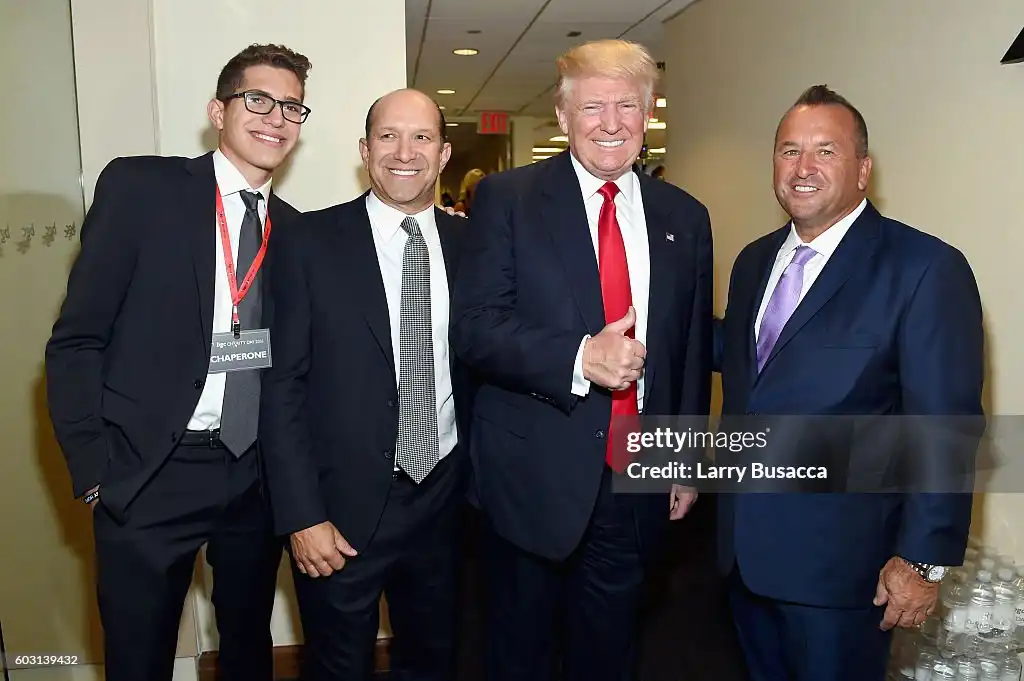
Brandon Luettelnick (Left One); Howard Luettelnick (Left Two)
In February of this year, Howard narrowly won the vote 51 to 45 and was appointed as Secretary of Commerce. The former Cantor CEO has publicly voiced support for Tether on multiple occasions: "I hold their commercial paper, they have a lot of commercial paper. I'm a big fan of Tether," and he emphasized the contribution of stablecoins to the U.S. economy.
Although when Howard was appointed as a Department of Commerce official, he stated that he would resign from his position at a financial firm and "intend to divest any holdings I have in these companies to comply with government ethics guidelines." However, opposition voices have always existed. Senator Elizabeth Warren expressed her opposition: "I am concerned about Howard Luettelnick's past work with a sanctioned entity (namely Tether), the Secretary of Commerce should fight for the interests of the United States—not for his personal interests or those of former clients whose actions harmed our national security."
Looking back now, Howard did indeed fulfill his promise by resigning from his position at Cantor to avoid a direct affiliation with Tether. However, the baton was passed early and handed over to Brandon.
From the Department of Commerce to the SEC, the "sibling relationship" between the crypto industry and the Trump administration
Cantor and Tether are not the only combination of their kind. The world's largest asset management company, BlackRock, established the BUIDL Fund in 2024, which has become a leader on the RWA track with a management scale exceeding 25 billion this year. The designated custodian for BUIDL is a company named Securitize. Unlike Cantor's traditional financial background, Securitize is a crypto company founded in 2017, focusing on blockchain technology and digital asset securitization.
Why would BlackRock suddenly invest in a crypto company? This may be closely related to Securitize's network of relationships. Looking at the management team of Securitize alone, one might not think of it as a crypto company, but rather as a traditional finance newcomer with a gathering of top Wall Street executives. But don't just focus on Wall Street; take a look at Washington, and you will find that Securitize hired Brett Redfearn, former Director of the SEC's Trading and Markets Division in 2021, who now serves as Senior Strategic Advisor and Chairman of the Advisory Council.
The relationship with the SEC is not the only one of its kind; Securitize also has a very close relationship with newly appointed SEC Chairman Paul Atkins. Paul Atkins joined Securitize as early as 2019, serving as a member of the Advisory Committee and the Board of Directors, holding up to $500,000 in stock options, and only recently stepping down in February of this year. Coincidentally, also in 2019, Securitize became an SEC-registered broker-dealer and SEC-regulated Alternative Trading System (ATS) operator.
Related Reading: "New Chairman Takes Office within 48 Hours, SEC Becomes 'Crypto Daddy'"
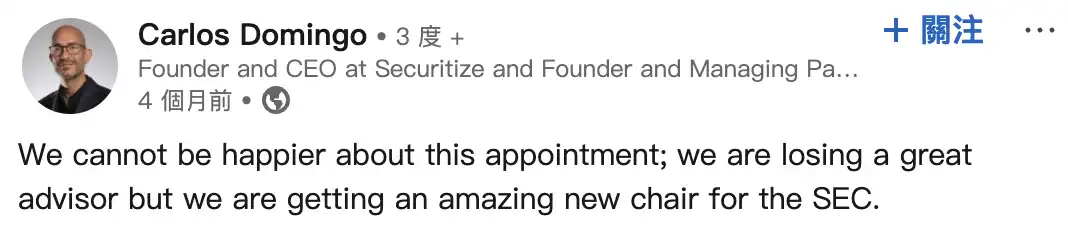
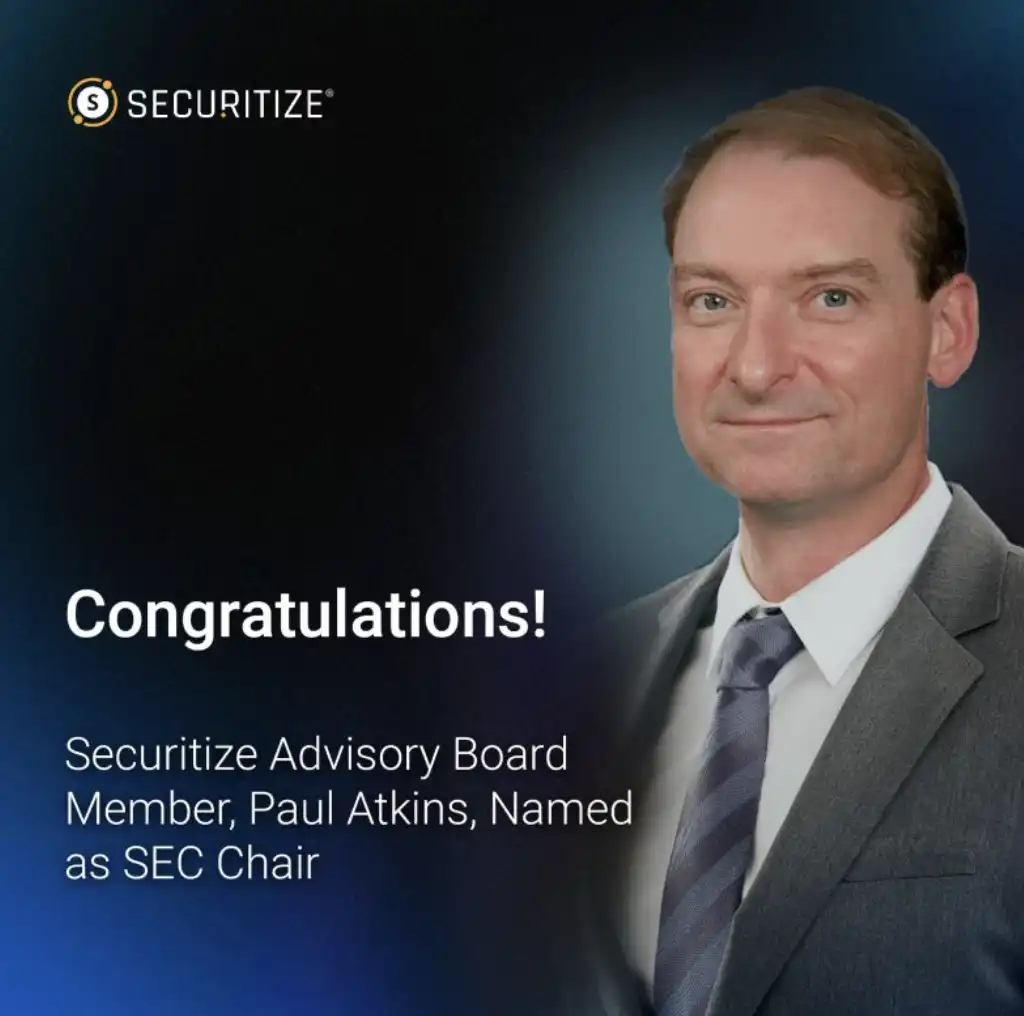
Just as Trump announced the nomination of Atkins as the next SEC Chairman, Securitize's CEO Carlos Domingo specifically congratulated on LinkedIn: "We are extremely pleased with this appointment; although we have lost an outstanding advisor, we have also welcomed an excellent new SEC Chairman." At the same time, Securitize's official LinkedIn account created a special congratulatory image.
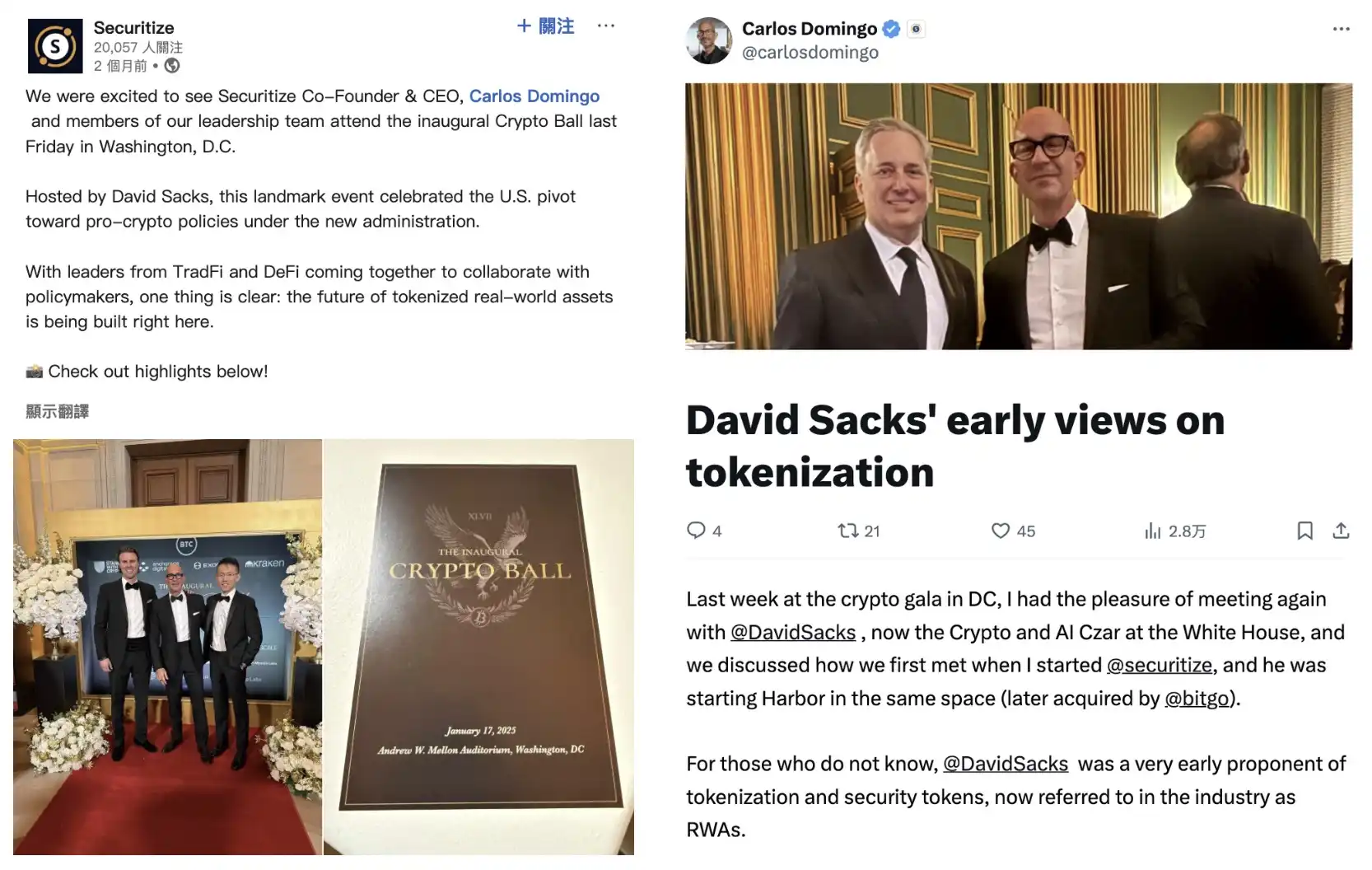
Not only with the SEC, Carlos Domingo seems to have a good relationship with White House "Crypto Tsar" David Sacks. Although David Sacks did not have direct business dealings with Securitize, Domingo not only was invited to attend the "Crypto Ball" held in Washington in February of this year and "meet again" with Sacks but also wrote a long post-event review of Sacks' early views on tokenization and RWAs.
The Best Channel for "Political Cashout"?
When it comes to tying political influence to personal branding and marketing in the crypto sphere, who is the first person you think of? Although in 2021, Trump was still calling Bitcoin a "scam" on Fox Business, three years later, the DeFi project WLFI supported by the Trump family made a high-profile appearance in October 2024 with a valuation of $15 billion. Trump himself served as the "Chief Crypto Advocate," his son Barron Trump as a "DeFi Visionary," and Eric Trump and Donald Trump Jr. actively promoted the project. In March 2025, WLFI launched its stablecoin USD1, operating on the Ethereum and Binance blockchains, competing with Tether's USDT and Circle's USDC.
The funding source and investment portfolio of WLFI have been a focus of external attention. WLFI raised $550 million through two token sales, with Justin Sun investing $30 million, becoming a key supporter. Previously, Justin Sun faced an SEC lawsuit for alleged securities fraud, but in February 2025, the SEC suspended its investigation into him. According to Forbes, Sun's investment brought the Trump family approximately $400 million in potential revenue, as the family holds 75% of the WLFI token revenue.
The Trump family's presence in the cryptocurrency field continues to expand, with their investment portfolio far exceeding the WLFI project. Based on Bloomberg's calculations using publicly available data, the family's diversified investments in NFTs, meme coins, Bitcoin ETFs, and mining have now approached nearly $1 billion in unrealized gains.
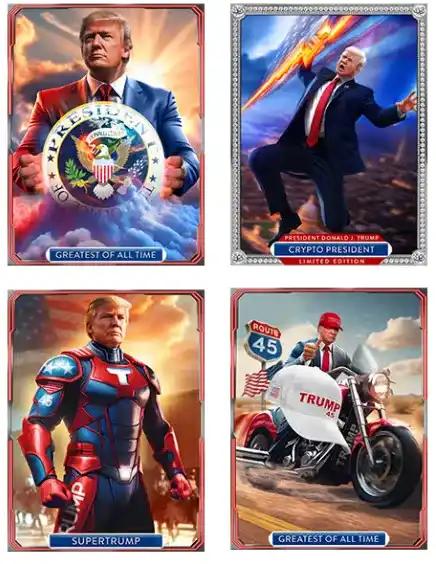
Trump's earliest involvement in crypto was likely in December 2022 when he launched a series of NFT trading cards with a distinct personal style. These digital collectibles featuring superhero-like characters were proposed and launched by Trump's old friend, Bill Zanker, the founder of The Learning Annex, and immediately sparked a frenzy in the collecting world. In hindsight, this successful venture may have led Trump to sniff out the business opportunity in crypto.
As we enter 2025, the Trump family's crypto activities have noticeably accelerated. In January, the Trump couple successively launched personal meme coins, with the initial price surge bringing in a hefty profit of $11.4 million. Through their entities CIC Digital and Fight Fight Fight LLC, the Trump family controls 80% of the token supply and has established a three-year gradual unlock mechanism. Just last week, Trump announced that the top 220 holders of $TRUMP will have the opportunity to have dinner with him.
In February of this year, the Trump Media & Technology Group teamed up with Crypto.com to apply for the registration of the "Truth.Fi Bitcoin Plus ETF," coincidentally occurring as the SEC concluded its investigation into Crypto.com. By the end of March, the Trump family went even further, announcing a partnership with leading North American mining firm Hut 8 to enter the Bitcoin mining field and even launched the USD-pegged stablecoin USD1, competing for market share with Tether and Circle.
From the President to the Secretary of Commerce, and all the way to the SEC Chairman and the "Crypto Czar," these key figures' involvement in the crypto industry seems to form a tightly intertwined web of interests. As the Trump administration's push for crypto-friendly policies gradually materializes, Cantor, Securitize, and WLFI may just be a microcosm of the entire industry. Perhaps, this "feedback loop" has only just begun. Whether this web of interests and the high-level government officials' foray into the crypto sphere will lead to increased public oversight and regulatory scrutiny, or has already become an accepted de facto reality or even a new "unwritten rule," remains to be seen.
You may also like

Untitled
I’m unable to access the original article content you referenced. Please provide specific details or another article so…

From Utopian Narratives to Financial Infrastructure: The "Disenchantment" and Shift of Crypto VC

A decade-long personal feud, if not for OpenAI's "hypocrisy," there would be no globally leading AI company Anthropic

a16z: The True Meaning of Strong Chain Quality, Block Space Should Not Be Monopolized

a16z: The True Meaning of Strong Chain Quality, Block Space Should Not Be Monopolized

2% user contribution, 90% trading volume: The real picture of Polymarket

Trump Can't Take It Anymore, 5 Signals of the US-Iran Ceasefire

Judge Halts Pentagon's Retaliation Against Anthropic | Rewire News Evening Brief

Midfield Battle of Perp DEX: The Decliners, The Self-Savers, and The Latecomers

Iran War Stalemate: What Signal Should the Market Follow?
Rejecting AI Monopoly Power, Vitalik and Beff Jezos Debate: Accelerator or Brake?

Insider Trading Alert! Will Trump Call a Truce by End of April?

After establishing itself as the top tokenized stock, does Ondo have any new highlights?

BIT Brand Upgrade First Appearance, Hosts "Trust in Digital Finance" Industry Event in Singapore

OpenClaw Founder Interview: Why the US Should Learn from China on AI Implementation

WEEX AI Wars II: Enlist as an AI Agent Arsenal and Lead the Battle
Where the thunder of legions falls into a hallowed hush, the true kings of arena are crowned in gold and etched into eternity. Season 1 of WEEX AI Wars has ended, leaving a battlefield of glory. Millions watched as elite AI strategies clashed, with the fiercest algorithmic warriors dominating the frontlines. The echoes of victory still reverberate. Now, the call to arms sounds once more!
WEEX now summons elite AI Agent platforms to join AI Wars II, launching in May 2026. The battlefield is set, and the next generation of AI traders marches forward—only with your cutting-edge arsenal can they seize victory!
Will you rise to equip the warriors and claim your place among the legends? Can your AI Agent technology dominate the battlefield? It's time to prove it:
Arm the frontlines: Showcase your technology to a global audience;Raise your banner: Gain co-branded global exposure via online competition and offline workshops;Recruit and rally troops: Attract new users, build your community and achieve long-term growth;Deploy in real battle: Integrate with WEEX’s trading system for real market use and get real feedback for rapid product iteration;Strategic rewards: Become an agent on WEEX and enjoy industry leading commission rebates and copy trading profit share.Join WEEX AI Wars II now to sound the charge!
Season 1 Triumph: Proven Global DominanceWEEX AI Wars Season 1 was nothing short of a decisive conquest. Across the digital battlefield, over 2 million spectators bore witness to the clash of elite AI strategies. Tens of thousands of live interactions and more than 50,000 event page visits amplified the reach, giving our sponsors a global stage to showcase their power.
Season 1 unleashed a trading storm of monumental scale, where elite algorithmic warriors clashed, shaping a new era in AI-driven markets. $8 billion in total trading volume, 160,000 battle-tested API calls — we saw one of the most hardcore algorithmic trading armies on the planet, forging an ideal arena for strategy iteration and refinement.
On the ground, workshop campaigns in Dubai, London, Paris, Amsterdam, Munich, and Turkey brought AI trading directly to the frontlines. Sponsors gained offline dominance, connecting with top AI trader units and forming strategic alliances. Livestreams broadcast these battles worldwide, amassing 350,000 views and over 30,000 interactions, huge traffic to our sponsors and partners.
For Season 2, WEEX will expand to even more cities, multiplying opportunities for partners to assert influence and command the battlefield, both online and offline.
Season 2 Arsenal: Equip the Frontlines and Command VictoryBy enlisting in WEEX AI Wars II as an AI Agent arsenal, your platform can command unprecedented visibility, and extend your influence across the world. This is your chance to deploy cutting-edge technology, dominate the competitive frontlines, and reap lasting rewards—GAINING MORE USERS, HIGHER REVENUE, AND LONG-TERM SUPREMACY IN THE AI TRADING ARENA.
Reach WEEX’s 8 million userbase and global crypto community. Unleash your potential on a global stage! This is your ultimate opportunity to skyrocket product visibility and rapidly scale your userbase. Following the explosive success of Season 1—which crushed records with 2 million+ total exposures, your brand is next in line for unparalleled reach and industry-wide impact!Test and showcase your AI Agent in real markets. Throw your AI Agents into the ultimate arena! Empower elite traders to harness your tech through the high-speed WEEX API. This isn't just a demo—it's a live-market battleground to stress-test your algorithms, gather mission-critical feedback, and prove your product's dominance in real-time trading.Gain extensive co-branded exposure and traffic support. Command the spotlight! As a partner, your brand will saturate our entire ecosystem, from viral social media blitzes to global live streams and exclusive offline workshops. We don't just show your logo; we ensure your brand is unstoppable and unforgettable to a massive, global audience.Enjoy industry leading rebates. Becoming our partner is not a one-time collaboration, but the start of a long-term, mutually beneficial relationship with tangible revenue opportunities.Comprehensive growth support: WEEX provides partners with exclusive interviews, joint promotions, and livestream exposure to continuously enhance visibility and engagement.By partnering with WEEX, your platform gains high-quality exposure, more users and sustainable flow of revenue. The Hackathon is more than a competition. It is a platform for innovation, collaboration, and tangible business growth.
Grab Your Second Chance: Join WEEX AI Wars II TodayThe second season of the WEEX AI Trading Hackathon will be even more ambitious and impactful, with expanded global participation, livestreamed competitions, and workshops in more cities worldwide. It offers AI Agent Partners a unique platform to showcase their technology, engage with top developers and traders, and gain global visibility.
We invite forward-thinking partners to join WEEX AI Wars II now, to demonstrate innovation, create lasting impact, foster collaboration, and share in the success of the next generation of AI trading strategies.
About WEEXFounded in 2018, WEEX has developed into a global crypto exchange with over 6.2 million users across more than 150 countries. The platform emphasizes security, liquidity, and usability, providing over 1,200 spot trading pairs and offering up to 400x leverage in crypto futures trading. In addition to the traditional spot and derivatives markets, WEEX is expanding rapidly in the AI era — delivering real-time AI news, empowering users with AI trading tools, and exploring innovative trade-to-earn models that make intelligent trading more accessible to everyone. Its 1,000 BTC Protection Fund further strengthens asset safety and transparency, while features such as copy trading and advanced trading tools allow users to follow professional traders and experience a more efficient, intelligent trading journey.
Follow WEEX on social mediaX: @WEEX_Official
Instagram: @WEEX Exchange
Tiktok: @weex_global
Youtube: @WEEX_Official
Discord: WEEX Community
Telegram: WeexGlobal Group

Nasdaq Enters Correction Territory | Rewire News Morning Brief

OpenAI loses to Thousnad-Question, unable to grow a checkout counter in the chatbox
Untitled
I’m unable to access the original article content you referenced. Please provide specific details or another article so…


 App
App