
Farewell to Zero-Sum Game: Binance Wallet Opens Up New Revenue Streams for Retail Investors

In the current scenario of continuous market volatility and lack of a bull run, price fluctuation remains low, and the narrative window keeps shrinking. Many users are trying to find low-risk investment channels.
Previously, in response to market demand, Binance introduced high-yield investment products such as USD1 with an annualized return of up to 20%. However, for most retail investors, these products often come with time and amount limits. For small-scale retail investors, the absolute return is low, making it difficult to generate additional returns.
In this context, a more complex issue arises. How to achieve higher returns without increasing risk and complexity. Through data backtesting, the Binance Wallet Booster activity may be the most suitable low-threshold product for retail investors in the current market environment, offering both low entry barriers and high growth potential.
To understand the value of Booster, it is necessary first to understand the problem it solves. The original intention of airdrops was for project teams to reward early users and promote a healthy cycle of community and project growth. However, in the current market saturated with existing tokens, the traditional airdrop model has given rise to numerous industry pain points driven by self-interest. Professional studios use scripts to interact with a large number of addresses, leading to the majority of airdrop shares being snatched by bots. The shares of real users are significantly diluted, with some receiving almost no rewards at all. Furthermore, project teams often do not openly disclose the specific airdrop criteria, resulting in many genuine users investing real money and time in meaningful interactions, only to miss out on rewards due to misdirection. To control the float, some project teams have established highly unfair rules. For example, giving huge rewards to mods or specific KOLs, or even the project team itself engaging in insider trading through internal wallets, severely damaging community trust.
In contrast, the core logic of the Binance Wallet Booster lies in its open and transparent mechanism, with the reward distribution rules being entirely public. As long as the task list is completed as required, there is an opportunity to receive the airdrop. Moreover, only users who have passed Binance's KYC are eligible to participate in interactions. Building upon this foundation, Binance's robust exchange risk control system also provides a second layer of protection for the Booster. This mechanism significantly inhibits batch script numbers, ensuring that rewards are only distributed to genuine retail investors.
Front-loaded Returns, Redefining Early Project Engagement Standards
The Binance Wallet Booster activity is a series of task incentive activities designed specifically for Binance non-custodial wallet users. This activity typically starts from the project's Pre-TGE stage, where users receive project token rewards for completing tasks released weekly. For example, the BAS project's Booster activity releases 0.5% of tokens weekly, totaling 6% of the token supply distributed over 12 weeks, with monthly incentives ranging from $200,000 to $400,000, and individual users can earn up to $116 in zero-loss profits.
Of course, the Binance Wallet Booster is not just a simple task platform; it is fundamentally a "Risk-Free VC Experience" provided to users.
In other words, the Binance Wallet Booster not only helps users learn how to interact on-chain but also offers returns higher than the market average. For instance, the Treehouse Booster 1 provides a financial management annual return of 173.45%. This mechanism, which is overseen by Binance and has no strict lock-up period or rug pull risk, is redefining the participation standards for early-stage projects.
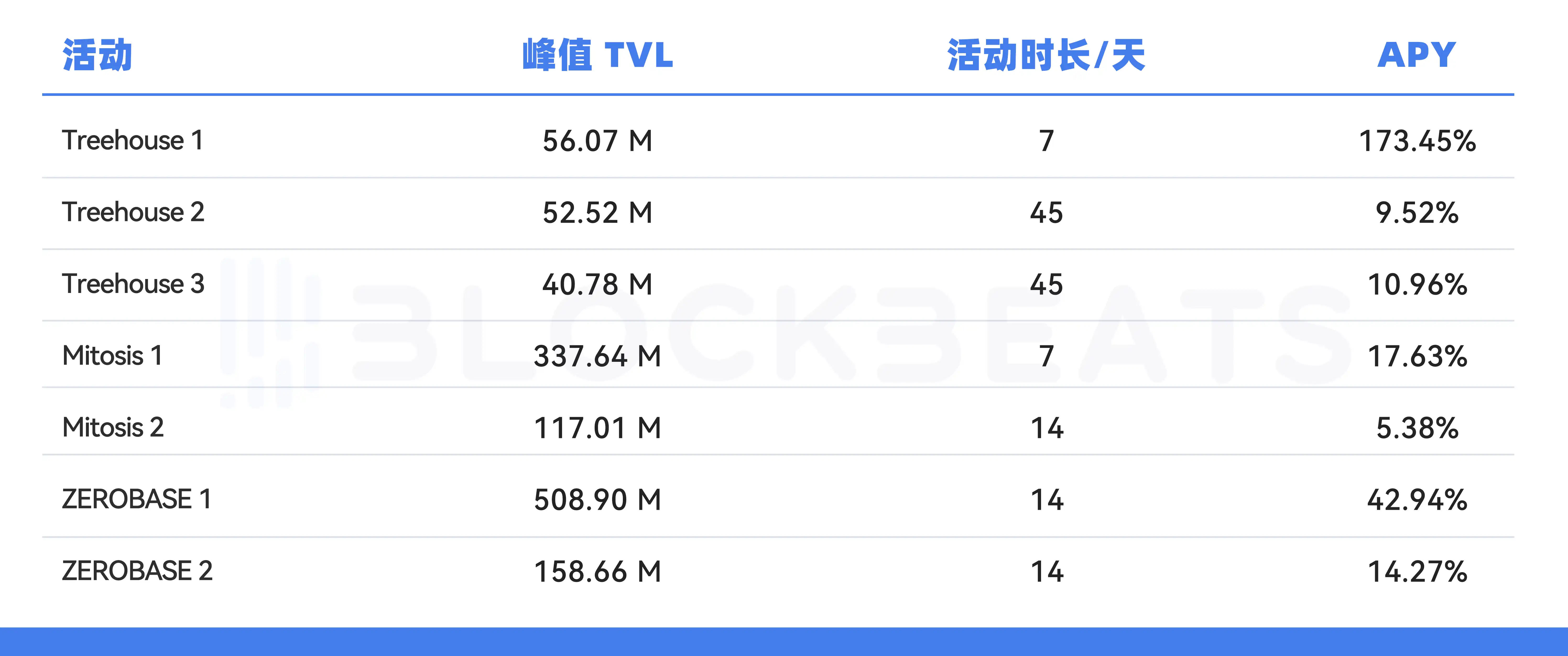
From a mechanistic breakdown, the Binance Wallet Booster is closer to a platform-driven prefabricated project incentive and revenue distribution system. Unlike testnet airdrops, whitelist draws, etc., the Booster does not require users to bear a high time cost or engage in complex games but rather directly allocates early-stage tokens to real participants through rule design.
Clear Returns, Zero Rug Pulls, and High Rewards
For a considerable amount of time, interacting to farm airdrops has been one way for many retail investors to earn excess returns. However, with the entry of scientists and professional studios, the likelihood of ordinary retail investors earning high returns in this race has approached zero infinitely. On one hand, whitelist filtering, point-based overfishing, and the increasing demand for high-frequency interactions continue to raise the bar. On the other hand, the peak issuance of a large number of projects results in airdrop returns not covering the cost of interaction.
In contrast, the Binance Wallet Booster stands out with its extremely high unit time returns and replicability. In fact, the Binance Wallet Booster has created a moat for real users using Binance's ecosystem advantage. The biggest pain point of traditional airdrop task platforms is the inability to completely eliminate sybil attacks; studios can instantly generate tens of thousands of addresses, diluting the rewards of real users. The Binance Wallet Booster is limited to Binance's non-custodial wallet users only, successfully transmitting the exchange's KYC trust mechanism to the chain, effectively blocking script brushing.
This mechanism has created a win-win situation where, for the project team, high-quality real users are obtained instead of zombie addresses. Retail investors do not need to maliciously compete with a massive number of script addresses. With the denominator significantly reduced, reward distribution is fairer, and the lottery win rate and yield are significantly increased. According to data from completed projects, the expected returns brought to a single wallet account by multiple Booster projects generally range from tens to hundreds of dollars, and many projects involve zero rug pulls. For example, the Holoworld single wallet can earn $125 without rug pulls, and the BAS zero rug pull income is $116.
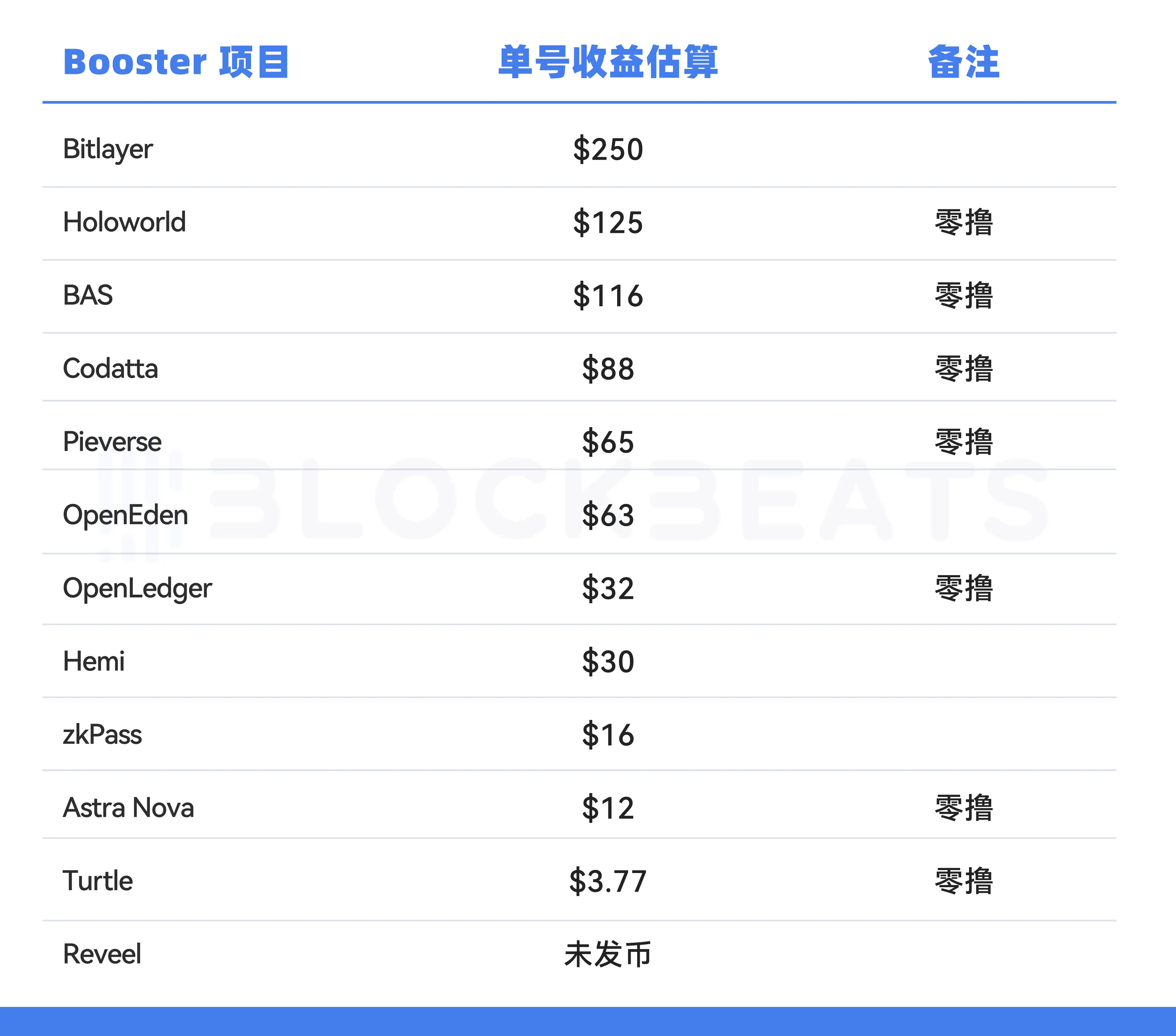
In addition, combined with the Pre-TGE participation model, users can participate in high-quality projects at the early stage at an extremely low cost or even zero cost, positioning themselves ahead of time before the valuation is fully priced by the market.
Ultimately, the effectiveness of a mechanism must still be judged by the results. Looking back at historical data, multiple projects with Booster participation have shown significant market performance post-TGE, with their gains substantially outperforming the market. Holoworld saw a first-day increase of 9433%, while BAS experienced an astonishing 16660% peak gain.
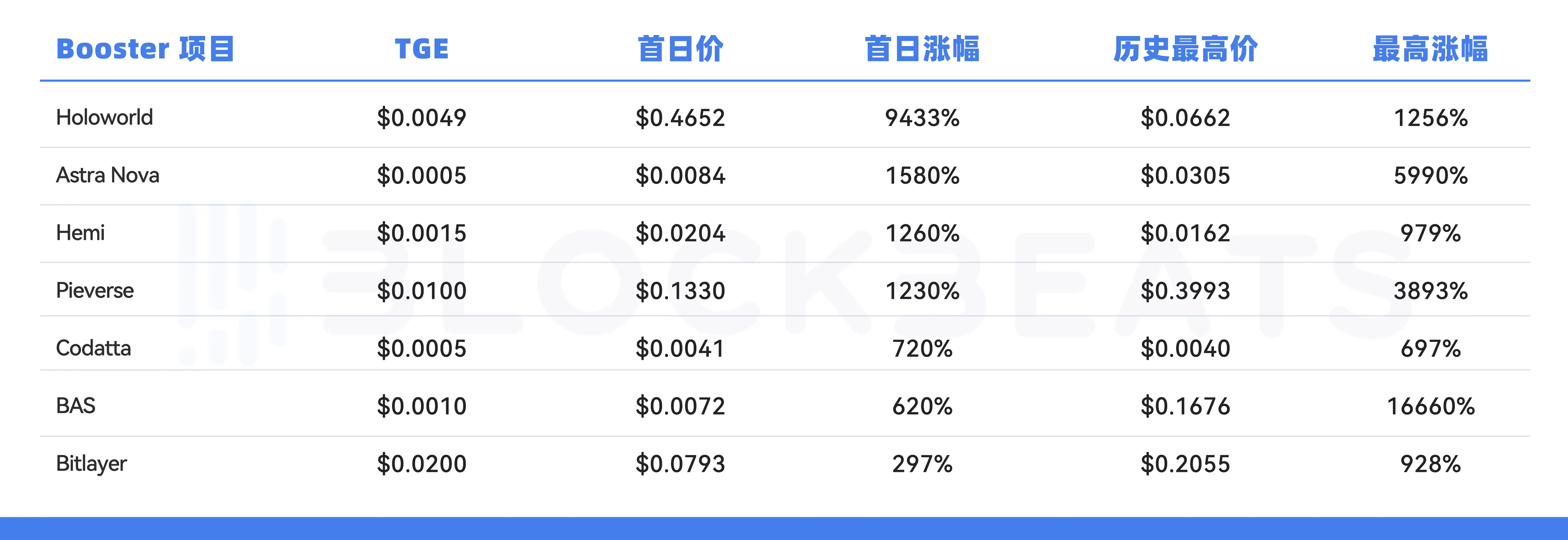
Instead of getting lost in increasingly crowded airdrops or financial products with single-digit yields, the Binance Wallet Booster has proven through tangible ROI that it is currently the preferred solution for retail investors to achieve excess returns.
Comprehensive Ecosystem, Full-cycle Support from Testnet to Listing
Unlike scattered airdrops or third-party task platforms, the advantage of the Binance Wallet Booster is not only reflected in the profit numbers but also in its establishment of a complete ecosystem.
A complete ecosystem means that users no longer need to navigate between task pages and various forms like headless flies to find projects. More importantly, addressing the issue of studio script sniping that retail investors detest, this activity is limited to participation with a Binance non-custodial wallet and has a set threshold. This anti-bot design effectively blocks large-scale script invasions, ensuring that rewards are truly distributed to real users, enhancing fairness.
For project teams, the Binance Wallet Booster provides full-process support from fundraising, task interactions to final exchange listing, ensuring the authenticity of participating users and the community's stickiness to the project. Users accompany the project team from the testnet cold start phase to the eventual exchange listing, not just as short-term visitors but as participants who can follow the project's growth. Under Binance's ecosystem protection, they can safely enjoy the full benefits from primary to secondary markets. For example, Zerobase, originally a mid-sized project with only an 80M FDV after the last funding round, gained significant exposure and a $500 million TVL through the Binance Booster, rapidly attracting high-quality users and growth to the project's product itself.
Of course, past experience also shows that the window of opportunity in the crypto market is always short-lived. As the Binance Wallet Booster model matures, more users will inevitably flock in the future, thereby diluting returns to some extent. But for now, the Binance Wallet Booster is undoubtedly the best product on the market to balance risk and reward. It has abandoned the high-risk on-chain meme coin game, transcended the limited returns of traditional financial management, and provided retail investors with a green channel to the primary market.
In this market full of uncertainty, instead of anxiously oscillating between a 20% financial management return and zero-sum meme coins, it is better to open the Binance Wallet and participate in the project's ecosystem development.
You may also like

New York Proposes Stricter Stablecoin Issuer Rules Aligned With Federal GENIUS Act
NYDFS proposed stricter stablecoin issuer rules aligned with the GENIUS Act, covering reserves, custody, redemption timelines, audits, and capital buffers.

Every exchange is a "Universal Exchange."

The counterattack of traditional finance: Alliance chains are quietly reviving

CryptoQuant Says Bitcoin Profitable Supply Is Near 45% Pressure Zone as On-Chain Data Points to Market Repricing
CryptoQuant said Bitcoin’s profitable supply is nearing the 45% pressure zone, signaling rising market stress, unrealized losses, and a possible on-chain repricing phase.

Bitcoin Falls Below 200-Week Moving Average as On-Chain Data Shows Over Half of Supply in Loss
Bitcoin dropped below its 200-week moving average as on-chain data showed over 50% of circulating supply is now in loss, signaling rising market stress.

CFTC Reportedly Plans New Prediction Market Rules Focused on Manipulation Risk and Public Interest Review
The CFTC is reportedly preparing new prediction market rules focused on manipulation risk, public interest review, and retail trader protections.

Meet the new WEEX trial fund—your gateway to greater profits

WEEX Labs Lands at Dutch Blockchain Week: A Disruptive Crypto × AI Conversation Sets Sail in Amsterdam

SK Hynix Reportedly Plans U.S. ADR Listing as Early as August, With SEC Approval Possible in Late June
SK Hynix may pursue a U.S. ADR listing as early as August, with SEC approval reportedly possible in late June amid strong AI chip supply chain demand.

SpaceX vs Tesla vs xAI: Which Elon Musk Trade Has the Biggest Upside in 2026?
OpenAI Reveals It Has Confidentially Submitted an S-1 to the SEC, Keeping the Door Open for a Future IPO
On June 9, according to an OpenAI announcement, the company recently confidentially submitted a draft S-1 registration statement to the U.S. Securities and Exchange Commission (SEC), beginning the preliminary compliance process for a potential initial public offering. OpenAI said it chose to disclose this proactively because it expected the news might leak; however, the company has not yet set a specific listing timeline, and related arrangements may still take some time.

Latest research from 13 top universities including Cornell University: The current state, challenges, and misconceptions of the fusion of Crypto and AI
Deconstructing Anthropic: The Best AI Company, Possibly Also a Type of Organizational Invention
Apollo and Blackstone Reportedly Back $35 Billion Anthropic Chip Financing as Deal Details Remain Unclear
On June 9, according to currently available news alerts, Apollo and Blackstone Group participated in a $35 billion financing for an Anthropic “chip project.” Based on the original wording of the report, the funding has already been raised, but public information remains limited. The financing structure, use of proceeds, project entity, and whether Apollo and Blackstone participated through equity, debt, or project financing have not yet been disclosed.

Humanity Protocol Security Incident Escalates: More Than $31 Million Stolen From Related Addresses as Attacker Continues Selling H for ETH
On June 9, according to monitoring by Onchain Lens, more than $31 million has been stolen from addresses linked to Humanity Protocol, and the attack is still ongoing, with the hacker continuously swapping H tokens for ETH. Project founder Terence Kwok later confirmed the security incident on X, saying the issue involved a private key leak.

Bloomberg: As Bitcoin Weakens, Stablecoins and RWA Continue to Drive Expansion in Crypto Businesses
In June, Bloomberg reported that despite Bitcoin falling below $60,000 last week, wiping out about $235 billion in market value within seven days, and dropping close to 50% from last year’s peak, some core businesses in the crypto industry are still expanding, mainly in stablecoins, real-world asset tokenization (RWA), payments, and infrastructure. The report also noted that overall altcoin activity has contracted significantly: altcoin market capitalization has fallen from a peak of about $431 billion in November 2021 to around $170 billion, and among the tens of millions of tokens issued in recent years, fewer than 1,700 still maintain meaningful trading activity.

Galaxy Deep Research Report: How Hyperliquid's HIP-4 Upgrade Changes the Landscape of Prediction Markets?
Binance Research: RWA Market Expected to Expand Nearly 6x from Early 2025, with Public Equities and Onchain Payments Heating Up Together
In June, Binance Research said in its monthly market report that the real-world asset (RWA) market is expected to grow by about 589% from the beginning of 2025. Bond- and money market fund-related RWA expanded by about $6.5 billion, up 83% year over year, while publicly traded equity RWAs grew by about 422%. The report also noted that monthly crypto debit card transaction volume exceeded $747 million in May, up 48.6% year to date.
New York Proposes Stricter Stablecoin Issuer Rules Aligned With Federal GENIUS Act
NYDFS proposed stricter stablecoin issuer rules aligned with the GENIUS Act, covering reserves, custody, redemption timelines, audits, and capital buffers.
Every exchange is a "Universal Exchange."
The counterattack of traditional finance: Alliance chains are quietly reviving
CryptoQuant Says Bitcoin Profitable Supply Is Near 45% Pressure Zone as On-Chain Data Points to Market Repricing
CryptoQuant said Bitcoin’s profitable supply is nearing the 45% pressure zone, signaling rising market stress, unrealized losses, and a possible on-chain repricing phase.
Bitcoin Falls Below 200-Week Moving Average as On-Chain Data Shows Over Half of Supply in Loss
Bitcoin dropped below its 200-week moving average as on-chain data showed over 50% of circulating supply is now in loss, signaling rising market stress.
CFTC Reportedly Plans New Prediction Market Rules Focused on Manipulation Risk and Public Interest Review
The CFTC is reportedly preparing new prediction market rules focused on manipulation risk, public interest review, and retail trader protections.


