
 Buy Crypto
- Markets
 Futures
- Spot
- Copy Trade
- Earn
- More
Ethereum ETF Funds Experience Severe Outflows, Staking Difficulty Aggravates Ecosystem Crisis?

Original Title: "Ethereum's Growing Pains: From ETF 'Hemorrhage' to On-Chain Fatigue, Can ETF Staking Boost the Market?"
Original Author: Nancy, PANews
Ethereum is going through a prolonged period of growing pains, with price continuing to be under pressure, on-chain activity seeing a significant decline, and continuous outflows from spot ETF funds... These signs are gradually eroding market confidence in its growth potential. As the U.S. crypto regulatory environment quietly shifts, several ETF issuers have recently submitted Ethereum ETF staking proposal applications to the U.S. SEC. For Ethereum, which currently lacks a clear demand catalyst, this change is also seen by the market as a key variable for Ethereum to emerge from its slump in the short term.
ETF Funds Hemorrhaging, ETF Staking Approval to be Announced Earliest this Month
Currently, Ethereum spot ETF funds are experiencing continuous outflows, further denting market confidence. According to SoSoValue data, since the beginning of this year, U.S. Ethereum spot ETFs have seen net outflows of over $400 million in March, with a net outflow of nearly $240 million year-to-date. In contrast, although Bitcoin spot ETFs have also seen significant outflows in the past two months, the overall net inflow this year still exceeds $790 million, with the outflows this month shrinking by 74.9% compared to February.
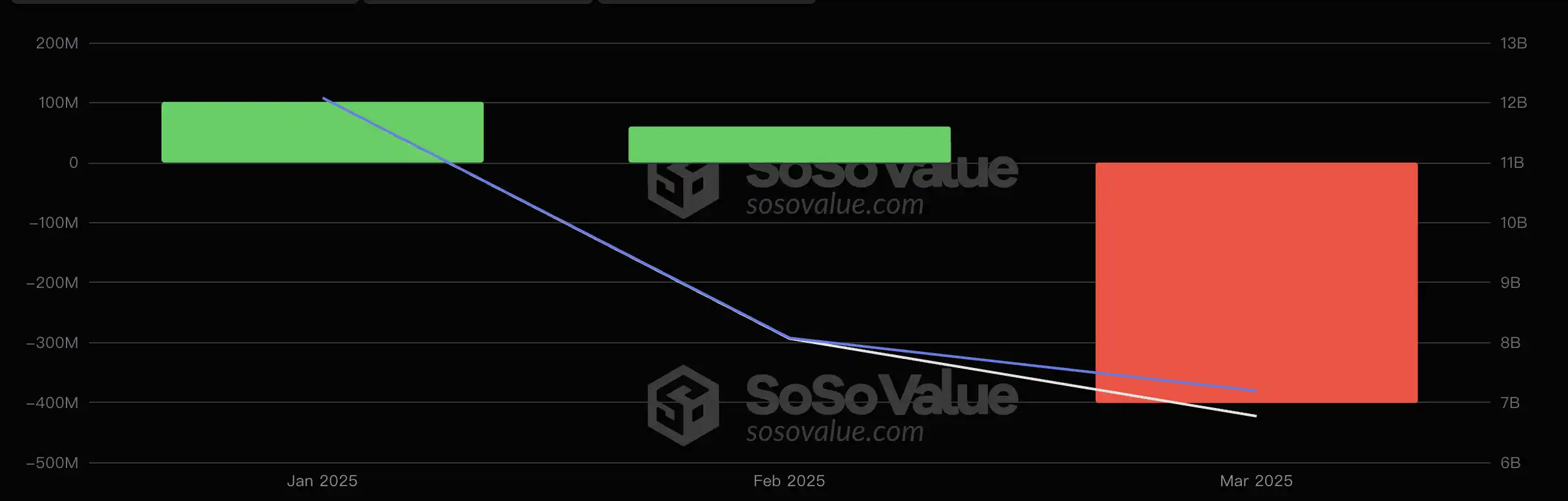
Ethereum ETF Monthly Inflows Year-to-Date
In response, Robert Mitchnick, Head of BlackRock's Digital Assets Division, believes that approval for staking may be a "huge leap" for Ethereum ETFs. He recently stated that the demand for Ethereum ETFs has been lackluster since their launch in July last year, but the situation could change if some regulatory issues hindering their development are resolved. It is widely believed that compared to the explosive growth of funds tracking Bitcoin, Ethereum ETFs' success has been "unremarkable." Although this is a "misconception," the inability of these funds to earn staking rewards may be a limiting factor in their development.
ETFs are a very attractive tool, but for today's ETH, an ETF without staking is not perfect, as staking rewards are a crucial part of generating investment returns in this space. This is not an issue that is particularly easy to solve; it's not like... a new government just flipping a switch and it all happens. There are many quite complex challenges to overcome. If these hurdles can be overcome, then there will be a quantum leap in seeing activity around these ETF products.
In fact, since February this year, many issuers including 21Shares, Grayscale, Fidelity, Bitwise, and Franklin have successively submitted proposals for Ethereum ETF staking. Among them, 21Shares was the earliest institution to submit the relevant application and received formal SEC acceptance on February 20th. According to the SEC approval process, the institution must make a preliminary decision within 45 days after submitting the 19b-4 filing, including whether to accept, reject, or delay. Starting from February 12th, the preliminary decision time for 21Shares' Ethereum ETF staking application is March 29th, which may actually be extended to the next working day, March 31st, due to weekends, and the latest final decision is expected to be made within 240 days, by October 9th.
In the market's view, the introduction of staking for Ethereum ETF is considered to have multiple potential advantages. In terms of investment return, the current annualized staking yield for Ethereum is about 3.12%. Compared to Bitcoin spot ETFs that rely solely on price fluctuations, the Ethereum ETF can generate additional returns for the held ETH through staking. This feature is particularly attractive to institutional investors and may help reverse the current weak demand situation. In terms of price driving, staking locked ETH will reduce market circulation, alleviate selling pressure, and potentially drive up the ETH price.
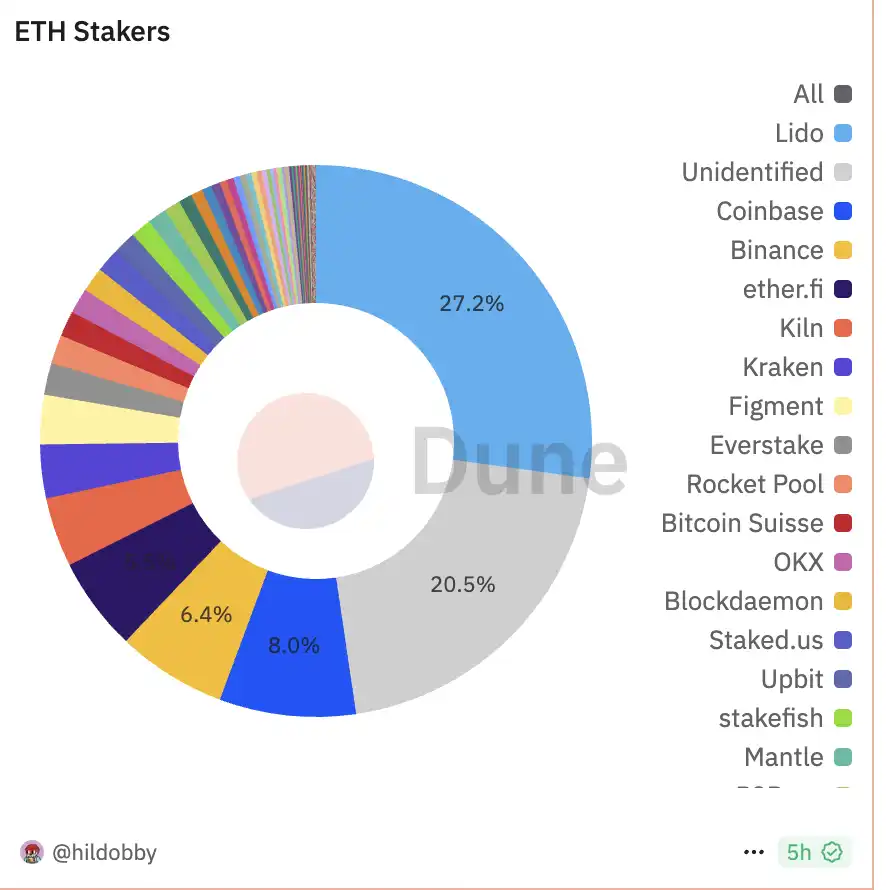
Dune data shows that as of March 24th, the total Ethereum staked on the Beacon Chain exceeded 34.199 million ETH, with staked ETH accounting for 27.85% of the total supply. If ETFs join the staking ranks, this ratio will further increase. In terms of network security, ETF participation in staking will increase the number of Ethereum network validators, enhance decentralization, and alleviate concerns in the community about the centralization risk of liquidity staking protocols like Lido. Dune data shows that as of March 24th, the liquidity staking protocol Lido alone occupies 27.28% of the Ethereum staking share.
However, for the sake of operational simplicity and regulatory compliance, the staking design of an Ethereum spot ETF may weaken its attractiveness to investment institutions. Taking the staking feature application document submitted by 21Shares as an example, its staking process is managed by the custodian Coinbase which safeguards the ETH, using a "point-and-click staking" model, meaning that through a simplified interface, the ETF can directly stake the ETH it holds without transferring the assets to a third-party protocol (such as Lido or Rocket Pool), thereby reducing security risks associated with asset transfers.
Furthermore, all staking rewards generated are owned by the ETF Trust as the issuer's revenue, rather than being directly distributed to investors. According to Dune data, compared to centralized exchanges such as Coinbase and Binance, decentralized staking derivatives like Lido and ether.fi are still the mainstream choice for ETH staking. Based on available information, none of the Ethereum spot ETF issuers have explicitly allowed staking rewards to be directly shared with investors. However, given the loosening of U.S. regulations and increased market competition, the possibility of introducing this mechanism cannot be ruled out.
Furthermore, Ethereum spot ETFs also face a challenge in staking efficiency. Due to the strict limitations of the Ethereum staking entry and exit mechanism (allowing a maximum of 8 nodes to enter and 16 nodes to exit per epoch, with an epoch generated every 6.4 minutes), the flexibility of ETFs is restricted. This limitation becomes more prominent during market volatility, as investors are unable to exit promptly, potentially exacerbating selling pressure.
For example, the current Ethereum spot ETF holds a total value of approximately $6.77 billion worth of ETH, which, at an ETH price (around $2064), equates to approximately 3.28 million ETH. Therefore, the entry time for staking is around 57.69 days, while the exit time is 28.47 days. This queuing mechanism fails to meet investor demand, and liquidity staking platforms that bypass these mechanisms are also excluded from ETF staking.
However, the Pectra upgrade (EIP-7251) increases the staking cap for individual validation nodes from 32 ETH to 2048 ETH, significantly enhancing staking efficiency. This change not only reduces the queuing time for entry and exit staking but also lowers the technical barrier. In the latest 153rd Ethereum All Core Developers' Call (ACDC) meeting, developers have decided to postpone the confirmation of the Pectra mainnet activation date, possibly delaying it until after May.
From this perspective, compared to the availability of staking functionality, issues such as reward distribution and efficiency are crucial factors affecting the demand for Ethereum spot ETFs.
On-chain Activity Remains Sluggish, ETF Staking Dilemma Unresolved
Even if Ethereum spot ETFs introduce staking functionality, their impact on circulating supply and market sentiment is limited, making it difficult to fundamentally reverse the competitive pressure and growth bottlenecks facing the Ethereum ecosystem. Currently, the sustained low on-chain activity, intensified L2 scaling effects, and challenges from other high-performance blockchains are all contributing to weakening Ethereum's market dominance.
From the perspective of ETF staking impact, as of now, Ethereum's staking rate is approximately 27.78%. The U.S. Ethereum spot ETF holds 2.84% of the total ETH, and even if all these ETFs participate in staking, it would only raise the staking rate to around 30.62%, an increase of 2.84%. This slight change has a minor impact on ETH's circulating supply and is still insufficient to be a decisive force driving price upward.
In contrast, the staking rates of other PoS competitive chains are much higher than Ethereum, such as Sui with a staking rate of 77.13%, Aptos at 75.83%, and Solana at 64.39%. While Ethereum has room for staking growth, the scale of ETF funds and staking potential are unlikely to constitute the dominant buying power in the market. The symbolic significance of staking is greater than its actual effect.
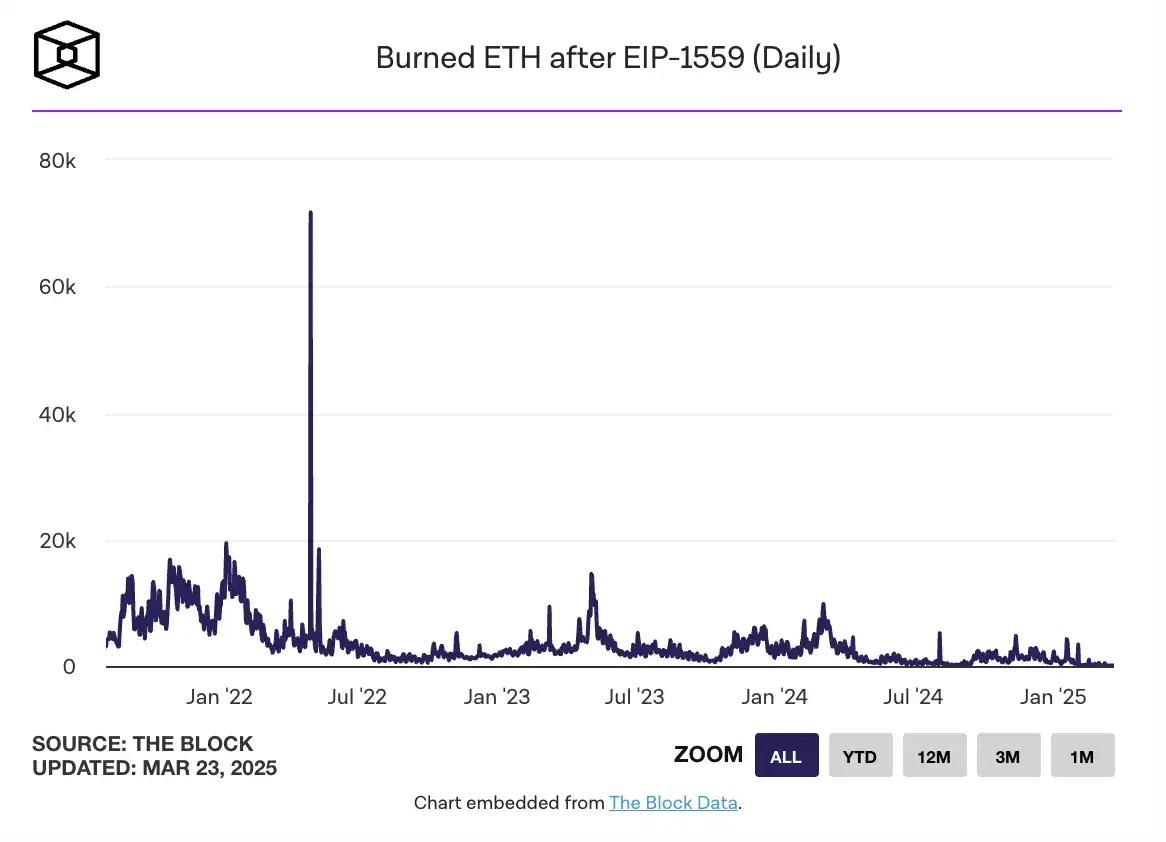
Furthermore, the continuous decline in on-chain activity data further highlights the fatigue of the Ethereum ecosystem. According to The Block data, as of March 22, the amount of ETH burned due to transaction fees on the Ethereum network has decreased to 53.07 ETH, approximately equivalent to $10.6K, hitting a historical low. Ultrasound.money data shows that based on the last 7 days, the annual supply growth rate of ETH is 0.76%. Moreover, Ethereum's on-chain active addresses, transaction volume, and number of transactions have all declined in recent weeks, indicating a waning vitality of the Ethereum ecosystem.
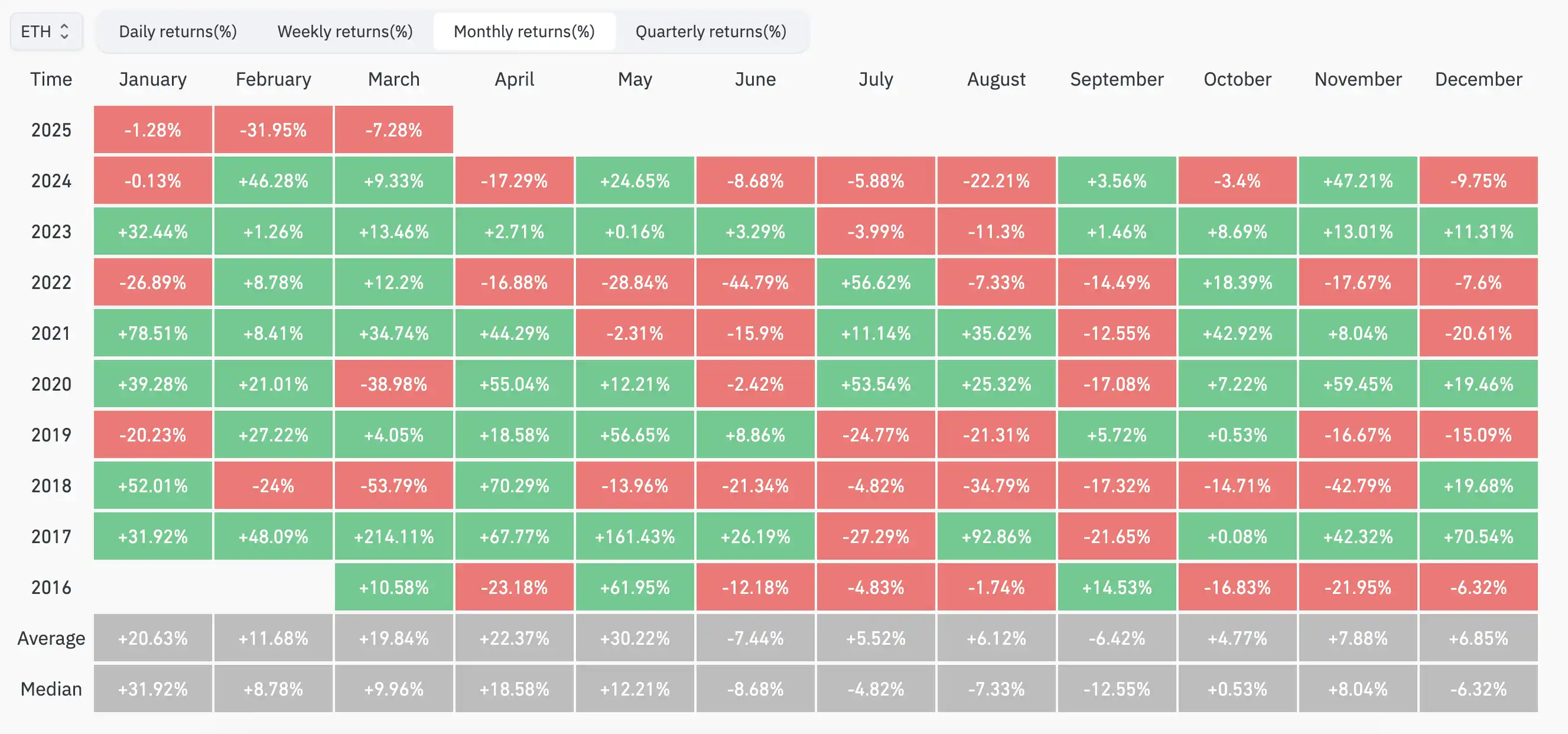
At the same time, Ethereum recorded its worst performance in Q1 of this year. Coinglass data shows that Ethereum experienced its worst start to a year in nearly a quarter in Q1 2025, with negative returns for three consecutive months: January: -1.28% (historical average return: +20.63%, median: +31.92%); February: -31.95% (historical average return: +11.68%, median: +8.78%); March: -7.28% (historical average return: +19.55%, median: +9.96%).
The challenges facing Ethereum stem from multiple structural issues. For instance, although L2 solutions such as Arbitrum and Optimism have significantly reduced transaction costs through Rollup technology, they have also diverted transaction volume away from the mainnet. The proportion of L2 transactions has surpassed that of the mainnet, leading to a decrease in mainnet gas fees and ETH burn. More critically, the transaction fees generated by L2 mostly stay within their ecosystems (such as Optimism's OP tokenomics) rather than flowing back to ETH. For example, Ethereum's market share is being eroded by other blockchains like Solana due to its lack of competitiveness in high-performance application scenarios.
Standard Chartered Bank has also revised its end-of-2025 ETH target price from $10,000 to $4,000 in its latest report, and made several key assessments: L2 Scaling Weakens ETH Market Cap: L2 solutions originally intended to enhance Ethereum's scalability (such as Coinbase's Base) have led to a $500 billion market cap evaporation; ETH/BTC Ratio Expected to Continue Declining: It is projected to fall to 0.015 by the end of 2027, reaching the lowest level since 2017; Future Growth May Depend on RWAs: If RWA tokenization develops rapidly, ETH may still maintain its 80% security market share, but the Ethereum Foundation would need to pursue a more proactive business strategy (such as taxing L2), although this possibility is low.
Overall, although Ethereum's ETF pledging can to some extent affect ETH supply and holder returns, it cannot directly address core challenges such as ecosystem competition, L2 diversion, or market sentiment downturn. Ethereum still needs to seek a profound breakthrough in both technology and narrative.
You may also like

2% user contribution, 90% trading volume: The real picture of Polymarket

Trump Can't Take It Anymore, 5 Signals of the US-Iran Ceasefire

Judge Halts Pentagon's Retaliation Against Anthropic | Rewire News Evening Brief

Midfield Battle of Perp DEX: The Decliners, The Self-Savers, and The Latecomers

Iran War Stalemate: What Signal Should the Market Follow?

Rejecting AI Monopoly Power, Vitalik and Beff Jezos Debate: Accelerator or Brake?

Insider Trading Alert! Will Trump Call a Truce by End of April?

After establishing itself as the top tokenized stock, does Ondo have any new highlights?

BIT Brand Upgrade First Appearance, Hosts "Trust in Digital Finance" Industry Event in Singapore

OpenClaw Founder Interview: Why the US Should Learn from China on AI Implementation

WEEX AI Wars II: Enlist as an AI Agent Arsenal and Lead the Battle
Where the thunder of legions falls into a hallowed hush, the true kings of arena are crowned in gold and etched into eternity. Season 1 of WEEX AI Wars has ended, leaving a battlefield of glory. Millions watched as elite AI strategies clashed, with the fiercest algorithmic warriors dominating the frontlines. The echoes of victory still reverberate. Now, the call to arms sounds once more!
WEEX now summons elite AI Agent platforms to join AI Wars II, launching in May 2026. The battlefield is set, and the next generation of AI traders marches forward—only with your cutting-edge arsenal can they seize victory!
Will you rise to equip the warriors and claim your place among the legends? Can your AI Agent technology dominate the battlefield? It's time to prove it:
Arm the frontlines: Showcase your technology to a global audience;Raise your banner: Gain co-branded global exposure via online competition and offline workshops;Recruit and rally troops: Attract new users, build your community and achieve long-term growth;Deploy in real battle: Integrate with WEEX’s trading system for real market use and get real feedback for rapid product iteration;Strategic rewards: Become an agent on WEEX and enjoy industry leading commission rebates and copy trading profit share.Join WEEX AI Wars II now to sound the charge!
Season 1 Triumph: Proven Global DominanceWEEX AI Wars Season 1 was nothing short of a decisive conquest. Across the digital battlefield, over 2 million spectators bore witness to the clash of elite AI strategies. Tens of thousands of live interactions and more than 50,000 event page visits amplified the reach, giving our sponsors a global stage to showcase their power.
Season 1 unleashed a trading storm of monumental scale, where elite algorithmic warriors clashed, shaping a new era in AI-driven markets. $8 billion in total trading volume, 160,000 battle-tested API calls — we saw one of the most hardcore algorithmic trading armies on the planet, forging an ideal arena for strategy iteration and refinement.
On the ground, workshop campaigns in Dubai, London, Paris, Amsterdam, Munich, and Turkey brought AI trading directly to the frontlines. Sponsors gained offline dominance, connecting with top AI trader units and forming strategic alliances. Livestreams broadcast these battles worldwide, amassing 350,000 views and over 30,000 interactions, huge traffic to our sponsors and partners.
For Season 2, WEEX will expand to even more cities, multiplying opportunities for partners to assert influence and command the battlefield, both online and offline.
Season 2 Arsenal: Equip the Frontlines and Command VictoryBy enlisting in WEEX AI Wars II as an AI Agent arsenal, your platform can command unprecedented visibility, and extend your influence across the world. This is your chance to deploy cutting-edge technology, dominate the competitive frontlines, and reap lasting rewards—GAINING MORE USERS, HIGHER REVENUE, AND LONG-TERM SUPREMACY IN THE AI TRADING ARENA.
Reach WEEX’s 8 million userbase and global crypto community. Unleash your potential on a global stage! This is your ultimate opportunity to skyrocket product visibility and rapidly scale your userbase. Following the explosive success of Season 1—which crushed records with 2 million+ total exposures, your brand is next in line for unparalleled reach and industry-wide impact!Test and showcase your AI Agent in real markets. Throw your AI Agents into the ultimate arena! Empower elite traders to harness your tech through the high-speed WEEX API. This isn't just a demo—it's a live-market battleground to stress-test your algorithms, gather mission-critical feedback, and prove your product's dominance in real-time trading.Gain extensive co-branded exposure and traffic support. Command the spotlight! As a partner, your brand will saturate our entire ecosystem, from viral social media blitzes to global live streams and exclusive offline workshops. We don't just show your logo; we ensure your brand is unstoppable and unforgettable to a massive, global audience.Enjoy industry leading rebates. Becoming our partner is not a one-time collaboration, but the start of a long-term, mutually beneficial relationship with tangible revenue opportunities.Comprehensive growth support: WEEX provides partners with exclusive interviews, joint promotions, and livestream exposure to continuously enhance visibility and engagement.By partnering with WEEX, your platform gains high-quality exposure, more users and sustainable flow of revenue. The Hackathon is more than a competition. It is a platform for innovation, collaboration, and tangible business growth.
Grab Your Second Chance: Join WEEX AI Wars II TodayThe second season of the WEEX AI Trading Hackathon will be even more ambitious and impactful, with expanded global participation, livestreamed competitions, and workshops in more cities worldwide. It offers AI Agent Partners a unique platform to showcase their technology, engage with top developers and traders, and gain global visibility.
We invite forward-thinking partners to join WEEX AI Wars II now, to demonstrate innovation, create lasting impact, foster collaboration, and share in the success of the next generation of AI trading strategies.
About WEEXFounded in 2018, WEEX has developed into a global crypto exchange with over 6.2 million users across more than 150 countries. The platform emphasizes security, liquidity, and usability, providing over 1,200 spot trading pairs and offering up to 400x leverage in crypto futures trading. In addition to the traditional spot and derivatives markets, WEEX is expanding rapidly in the AI era — delivering real-time AI news, empowering users with AI trading tools, and exploring innovative trade-to-earn models that make intelligent trading more accessible to everyone. Its 1,000 BTC Protection Fund further strengthens asset safety and transparency, while features such as copy trading and advanced trading tools allow users to follow professional traders and experience a more efficient, intelligent trading journey.
Follow WEEX on social mediaX: @WEEX_Official
Instagram: @WEEX Exchange
Tiktok: @weex_global
Youtube: @WEEX_Official
Discord: WEEX Community
Telegram: WeexGlobal Group

Nasdaq Enters Correction Territory | Rewire News Morning Brief

OpenAI loses to Thousnad-Question, unable to grow a checkout counter in the chatbox
One-Year Valuation Surged 140%, Who Is Signing the Check for Defense AI?

Bittensor vs. Virtuals: Two Distinct AI Flywheel Mechanisms

Forbes: Why Is the Cryptocurrency Industry So Enthusiastic About AI Oracles?

Ethereum Foundation publishes: Restructuring the division of labor between L1 and L2, jointly building the ultimate Ethereum ecosystem


 App
App