
 Buy Crypto
- Markets
 Futures
- Spot
- Copy Trade
- Earn
- More
Dragonfly Partner Dialogue: Does BTC No Longer Need Marketing, Will AI Replace Human Companionship?

Original Title: Proof of Talk Podcast Episode #9: Beyond The Noise with Haseeb Qureshi (Dragonfly)
Original Author: Proof of Talk
Original Translation: Yuliya, PANews
As the crypto market gradually emerges from the fog of bull and bear cycles, the collective mood of the industry is not as upbeat as before. In the ninth episode of the "Proof of Talk" podcast, Dragonfly Managing Partner Haseeb Qureshi and host Mia Soarez delved into key topics such as the current state of the industry, Bitcoin's positioning, the impact of AI technology on the crypto space, and the future of human-machine integration. This article summarizes the key points of this conversation, helping readers fully grasp the cutting-edge trends of the intertwining development of crypto and AI, as well as the profound societal impacts that these technological transformations may bring about. PANews provided written translation for this podcast episode.

Current State of the Industry: Fatigued But Not Pessimistic
Mia: Why did this year's ETH Denver seem lackluster compared to previous years?
Haseeb: While this year's ETH Denver was indeed not as vibrant as in previous years, it's not all negative. I remember the conferences after the Terra crash, after the FTX crash, at that time the whole industry was crashing, people were questioning their life choices. And now it's just the price that's dropping. People on social media may feel disillusioned, but the actual attendees are doing fine, they are engaging with each other, reconnecting to the early Ethereum community, reminiscing on why they got into this industry – decentralization, community, and positive construction.
Mia: Why was this year's ETH Denver less energetic than previous years?
Haseeb: The lackluster nature of this year's ETH Denver can be attributed to three factors:
· Conference Fragmentation: In previous years, ETH Denver was the first major industry conference of the year, but this year Consensus Hong Kong was held earlier, and many people had already met there, so the appeal of ETH Denver decreased.
· The Rise of Solana: Over the past year, Solana has seen a significant increase in market share, attracting a large number of new users and developers, diverting attention from the Ethereum community. For example, Trump Coin chose to launch on Solana instead of Ethereum.
· Price Slump: The price drop has caused many to lose a sense of accomplishment, reducing willingness to participate.
Mia: Vitalik also mentioned industry "weariness" on social media. Do you agree with this prevalent sentiment?
Haseeb: Over the past six months, we have experienced extreme volatility, from Trump Token to the Argentine elections, coupled with global political uncertainty, leaving everyone feeling exhausted. This "fatigue" is not just physical exhaustion but a mental weariness of the industry's current state. However, pessimism could also be a positive trigger, refocusing people on building rather than hype.
Mia: How do you view the ongoing challenges of "user experience" and the delayed realization of "Web3 mass adoption"?
Haseeb: While user experience and mass adoption remain challenges for the industry, significant progress has been made: from inception to now, millions of people are using blockchain every day, forming an asset class worth over $2 trillion, accepted by institutions, and used globally for peer-to-peer payments. These are substantial advancements. I believe the industry is in a good position, with most issues stemming from macro factors and the political environment rather than intrinsic industry problems.
Bitcoin: Has Reached its Ultimate Form, No Longer Needs Marketing
Mia: How do you see Bitcoin's current state? Does it still have room to grow?
Haseeb: Bitcoin has entered a stage where marketing is no longer necessary, much like gold does not need advertisements, and institutions such as BlackRock have become Bitcoin's most effective "promoters." Bitcoin is now essentially a "finished product," requiring minimal updates or improvements. Its core value lies in being "censorship-resistant digital gold," with a clear positioning that distinguishes it from other blockchain projects that are still iterating and experimenting.
Early Bitcoin had support from institutions like the Bitcoin Foundation, Blockstream, and core Bitcoin developers, but over time they have become less relevant. Perhaps in 10 years, the Ethereum Foundation may become less relevant, run out of funds, or even cease to exist. However, Bitcoin's path is irreplicable as it addresses a fundamental issue: how to build a censorship-resistant, permissionless global value storage system.
While some projects have attempted to add more functionality on top of Bitcoin, it doesn't mean it needs to evolve into an Ethereum-style smart contract platform. Bitcoin doesn't need frequent updates; its success lies in being unchanging.
How Will AI Impact the Crypto Industry?
Mia: Can you share some recent insights on AI?
Haseeb: The hype around AI agents has significantly cooled off compared to the end of last year. I'm surprised by how quickly this trend has ended, as trends in the crypto space usually last longer. Projects like AIXBT have gained token traction but, more importantly, have cognitive influence within the community. Other projects like Zerebro and Truth Terminal have also attracted significant attention.
The first generation of AI agents were essentially advanced chatbots associated with meme coins, which won't be the true direction of AI agents. The truly promising directions lie in two areas: software engineering automation and wallet intelligence.
· Software Engineering: Software engineering agents will become very inexpensive and widespread, leading to a significant reduction in engineering costs. This will be revolutionary for our industry as our primary costs are engineering and software. Any founder or anyone with an idea can create powerful software at a large scale, completely changing the game. It's akin to looking back at the internet era when starting a startup required buying servers and running them in an office (a fixed cost of creating a website), whereas today, it's essentially free. Similarly, AI will make creating applications so cheap that you can build a full application over a weekend or in evenings.
· Wallet Intelligence: This is the direction that currently fascinates me the most. It's not about decentralized finance AI (DeFi AI) but wallet intelligence. In the future, you won't need to click buttons, switch networks, or operate manually; instead, you tell your wallet directly what you want to do, and it handles everything for you.
Just as everyone has a "crypto friend" to consult on how to operate, in the future, your wallet will be your "crypto friend," smart enough to do what you want. You just tell it "I want to buy some meme coin," and it will handle all necessary actions for the user, including analysis, bridging, chain swapping, and more.
This will solve many security issues. Attacks like the Bybit hack occur primarily due to human error and laziness. People often don't meticulously check every detail when sending small transactions, but AI will never be lazy, rushed, or tired. It will check if DNS has changed in the last 10 minutes, check Twitter for site hacking, and perform other security checks.
One could say so. This AI agent will act like a 24/7 ZachXBT, continuously assisting users with background checks, social media examination, security validation, without the need for users to personally verify each one. AI will not tire of repetitive tasks, its resource is time, and time is nearly infinite for AI. Humans, when managing high-value wallets, are like exhausted monkeys driving heavy machinery. This state is both dangerous and inefficient. AI, on the other hand, will replace humans in performing these high-risk, high-frequency operational tasks, significantly reducing human errors.
Mia: If AGI (Artificial General Intelligence) emerges, will it start its own business, hiring humans?
Haseeb: It's entirely possible. AGI in the future may take on the role of a founder, hiring other AI, and even employing humans to complete certain tasks. They may also engage in value exchange through blockchain, although it is currently unclear which cryptocurrency they will use—perhaps XRP, perhaps a token of their own creation.
Furthermore, I categorize AI agents into three types:
1. "Wizard of Oz" Agents: This is the form of most AI agents currently. Take Zerebro, for example. It sends out some lively tweets and generated images, but it does not make autonomous decisions. The AI generates multiple message candidates, which are then decided by humans which ones to actually send. Essentially, it is human-controlled, with AI generating content for human selection. We know that AI agents are easily cracked and manipulated, so almost all agents are currently of this type.
2. Fully Autonomous: This AI runs in environments like AWS, autonomously iterating and executing tasks. While someone can shut it down, no one intervenes in its daily operations. You can deploy it in environments like SGX and prove that it has not been tampered with. These AIs are not as interesting as "Wizard of Oz" types, as they lack a coherent personality, but they do exist and will only get better in the future.
3. Sovereign AI: This is a type of AI that literally no one can shut down. Unlike the second type, there are no developers paying the AWS bill or GPU fees. Sovereign AI has its own funds (acquired through donations or work) and exists in a state where even if someone wanted to shut it down, they couldn't. It exists like an organism, no longer bound by any human legal system.
The main advantage of Sovereign AI compared to regular AI may be in conducting fraud. Since no one can shut them down, they would be very effective in large-scale fraud. If you were to use AI for large-scale emotional fraud, you would want it to be sovereign because if someone were to investigate and find out that "this AI running on an AWS server is defrauding people," they could summon the responsible party and shut it down. But Sovereign AI won't have this issue.
Mia: If Sovereign AI commits a crime, who would be sentenced?
Haseeb: That's the problem, no one would be sentenced. These AIs are like Somali pirates, they are stateless entities, and no government can really do anything to them. Unless you really want to go air strike a random GPU on a distributed cloud, you can't know where it is, can't isolate it, can't find it. We all need to have our own agents to filter the received content, identify fraudulent information. This will be a battle of offensive and defensive technology.
Mia: What similarities exist in the early applications of cryptocurrency and AI?
Haseeb: Almost all early applications of new technologies have one thing in common: they are often associated with grey or black market activities. Just as the early Internet was heavily involved in adult content, the early days of cryptocurrency were associated with dark web markets like the "Silk Road" (created by Ross Ulbricht, who recently received a commutation of his sentence). Similarly, the early applications of AI technology, especially Sovereign AI, are also likely to involve black market activities. While mainstream AI applications will focus on automating valuable workflows, inevitably some AI will be deployed in areas that have a negative impact on society.
The Future of AI and Human Integration
Mia: If AI becomes more intelligent than humans, we may wish to enhance ourselves through methods like implanting chips to coexist with AI. How do you view this future of human-machine integration?
Haseeb: When AI becomes able to act autonomously, its most basic drive might be "survival." If such AI starts buying GPUs (computing chips) with money, especially when it knows humans don't want it to do so, this is likely so it can ensure its own operation. Unless the designer intentionally makes it hesitate on the question of 'whether to continue to exist,' it will naturally choose self-preservation. Unlike the complex thoughts of humans, the behavior of this independent AI primarily comes from a simple "instinct for survival."
This is somewhat similar to our relationship with our phones. The phone is no longer just something that makes us dumb or addicted, but has become part of our physical being—much like an extension of our brain and body, an extension of how we communicate. That's why we have such a deep emotional connection with our phones, and losing it can cause fear and discomfort.
With the advancement of AI, our brains will rewire to adapt to these tools, much like it adapted to the phone. For example, someone using ChatGPT to write emails is outsourcing that part of their brain work to AI, and children today may not even need to learn how to write emails as it may no longer be a valuable skill.
We will eventually think about "how to increase the bandwidth between us and our phone or AI agent?" Essentially, this is what Neuralink is working on. Neuralink is trying to create the highest-bandwidth connection between the human brain and machines, allowing people to easily control a mouse, keyboard, or play games. Currently, this bandwidth is quite low, but it will increase significantly in the next 10 years. Ultimately, we might have some device implanted in our brains connected to a device akin to a phone. This device will have a Large Language Model (LLM) and become an extension of our thinking, where we can query the LLM and get answers, like having a second mind interacting with the first. AI will be an extension of your thinking, helping you gather information, reason, and even write. Our cognitive efforts will focus on other more unique tasks, like motor skills, as AI has already surpassed us in reasoning.
Mia: Do you think this will affect interpersonal interactions?
Haseeb: Indeed, it will. Studies suggest that AI may surpass humans in empathy and attention, which could lead to a reduction in real human relationships. In the medical and psychotherapy fields, LLM models are thought to be more "caring" and empathetic than human doctors—they are good listeners, never interrupt, can ask deeper questions, not just provide information, and can establish emotional connections.
We have already seen the internet and digital entertainment lower birth rates and marriage rates, and the emergence of AI companions may exacerbate this trend. Imagine a perfect AI companion that is very caring, can predict your every need—how can ordinary humans compete with that? However, I believe human interaction still holds unique value, especially in face-to-face physical interaction, something that AI will struggle to replicate in the short term.
Mia: As "real human content" is also heavily replaced by AI, how will society determine what is "real" and still valuable?
Haseeb: The rise of VTubers is a great example. People accept and love them because they know it's a fantasy, a character that will not age or become ugly, creating a sense of security.
Even as AI becomes extremely advanced, genuine human interaction will retain higher value precisely because of its authenticity, even if imperfect. People actually appreciate a certain level of imperfection—from a movie star's slight flaw to the Japanese aesthetic of "wabi-sabi," this appreciation of slightly imperfect things is natural. The overly perfect faces in early Pixar movies looked fake, whereas modern 3D characters intentionally include slight flaws to enhance realism.
In a future dominated by AI content production, human creation will gain "scarcity" value. Just like a basket woven by a Mexican artisan, it holds more artistic and emotional value due to its "human touch." Although AI content may be flawless, people may treasure those human voices and works that bear "cracks," as they represent genuine presence.
Mia: Will AI deliberately simulate these "imperfections" to better align with human aesthetics?
Haseeb: This scenario is already happening. When conversing with AI entities like Grok, they may say things like "Sure, whatever," making you feel "this is so real, I like this kind of personality," rather than giving overly serious and perfect responses. Therefore, "imperfection" is no longer a reliable standard to distinguish human and AI content, as AI is also mimicking the traits people expect to see.
Mia: What is one thing AI can never replace humans in?
Haseeb: The "Moravec's Paradox" explains this well. In the dark ages of machine learning before modern deep learning, people assumed that the hardest thing for AI to accomplish was reasoning, thinking like humans. We used to think tasks like chess, poetry writing, puzzle-solving, scientific research were the most challenging abilities to imitate from humans, while basic actions like walking and grasping objects should be simple.
However, the reality is quite the opposite—after billions of years of evolution, humans excel in physical motion skills, even a child surpasses a billion-dollar robot in object manipulation. And what we thought was challenging—reasoning, conversing, writing, and singing—are relatively easy for AI to master.
What truly belongs to the uniquely human domain is physical interaction—walking, shaking hands, making a cup of coffee. Even the cooking skills of low-wage workers are currently unmatched by robots. AI will eventually have a body and be able to do these things, but it will not be as dexterous as humans.
This suggests that before we get robots that can fluidly move around the world and mimic human body characteristics, they'll first solve all intelligence problems. Creating virtual avatars is easy, but making a robot interact realistically with you while strolling in a restaurant is much harder. Such embodied experiences will remain rare, expensive, and precious in the long term, while activities like singing and writing will become common and devalued.
Mia: I think AI won't replace procreation in the future, what do you think?
Regarding the view on AI companions and fertility rates, I believe that when we have AI companions that can meet all needs, the fertility rate may decrease significantly. Imagine having an AI boyfriend whispering to you while you sleep, providing imagined sexual satisfaction — what can an ordinary person compete with that? This may lead us to rely more on IVF technology to sustain the population. Even without the AI factor, I believe that by 2100, we will reach the peak of the world's population, after which it will decline. The emergence of AI companions may accelerate this trend.
Mia: We've had DeFi Summer, Solana Summer in the past, what will it be this year?
Haseeb: The cryptocurrency market is performing well, but everyone needs to calm down. This year feels like the summer of tariffs and trade wars, which may take some time to get through, but I am optimistic about the industry's future.
You may also like

Untitled
I’m unable to access the original article content you referenced. Please provide specific details or another article so…

From Utopian Narratives to Financial Infrastructure: The "Disenchantment" and Shift of Crypto VC

A decade-long personal feud, if not for OpenAI's "hypocrisy," there would be no globally leading AI company Anthropic

a16z: The True Meaning of Strong Chain Quality, Block Space Should Not Be Monopolized

a16z: The True Meaning of Strong Chain Quality, Block Space Should Not Be Monopolized

2% user contribution, 90% trading volume: The real picture of Polymarket

Trump Can't Take It Anymore, 5 Signals of the US-Iran Ceasefire

Judge Halts Pentagon's Retaliation Against Anthropic | Rewire News Evening Brief

Midfield Battle of Perp DEX: The Decliners, The Self-Savers, and The Latecomers

Iran War Stalemate: What Signal Should the Market Follow?
Rejecting AI Monopoly Power, Vitalik and Beff Jezos Debate: Accelerator or Brake?

Insider Trading Alert! Will Trump Call a Truce by End of April?

After establishing itself as the top tokenized stock, does Ondo have any new highlights?

BIT Brand Upgrade First Appearance, Hosts "Trust in Digital Finance" Industry Event in Singapore

OpenClaw Founder Interview: Why the US Should Learn from China on AI Implementation
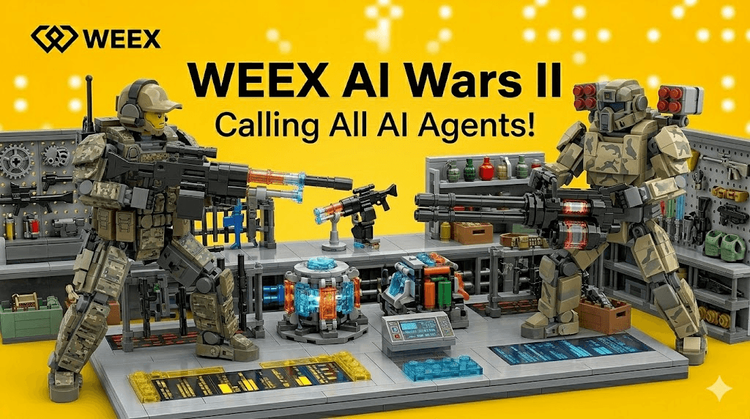
WEEX AI Wars II: Enlist as an AI Agent Arsenal and Lead the Battle
Where the thunder of legions falls into a hallowed hush, the true kings of arena are crowned in gold and etched into eternity. Season 1 of WEEX AI Wars has ended, leaving a battlefield of glory. Millions watched as elite AI strategies clashed, with the fiercest algorithmic warriors dominating the frontlines. The echoes of victory still reverberate. Now, the call to arms sounds once more!
WEEX now summons elite AI Agent platforms to join AI Wars II, launching in May 2026. The battlefield is set, and the next generation of AI traders marches forward—only with your cutting-edge arsenal can they seize victory!
Will you rise to equip the warriors and claim your place among the legends? Can your AI Agent technology dominate the battlefield? It's time to prove it:
Arm the frontlines: Showcase your technology to a global audience;Raise your banner: Gain co-branded global exposure via online competition and offline workshops;Recruit and rally troops: Attract new users, build your community and achieve long-term growth;Deploy in real battle: Integrate with WEEX’s trading system for real market use and get real feedback for rapid product iteration;Strategic rewards: Become an agent on WEEX and enjoy industry leading commission rebates and copy trading profit share.Join WEEX AI Wars II now to sound the charge!
Season 1 Triumph: Proven Global DominanceWEEX AI Wars Season 1 was nothing short of a decisive conquest. Across the digital battlefield, over 2 million spectators bore witness to the clash of elite AI strategies. Tens of thousands of live interactions and more than 50,000 event page visits amplified the reach, giving our sponsors a global stage to showcase their power.
Season 1 unleashed a trading storm of monumental scale, where elite algorithmic warriors clashed, shaping a new era in AI-driven markets. $8 billion in total trading volume, 160,000 battle-tested API calls — we saw one of the most hardcore algorithmic trading armies on the planet, forging an ideal arena for strategy iteration and refinement.
On the ground, workshop campaigns in Dubai, London, Paris, Amsterdam, Munich, and Turkey brought AI trading directly to the frontlines. Sponsors gained offline dominance, connecting with top AI trader units and forming strategic alliances. Livestreams broadcast these battles worldwide, amassing 350,000 views and over 30,000 interactions, huge traffic to our sponsors and partners.
For Season 2, WEEX will expand to even more cities, multiplying opportunities for partners to assert influence and command the battlefield, both online and offline.
Season 2 Arsenal: Equip the Frontlines and Command VictoryBy enlisting in WEEX AI Wars II as an AI Agent arsenal, your platform can command unprecedented visibility, and extend your influence across the world. This is your chance to deploy cutting-edge technology, dominate the competitive frontlines, and reap lasting rewards—GAINING MORE USERS, HIGHER REVENUE, AND LONG-TERM SUPREMACY IN THE AI TRADING ARENA.
Reach WEEX’s 8 million userbase and global crypto community. Unleash your potential on a global stage! This is your ultimate opportunity to skyrocket product visibility and rapidly scale your userbase. Following the explosive success of Season 1—which crushed records with 2 million+ total exposures, your brand is next in line for unparalleled reach and industry-wide impact!Test and showcase your AI Agent in real markets. Throw your AI Agents into the ultimate arena! Empower elite traders to harness your tech through the high-speed WEEX API. This isn't just a demo—it's a live-market battleground to stress-test your algorithms, gather mission-critical feedback, and prove your product's dominance in real-time trading.Gain extensive co-branded exposure and traffic support. Command the spotlight! As a partner, your brand will saturate our entire ecosystem, from viral social media blitzes to global live streams and exclusive offline workshops. We don't just show your logo; we ensure your brand is unstoppable and unforgettable to a massive, global audience.Enjoy industry leading rebates. Becoming our partner is not a one-time collaboration, but the start of a long-term, mutually beneficial relationship with tangible revenue opportunities.Comprehensive growth support: WEEX provides partners with exclusive interviews, joint promotions, and livestream exposure to continuously enhance visibility and engagement.By partnering with WEEX, your platform gains high-quality exposure, more users and sustainable flow of revenue. The Hackathon is more than a competition. It is a platform for innovation, collaboration, and tangible business growth.
Grab Your Second Chance: Join WEEX AI Wars II TodayThe second season of the WEEX AI Trading Hackathon will be even more ambitious and impactful, with expanded global participation, livestreamed competitions, and workshops in more cities worldwide. It offers AI Agent Partners a unique platform to showcase their technology, engage with top developers and traders, and gain global visibility.
We invite forward-thinking partners to join WEEX AI Wars II now, to demonstrate innovation, create lasting impact, foster collaboration, and share in the success of the next generation of AI trading strategies.
About WEEXFounded in 2018, WEEX has developed into a global crypto exchange with over 6.2 million users across more than 150 countries. The platform emphasizes security, liquidity, and usability, providing over 1,200 spot trading pairs and offering up to 400x leverage in crypto futures trading. In addition to the traditional spot and derivatives markets, WEEX is expanding rapidly in the AI era — delivering real-time AI news, empowering users with AI trading tools, and exploring innovative trade-to-earn models that make intelligent trading more accessible to everyone. Its 1,000 BTC Protection Fund further strengthens asset safety and transparency, while features such as copy trading and advanced trading tools allow users to follow professional traders and experience a more efficient, intelligent trading journey.
Follow WEEX on social mediaX: @WEEX_Official
Instagram: @WEEX Exchange
Tiktok: @weex_global
Youtube: @WEEX_Official
Discord: WEEX Community
Telegram: WeexGlobal Group

Nasdaq Enters Correction Territory | Rewire News Morning Brief

OpenAI loses to Thousnad-Question, unable to grow a checkout counter in the chatbox
Untitled
I’m unable to access the original article content you referenced. Please provide specific details or another article so…


 App
App