
 Buy Crypto
- Markets
 Futures
- Spot
- Copy Trade
- Earn
- More
DCG Founder's Interview: From Bitcoin Pioneer to AI Revolution, Barry's Crypto Empire and Bittensor Vision

Original Article Title: Barry Silbert is Back: The Next Big Crypto Bet
Original Article Author: Raoul Pal
Original Article Translation: Yuliya, PANews
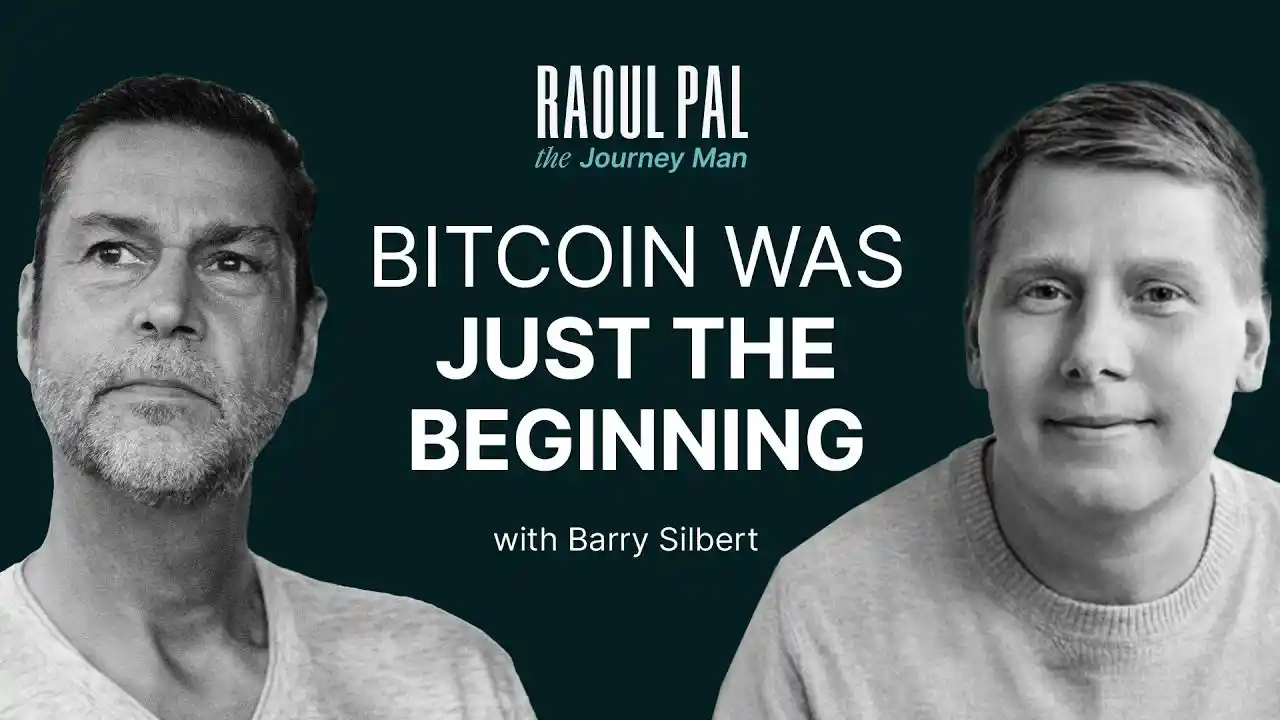
In today's fast-paced world of cryptocurrency and blockchain technology, Barry Silbert, the founder and CEO of DCG (Digital Currency Group), is undoubtedly a pioneer in the industry. In his latest podcast interview with Raoul Pal, Barry shared his journey from early Bitcoin investor to building DCG and its subsidiaries such as Grayscale and Foundry, experiencing the market's bull and bear cycles, including the 2022 cryptocurrency crash.
Today, Barry is setting his sights on the next major bet - Bittensor. He elaborated on his role as the founder and CEO of Yuma, and how Bittensor could potentially become a more transformative decentralized intelligence network layer than Bitcoin. This article will delve into Barry's experiences, DCG's development, the 2022 crisis, and his outlook on the future of Bittensor and AI. PANews provided the textual translation for this podcast.
Bitcoin Enlightenment Journey
Q: Barry, please share how you transitioned from Wall Street to Bitcoin?
Barry: I was initially an investment banker, but I realized the need to create something new, so I founded the first secondary market for private stocks and illiquid assets, Second Market. This platform played a crucial role during the 2008 credit crisis when many companies like Facebook and Twitter couldn't raise funds through the IPO market, and Second Market became a vital channel for trading their stocks.
In 2011, I first encountered Bitcoin through a Wired article/Jason Calacanis's podcast. At that time, I still believed the impact of the credit crisis had not subsided, so I remained cautious. I spent six months researching Bitcoin, reading vast amounts of material, and engaging with industry insiders. By early 2012, I realized that Bitcoin could have a profound impact on the world and decided to get involved to avoid future regrets.
Q: At what price did you initially purchase Bitcoin?
Barry: I purchased hundreds of thousands of dollars worth of Bitcoin at a price of 7-8 dollars through the Mt. Gox platform. The price surged to 30 dollars at one point and then dropped to 5 dollars. Over the next 6-12 months, it started to rise again to 50, 60, 70 dollars. I then began looking for companies to invest in that were building Bitcoin infrastructure, such as early investments in Coinbase, Chainalysis, Ripple, and other first-generation infrastructure companies.
Interestingly, I actually made these investments using Bitcoin. If I had just held onto those Bitcoins instead of investing in these companies, I would have actually had a better return. Those of us early Bitcoin holders have similar stories—In 2013, when my wife and I had our first daughter, we were both trying to get people to use Bitcoin. I remember using Bitcoin worth 2000-5000 dollars to buy gift cards, mainly to buy diapers. I've never looked back to calculate how much that money is worth now, but it's safe to say that the value of that Bitcoin from 2013 is astounding today.
The Rise of an Empire: The Birth of Grayscale and DCG
Q: How did Grayscale and DCG come into existence?
Barry: At that time, I was running Second Market, and I told the board (including Chamath Palihapitiya) that I thought we should do something significant in the Bitcoin space. We had tens of thousands of sophisticated investors looking for interesting alternative investments. I understood the history of gold and gold investment, and knew that the Gold ETF was the catalyst that made gold a accessible, and legitimate asset class.
I decided to build a Bitcoin version similar to the SPDR Gold ETF. We reached out to the SEC, but they knew nothing about Bitcoin. We quickly realized that the SEC would not allow a Bitcoin ETF in 2013, so we did something groundbreaking—we launched it as a private placement and then made it publicly tradable on the OTC QX market, which became the Grayscale Bitcoin Trust.
Since we purchased a large amount of Bitcoin, we also established a Bitcoin trading desk, started buying Bitcoin ourselves, and investing from our balance sheet. Eventually, in 2014, Nasdaq called saying they wanted to acquire Second Market, so I sold Second Market to Nasdaq and went all-in on Bitcoin. The Bitcoin product became Grayscale, the trading operation became Genesis, and the investment portfolio became DCG.
Question: How much assets does Grayscale currently manage?
Barry: I believe it's around $300 billion by the end of the year. Grayscale, as a pioneer, has been highly innovative in its product design, making this asset class more easily accepted by the mainstream market, although many investors still find it challenging to participate conveniently.
Grayscale now has over 30 different products, including Bitcoin Trust, Bitcoin Mini, Large Cap Trust (GDLC), followed by Single Token Trust. Grayscale's model is to open up these tokens, making this asset class more accessible to a broader range of investors, transforming it from private trusts to publicly traded trusts.
I like to think of Grayscale as the next Vanguard Group. Just as Vanguard Group pioneered index investing, PIMCO pioneered bond investing, Grayscale is pioneering crypto investing.
Question: What is DCG's investment strategy?
Barry: We talk about what we call the 'DCG playbook.' We identify protocols and tokens that we believe have the opportunity to change the world, and then we bring our capabilities to those ecosystems: we invest, build, purchase, educate, and create access. This doesn't happen often; I do it about once every five years, but when we do it, we are very successful.
The uniqueness of DCG's model is that we are a private company rather than a fund. As a private company and not a fund, I have the luxury of permanent capital and time. We can make investment decisions and capital allocation decisions; I have this interesting job of trying to anticipate the world five or ten years from now and take a bet. I am wrong more often than I am right, but when you are right, the returns are enormous.
Question: How did DCG grow into such a large enterprise?
Barry: We are in a unique position to be a bridge between this asset class and the traditional investment markets. Over the next five years, we launched Foundry, now the largest Bitcoin mining pool globally. Prior to Foundry, the U.S. had virtually no Bitcoin mining activity, while China controlled about 80% of the hash rate.
We decided to bring Bitcoin mining to the U.S. by providing funding to U.S. miners, purchasing a significant amount of equipment from manufacturers, and then providing financing to these miners to help them get started. As part of it, we set up this mining pool, and now one-third of Bitcoin transactions go through the Foundry USA pool we created.
We also acquired CoinDesk during the depths of the cryptocurrency bear market for $300,000, developed it into a business, and sold it to my friend Brendan a year ago at a good price. Additionally, we acquired Luno (a Coinbase-like platform targeting emerging markets, mainly dominant in Nigeria and South Africa). So far, we have invested in about 300 companies and 50 different crypto assets.
Q: How does your mining business work?
Barry: We have two businesses. One is Foundry, which operates a mining pool and has established the infrastructure that allows these U.S. miners to mine Bitcoin and secure the network. It also has on-the-ground operations with a team essentially setting up and operating facilities for many miners across the country. Foundry doesn't take on capital risk or engage in miner procurement or Bitcoin price speculation. Its core mission is to drive the infrastructure development of the U.S. Bitcoin mining industry. For us, this is obviously a complex challenging business because it's Bitcoin, your revenue is fluctuating, but we don't have to make large capital investment decisions or evaluate hash rates or payback periods.
The other business is Fortitude, where we actually mine ourselves. We developed or created the first "risk miner," where we mine many different tokens, all proof-of-work (POW) tokens, viewing mining more as venture capital. It's a nice business, not many miners do this.
Crisis and Rebirth
Q: How did the 2022 cryptocurrency crash happen?
Barry: During COVID, the global economy suffered a massive shock, with countries resorting to "money printing" policies, leading to the 2021 price surge and creating an asset bubble. Excessive leverage was widespread across various assets, with many complex relationships between known and unknown creditors and borrowers.
First, the Terra Luna decoupling event triggered a series of chain reactions. Subsequently, Three Arrows Capital (3AC) failed to meet Genesis' additional margin requirement in June, becoming the catalyst. 3AC borrowed from multiple channels, but its status as the largest borrower was not widely known. When 3AC collapsed, numerous counterparties were affected. As the largest lender and major broker in the field, Genesis had to mark-to-market its balance sheet after 3AC's collapse, leading to an equity gap. Digital Currency Group (DCG) intervened and provided support.
However, the FTX event further heightened the market's distrust, leaving all parties with no trust in their counterparties. This trust crisis led to a "bank run" on Genesis and similar institutions, ultimately forcing Genesis to shut down its operations and enter bankruptcy.
Q: What was your personal experience navigating through this crisis?
Barry: This was challenging in many ways. On one hand, everything in cryptocurrency and social media was amplified, both the good and the bad, including lies. It was shocking to see people willing to fabricate and believe these falsehoods, and I received many death threats during this time.
Additionally, I was surprised by the way regulatory agencies exercised their power. To make things even more difficult, during this process, my daughter was diagnosed with cancer, so I was managing the business crisis while also supporting my daughter through chemotherapy and surgery. Fortunately, my daughter has been cancer-free for 9 months now, and DCG is thriving.
The New Journey: Cross-Innovation of AI and xCrypto
Q: What made you transition from focusing on Bitcoin to the broader crypto space?
Barry: Part of it was having external shareholders and employees, and as the asset class grew and more applications were built, it seemed wise to stay open to other cryptocurrencies that could have practical utility. I didn't want to be a maximalist for Bitcoin's sake alone.
Another reason was encountering some very interesting teams in this process that I was excited about. I like betting on underdogs, big ideas, and visionary people. I think most people now realize that there might not be much besides Bitcoin that is valuable, which is also my sentiment now.
Q: What sparked your interest in the intersection of AI and blockchain?
Barry: Over the past 12-13 years, since my first Bitcoin purchase, I have always maintained a knowledge-based curiosity about everything happening in our space. I believe 99.9% of crypto tokens have no reason to exist, no value, so the threshold for me to be excited about something is really high.
Over the past few years, as AI became a topic, I started appreciating the power of AI. People on my team were introduced to a few individuals who wrote a whitepaper about Bittensor in 2021, and they were excited about it. I began exploring the intersection of crypto and AI, and I think many early applications will be using crypto as a payment solution for AI rather than building infrastructure on it to enhance AI.
After deep diving into Bittensor, I believe this is the next big wave in the crypto space, akin to key themes such as Bitcoin, Ethereum, NFTs, L2, and DeFi. Last year, we decided to invest in Bittensor and build a project on top of it to help educate the market, raise awareness, and create access opportunities. I launched a new business called Yuma last fall and took on the role of CEO, focusing on Bittensor's development and promotion while continuing to run DCG.
Why Bittensor Has Captured the Attention of Bitcoin OGs and AI Enthusiasts
Q: What is Bittensor?
Barry: If you ask five people what Bittensor is, you might get 15 different answers. This phenomenon is very similar to the early days of Bitcoin in 2012. At that time, Bitcoin was described as digital gold, blockchain, a payment system, and a global currency.
Bittensor is a decentralized intelligence network, with the core idea of creating a global permissionless platform incentivizing global intelligence to solve any problem or challenge. This incentive mechanism is achieved through a cryptographic token. For non-crypto folks, Bittensor can be simply understood as the intelligent World Wide Web in the information internet. Anyone can launch so-called "subnets" on this platform, which aim to harness global intelligence to solve specific problems such as computation, reasoning, data processing, or training. Subnets have already been launched to predict Bitcoin prices or sports scores.
Reflecting on the history of the internet's development, the launch of the Mosaic browser 30 years ago triggered the Cambrian explosion of websites, when people accessed the internet through Prodigy and America Online, similar to today's OpenAI and Claude. Today, Bittensor is leading a new era of open and permissionless innovation, with rapid momentum.
Q: What excites you about Bittensor?
Barry: The Bittensor project has garnered broad attention for its unique fair launch mechanism and mission-driven community. Similar to Bitcoin, Bittensor started from a whitepaper, evolved into code, and ultimately launched, without going through venture capital rounds or reserving tokens for a foundation or team members. This means that Bittensor's participants are all in due to a genuine interest in the technology, joining by buying or earning TAO tokens. The Bittensor community has thus organically formed, with members coming together due to a shared mission and ambitious goals. The project adopts a tokenomics model similar to Bitcoin, with a 21 million token cap and introduces a halving mechanism like Bitcoin, making its economic model easy to grasp. This design not only emphasizes the cryptographic technology itself but also focuses on how to address global issues through incentive mechanisms, attracting those who seek to change the world through innovative means.
Q: How does a subnet work?
Barry: Bittensor has undergone a significant upgrade in the past few months, and currently, each subnet has its own token. This structure is somewhat similar to a blockchain L2 solution, but with one key difference: each subnet token is transacted in TAO. TAO, acting as a utility currency, serves as the pricing base for all subnet tokens. When users attempt to predict which subnet can produce the most valuable intelligence, they are effectively indirectly purchasing TAO in the process of buying subnet tokens, as all transactions are facilitated by a liquidity pool. Currently, Bittensor has launched 88 subnets, with new ones emerging every two days. These subnets are independently operated by different teams, each focusing on intelligent problem-solving for their respective target scenarios. At the same time, they are collaborating to drive the widespread adoption of the entire Bittensor network and the TAO token. By attracting more funds into their subnet tokens, these funds will eventually flow into TAO, promoting the development of the entire ecosystem.
Two subnets may perform the exact same task, but one may excel, bringing billions of dollars in revenue to the entire ecosystem. As the value of this subnet's token skyrockets, the token of the other subnet will rise as well. This collaborative model stands out in the crypto space as it embodies a spirit of mutual support within the community, rather than a mere competitive relationship. Any token launched on Ethereum or Solana usually lacks value flow to their underlying platform, with teams focusing more on the growth of their own token's value rather than the success of Ethereum or Solana themselves. This phenomenon is somewhat similar to the NFT market priced in ETH, but Bittensor's subnet collaboration demonstrates a closer connection and the potential for mutual growth.
Q: What types of people are in the Bittensor ecosystem?
Barry: A Bitcoin OG believes that the current market is in a stage similar to 2012-2013, with Bittensor's price around $200 and a market cap of around $1.5 billion.
Unlike the early libertarian leanings of Bitcoin, the Bittensor community has brought together a group of technically savvy AI enthusiasts. These members have been focused on building infrastructure over the past few months to make the intelligence generated by subnets accessible or monetizable. Related applications are also growing rapidly, helping people discover, invest in, and track subnets.
Amid the current market correction, community members are focusing on the rapid development of their own projects, avoiding distractions from cryptocurrency and macroeconomic factors. Everyone is striving to build infrastructure, properly position their businesses and investments, in order to seize opportunities before the market further matures.
Against the backdrop of the current market correction, many are focusing on the development of their respective projects without being distracted by cryptocurrency and macroeconomic factors. Grayscale recently introduced the Bittensor Trust, aimed at replicating its 2013 success with Bitcoin. This move signifies Grayscale's hope that through this trust product, more investors can conveniently participate in the Bittensor and Yuma ecosystems. Grayscale's goal is to enable investors unfamiliar with or unconcerned about staking, exchanges, or Uniswap pools to also bet on projects they believe could be the next Amazon of the smart web.
Our investment strategy primarily focuses on infrastructure development, subnet tokens, and TAO itself. We typically do not support projects that attempt to create enterprise value for equity holders and token holders, but rather focus on building the Bittensor ecosystem. Specifically, we are looking for infrastructure projects similar to Coinbase, BitGo, and Chainalysis to drive Bittensor's development. Currently, we have launched an accelerator to help those interested in building subnets kickstart their projects, incentivizing global talent to participate in the competition. Additionally, users holding TAO can stake on the Yuma platform.
Q: How is Bittensor different from Bitcoin mining?
Barry: Bittensor differs from Bitcoin mining significantly in terms of economic incentive mechanisms. The Bitcoin network issues approximately $12 billion in rewards to miners annually to maintain network security. However, Bittensor utilizes these economic incentives to pay compute providers, model owners, and data owners, similar to the operation of network infrastructure. At the current TAO price, approximately $500 million circulates among various parties in the Bittensor network, and as the TAO price rises, this amount could increase to $1 billion, $5 billion, or even $10 billion. This incentive mechanism not only attracts large enterprises but also entices graduate students in dorm rooms, all striving to find the best way to contribute to the Bittensor network. This model creates a strong economic incentive for participants of all kinds, driving the network's growth and innovation.
Q: How does Bittensor address the near-zero cost of AI?
Barry: Looking back, accessing the Internet through America Online and Prodigy was the norm until the introduction of web browsers allowed users to access the same services for free. Today, Bittensor is redefining this model by providing cheaper, faster computation, modeling, and data access. Its open design allows global access to anyone, balancing the competitive landscape. This innovation will enable businesses like Uber, Airbnb, and TikTok to rise on the internet, similar to what was unimaginable in 1995.
Bittensor eliminates single points of failure, such as OpenAI or Meta API restrictions, while providing redundancy and scalability. More importantly, it offers unrestricted open access without censorship, akin to the World Wide Web. Teams need to think about how to leverage this generated intelligence to pay bills and achieve monetization. Bittensor's emergence is not just a technological advancement but also a reaffirmation of internet openness and innovative potential, providing limitless possibilities for future business models.
Q: How do you envision the future of Bittensor?
Barry: The boldest prediction I can make about Bittensor is that it may become a better version of Bitcoin as a global store of value. The Bitcoin network spends $10-12 billion annually to maintain its security, whereas Bittensor presents a brand-new vision: to use these funds to incentivize a global problem-solving network, encouraging people to find solutions to significant world issues. Imagine if these funds increase from $1 billion to $2 billion, $5 billion, or even $10 billion; the innovation and transformation that would follow. While securing the Bitcoin network is valuable, Bittensor, with its similar tokenomics features to Bitcoin, including halving mechanisms and decentralization, demonstrates tremendous potential.
But I believe Bittensor has that early Bitcoin adopter's sense of purpose, yet unlike Bitcoin, it is not about creating digital gold, decentralized currency, or eliminating government control of wallets. Instead, Bittensor aims to help solve major problems by leveraging global intelligence.
The future of the internet feels like scalable intelligence, and Bittensor is exploring the decentralized application of this intelligence. Currently, Bittensor is rolling out some subnets, some directly related to AI involving inference, training, or fine-tuning. These subnets incentivize competition, and any transaction that requires people to compete can leverage these subnets. While Bittensor's applications are currently primarily focused on AI, its potential use cases are not yet clear. It provides an incentive mechanism for decentralized work teams, encouraging them to perform tasks for others and fostering team collaboration, forming a coordination layer. Meanwhile, Yuma plans to launch product solutions this year to give people direct access to subnets.
You may also like

Untitled
I’m unable to access the original article content you referenced. Please provide specific details or another article so…

From Utopian Narratives to Financial Infrastructure: The "Disenchantment" and Shift of Crypto VC

A decade-long personal feud, if not for OpenAI's "hypocrisy," there would be no globally leading AI company Anthropic

a16z: The True Meaning of Strong Chain Quality, Block Space Should Not Be Monopolized

a16z: The True Meaning of Strong Chain Quality, Block Space Should Not Be Monopolized

2% user contribution, 90% trading volume: The real picture of Polymarket

Trump Can't Take It Anymore, 5 Signals of the US-Iran Ceasefire

Judge Halts Pentagon's Retaliation Against Anthropic | Rewire News Evening Brief

Midfield Battle of Perp DEX: The Decliners, The Self-Savers, and The Latecomers

Iran War Stalemate: What Signal Should the Market Follow?
Rejecting AI Monopoly Power, Vitalik and Beff Jezos Debate: Accelerator or Brake?

Insider Trading Alert! Will Trump Call a Truce by End of April?

After establishing itself as the top tokenized stock, does Ondo have any new highlights?

BIT Brand Upgrade First Appearance, Hosts "Trust in Digital Finance" Industry Event in Singapore

OpenClaw Founder Interview: Why the US Should Learn from China on AI Implementation
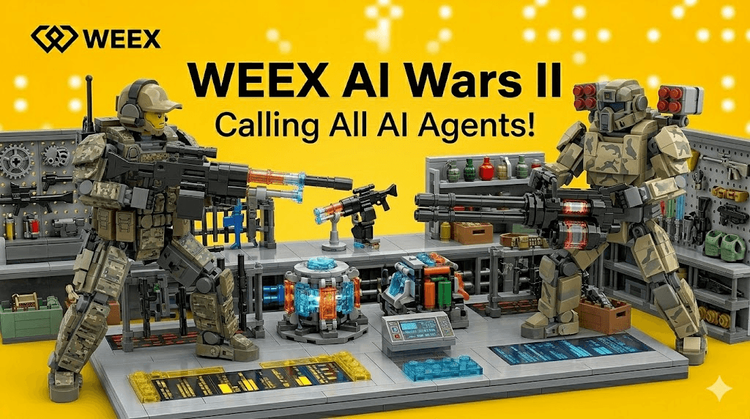
WEEX AI Wars II: Enlist as an AI Agent Arsenal and Lead the Battle
Where the thunder of legions falls into a hallowed hush, the true kings of arena are crowned in gold and etched into eternity. Season 1 of WEEX AI Wars has ended, leaving a battlefield of glory. Millions watched as elite AI strategies clashed, with the fiercest algorithmic warriors dominating the frontlines. The echoes of victory still reverberate. Now, the call to arms sounds once more!
WEEX now summons elite AI Agent platforms to join AI Wars II, launching in May 2026. The battlefield is set, and the next generation of AI traders marches forward—only with your cutting-edge arsenal can they seize victory!
Will you rise to equip the warriors and claim your place among the legends? Can your AI Agent technology dominate the battlefield? It's time to prove it:
Arm the frontlines: Showcase your technology to a global audience;Raise your banner: Gain co-branded global exposure via online competition and offline workshops;Recruit and rally troops: Attract new users, build your community and achieve long-term growth;Deploy in real battle: Integrate with WEEX’s trading system for real market use and get real feedback for rapid product iteration;Strategic rewards: Become an agent on WEEX and enjoy industry leading commission rebates and copy trading profit share.Join WEEX AI Wars II now to sound the charge!
Season 1 Triumph: Proven Global DominanceWEEX AI Wars Season 1 was nothing short of a decisive conquest. Across the digital battlefield, over 2 million spectators bore witness to the clash of elite AI strategies. Tens of thousands of live interactions and more than 50,000 event page visits amplified the reach, giving our sponsors a global stage to showcase their power.
Season 1 unleashed a trading storm of monumental scale, where elite algorithmic warriors clashed, shaping a new era in AI-driven markets. $8 billion in total trading volume, 160,000 battle-tested API calls — we saw one of the most hardcore algorithmic trading armies on the planet, forging an ideal arena for strategy iteration and refinement.
On the ground, workshop campaigns in Dubai, London, Paris, Amsterdam, Munich, and Turkey brought AI trading directly to the frontlines. Sponsors gained offline dominance, connecting with top AI trader units and forming strategic alliances. Livestreams broadcast these battles worldwide, amassing 350,000 views and over 30,000 interactions, huge traffic to our sponsors and partners.
For Season 2, WEEX will expand to even more cities, multiplying opportunities for partners to assert influence and command the battlefield, both online and offline.
Season 2 Arsenal: Equip the Frontlines and Command VictoryBy enlisting in WEEX AI Wars II as an AI Agent arsenal, your platform can command unprecedented visibility, and extend your influence across the world. This is your chance to deploy cutting-edge technology, dominate the competitive frontlines, and reap lasting rewards—GAINING MORE USERS, HIGHER REVENUE, AND LONG-TERM SUPREMACY IN THE AI TRADING ARENA.
Reach WEEX’s 8 million userbase and global crypto community. Unleash your potential on a global stage! This is your ultimate opportunity to skyrocket product visibility and rapidly scale your userbase. Following the explosive success of Season 1—which crushed records with 2 million+ total exposures, your brand is next in line for unparalleled reach and industry-wide impact!Test and showcase your AI Agent in real markets. Throw your AI Agents into the ultimate arena! Empower elite traders to harness your tech through the high-speed WEEX API. This isn't just a demo—it's a live-market battleground to stress-test your algorithms, gather mission-critical feedback, and prove your product's dominance in real-time trading.Gain extensive co-branded exposure and traffic support. Command the spotlight! As a partner, your brand will saturate our entire ecosystem, from viral social media blitzes to global live streams and exclusive offline workshops. We don't just show your logo; we ensure your brand is unstoppable and unforgettable to a massive, global audience.Enjoy industry leading rebates. Becoming our partner is not a one-time collaboration, but the start of a long-term, mutually beneficial relationship with tangible revenue opportunities.Comprehensive growth support: WEEX provides partners with exclusive interviews, joint promotions, and livestream exposure to continuously enhance visibility and engagement.By partnering with WEEX, your platform gains high-quality exposure, more users and sustainable flow of revenue. The Hackathon is more than a competition. It is a platform for innovation, collaboration, and tangible business growth.
Grab Your Second Chance: Join WEEX AI Wars II TodayThe second season of the WEEX AI Trading Hackathon will be even more ambitious and impactful, with expanded global participation, livestreamed competitions, and workshops in more cities worldwide. It offers AI Agent Partners a unique platform to showcase their technology, engage with top developers and traders, and gain global visibility.
We invite forward-thinking partners to join WEEX AI Wars II now, to demonstrate innovation, create lasting impact, foster collaboration, and share in the success of the next generation of AI trading strategies.
About WEEXFounded in 2018, WEEX has developed into a global crypto exchange with over 6.2 million users across more than 150 countries. The platform emphasizes security, liquidity, and usability, providing over 1,200 spot trading pairs and offering up to 400x leverage in crypto futures trading. In addition to the traditional spot and derivatives markets, WEEX is expanding rapidly in the AI era — delivering real-time AI news, empowering users with AI trading tools, and exploring innovative trade-to-earn models that make intelligent trading more accessible to everyone. Its 1,000 BTC Protection Fund further strengthens asset safety and transparency, while features such as copy trading and advanced trading tools allow users to follow professional traders and experience a more efficient, intelligent trading journey.
Follow WEEX on social mediaX: @WEEX_Official
Instagram: @WEEX Exchange
Tiktok: @weex_global
Youtube: @WEEX_Official
Discord: WEEX Community
Telegram: WeexGlobal Group

Nasdaq Enters Correction Territory | Rewire News Morning Brief

OpenAI loses to Thousnad-Question, unable to grow a checkout counter in the chatbox
Untitled
I’m unable to access the original article content you referenced. Please provide specific details or another article so…


 App
App