
 Buy Crypto
- Markets
 Futures
- Spot
- Copy Trade
- Earn
- More
Circle and Mastercard Announce Partnership, the Next Stage for the Crypto Industry Belongs to Payments

Original Title: Why Circle thinks the next phase of crypto will be about payments, not speculation
Original Author: @benfoxrubin, Mastercard
Translation: Peggy, BlockBeats
Editor's Note: As the scale of stablecoins continues to expand, blockchain is gradually transitioning from a speculative narrative to financial infrastructure. Recently, Mastercard launched the Crypto Partner Program, collaborating with multiple institutions including Circle to promote the practical application of digital assets, reflecting a reevaluation of the role of blockchain in the traditional payment system.
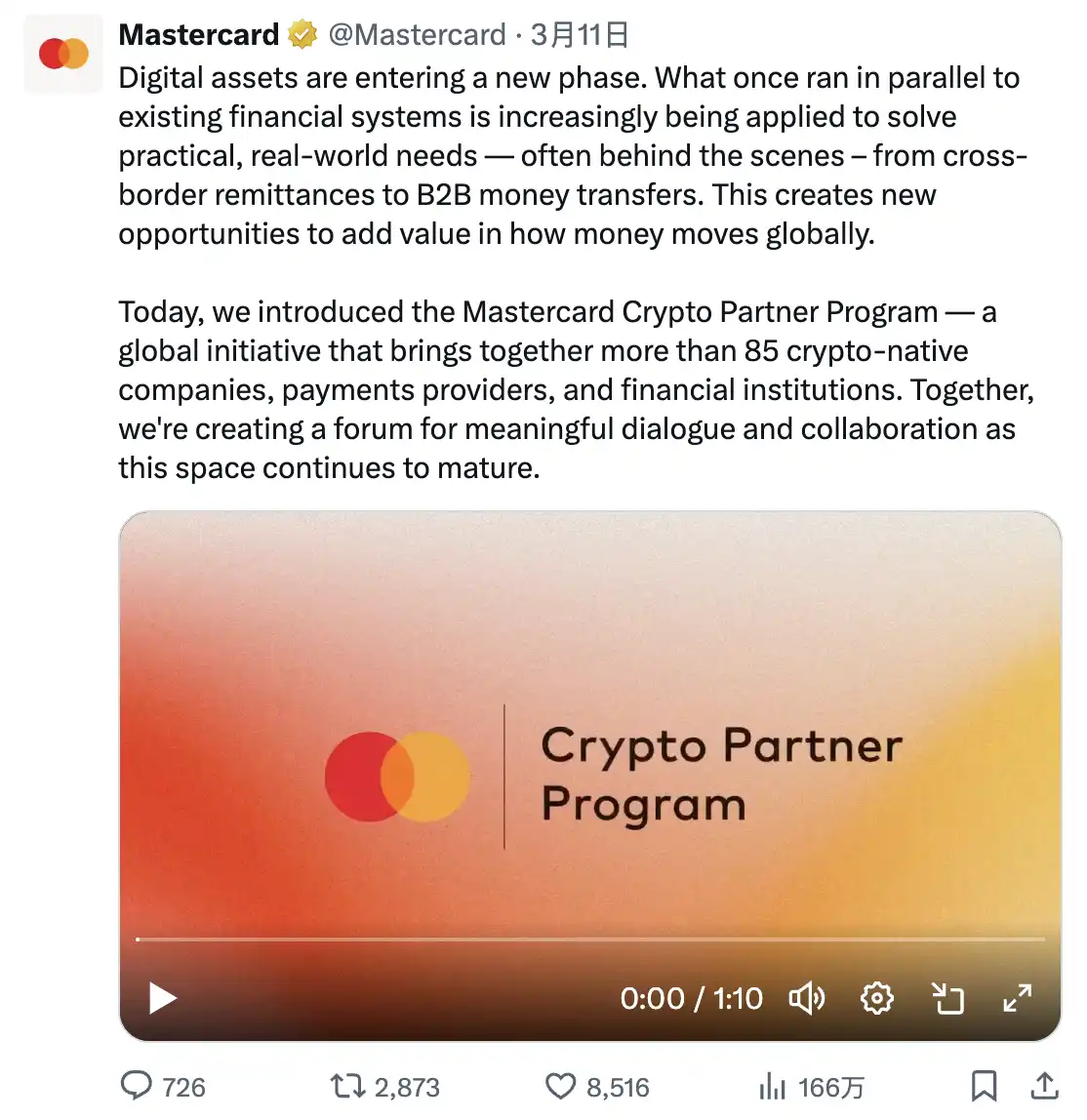
In the view of Circle's Chief Business Officer Kash Razzaghi, the widespread adoption of stablecoins will not manifest as a "crypto product" but rather as an invisible financial "pipeline" embedded in the payment system. This article discusses this trend, exploring the path of stablecoins from a trading tool to payment infrastructure, and why traditional financial institutions are actively participating in this transformation.
The following is the original text:
Circle's most well-known product is its stablecoin USDC. Currently, the circulation of USDC has exceeded $77 billion, making it one of the world's largest stablecoins. However, Circle's ambitions extend beyond this.
The company is dedicated to building a comprehensive infrastructure to drive the mass adoption of blockchain payments and financial services. Specifically, Circle achieves this by providing developer tools, launching the Circle Payments Network, and creating its proprietary blockchain Arc, enabling enterprises to access blockchain-based payment capabilities and financial functions, allowing almost any company to connect to the on-chain financial system.
Kash Razzaghi, Circle's Chief Business Officer (responsible for company partnerships and strategy), stated: "We are building a system called an internet finance platform, the goal of which is to truly drive and accelerate the trend of funds flowing on-chain."
In his view, migrating financial infrastructure onto the blockchain is expected to make fund transfers faster, lower cost, and more transparent. However, he also pointed out that reshaping the entire payment ecosystem is not something any single institution can accomplish independently, so Circle is collaborating with multiple companies including Mastercard to expand the global usage and acceptance of stablecoins. This week, Mastercard announced a new Crypto Partner Program, with Circle being one of its members.
Razzaghi added, "This requires the collective participation of the entire ecosystem. Mastercard's involvement has brought significant credibility to what this technology can develop into and what the future of this industry might look like."
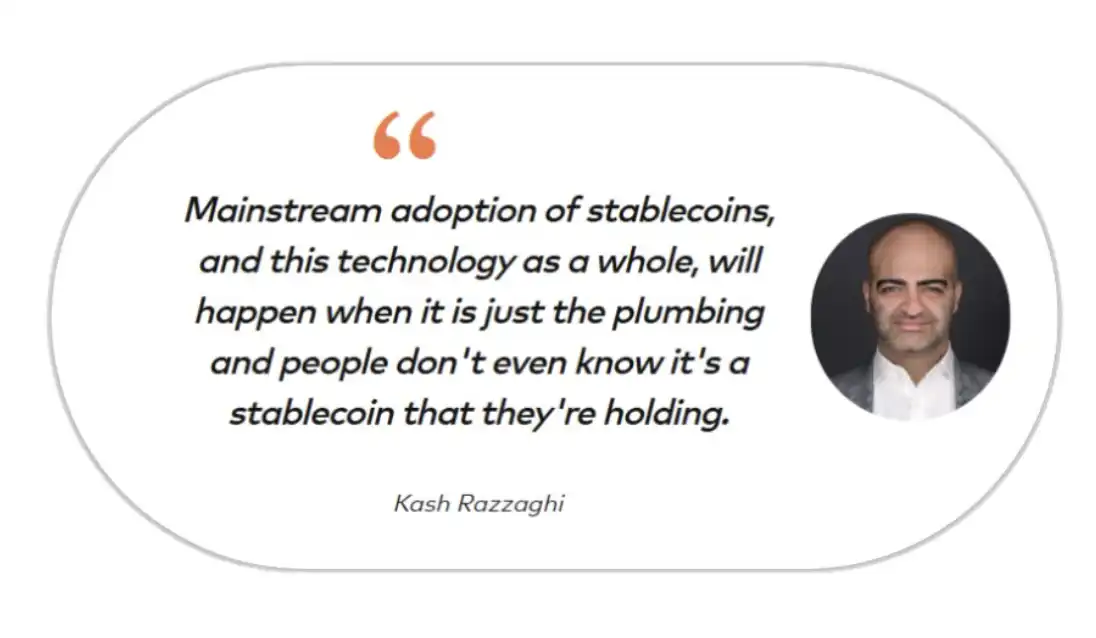
Kash Razzaghi (COO of Circle): When stablecoins and this entire technology achieve mainstream adoption, they will become like a 'water pipeline,' serving as the underlying infrastructure that people use without even realizing they are holding stablecoins.
Shortly after returning from the World Economic Forum (WEF) in January, Kash Razzaghi sat down for an interview with the Mastercard Newsroom. During Davos, he engaged with numerous individuals from the financial and fintech industries, aiming to attract more institutions to join the growing blockchain ecosystem.
The following Q&A content has been edited for length and clarity.
How do you view the current free-floating cryptocurrency market?
Market volatility is to be expected. In fact, speculation has been a primary driver throughout much of the history of the crypto industry.
But what truly excites us is that this industry is shifting from speculation to infrastructure. Of course, trading and speculation will not disappear entirely, and that is not the focus. The key is that the industry is undergoing an evolution: from a speculative market to gradually becoming financial infrastructure.
The crypto market has indeed seen boom times and more tumultuous periods. These cycles have always existed. If some choose to exit, new participants will surely enter—the market operates in this manner.
What was the focus of blockchain discussions at Davos this year?
The discussions at Davos this year almost entirely revolved around infrastructure.
People were discussing how blockchain technology and digital assets can solve real-world problems, or how they can enhance the ability for funds to flow, store value, and access the financial system.
This year's Davos felt very positive. As regulations gradually pave the way for institutional participation, the advantages of blockchain infrastructure are becoming more apparent. The focus of the discussions has shifted away from speculation and towards:
How to use this technology to securely, instantly, and at a low cost transfer tens of billions or even trillions of dollars in value
How to Upgrade a Financial System Infrastructure That Has Barely Changed in the Past 75 Years
The industry generally believes that this transformation will benefit the entire ecosystem. Whether it's financial infrastructure companies, financial market participants, or financial service providers, all can leverage this technological upgrade to enhance their businesses and deliver better services.
For a long time, the market narrative was: Will blockchain replace banks? Will it replace card networks? Will it replace the traditional financial system?
But that's not the reality.
What is truly exciting is that today's discussion has shifted to how to upgrade and collaborate on top of the existing financial system. Banks, financial institutions, traditional exchanges, card networks are all embracing this technology because everyone anticipates that the cost of fund transfers will approach zero, and the speed of fund transfers will increase significantly.
If the financial system is indeed going to upgrade, what does this mean for Mastercard? How can both parties cooperate and achieve mutual benefits?
Fundamentally, what does Mastercard provide?
Trust.
You have built a global trust network. I have a Mastercard myself. When I swipe my card, the reason merchants feel confident is that they know the funds will definitely arrive—because Mastercard guarantees it in the background.
In my view, the importance of trust will never disappear.
Mastercard's role in this ecosystem is not only to continue maintaining this trust network but also to: provide more advanced technology for transactions, make payments simpler, make financial services more inclusive, reduce intermediaries, lower friction costs, and even over time, further reduce transaction costs.
As for Circle, the benefit is: the mainstream adoption of stablecoins and digital assets.
We believe that future fund transfers will increasingly occur on-chain. We think that, in the long term, on-chain fund transfers will be more efficient.
Of course, to achieve this, many things still need to be done, such as: infrastructure development, regulatory frameworks, compliance systems.
We are not fully there yet. But when Mastercard truly starts building on-chain products and offering on-chain services to its clients, it will greatly accelerate the mainstream adoption of stablecoins.
What are the current primary use cases for stablecoins?
Currently, there are three main use cases.
Trading and Investment
Currently, the biggest use case for stablecoins is still cryptocurrency asset trading and investment.
If you invest in digital assets like btc-42">Bitcoin, Ethereum, using USDC as a medium of exchange is very convenient. You can easily switch between different assets and keep your funds in a stable-value asset when needed.
Payments (Especially Cross-Border Payments)
The second scenario is payments, especially cross-border payments. If you need to transfer money from one country to another, whether it's institutional fund transfers or personal remittances, stablecoins are a very efficient way to do so.
Transferring funds on the blockchain can: reduce intermediaries, lower costs, and shorten settlement times from days or even weeks to seconds or minutes.
We have seen almost every industry undergoing large-scale fund transfers. Even a large institution, if it needs to transfer funds from Singapore to New York, can do so using stablecoins, unrestricted by bank hours.
In the future, stablecoin payments will not only be used for cross-border scenarios but will expand to almost all payment areas.
Store of Value
The third scenario is a store of value.
This need mainly arises in countries with significant currency devaluation, such as Iran (my birthplace), Venezuela, Argentina.
In these high inflation countries, residents often no longer trust the local currency and prefer to hold USD-denominated assets as a hedge. Stablecoins provide a digitalized dollar-denominated store of value.
We believe the demand for payments and a store of value will drive the stablecoin market far beyond its current levels.
When do you think stablecoins will achieve mainstream adoption?
There is a view that when stablecoins and blockchain technology truly achieve mainstream adoption, they will become foundational infrastructure. In other words, people are simply holding dollars, sending dollars, without realizing they are actually holding stablecoins.
We often use an analogy: When you visit a website, there is HTTP at the beginning of the URL. But most people do not understand HTTP technology; they simply use the internet.
A similar situation could arise in the future with stablecoins, where on-chain finance becomes infrastructure, and users are hardly aware of its existence.
Your professional experience spans multiple industries, how does this help you in your current role?
There is actually no such thing as a "standard career path." Career development requires both luck and timing, as well as continuously accumulated experience.
If you look back at my career, you will find that it is quite diverse: the fashion industry, a sports social platform, a video distribution platform, the crypto industry
However, the common threads behind these experiences are: entrepreneurial spirit, go-to-market expertise, business development, sales acumen
I have always enjoyed building things from scratch and have wanted to be involved in projects that can impact a large number of people.
When I joined Circle six years ago, I wasn't particularly "crypto-native" nor could I be called a crypto expert. But once you truly understand the potential of this technology, you will be inspired by it and gradually develop a sense of mission.
You may also like

From x402 to MPP: Cloudflare's crucial vote, will it go to Coinbase or Stripe?

BlackRock CEO issues annual open letter: The wave of tokenization has arrived, and we will lead this trend

When Backpack backstabs the community

When gold is no longer a safe haven, and Bitcoin continues to panic

Trump, the World's Largest Oil Trader

If the US and Iran have not reached an agreement in 5 days, what other cards does Trump have?

Tether Whale Dumps £12 Million, Backing Crypto’s ‘British Trump’
Ethereum Foundation Post: Rethinking the Division of Work Between L1 and L2 to Build the Ultimate Ethereum Ecosystem

Two Major Prediction Market Platforms Unite Rarely, What Is the Story Behind This New Fund?
Dragonfly Partners: Most agents will not engage in autonomous trading, how can crypto payments prevail?

US AI Startup Goes All In on Chinese Mega-Model | Rewire News Morning Brief

Trump Lies Again: A "Five-Day Pause" Psyop, How Wall Street, Bitcoin, and Polymarket Insiders Synced Uposciogen

When a Token Becomes Labor, People Become the Interface

Ceasefire News Leaked Ahead of Time? Large Polymarket Bets on Outcome Before Trump's Tweet
BlackRock CEO's Annual Shareholder Letter: How is Wall Street Using AI to Keep Profiting from National Pension Funds?

Sun Valley Releases 2025 Financial Report: Bitcoin Mining Revenue Reaches $670 Million, Accelerating Transformation to AI Infrastructure Platform
On March 16, 2026, in Dallas, Texas, USA, CanGu Company (New York Stock Exchange code: CANG, hereinafter referred to as "CanGu" or the "Company") today announced its unaudited financial performance for the fourth quarter and full year ended December 31, 2025. As a btc-42">bitcoin mining enterprise relying on a globally operated layout and dedicated to building an integrated energy and AI computing power platform, CanGu is actively advancing its business transformation and infrastructure development.
• Financial Performance:
Total revenue for the full year 2025 was $688.1 million, with $179.5 million in the fourth quarter.
Bitcoin mining business revenue for the full year was $675.5 million, with $172.4 million in the fourth quarter.
Full-year adjusted EBITDA was $24.5 million, while the fourth quarter was -$156.3 million.
• Mining Operations and Costs:
A total of 6,594.6 bitcoins were mined throughout the year, averaging 18.07 bitcoins per day; of which 1,718.3 bitcoins were mined in the fourth quarter, averaging 18.68 bitcoins per day.
The average mining cost for the full year (excluding miner depreciation) was $79,707 per bitcoin, and for the fourth quarter, it was $84,552;
The all-in sustaining costs were $97,272 and $106,251 per bitcoin, respectively.
As of the end of December 2025, the company has cumulatively produced 7,528.4 bitcoins since entering the bitcoin mining business.
• Strategic Progress:
The company has completed the termination of the American Depositary Receipt (ADR) program and transitioned to a direct listing on the NYSE to enhance information transparency and align with its strategic direction, with a long-term goal of expanding its investor base.
CEO Paul Yu stated: "2025 marked the company's first full year as a bitcoin mining enterprise, characterized by rapid execution and structural reshaping. We completed a comprehensive adjustment of our asset system and established a globally distributed mining network. Additionally, the company introduced a new management team, further strengthening our capabilities and competitive advantage in the digital asset and energy infrastructure space. The completion of the NYSE direct listing and USD pricing also signifies our transformation into a global AI infrastructure company."
"As we enter 2026, the company will continue to optimize its balance sheet structure and enhance operational efficiency and cost resilience through adjustments to the miner portfolio. At the same time, we are advancing our strategic transformation into an AI infrastructure provider. Leveraging EcoHash, we will utilize our capabilities in scalable computing power and energy networks to provide cost-effective AI inference solutions. The relevant site transformations and product development are progressing simultaneously, and the company is well-positioned to sustain its execution in the new phase."
The company's Chief Financial Officer, Michael Zhang, stated: "By 2025, the company is expected to achieve significant revenue growth through its scaled mining operations. Despite recording a net loss of $452.8 million from ongoing operations, mainly due to one-time transformation costs and market-driven fair value adjustments, the company, from a financial perspective, will reduce its leverage, optimize its Bitcoin reserve strategy and liquidity management, introduce new capital to strengthen its financial position, and seize investment opportunities in high-potential areas such as AI infrastructure while navigating market volatility."
The total revenue for the fourth quarter was $1.795 billion. Of this, the Bitcoin mining business contributed $1.724 billion in revenue, generating 1,718.3 Bitcoins during the quarter. Revenue from the international automobile trading business was $4.8 million.
The total operating costs and expenses for the fourth quarter amounted to $4.56 billion, primarily attributed to expenses related to the Bitcoin mining business, as well as impairment of mining machines and fair value losses on Bitcoin collateral receivables.
This includes:
· Cost of Revenue (excluding depreciation): $1.553 billion
· Cost of Revenue (depreciation): $38.1 million
· Operating Expenses: $9.9 million (including related-party expenses of $1.1 million)
· Mining Machine Impairment Loss: $81.4 million
· Fair Value Loss on Bitcoin Collateral Receivables: $171.4 million
The operating loss for the fourth quarter was $276.6 million, a significant increase from a loss of $0.7 million in the same period of 2024, primarily due to the downward trend in Bitcoin prices.
The net loss from ongoing operations was $285 million, compared to a net profit of $2.4 million in the same period last year.
The adjusted EBITDA was -$156.3 million, compared to $2.4 million in the same period last year.
The total revenue for the full year was $6.881 billion. Of this, the revenue from the Bitcoin mining business was $6.755 billion, with a total output of 6,594.6 Bitcoins for the year. Revenue from the international automobile trading business was $9.8 million.
The total annual operating costs and expenses amount to $1.1 billion.
Specifically, they include:
· Revenue Cost (excluding depreciation): $543.3 million
· Revenue Cost (depreciation): $116.6 million
· Operating Expenses: $28.9 million (including related-party expenses of $1.1 million)
· Miner Impairment Loss: $338.3 million
· Bitcoin Collateral Receivable Fair Value Change Loss: $96.5 million
The full-year operating loss is $437.1 million. The continuing operations net loss is $452.8 million, while in 2024, there was a net profit of $4.8 million.
The 2025 non-GAAP adjusted net profit is $24.5 million (compared to $5.7 million in 2024). This measure does not include share-based compensation expenses; refer to "Use of Non-GAAP Financial Measures" for details.
As of December 31, 2025, the company's key assets and liabilities are as follows:
· Cash and Cash Equivalents: $41.2 million
· Bitcoin Collateral Receivable (Non-current, related party): $663.0 million
· Miner Net Value: $248.7 million
· Long-Term Debt (related party): $557.6 million
In February 2026, the company sold 4,451 bitcoins and repaid a portion of related-party long-term debt to reduce financial leverage and optimize the asset-liability structure.
As per the stock repurchase plan disclosed on March 13, 2025, as of December 31, 2025, the company had repurchased a total of 890,155 shares of Class A common stock for approximately $1.2 million.

The US AI Startup Is Loving China's Open Source Model



 App
App