
 Buy Crypto
- Markets
 Futures
- Spot
- Copy Trade
- Earn
- More
Bitcoin Network Hash Rate Hits Record High, Drops 15% - Have Miners Been Sniped by AI?

Original Article Title: "Bitcoin Network Hash Rate Drops From Peak by 15%, Have Miners Been Poached by AI?"
Original Article Author: ChandlerZ, Foresight News
The Bitcoin hash rate has grown approximately 10 times since 2020, but has seen a more pronounced decline in recent months.
Data shows that the Bitcoin network's hash rate has dropped by around 15% from its October peak, with miners surrendering for nearly 60 days. The network's average hash rate has decreased from around 1.1 ZH/s in October to around 977 EH/s, indicating that miners are shutting down machines or surrendering as profitability declines.
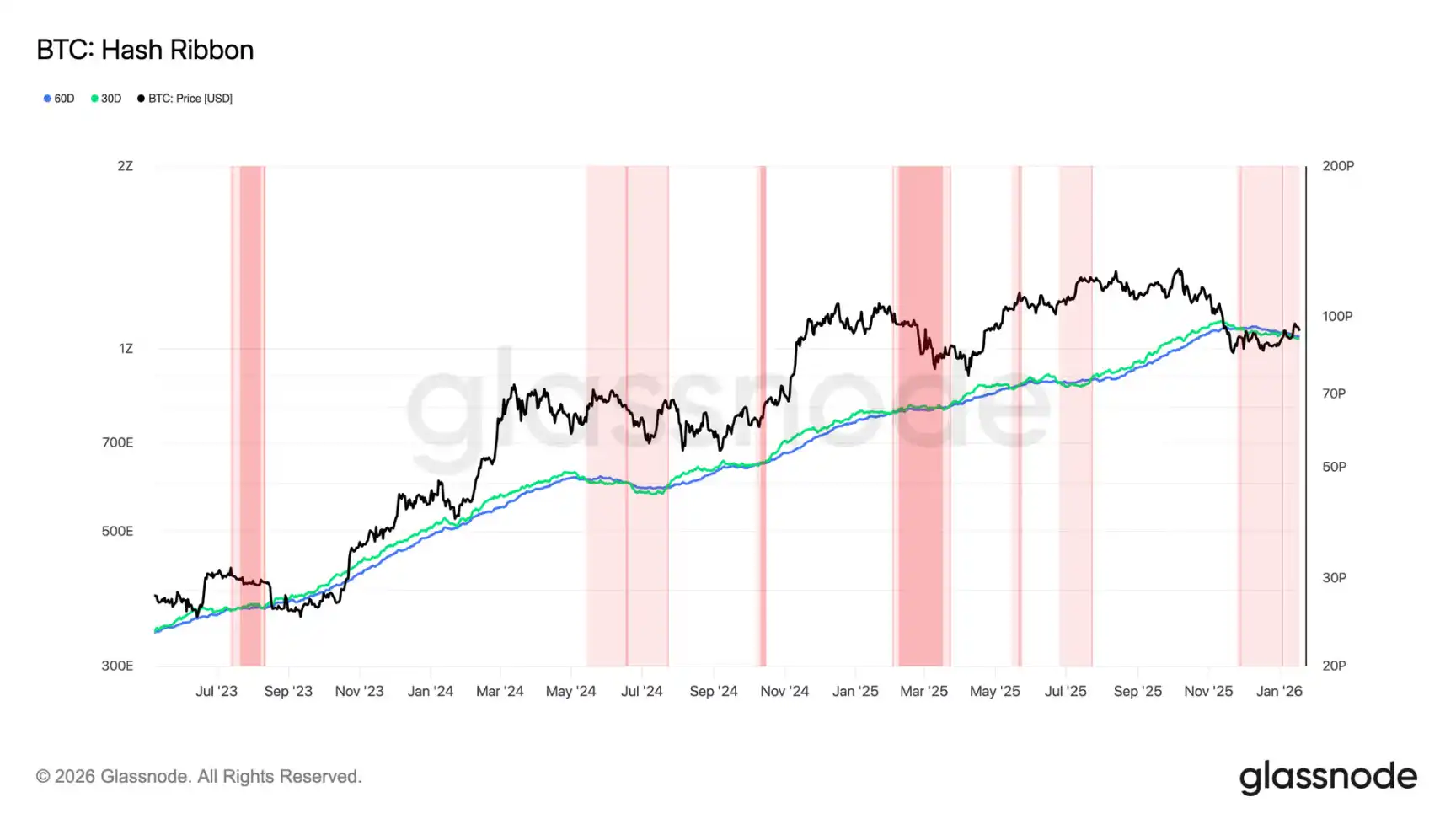
Furthermore, Glassnode's Hash Ribbon indicator reversed on November 29, reflecting miners' surrender by tracking short-term and long-term hash rate trends. Currently, short-term supply pressure in the Bitcoin market may increase further, and the Bitcoin mining difficulty is expected to see its seventh downward adjustment out of the past eight on January 22, dropping to around 139 T.
Mining Profitability Sees Five-Month Continuous Decline
JPMorgan Chase stated that the Bitcoin network's hash rate decreased by about 3% month-over-month to 1045 EH/s in December 2025, easing miner competition, but mining profitability continues to decline.
However, data shows that in December 2025, miners' average daily block reward income per EH/s was $38,700, a 7% decrease from November and a 32% year-over-year decrease, hitting a historical low.
A report analysis by VanEck suggests that the Bitcoin mining industry is facing significant pressure. On one hand, the periodic halving of block rewards causes miners' income to decrease "step-wise"; on the other hand, since 2020, the network's hash rate has expanded at a compound growth rate of about 62%, forcing miners to continuously invest in CAPEX to increase hash rate to avoid obsolescence. If the coin price fails to hedge against the decline in subsidies and the unit cost increase brought by hash rate growth, miner profits will be systematically compressed.
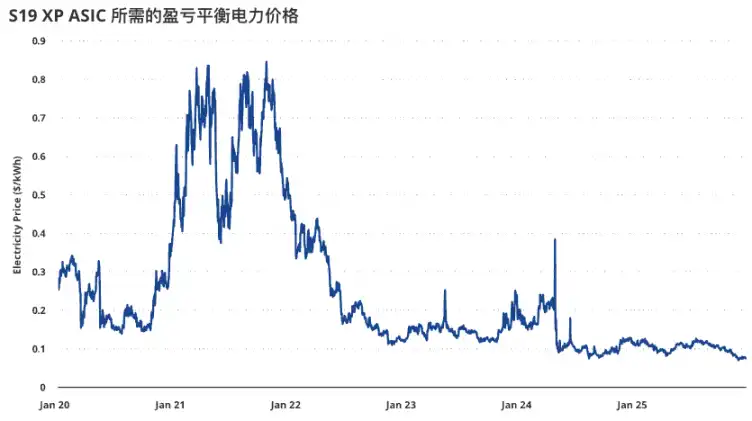
The deterioration of miner profitability can be seen intuitively from the electricity price breakeven point. Taking the 2022 generation mining machine S19 XP as an example, its tolerable breakeven electricity price has decreased from around $0.12 per kWh in December 2024 to around $0.077 per kWh in December 2025. This means that against the backdrop of a recent weakening BTC price, mining marginal economics have significantly worsened, further increasing the industry's reliance on low electricity price resources, economies of scale, and operational efficiency.
Despite the approximately 10x increase in total network hash rate since 2020, the past 30 days have seen a 4% decline in network hash rate based on a 30-day moving average, marking the largest drop since April 2024. Simultaneously, supply-side disruptions have also impacted the hash rate, such as mining facilities in the Xinjiang region shutting down approximately 1.3GW of capacity under regulatory review, with an estimated 400,000 miners turned off.
Mining Farms Actively Transitioning to AI Data Centers
A report from Guojin Securities indicates that by the third quarter of 2025, the depreciation-adjusted mining cost for publicly listed U.S. companies has risen to $112,000, exceeding the current Bitcoin price. Cryptocurrency mining companies possess powered and high-bandwidth hash rate infrastructure near major urban centers, with electricity costs generally ranging from 3 to 5 cents per kWh, making them naturally suited for AI cloud service operations. With the increasing demand for AI computing power, the transition of cryptocurrency mining farms to AI data centers is an inevitable choice.
The 14 major publicly traded mining farm companies are expected to reach a power capacity of 15.6GW by 2027, with the primary transformed business models being cloud computing leasing and IDC power leasing.
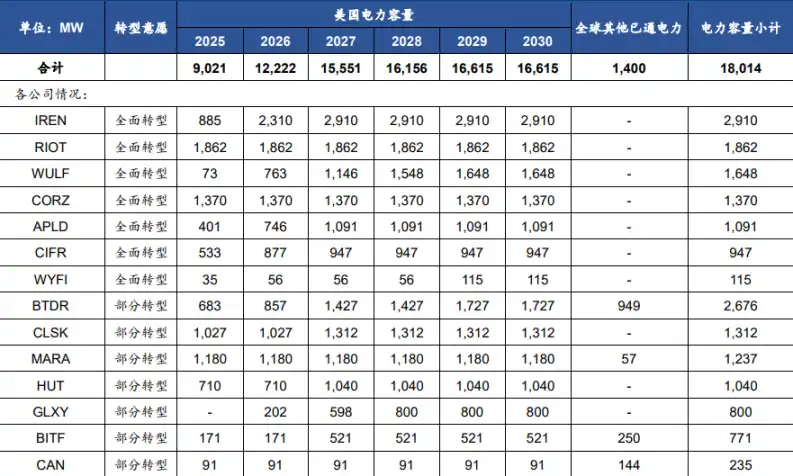
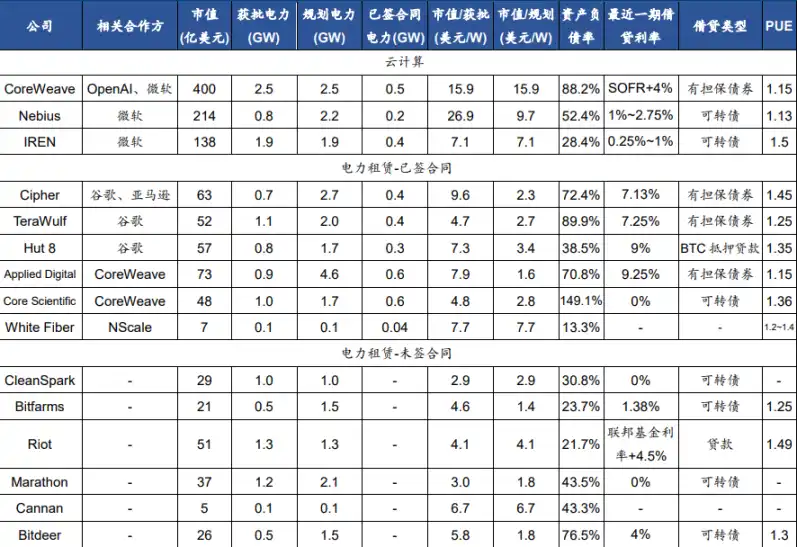
Cryptocurrency mining farms transitioning to AI data centers mainly have two business models.
One is similar to CoreWeave and Nebius, purchasing chips for cloud computing leasing. Currently, IREN adopts this business model. IREN has an electricity gross capacity of 2.91GW, corresponding to approximately 1.9GW of core capacity, with a market value per watt lower than CoreWeave and Nebius. It has already partnered with Microsoft for a 200MW core capacity.
The second model is similar to IDC power leasing, only leasing the rights to use data center buildings and power capacity, with tenants paying for servers and electricity. Currently, most cryptocurrency mining farms use this hosting model. Some companies have signed leasing contracts with Google, Amazon, CoreWeave, and other firms, while the majority are still seeking partners due to their late transition.
VanEck: Hash Rate Decline Could Actually Be a Positive
However, the VanEck report also suggests that a hash rate decline could actually be a positive factor. By comparing the 30-day and expected 90-day returns since 2014 based on Bitcoin's hash rate changes, when the Bitcoin hash rate drops, there is a higher likelihood of positive expected returns compared to when the hash rate rises. Moreover, the average expected return over 180 days is approximately 30 basis points higher when the hash rate declines versus when it increases.
When hash rate compression persists for a long time, forward-looking profitability often occurs more frequently and to a greater extent. Since 2014, out of the 346 days with negative 90-day hash rate growth, the probability of positive 180-day Bitcoin forward returns is 77%, with an average return of +72%. In addition, the probability of positive 180-day Bitcoin forward returns is around 61%, with an average return of +48%.
Therefore, buying BTC when the 90-day hash rate growth is negative has historically increased the expected return for 180 days by 2400 basis points.
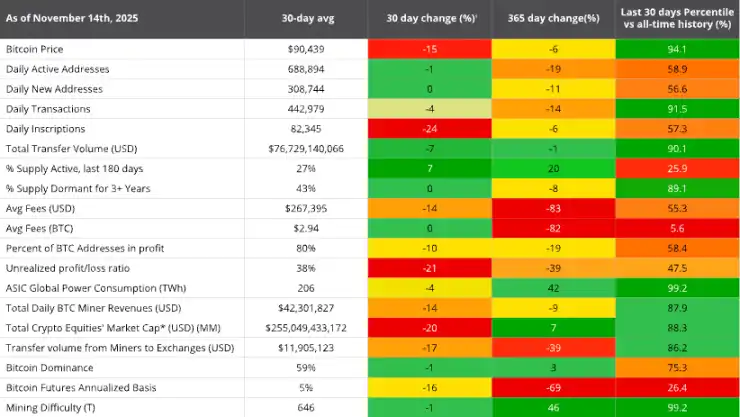
Even in an economically weaker phase, many entities choose to continue mining. Short-term profit pressures and hash rate fluctuations are more likely to lead to industry consolidation and centralization, accelerating the cleansing of the industry, which does not necessarily imply the long-term decline of the mining industry.
You may also like

Cyber Taoist Fortune Teller: Fake Taoist, AI Fortune Telling, and Northeastern Metaphysics History

Bloomberg: Stablecoin Payments Emerge as Crypto VC's Newest Favorite Thing
BeatSwap is evolving towards a full-stack Web3 infrastructure, covering the entire lifecycle of IP rights.
BeatSwap, a global Web3 Intellectual Property (IP) infrastructure project, is attempting to overcome the current fragmentation limitations of the Web3 ecosystem, building a full-stack system that covers the entire lifecycle of IP rights.
Currently, most Web3 projects are still in the stage of functional fragmentation, often focusing only on a single aspect, such as IP asset tokenization, transaction functionality, or a simple incentive model. This structural dispersion has become a key bottleneck hindering the industry's scale application.
BeatSwap's approach is more integrated, integrating multiple core modules into the same system, including:
· IP authentication and on-chain registration
· Authorization-based revenue sharing mechanism
· User-engagement-driven incentive system
· Transaction and liquidity infrastructure
Through the above integration, the platform builds an end-to-end closed-loop path, allowing IP rights to complete a full cycle of "creation, use, and monetization" within the same ecosystem.
BeatSwap is not limited to existing crypto users but is attempting to take the global music industry as a starting point, actively creating new market demand. Its core strategies include:
Exploring and incubating music creators (Artist discovery)
Building a fan community
Igniting IP-centric content consumption demand
The current global music industry is valued at around $260 billion, with over 2 billion digital music users. This means that the potential market corresponding to the tokenization and financialization of IP far exceeds the traditional crypto user base.
In this context, BeatSwap positions itself at the intersection of "real-world content demand" and "on-chain infrastructure," attempting to bridge the structural gap between content production and financial flow.
BeatSwap's upcoming core product "Space" is scheduled to launch in the second quarter of 2026. This product is defined as the SocialFi layer in the ecosystem, aiming to directly connect creators with users and achieve deep integration with other platform modules.
Key designs include:
A fan-centric interactive mechanism
Exposure and distribution logic based on $BTX staking
User paths connected to DeFi and liquidity structures
Thus, a complete user behavior loop is formed within the platform: Discovery → Participation → Consumption → Rewards → Trading
$BTX is designed to be a core utility asset within the ecosystem, rather than just a simple incentive token, with its value directly tied to platform activity and IP use cases.
Main features include:
· Yield distribution based on on-chain authorized actions
· Value reflection based on IP usage and user engagement dynamics
· Support for staking and DeFi participation mechanisms
· Value growth driven by ecosystem expansion
With the increased frequency of IP use, the utility and value support of $BTX will enhance simultaneously, helping alleviate the "disconnect between value and utility" issue present in traditional Web3 token models to some extent.
Currently, $BTX has been listed on several mainstream exchanges, including:
Binance Alpha
Gate
MEXC
OKX Boost
As the launch of "Space" approaches, BeatSwap is actively pursuing more exchange listings to further enhance liquidity and global accessibility, laying a foundation for future market expansion.
BeatSwap's goal is no longer limited to the traditional Web3 narrative but aims to target over 2 billion digital music users and a trillion KRW-scale content market.
By integrating content creators, users, capital, and liquidity into a blockchain framework centered around IP rights, BeatSwap is striving to build a next-generation infrastructure focused on "IP tokenization."
BeatSwap integrates IP authentication, authorization distribution, incentive mechanism, transaction system, and market construction to establish a unified structure that bridges the full lifecycle path of IP rights.
With the launch of the Q2 2026 "Space," the project is expected to become a key infrastructure connecting content and finance in the IP-RWA (Real World Assets) track.

Mag 7 Evaporates $2 Trillion | Rewire News Morning Edition

Losing $19K per Coin Mined, Bitcoin Mining Firms Collective AI Defection

Morning Report | Tom Lee predicts that the cryptocurrency winter will end in April; xStocks introduces a new on-chain private equity fund; Sui mainnet upgraded to V1.68.1

Polymarket rules have changed, how should airdrop participants respond?

Crypto ETF Weekly | Last week, the net outflow of Bitcoin spot ETFs in the U.S. was $296 million; the net outflow of Ethereum spot ETFs in the U.S. was $206 million

This Week's Key News Preview | The U.S. Releases March Non-Farm Payroll Data; Polymarket Expands Fee Structure

Slow Down, That's the Answer to the Age of the Agent

From Cash to Cryptocurrency: Moving Towards a Unified Regulatory Path for Illegal Payments
Who will own the most Bitcoin in 2026

A private feud lasting 10 years, if not for OpenAI's "hypocrisy," would not have led to the world's strongest AI company, Anthropic

"Crypto Tsar" steps down: 130 days of political performance come to an end, how much of Trump's crypto promise remains?

From Utopian Narratives to Financial Infrastructure: The "Disenchantment" and Shift of Crypto VC
A decade-long personal feud, if not for OpenAI's "hypocrisy," there would be no globally leading AI company Anthropic

a16z: The True Meaning of Strong Chain Quality, Block Space Should Not Be Monopolized
a16z: The True Meaning of Strong Chain Quality, Block Space Should Not Be Monopolized
Cyber Taoist Fortune Teller: Fake Taoist, AI Fortune Telling, and Northeastern Metaphysics History
Bloomberg: Stablecoin Payments Emerge as Crypto VC's Newest Favorite Thing
BeatSwap is evolving towards a full-stack Web3 infrastructure, covering the entire lifecycle of IP rights.
BeatSwap, a global Web3 Intellectual Property (IP) infrastructure project, is attempting to overcome the current fragmentation limitations of the Web3 ecosystem, building a full-stack system that covers the entire lifecycle of IP rights.
Currently, most Web3 projects are still in the stage of functional fragmentation, often focusing only on a single aspect, such as IP asset tokenization, transaction functionality, or a simple incentive model. This structural dispersion has become a key bottleneck hindering the industry's scale application.
BeatSwap's approach is more integrated, integrating multiple core modules into the same system, including:
· IP authentication and on-chain registration
· Authorization-based revenue sharing mechanism
· User-engagement-driven incentive system
· Transaction and liquidity infrastructure
Through the above integration, the platform builds an end-to-end closed-loop path, allowing IP rights to complete a full cycle of "creation, use, and monetization" within the same ecosystem.
BeatSwap is not limited to existing crypto users but is attempting to take the global music industry as a starting point, actively creating new market demand. Its core strategies include:
Exploring and incubating music creators (Artist discovery)
Building a fan community
Igniting IP-centric content consumption demand
The current global music industry is valued at around $260 billion, with over 2 billion digital music users. This means that the potential market corresponding to the tokenization and financialization of IP far exceeds the traditional crypto user base.
In this context, BeatSwap positions itself at the intersection of "real-world content demand" and "on-chain infrastructure," attempting to bridge the structural gap between content production and financial flow.
BeatSwap's upcoming core product "Space" is scheduled to launch in the second quarter of 2026. This product is defined as the SocialFi layer in the ecosystem, aiming to directly connect creators with users and achieve deep integration with other platform modules.
Key designs include:
A fan-centric interactive mechanism
Exposure and distribution logic based on $BTX staking
User paths connected to DeFi and liquidity structures
Thus, a complete user behavior loop is formed within the platform: Discovery → Participation → Consumption → Rewards → Trading
$BTX is designed to be a core utility asset within the ecosystem, rather than just a simple incentive token, with its value directly tied to platform activity and IP use cases.
Main features include:
· Yield distribution based on on-chain authorized actions
· Value reflection based on IP usage and user engagement dynamics
· Support for staking and DeFi participation mechanisms
· Value growth driven by ecosystem expansion
With the increased frequency of IP use, the utility and value support of $BTX will enhance simultaneously, helping alleviate the "disconnect between value and utility" issue present in traditional Web3 token models to some extent.
Currently, $BTX has been listed on several mainstream exchanges, including:
Binance Alpha
Gate
MEXC
OKX Boost
As the launch of "Space" approaches, BeatSwap is actively pursuing more exchange listings to further enhance liquidity and global accessibility, laying a foundation for future market expansion.
BeatSwap's goal is no longer limited to the traditional Web3 narrative but aims to target over 2 billion digital music users and a trillion KRW-scale content market.
By integrating content creators, users, capital, and liquidity into a blockchain framework centered around IP rights, BeatSwap is striving to build a next-generation infrastructure focused on "IP tokenization."
BeatSwap integrates IP authentication, authorization distribution, incentive mechanism, transaction system, and market construction to establish a unified structure that bridges the full lifecycle path of IP rights.
With the launch of the Q2 2026 "Space," the project is expected to become a key infrastructure connecting content and finance in the IP-RWA (Real World Assets) track.


 App
App