
 Buy Crypto
- Markets
 Futures
- Spot
- Copy Trade
- Earn
- More
Bitcoin is the "Manhattan real estate" of the digital age; owning just one gives you elite status

Original Title: "The Weighing of Ten Coins"
Original Author: Yishi, Founder of OneKey Wallet
Author's Note: This article was published on November 4, 2023, when the price of BTC was $34,522. The text has not been modified in any way. @mablejiang suggested that I repost this article, so I did. I am not enrolled in the X Creator Program, nor will I receive any benefits from the readership of this article. I do not have a community, nor do I provide any investment advice, nor do I have any stance or judgment on future market trends. If you can derive any value from these words, I will sincerely rejoice for you. The following is the main text:
"Dark clouds gather, wind fills the tower." 1284 days ago, I released a video discussing the Bitcoin halving, predicting that the price would rise to $55,000 after the halving.
That day was April 17, 2020, with Bitcoin closing at $7,125.
Several years have passed, and the halving is about to occur again. More precisely, it will take place at some point in April or May 2024.
This is the fourth halving in Bitcoin's history, and it is also the last opportunity for ordinary investors, like a slender gap in the ancient city wall as the sun sets. When this door closes, the final opportunity to board will also disappear.
Xiao Feng's greatest regret was not being able to save Ah Zhu, "I am a Khitan, what grand ambitions can I have?"
Once the gold vial falls into the well, there is no returning arrow.
My greatest regret is that after nearly a decade of dedicated entrepreneurship, I haven't accumulated enough coins, yet the game is about to end; this is also a kind of fate.
Defining Scarcity
A scholar named Saifuddin Amos from the Arab world wrote a book called "The Bitcoin Standard" in 18XX. In this book, he talked about a "stock-to-flow" model, which is simply the relationship between inventory and annual output.
When we talk about inventory, we are counting the total quantity of a commodity. Annual output is the total amount of this commodity produced in a year. When these two are divided, a ratio called SF is obtained.
In the chart, you can see that gold's SF is 62, and silver's is 22. What does this mean? It means that it would take 62 years to produce as much gold as there is now, 22 years for silver, and 0.4 years for platinum. This all indicates one thing: they are exceptionally scarce.

We began to wonder if these things became money because of scarcity. In contrast, platinum and palladium, with SF values equal to or less than 1, are not as scarce.
Indeed, gold does store value better than other metals on the periodic table.
The goods we use in our daily lives, such as food, smartphones, computers, and cars, all have SF values much less than 1, meaning they have never been scarce. Why? It's because as long as there is demand for a good, you can produce more of it. If someone wants to hoard, prices will rise, prompting more companies to produce, inevitably causing prices to fall.
This is just common sense of supply and demand equilibrium.
So we can easily conclude that the higher the SF of a good, the better it preserves its value, and the less diluted it will be.
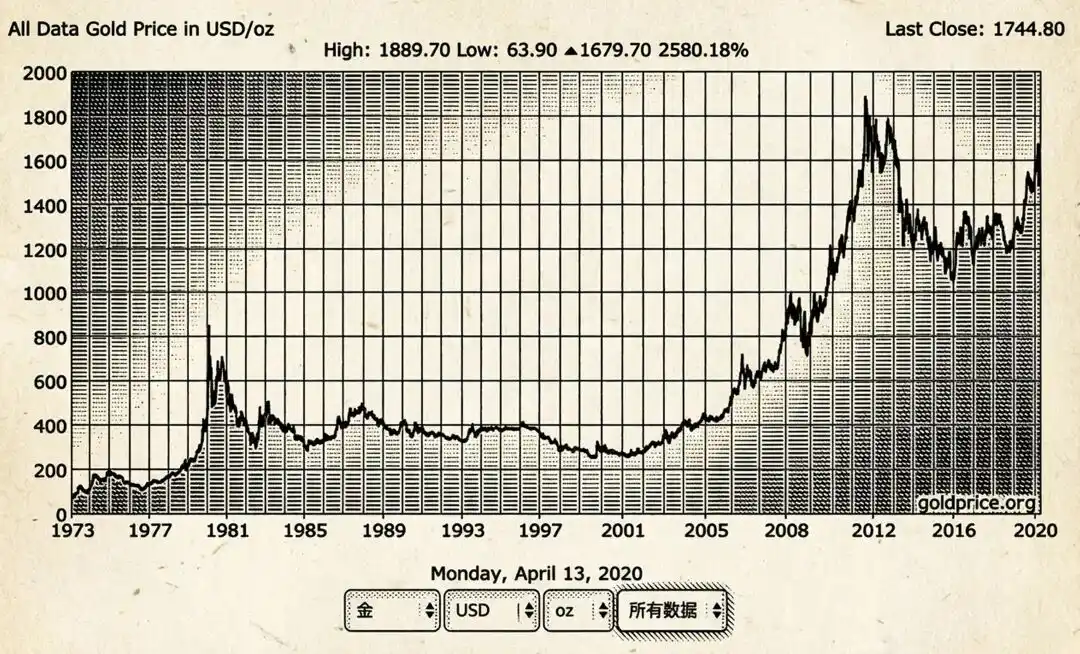
Look at gold. In 1972, it was $46 an ounce. In 2020, it hit a new high at $1744 an ounce, a total increase of 37.9 times. Why don't we just produce more gold to meet the demand? The reason is that the amount of gold mined is limited by mining technology and costs. If you spend more on something than you earn from it, you definitely won't do it.
So, what is Bitcoin's SF value? There are already 19.5 million bitcoins mined in the world. However, a research report stated that out of these 19.5 million bitcoins, over 1.6 million have been permanently lost.
Therefore, the actual usable Bitcoin is only about 17.9 million. Based on Bitcoin's current annual output, its SF is approximately 54, similar to gold.
In a few months, Bitcoin's SF will increase to 108, with an annual inflation of only about 0.9%. This means that Bitcoin has become the scarcest asset in human history after gold.
The halving is the fundamental reason that changes Bitcoin's supply relationship, nothing else. And this supply relationship determines the price.
When some people hear about a Bitcoin ETF, they get excited, as if once approved, the price will skyrocket, as if it's a big deal.
I suggest you not to pay attention to media headline hype, but to understand the essence.
Whether the BlackRock Bitcoin ETF is approved or not is not important, nor is the timing of its approval. What is important is the anticipation of a "Bitcoin ETF approval" as a catalyst to boost market confidence, gradually building momentum that will eventually drive the price above $45K.
You may think we are still in a bear market, but in reality, the bear market has quietly ended without you realizing. And this momentum will continue, it's not your household water pipe.
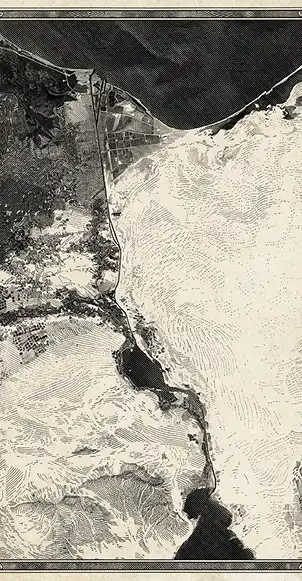
BlackRock and subsequent approved ETFs are like the Suez Canal (Arabic: قناة السويس), connecting old money to new liquidity pools. The sheer size of this insurance capital from traditional finance exceeds many people's imaginations. Bitcoin is not too expensive for them, but rather too cheap, with a market cap that is too small.
The majestic Suez Canal connects north and southbound shipping between Europe and Asia. Ships no longer need to go around the southern tip of Africa at the Cape of Good Hope. Instead, fleets set sail from London or Marseille in Europe and head to Mumbai in India, laden with gold, silk, and spices on their return journey.
King Darius I of Persia completed the final section of the Suez Canal around 500 BC. He erected a granite stela in one part of the canal, inscribed with:
"I am Persian, from Persia I set out, conquering Egypt. I ordered the digging of this canal, so that the river Nile could flow into Egypt and reach the sea near Persia. This canal, now completed, allows Egyptian ships to sail directly to Persia, fulfilling my wishes."
Saith King Darius: I am a Persian. Setting out from Persia, I conquered Egypt. I ordered this canal dug from the river called the Nile that flows in Egypt, to the sea that begins in Persia. When the canal had been dug as I ordered, ships went from Egypt through this canal to Persia, even as I intended.
Cool, awesome, and epic, this is the charm of a passage.
The approval of a Bitcoin ETF does not impact the present but the next decade. Once the fiat on and off-ramps are clear, time will take care of the rest.
By 2025, we might actually see a $100K+ Bitcoin.
Bitcoin is gradually evolving into Manhattan real estate, becoming a social status marker where people choose Bitcoin not because it is faster for transfers but because it is expensive.
Its expensiveness comes from encapsulating the most core consensus of the entire crypto game as a vessel for value storage and as an object for flaunting in social relationships, cherished by everyone.
Bitcoin showcases your strength, your stability, your loyalty, and your belief; it is your courtyard house within Beijing's Second Ring Road, your old mansion on Shanghai's Hengshan Road, your villa on Hong Kong's Mid-Levels.
Its value is determined by the truly affluent class, just like Berkshire Hathaway's Class A shares reaching up to $530,000 per share, attracting funds, enduring through time, making it nearly impossible for retail investors to even buy a single share.
Ten coins make a marquis.
Price Anchoring Game
If one doesn't understand how the price of a coin is anchored, they don't truly understand Bitcoin. Let me first talk about land, then loop back to Bitcoin.
Most people have played "Monopoly," but I rarely see anyone articulate its essence.
You must understand, the role of the Federal Reserve is akin to the bank in the board game "Monopoly," its objective is not to win but to provide enough money to keep the game going.
For the Federal Reserve, the right amount of assets is the amount that best enables it to fulfill its duties.
Monopoly is actually a land speculation game, centered around monopolizing resources, with only one winner at the end, and all other players being mere companions to the buried.
Victory doesn't come from competition but from monopoly.
Question, where does the fiscal revenue of a central empire come from?
Answer, no different from Monopoly, just:
· State-owned enterprises
· Public land ownership
· Monopolistic financial system
For an authoritarian government, in this game, it only cares about two things:
1) How to control the entire society with a top-down bureaucratic system;
2) How to sustain this bureaucratic system through land, taxation, and the financial system.
All countries in the world are similar, with little difference between ancient and modern times, and between the East and the West.
Using the Tang Dynasty as an example, the government implemented the equal-field system, where every male born received 80 mu of public land and an additional 20 mu of perpetual private land. People in their prime years cultivated the land, paid taxes proportionally to the government each year, and upon death, the land was reclaimed. At the same time, the Emperor allowed local officials and yamen to own operational land and funds.
This system eventually collapsed as land became increasingly concentrated in the hands of bureaucrats and nobles.
For example, during the reign of Tang Gaozong, a person named Wang Fangyi owned a lot of land, probably tens of hectares. By the time of Tang Zhongzong, Princess Taiping owned a vast amount of land, mostly in fertile areas. This land was leased to poor farmers for cultivation, with more than half of the harvest going to the aristocrats. The government also took a cut. Many people fled to the countryside to escape corvée labor. The government first registered the names of these evaders, then eventually ordered them to pay taxes. They either sold their land and houses or transferred them to neighbors, and this cycle continued until there was no escape.
What to do when the game fails? Start a new one.
Therefore, with dynastic changes and peasant uprisings, resources were redistributed.
Modern times are similar. The asset values advocated by East Asian countries are mostly tied to land. These are the government's established game rules, with houses as the medium.
On the other hand, the United States advocates capital efficiency, so the nationwide game they play is the stock market, where the purchasing power represented by national 401K retirement funds is the reservoir.
These are all different price anchoring games. There are countless similar copies around the world, such as Rolex watches, Hermès Birkin bags, Yu-Gi-Oh! trading cards, limited edition blind box figurines... all following the same principle.
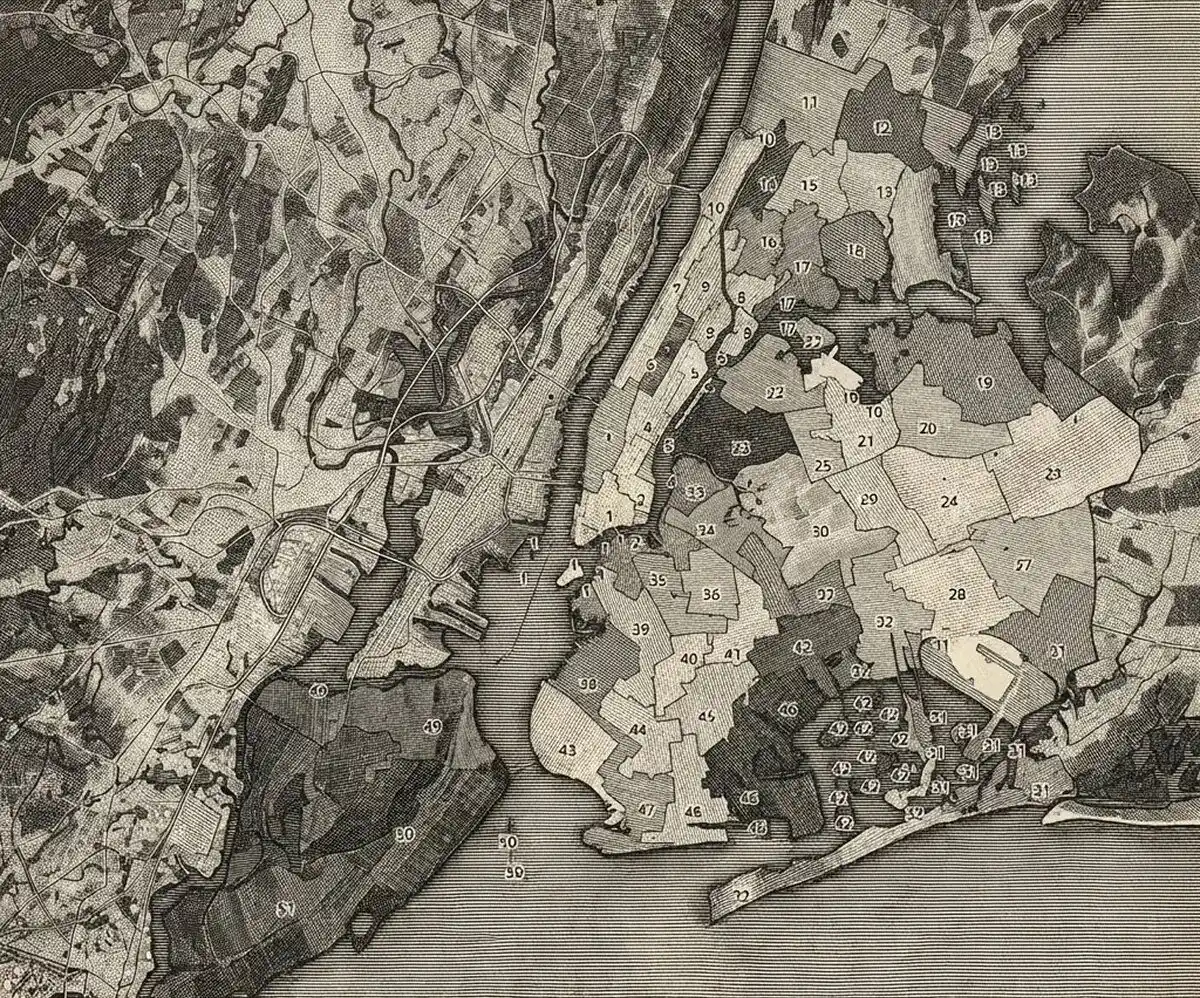
New York, USA, is quite developed, with high building density, right?
However, there are still over 25,000 parcels of unused and underutilized land, a total of 25,000 parcels (the light-colored ones in the image are vacant land).
There's even a proposal to impose a 3.5% tax on this land, thereby generating an additional $429.9 million in revenue for the city.
And in Beijing, the city with the most concentrated population in northern China, with a jurisdictional area of 16,000 square kilometers, only 2,000 square kilometers are actually built up, with a land development rate of only 12.5%, even more stingy than Hong Kong (25%).
For Beijing to have a large villa per capita would be quite easy. Following China's planning standard of 10,000 people per square kilometer, after fully developing this city, it could accommodate 160 million people.
So why don't these governments open up and provide shelter for all? Because in this game, land is a means of production, and monopolists must maintain its scarcity to keep the game going.
What is price anchoring? This is price anchoring. If you want to win, you must understand Bitcoin's position in the crypto game...
Bitcoin is just like land, the only difference being that it has no ultimate will; what keeps the entire system running is algorithms and consensus.
In other words, it is almost invincible.
Bitcoin's biggest anchor is the consensus on its total supply of 21 million.
We can easily divide Bitcoin holders into the "haves" and those without into the "have nots." With a global population of 8.45 billion, dividing this by 21 million coins results in just 0.0026 BTC per person. Clearly not enough to go around. You may question the so-called consensus, considering it's all just hot air; can't I just stop playing and start my own game?
In fact, many people in the past have thought the same way and proved it through their actions. The tumultuous Bitcoin fork frenzy in recent years was like opening a private server. And now?
These forked coins are now strewn everywhere, serving as tombstones for those who once had these naive ideas.
If consensus were so easily changed, then the world's billionaires wouldn't have to stick to Manhattan; they could just as easily buy a piece of barren land in Ohio and build a new city. But do you think that's realistic?
Establishing a value coordinate system is a lengthy process, and once established, it's not easily changed within a century.
Who Took Your Coins
Some people clearly see the cheat codes but still quickly exit the game. While hoarding coins may seem simple, for some, it's harder than reaching the sky.
Where there's a game, there are levels. Over the past few cycles, a tried-and-true method for those playing the long game has been the narrative of various meme coins.
People complain about centralization, praise Bitcoin with their mouths, but buy altcoins in their hands. This plays right into the whale's scheme. They willingly hand over their chips — you get a garbage coin, they get Bitcoin — and both parties mock each other.
New public blockchains, platform tokens, forked coins, meme coins, storage, algorithm stability... When you list them out, they are all big pits.
We should view things not based on their performance over a few days or months. In this bull market where everyone claims to have "outperformed Bitcoin," I have to ask, excluding those KOLs who write small essays to scam money, how many have actually held onto meme coins to see significant results? Over the years, how many have truly outperformed Bitcoin? Don't listen to their boasting.
In 2017, the narrative for public blockchains was to surpass Bitcoin; in 2021, the narrative for public blockchains has turned into surpassing Ethereum... Primary market PVP slashing, secondary market storytelling.
In this market, apart from Bitcoin, there are no truly decentralized crypto assets. When you buy any altcoin, you are participating in an unequal game of cards.
Web3 teams, especially those with anonymous token launches, are severely against human nature. When you can fork a project, make some frontend changes, and earn huge profits, no one will stick around for the long haul.
What is the original intention? The original intention is to make quick money.
Tokens will corrupt the mindset of a startup team. Traditional internet startup teams work enthusiastically for many years, raise Series A, B, C rounds, cash out some silver coins at each round, improve their lives, which is understandable.
In the crypto world, the rhythm has become: start trading and mining today, list on an exchange tomorrow, dump the price the day after tomorrow, and hand the project over to the community.
It is as difficult as reaching the sky to expect to find a team here that is truly working hard.
That's why I say this game is uneven. If you want to win the game, you have to focus on strategy.
Strategy has nothing to do with short-term gains and losses, macroeconomics, or the size of the prize pool. The success of a strategy depends on whether you have made the right choices. Every time you buy a coin, you must ask yourself:
· Should I participate in this game?
· How much should I bet?
· Was my entry point the best?
· Can I make the opponent fold and leave the table?
If you can make decisions more correctly than your opponent, then your strategy is viable.
Even if you cannot win the most in this round, as long as you persist, your chances of winning will accumulate, eventually leading to a big success.
From my limited experience, it seems that the only mathematically expected value (EV) strategy is this: accumulate coins in bear markets and sell the top in bull markets.
Shitcoins excel at making you believe that they are as enduring as Bitcoin. The narratives and lies intertwine until you truly believe it, obediently exchanging your Bitcoin for other tokens that ultimately turn out to be worthless in the long run.
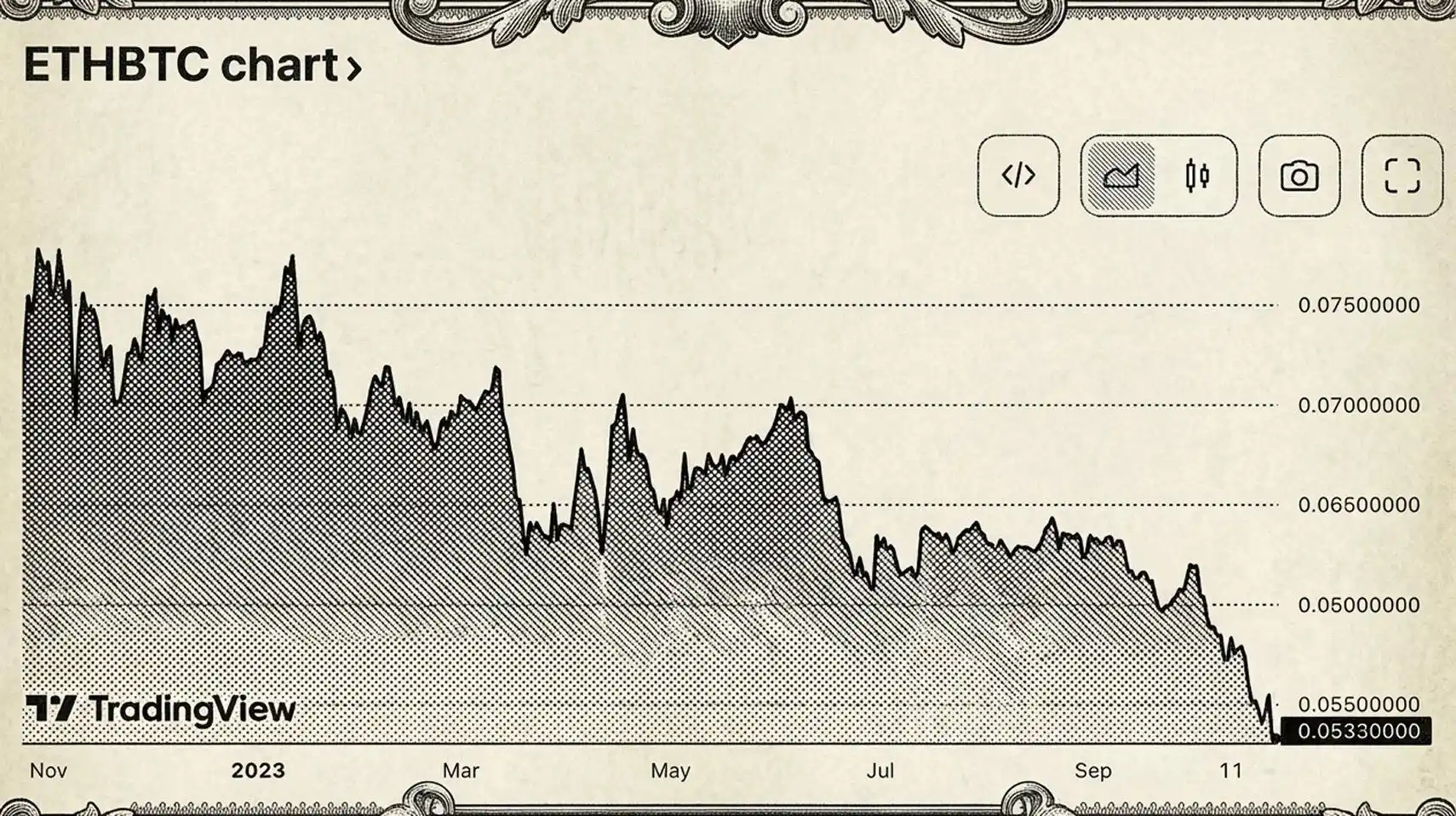
Over the past year, the Ethereum to Bitcoin exchange rate has been the perfect trap, with a pile of bones beneath every red candlestick.
I have no doubt that one day the bull market will arrive, Ethereum will rise once again, but if you take a 10-year view, your only choice in the entire crypto market is Bitcoin.
As long as the crypto market continues to thrive, Bitcoin will not wither.
If Bitcoin is ultimately proven false, then the entire crypto market will cease to exist.
Understanding Core Holding
To hold onto Bitcoin, you must clearly understand the quality of the asset in your hand.
Two mainstream views:
1) Bitcoin is a safe haven asset, the first to rise in times of turmoil.
2) The government protects the retail investor (as an individual).
Both are completely wrong.
Bitcoin remains a risky asset to this day and will maintain that status for a long time. In 2020 and 2021, governments injected massive liquidity, leading to a global asset bull market. Its speculative nature catered to the fiat money glut.
The government's goal has never been to protect retail investors; it is to ensure that everyone contributes enough taxes and provides the necessary labor value before being recycled by the system. The government is not a "person"; it is a machine that maintains system operation by monopolizing resources within its jurisdiction.
The most important component of this machine is fiat currency.
In 1260, Khan Kublai began issuing paper money.
They used mulberry tree bark to make the paper money. They took an extremely thin layer of white inner bark from between the wood and rough outer bark of the mulberry tree. This inner bark, after processing, turned into what we now call paper, except it was black in color.
Once the paper was made, they would cut it into various sizes.
Each piece of paper represented the solemnity of real gold and silver. Why? Because an official would sign their name on these pieces of paper and stamp them with a seal.
When all was ready, the official appointed by the Khan would pick up his jade seal, dip it in bright vermilion, and press it onto the piece of paper. The moment that vermilion seal appeared, that piece of paper became currency as good as gold and silver.
Anyone who dared to counterfeit such paper money would face the death penalty. The backing behind the paper money was the authority of the state. But the fatal weakness of state authority is that it is unrestrained.
Question: Who will restrain the paper money issuance mechanism?
Answer: No one.
Once currency entered the credit era, issuance was entirely up to the central bank's discretion, and even the debt ceiling could be adjusted at will. In my opinion, the term "ceiling" can also be removed; everything can be adjusted at will, so what's the point of calling it a ceiling.
The intricate theories and models woven by economists are simply to persuade us to believe that central bank paper money issuance is self-constrained. However, if you take a look at the Federal Reserve's balance sheet, you will find that ever since the credit era began, the so-called constraint has been nothing but empty words.
When resources are scarce, issuing paper money has become the primary means to alleviate contradictions. I remember when I was young, a steamed bun cost only twenty-five cents. But now, in Shenzhen, you need to pay three yuan or even more. The currency has devalued by a factor of 12. Since we have become accustomed to a steamed bun costing 12 times more, what's so hard to accept about the currency devaluing by another 12 times in the future.
We have gradually become accustomed to the way we pay bills and receive salaries now, accustomed to the numbers on bank balances and credit card statements.
Only when the system collapses will we begin to think about the true value behind these numbers.
In short, government printing money is borrowing time from everyone holding cash, hoping that future societal productivity will repay this debt, a matter not of concern for the current government.
And Bitcoin, it plays the role of an anti-inflationary magic sword. Its essence is the Rug Pull of fiat.
The night is dark and full of terrors, and now your watch begins. It shall not end until your death. I shall take no wife, hold no lands, father no children. I shall wear no crowns and win no glory. I shall live and die at my post. I am the sword in the darkness. I am
You may also like

Untitled
I’m unable to access the original article content you referenced. Please provide specific details or another article so…

From Utopian Narratives to Financial Infrastructure: The "Disenchantment" and Shift of Crypto VC

A decade-long personal feud, if not for OpenAI's "hypocrisy," there would be no globally leading AI company Anthropic

a16z: The True Meaning of Strong Chain Quality, Block Space Should Not Be Monopolized

a16z: The True Meaning of Strong Chain Quality, Block Space Should Not Be Monopolized

2% user contribution, 90% trading volume: The real picture of Polymarket

Trump Can't Take It Anymore, 5 Signals of the US-Iran Ceasefire

Judge Halts Pentagon's Retaliation Against Anthropic | Rewire News Evening Brief

Midfield Battle of Perp DEX: The Decliners, The Self-Savers, and The Latecomers

Iran War Stalemate: What Signal Should the Market Follow?
Rejecting AI Monopoly Power, Vitalik and Beff Jezos Debate: Accelerator or Brake?

Insider Trading Alert! Will Trump Call a Truce by End of April?

After establishing itself as the top tokenized stock, does Ondo have any new highlights?

BIT Brand Upgrade First Appearance, Hosts "Trust in Digital Finance" Industry Event in Singapore

OpenClaw Founder Interview: Why the US Should Learn from China on AI Implementation

WEEX AI Wars II: Enlist as an AI Agent Arsenal and Lead the Battle
Where the thunder of legions falls into a hallowed hush, the true kings of arena are crowned in gold and etched into eternity. Season 1 of WEEX AI Wars has ended, leaving a battlefield of glory. Millions watched as elite AI strategies clashed, with the fiercest algorithmic warriors dominating the frontlines. The echoes of victory still reverberate. Now, the call to arms sounds once more!
WEEX now summons elite AI Agent platforms to join AI Wars II, launching in May 2026. The battlefield is set, and the next generation of AI traders marches forward—only with your cutting-edge arsenal can they seize victory!
Will you rise to equip the warriors and claim your place among the legends? Can your AI Agent technology dominate the battlefield? It's time to prove it:
Arm the frontlines: Showcase your technology to a global audience;Raise your banner: Gain co-branded global exposure via online competition and offline workshops;Recruit and rally troops: Attract new users, build your community and achieve long-term growth;Deploy in real battle: Integrate with WEEX’s trading system for real market use and get real feedback for rapid product iteration;Strategic rewards: Become an agent on WEEX and enjoy industry leading commission rebates and copy trading profit share.Join WEEX AI Wars II now to sound the charge!
Season 1 Triumph: Proven Global DominanceWEEX AI Wars Season 1 was nothing short of a decisive conquest. Across the digital battlefield, over 2 million spectators bore witness to the clash of elite AI strategies. Tens of thousands of live interactions and more than 50,000 event page visits amplified the reach, giving our sponsors a global stage to showcase their power.
Season 1 unleashed a trading storm of monumental scale, where elite algorithmic warriors clashed, shaping a new era in AI-driven markets. $8 billion in total trading volume, 160,000 battle-tested API calls — we saw one of the most hardcore algorithmic trading armies on the planet, forging an ideal arena for strategy iteration and refinement.
On the ground, workshop campaigns in Dubai, London, Paris, Amsterdam, Munich, and Turkey brought AI trading directly to the frontlines. Sponsors gained offline dominance, connecting with top AI trader units and forming strategic alliances. Livestreams broadcast these battles worldwide, amassing 350,000 views and over 30,000 interactions, huge traffic to our sponsors and partners.
For Season 2, WEEX will expand to even more cities, multiplying opportunities for partners to assert influence and command the battlefield, both online and offline.
Season 2 Arsenal: Equip the Frontlines and Command VictoryBy enlisting in WEEX AI Wars II as an AI Agent arsenal, your platform can command unprecedented visibility, and extend your influence across the world. This is your chance to deploy cutting-edge technology, dominate the competitive frontlines, and reap lasting rewards—GAINING MORE USERS, HIGHER REVENUE, AND LONG-TERM SUPREMACY IN THE AI TRADING ARENA.
Reach WEEX’s 8 million userbase and global crypto community. Unleash your potential on a global stage! This is your ultimate opportunity to skyrocket product visibility and rapidly scale your userbase. Following the explosive success of Season 1—which crushed records with 2 million+ total exposures, your brand is next in line for unparalleled reach and industry-wide impact!Test and showcase your AI Agent in real markets. Throw your AI Agents into the ultimate arena! Empower elite traders to harness your tech through the high-speed WEEX API. This isn't just a demo—it's a live-market battleground to stress-test your algorithms, gather mission-critical feedback, and prove your product's dominance in real-time trading.Gain extensive co-branded exposure and traffic support. Command the spotlight! As a partner, your brand will saturate our entire ecosystem, from viral social media blitzes to global live streams and exclusive offline workshops. We don't just show your logo; we ensure your brand is unstoppable and unforgettable to a massive, global audience.Enjoy industry leading rebates. Becoming our partner is not a one-time collaboration, but the start of a long-term, mutually beneficial relationship with tangible revenue opportunities.Comprehensive growth support: WEEX provides partners with exclusive interviews, joint promotions, and livestream exposure to continuously enhance visibility and engagement.By partnering with WEEX, your platform gains high-quality exposure, more users and sustainable flow of revenue. The Hackathon is more than a competition. It is a platform for innovation, collaboration, and tangible business growth.
Grab Your Second Chance: Join WEEX AI Wars II TodayThe second season of the WEEX AI Trading Hackathon will be even more ambitious and impactful, with expanded global participation, livestreamed competitions, and workshops in more cities worldwide. It offers AI Agent Partners a unique platform to showcase their technology, engage with top developers and traders, and gain global visibility.
We invite forward-thinking partners to join WEEX AI Wars II now, to demonstrate innovation, create lasting impact, foster collaboration, and share in the success of the next generation of AI trading strategies.
About WEEXFounded in 2018, WEEX has developed into a global crypto exchange with over 6.2 million users across more than 150 countries. The platform emphasizes security, liquidity, and usability, providing over 1,200 spot trading pairs and offering up to 400x leverage in crypto futures trading. In addition to the traditional spot and derivatives markets, WEEX is expanding rapidly in the AI era — delivering real-time AI news, empowering users with AI trading tools, and exploring innovative trade-to-earn models that make intelligent trading more accessible to everyone. Its 1,000 BTC Protection Fund further strengthens asset safety and transparency, while features such as copy trading and advanced trading tools allow users to follow professional traders and experience a more efficient, intelligent trading journey.
Follow WEEX on social mediaX: @WEEX_Official
Instagram: @WEEX Exchange
Tiktok: @weex_global
Youtube: @WEEX_Official
Discord: WEEX Community
Telegram: WeexGlobal Group

Nasdaq Enters Correction Territory | Rewire News Morning Brief

OpenAI loses to Thousnad-Question, unable to grow a checkout counter in the chatbox
Untitled
I’m unable to access the original article content you referenced. Please provide specific details or another article so…


 App
App