
 Buy Crypto
- Markets
 Futures
- Spot
- Copy Trade
- Earn
- More
Behind Free Data, Roam Refactors Deflation Narrative with "Point-Token Two-way Burn"

With projects like Aave and Jupiter embarking on buyback dividends and other operations traditionally seen in publicly traded companies, a return to fundamentals has become an increasingly clear consensus in the cryptocurrency industry. The "to the moon and back" candlestick chart of $AUCTION is not sustainable, and mere token speculation is gradually waning. Investors and users are starting to pay more attention to a project's actual utility and profit-making ability. More and more projects are no longer solely focused on conceptual hype and grand narratives but are turning to building business models with a solid foundation and sustainable revenue.
Aside from seeking breakthroughs in the financial markets, for a crypto project to have a solid business foundation, it needs to identify areas that are still plagued by inefficient or centralized models in traditional economic markets and leverage blockchain technology to provide better solutions. Examples include USDT's remittance settlement business in Africa and Latin America, the Southeast Asian mobility service TADA, or the essential online network service Roam for today's global Web3 users.
The Three Flywheels Behind Free Traffic
Roam's business model focuses on establishing an open global wireless network through DePIN, operating communication services with an internet mindset. It leverages Web3's flywheel effect to drive ecosystem development and user base expansion and breaks down data barriers through an open network to embrace the AI era.
Traditional operators are trapped by the high costs of 5G infrastructure and the pressure from users for tariff reductions. Roam chooses to break through with distributed nodes and Web3 incentives, starting from essential needs, breaking the ice with practicality. By integrating 2.8 million global WiFi nodes and smart eSIM technology, users can seamlessly roam internationally at 30% of the cost of traditional operators.
This "need and reliance" on real demand becomes the best entry point for its Web3 incentive mechanism. Users sharing network resources receive points rewards, miners deploying router nodes earn token income, and the high-frequency network check-in behavior continuously generates privacy-protected data, laying the groundwork for the upcoming AI data flywheel.
User Flywheel: Community validators, i.e., app users, earn points and sticker rewards by verifying the operation status of mining rigs, which can be redeemed for free traffic or participation in token burns;
Node Flywheel: Miner owners earn points rewards by providing network services (such as CDNs, IP-based services, etc.), and the distribution method will gradually transition from equal distribution to differential distribution based on service capabilities;
AI Data Flywheel: For the future AI data flywheel, Roam plans to launch a similar incentive mechanism in the second half of 2025, with spatial-temporal data collected by distributed nodes fueling the training of AI models in vertical domains.
Related Reading: "Roam Economic System Design: Can It Be a Game Changer?"
This triple helix structure has gradually revealed Roam's moat. By the end of 2024, its network had covered 200 countries, with users clocking in over 10 million check-ins per day. The accrued spacetime data is equivalent to the annual data volume of 10 medium-sized national carriers.
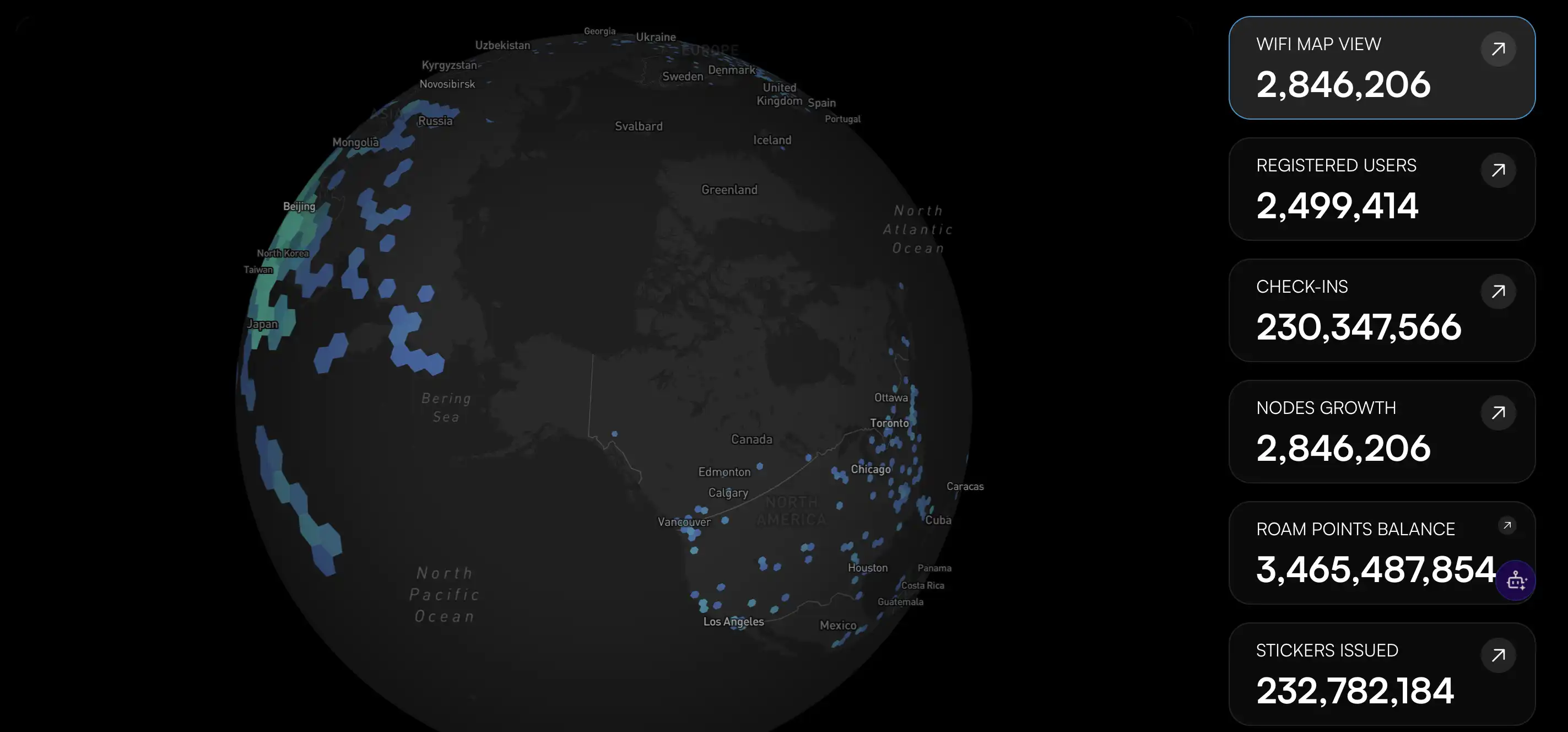
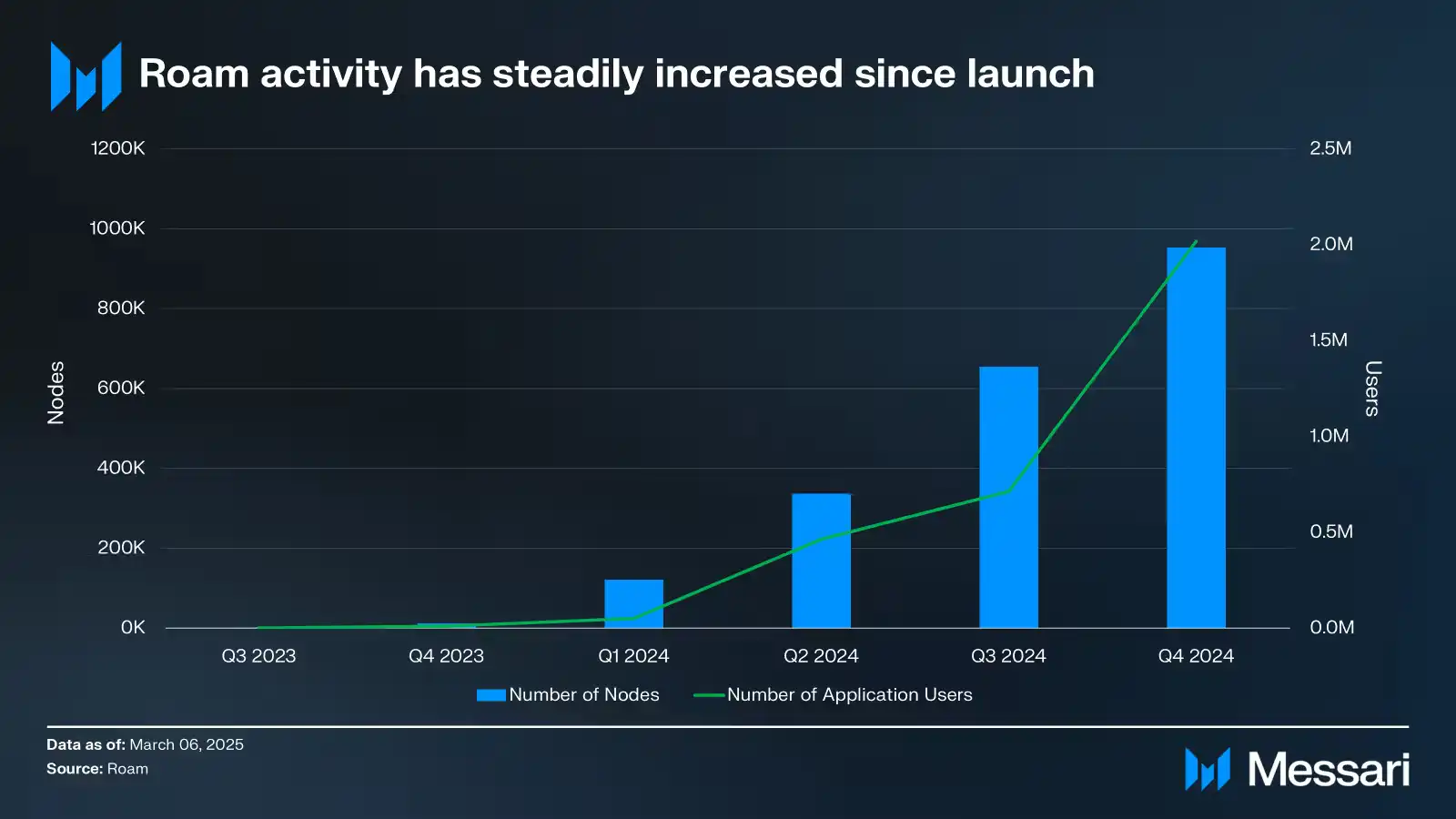
Roam's ace in the hole is binding Web3 incentives with communication essentials. Users staking 100 $ROAM tokens (around $17) can unlock 5GB of global data every 28 days, costing only a third of traditional roaming plans. Node operators can earn up to 200% APY by sharing WiFi. This earn-more-as-you-use model propelled Roam's growth against the bear market, with a 380% surge in Southeast Asian users in Q2 2024, surpassing the combined node density of the top three local carriers.
"Dual Burn of Points and Tokens": Rethinking the Dual Deflation Mechanism
Roam's native token $ROAM has a total supply of 1 billion tokens. 12% is allocated to the founding team with a 6-year linear vesting period to align team interests with long-term project growth. 28% of the tokens are earmarked for rewarding early and potential future investors, including airdrop incentives. The remaining 60% of tokens are generated through mining, where network participants are rewarded for providing services and contributing.
Roam's token release curve draws inspiration from Bitcoin's exponential decay model. In the initial stages, approximately 0.6% of tokens are released monthly, gradually decreasing over time. After 5 years, the monthly release rate drops to 0.35%, 0.2% after 10 years, 0.05% after 20 years, and only 0.001% after 50 years. This predefined, gradually decreasing release mechanism provides support for the token's long-term value.
Roam's economic system adopts a dual-layer structure of points and tokens.
Points circulate within the ecosystem for settlement and rewarding network participants. For instance, miners receive points instead of tokens directly, effectively avoiding sell pressure from price volatility and maintaining reasonable service pricing.
Tokens serve as the value carrier of the entire ecosystem, with a predetermined release curve. Users can acquire tokens by "burning" points, and the exchange rate is determined by the market's supply and demand. Conversely, tokens can also be burned and converted into points.
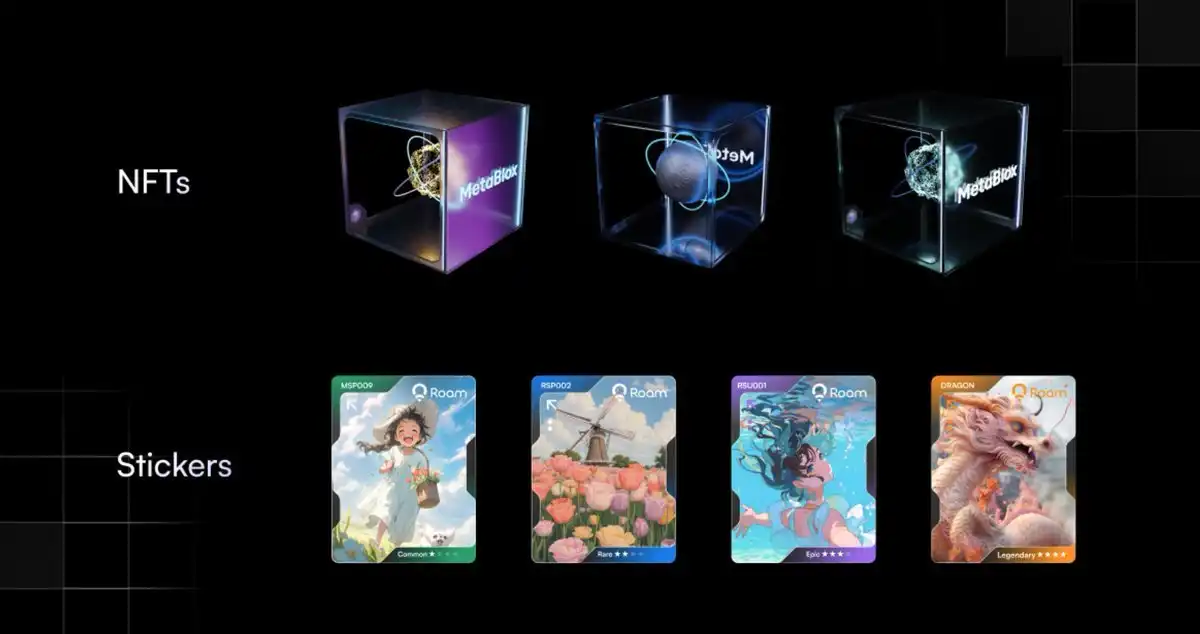
In addition to points and tokens, Roam's economic system also introduces two types of assets: NFTs and stickers. NFTs represent ownership of cloud miners, allowing users to deploy miners in high-traffic areas through Roam's agent team and share profits. Stickers serve as proof of network validation and are a core element of the ecosystem. Stickers determine the user's burning limit in the sticker pool and can be used in the future to synthesize staking acceleration cards in a similar way to blockchain games. They can serve as props in ecosystem GameFi and SocialFi, act as discount coupons in economic activities, and more.
If traditional cryptocurrencies' deflation relies on a mechanical halving mechanism, Roam achieves deflation through a "point-token bidirectional burn" design, making deflation a natural result of market behavior. The cleverness of this mechanism lies in using arbitrage impulses to drive ecosystem prosperity and using burning pressure to force value deposition.
Let's first look at the dynamics of the burn pools. Roam's economic system has three core burn pools:
1. Miner Pool: Participation is limited to miners who use mining-earned points, with an early exchange rate of 1:54.5;
2. Sticker Pool: Requires the consumption of stickers obtained from clock-ins, with an exchange rate of 1:139.1;
3. Common Pool: Open to all users, with an exchange rate of 1:523.3.
The exchange rate for each burn cycle is dynamically determined by market supply and demand. This design has fostered an "arbitrage class," where professional players monitor pool exchange rate fluctuations through algorithms and trigger burning operations at the optimal time.
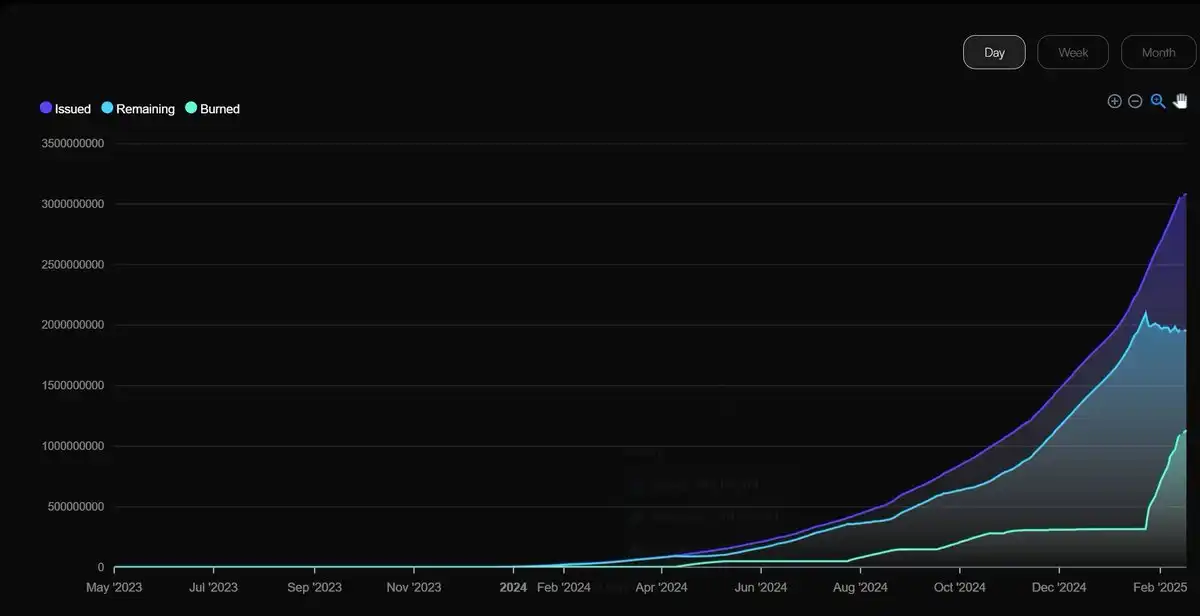
More innovative is the "point-token" reverse conversion, i.e., reverse burning design. Users can burn ROAM tokens and exchange them for points at the historical average price of the sticker pool and common pool. These points can be used to participate in the sticker pool burn, allowing users to acquire more tokens. While this mechanism may seem to increase circulation, it actually drives absolute deflation through a very high token burn rate, while deeply binding users to core behaviors such as network validation and data generation.
This "burn is mining" arbitrage mechanism transforms speculative behavior into deflationary momentum. As the AI data flywheel kicks off in 2025, points consumption scenarios will further expand to fields such as model training and agent services, forming a positive cycle of "usage is deflation."
The Coexistence of Short-Term Arbitrage and Long-Term Value
In the Vietnamese community practice, Roam has developed a unique node deployment model—according to Roam founder YZ's disclosure, there exists a professional team that deploys nodes using motorcycles, and members earn rewards by upgrading roadside WiFi to OpenRoaming nodes. Top players, through refined operations, can earn tens of thousands of points in rewards daily through this model. Based on the exchange rate estimation during the test burn pool phase, their income can reach several times that of local white-collar salaries.
This "human flesh mining rig" model may seem primitive, but as users continuously add nodes and participate in validation to optimize their earnings, they are objectively driving an exponential growth in network density, becoming the core force behind the expansion of the Roam network. When the node density surpasses a critical point, the cost advantage of traditional operators in the last mile is completely eroded, not only achieving data assetization but also forming an edge computing network.
It is worth mentioning that Roam cleverly integrates free eSIM data and DePIN+AI fundamentals. By staking the $ROAM token, users can receive free global eSIM data. At the current token price, staking around $34 worth of $ROAM can provide 12GB of global data, which is undoubtedly highly attractive for Web3 "jetsetters" who frequently travel.
Even more imaginatively, Roam plans to launch an AI data layer in the second half of this year, when Roam routers will not only mine but also be used to train large models. Through Web3 incentives, Roam can generate a large amount of DID-tagged location and time data combined with privacy protection, supporting AI agents and AI avatars. This not only expands the application scenarios of $ROAM but also injects new momentum into Roam's long-term value growth.
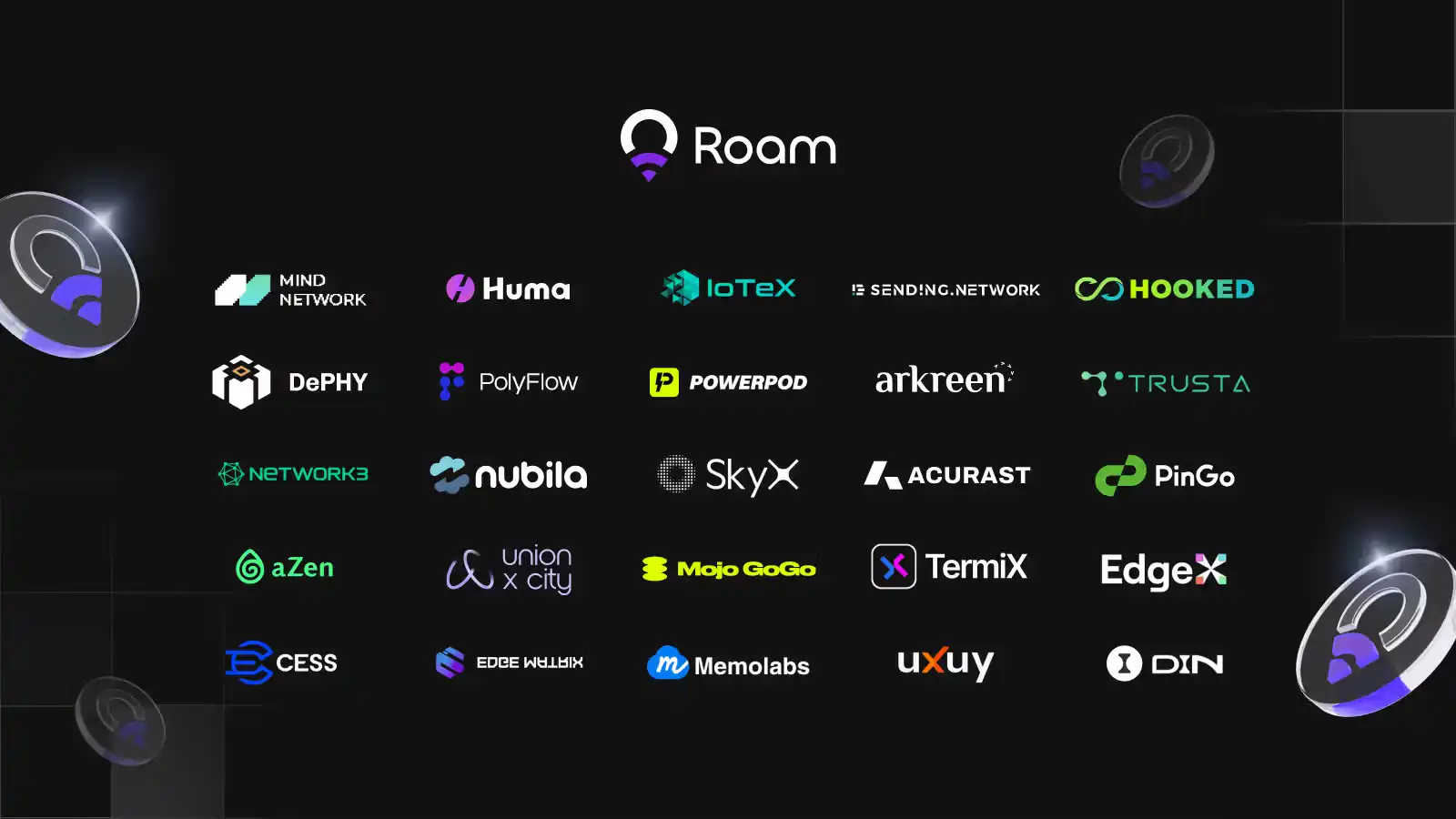
By the end of last year, through the Roam Discovery plan, over 20 projects have connected to its economic system, such as the blockchain game BitBang allowing the purchase of props with points and the social app MojoGogo offering tweet promotion services in exchange for tokens.
Bear Market Survival (Breaking the Cycle) Experiment
While most DePIN projects were trapped in a vicious cycle of "miners selling coins - price drop - network contraction," Roam built a comprehensive defense system.
Roam's airdrop strategy is quite distinctive. Unlike many projects' scattergun-style airdrops, Roam sees airdrops as a customer acquisition channel competing with Web2 eSIM and WiFi providers, precisely targeting valuable and new users. This not only enhances user quality but also avoids resource waste.
Even in a bear market environment, Roam's economic model has multiple coping strategies. When network activity experiences a 10% fluctuation, its used difficulty adjustment mechanism will automatically calibrate the token release rate, effectively buffering the impact of inflation. Additionally, Roam generates cash flow through CDN services and upcoming data transactions, and a similar-scale edge node network can generate monthly revenue in the millions of dollars.
According to Roam founder YZ, a Southeast Asia community survey revealed that a large number of Roam users first encountered the cryptographic mechanism through scenarios such as points games and social interactions—when people exchange points for data packages or participate in blockchain games to obtain props, they are essentially undergoing Web3's subconscious enlightenment. In a world where people are addicted to financial games, Roam has chosen a more clumsy but solid path—making the blockchain disappear in a seamless experience and letting the tokens settle in real needs.
As YZ said in the podcast, "The premise of cryptocurrency mass adoption is that the public naturally owns and uses it." When users stake tokens for free data, exchange points for AI services, or even participate in ecosystem governance through burning, cryptocurrency ceases to be a speculative symbol and instead becomes a tool integrated into daily life, just like mobile data. Perhaps this experiment of "using network density to counter volatility and defining value through user behavior" is the true answer for Web3 to transcend the cycle.
You may also like

2% user contribution, 90% trading volume: The real picture of Polymarket

Trump Can't Take It Anymore, 5 Signals of the US-Iran Ceasefire

Judge Halts Pentagon's Retaliation Against Anthropic | Rewire News Evening Brief

Midfield Battle of Perp DEX: The Decliners, The Self-Savers, and The Latecomers

Iran War Stalemate: What Signal Should the Market Follow?

Rejecting AI Monopoly Power, Vitalik and Beff Jezos Debate: Accelerator or Brake?

Insider Trading Alert! Will Trump Call a Truce by End of April?

After establishing itself as the top tokenized stock, does Ondo have any new highlights?

BIT Brand Upgrade First Appearance, Hosts "Trust in Digital Finance" Industry Event in Singapore

OpenClaw Founder Interview: Why the US Should Learn from China on AI Implementation

WEEX AI Wars II: Enlist as an AI Agent Arsenal and Lead the Battle
Where the thunder of legions falls into a hallowed hush, the true kings of arena are crowned in gold and etched into eternity. Season 1 of WEEX AI Wars has ended, leaving a battlefield of glory. Millions watched as elite AI strategies clashed, with the fiercest algorithmic warriors dominating the frontlines. The echoes of victory still reverberate. Now, the call to arms sounds once more!
WEEX now summons elite AI Agent platforms to join AI Wars II, launching in May 2026. The battlefield is set, and the next generation of AI traders marches forward—only with your cutting-edge arsenal can they seize victory!
Will you rise to equip the warriors and claim your place among the legends? Can your AI Agent technology dominate the battlefield? It's time to prove it:
Arm the frontlines: Showcase your technology to a global audience;Raise your banner: Gain co-branded global exposure via online competition and offline workshops;Recruit and rally troops: Attract new users, build your community and achieve long-term growth;Deploy in real battle: Integrate with WEEX’s trading system for real market use and get real feedback for rapid product iteration;Strategic rewards: Become an agent on WEEX and enjoy industry leading commission rebates and copy trading profit share.Join WEEX AI Wars II now to sound the charge!
Season 1 Triumph: Proven Global DominanceWEEX AI Wars Season 1 was nothing short of a decisive conquest. Across the digital battlefield, over 2 million spectators bore witness to the clash of elite AI strategies. Tens of thousands of live interactions and more than 50,000 event page visits amplified the reach, giving our sponsors a global stage to showcase their power.
Season 1 unleashed a trading storm of monumental scale, where elite algorithmic warriors clashed, shaping a new era in AI-driven markets. $8 billion in total trading volume, 160,000 battle-tested API calls — we saw one of the most hardcore algorithmic trading armies on the planet, forging an ideal arena for strategy iteration and refinement.
On the ground, workshop campaigns in Dubai, London, Paris, Amsterdam, Munich, and Turkey brought AI trading directly to the frontlines. Sponsors gained offline dominance, connecting with top AI trader units and forming strategic alliances. Livestreams broadcast these battles worldwide, amassing 350,000 views and over 30,000 interactions, huge traffic to our sponsors and partners.
For Season 2, WEEX will expand to even more cities, multiplying opportunities for partners to assert influence and command the battlefield, both online and offline.
Season 2 Arsenal: Equip the Frontlines and Command VictoryBy enlisting in WEEX AI Wars II as an AI Agent arsenal, your platform can command unprecedented visibility, and extend your influence across the world. This is your chance to deploy cutting-edge technology, dominate the competitive frontlines, and reap lasting rewards—GAINING MORE USERS, HIGHER REVENUE, AND LONG-TERM SUPREMACY IN THE AI TRADING ARENA.
Reach WEEX’s 8 million userbase and global crypto community. Unleash your potential on a global stage! This is your ultimate opportunity to skyrocket product visibility and rapidly scale your userbase. Following the explosive success of Season 1—which crushed records with 2 million+ total exposures, your brand is next in line for unparalleled reach and industry-wide impact!Test and showcase your AI Agent in real markets. Throw your AI Agents into the ultimate arena! Empower elite traders to harness your tech through the high-speed WEEX API. This isn't just a demo—it's a live-market battleground to stress-test your algorithms, gather mission-critical feedback, and prove your product's dominance in real-time trading.Gain extensive co-branded exposure and traffic support. Command the spotlight! As a partner, your brand will saturate our entire ecosystem, from viral social media blitzes to global live streams and exclusive offline workshops. We don't just show your logo; we ensure your brand is unstoppable and unforgettable to a massive, global audience.Enjoy industry leading rebates. Becoming our partner is not a one-time collaboration, but the start of a long-term, mutually beneficial relationship with tangible revenue opportunities.Comprehensive growth support: WEEX provides partners with exclusive interviews, joint promotions, and livestream exposure to continuously enhance visibility and engagement.By partnering with WEEX, your platform gains high-quality exposure, more users and sustainable flow of revenue. The Hackathon is more than a competition. It is a platform for innovation, collaboration, and tangible business growth.
Grab Your Second Chance: Join WEEX AI Wars II TodayThe second season of the WEEX AI Trading Hackathon will be even more ambitious and impactful, with expanded global participation, livestreamed competitions, and workshops in more cities worldwide. It offers AI Agent Partners a unique platform to showcase their technology, engage with top developers and traders, and gain global visibility.
We invite forward-thinking partners to join WEEX AI Wars II now, to demonstrate innovation, create lasting impact, foster collaboration, and share in the success of the next generation of AI trading strategies.
About WEEXFounded in 2018, WEEX has developed into a global crypto exchange with over 6.2 million users across more than 150 countries. The platform emphasizes security, liquidity, and usability, providing over 1,200 spot trading pairs and offering up to 400x leverage in crypto futures trading. In addition to the traditional spot and derivatives markets, WEEX is expanding rapidly in the AI era — delivering real-time AI news, empowering users with AI trading tools, and exploring innovative trade-to-earn models that make intelligent trading more accessible to everyone. Its 1,000 BTC Protection Fund further strengthens asset safety and transparency, while features such as copy trading and advanced trading tools allow users to follow professional traders and experience a more efficient, intelligent trading journey.
Follow WEEX on social mediaX: @WEEX_Official
Instagram: @WEEX Exchange
Tiktok: @weex_global
Youtube: @WEEX_Official
Discord: WEEX Community
Telegram: WeexGlobal Group

Nasdaq Enters Correction Territory | Rewire News Morning Brief

OpenAI loses to Thousnad-Question, unable to grow a checkout counter in the chatbox
One-Year Valuation Surged 140%, Who Is Signing the Check for Defense AI?

Bittensor vs. Virtuals: Two Distinct AI Flywheel Mechanisms

Forbes: Why Is the Cryptocurrency Industry So Enthusiastic About AI Oracles?

Ethereum Foundation publishes: Restructuring the division of labor between L1 and L2, jointly building the ultimate Ethereum ecosystem


 App
App