
 Buy Crypto
- Markets
 Futures
- Spot
- Copy Trade
- Earn
- More
An Analysis of the Curve Founder's New Project, Yield Basis - What Other Potential Opportunities Exist for BTC Yield Farming?

Original Title: Yield Basis: Real Yield On Bitcoin
Original Author: Rui, Investor at SevenX Ventures
Original Translation: CryptoLeo, Translator at Odaily
Editor's Note: Curve Finance founder Michael Egorov launched a new project called Yield Basis in February, raising $5 million through a $50 million token valuation. In this article, a SevenX Ventures investor wrote about the current state of BTC yield sources, analyzed the operational process of the Yield Basis protocol, and the potential opportunities for the future BTC yield layer. The following is the original content, translated by Odaily:
BTC APR sounds attractive, but it may be a house of cards built on layers of altcoin incentives, ready to collapse at any time.
Faced with BTC APR, people usually ask some questions: Is the yield settled in BTC or altcoins? What risks are involved? How much potential principal loss is there? Is this yield sustainable? Will it be diluted as TVL grows?
This article focuses on sustainable BTC settlement yield in CeFi and DeFi, divided into three parts:
1. Original BTC Yield Sources: Quantitative trading, DEX LP, lending, staking, collateral, LST, and Pendle;
2. New Venues for BTC Yield: Yield Basis Protocol;
3. Outlook: Small mistakes could lead to catastrophic failures; the scarcity of elite quant teams; the convergence of TradFi, CeFi, and DeFi, and IPO opportunities.
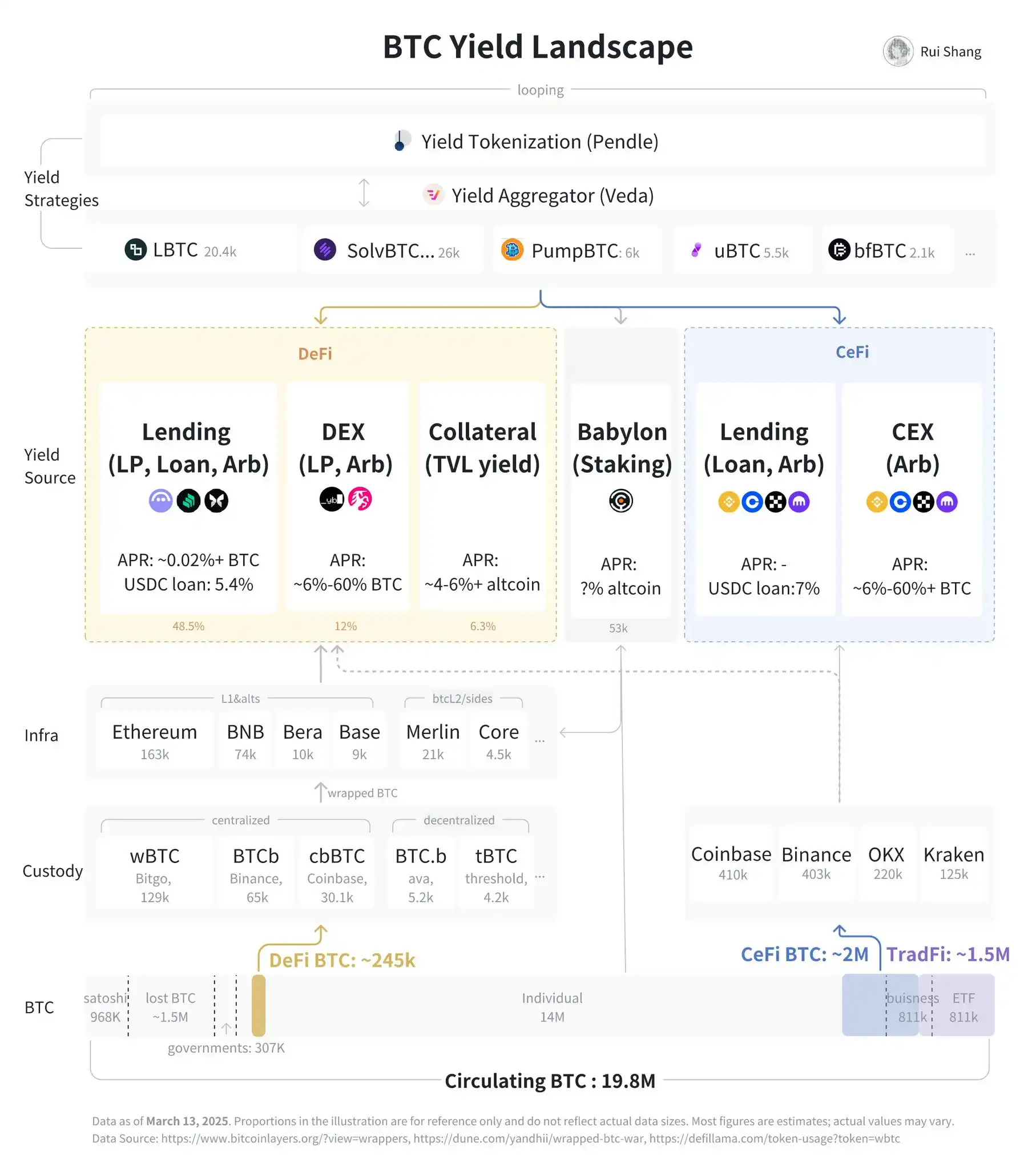
Original BTC Yield Sources
While there are many ways to cycle and compound, we can categorize original yields into five major types: quantitative trading, DEX LP, lending, staking, and collateral. (The following chart compares yield and risk.)
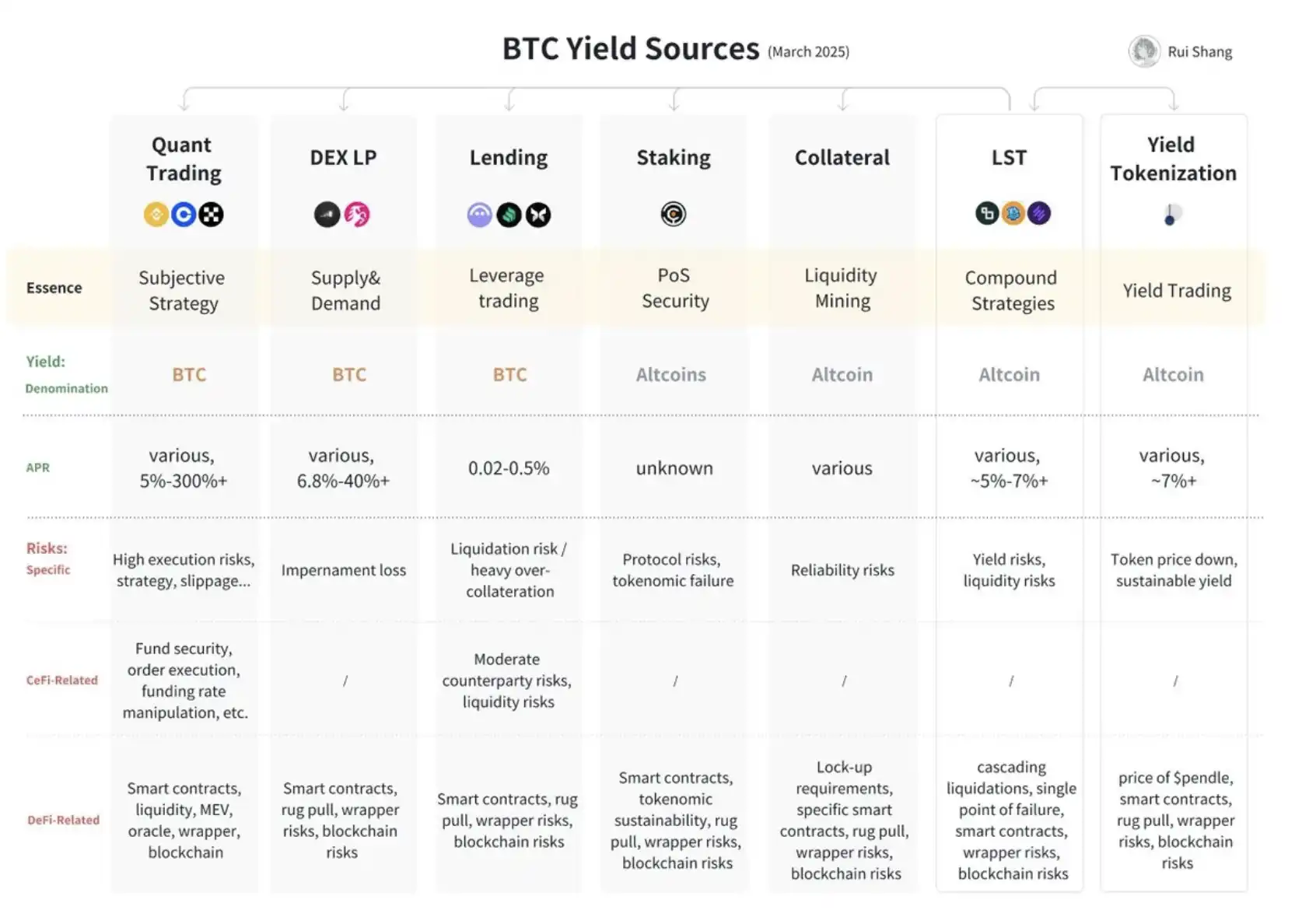
1. Quantitative Trading Strategy: The "Zero Sum" Game
Ensure that your Alpha strategy is net profitable. Arbitrage strategies include funding rates, spot-futures basis, cross-exchange and borrowing arbitrage, or event-driven trading, requiring deep liquidity — mostly currently on TradFi and CeFi. Additionally, TradFi to DeFi arbitrage lacks cross-domain infrastructure.
· BTC Yield: Varies based on asset size, risk profile, and execution. The target for market-neutral strategies may be a 4-8% bitcoin-denominated annual rate with around 1% stop loss. Top-performing quant teams may even pursue a 200-300%+ annual rate and engage in intricate risk controls around the 10-30% stop loss mark.
· Risk: Highly subjective with model, judgment, and execution risks — even neutral strategies can end up directional bets. Requires real-time monitoring, robust infrastructure (e.g., latency, custody, and settlement protocols), loss insurance, and exchange risk controls.
2. DEX LP: Constrained by Supply and Demand
In addition to arbitrage, DEX also drives actual trading volumes. Due to limited supply and demand, only about 3% of wrapped BTC is currently on DEX. In volatile LPing pairs (e.g., WBTC-USDC), supply is constrained by impermanent loss, while demand faces attrition of wrapped BTC and limited utility in DeFi.
· BTC Yield: High volatility, Uniswap currently offers an annual rate of 6.88%, which can go up to double digits.
· Risk: Due to impermanent loss, simply holding BTC often outperforms providing liquidity. However, new LPs are often misled, reflecting a common behavioral bias: fee yield and APR are prominent indicators, tempting LPs to maximize short-term gains while overlooking less obvious long-term capital erosion, DeFi risks apply here too.
3. Lending: BTC Lending
BTC primarily serves as collateral for dollar-pegged or stablecoin borrowing, used for cycling or leveraged trading, rather than concerning with the APR for lending out BTC — as current lending demand is low.
· BTC Yield: CeFi and DeFi loan interest rates are usually lower, around 0.02%-0.5% annual interest rate. The loan-to-value (LTV) ratio varies: TradFi has a 60-75% LTV with a current discounted rate of 2-3%, CeFi has a 33-50% LTV with the current USDC rate at 7%; DeFi LTV is 33-67% with the current USDC rate at 5.2%.
· Risk: Despite the low LTV ratio helping to reduce capital efficiency and hedge strategies providing additional protection, there are risks in both CeFi and DeFi, including liquidation risk.
4. Staking: Earning Altcoin Rewards
Babylon is in a unique position where staking contributes to the security of the associated PoS chain.
· Altcoin Yield: Denominated in altcoins, with an unknown APR.
· Risk: The Babylon protocol should undergo multiple security audits and disclose the expected staking rewards post-system launch. If the Babylon token issuance is unsuccessful, the ecosystem's sustainability is at risk.
5. Collateral: Liquidity Mining
When you provide BTC to DeFi, BTC L2, and other protocols as TVL to earn altcoin rewards.
· Altcoin Yield Rate: Varies but is approximately between 5-7%, with whales always able to get more favorable rates.
· Risk: Each protocol has different reliability and verifiable records, along with varying lock-up periods and capital requirements.
6. Liquidity Staking Token: Composite Yield
BTC "LST" akin to Lombard, PumpBTC, Solv Protocol, BitFi, these LST protocols originating from the Babylon ecosystem are now yield cross-chain BTC with sophisticated yield strategies. Veda acts like an aggregator.
· Yield is Mainly Presented in Altcoin Form: Combines Babylon staking rewards, points from different chains, Pendle, some introducing quant strategies through third parties. Additionally, it offers its token as an incentive.
· Risk: LST has low liquidity, with the presence of cascading liquidation risk. There are single points of failure in the minting, redeeming, staking, and bridging processes. It heavily relies on both proprietary and third-party meme coin yields, indicating significant yield volatility.
7. Yield Tokenization: Yield Trading
Pendle is the primary platform for LST to earn additional yield, currently managing a $4.4417 billion BTC TVL, enabling traders to earn fixed yield from their principal (such as spot alternatives), hedge interest rate volatility, and gain yield liquidity, long/short yield positions.
· Meme Coin Yield: The yield rate may be unstable. YT holders can receive base yield of LST, swap fees, fixed yield rate, and PENDLE tokens.
· Risk: A decline in the PENDLE token price would significantly impact participation. Pendle relies on sustainable yield volatility—it becomes tricky when most of its assets depend on multi-tiered token incentives (including Pendle itself).
New Frontier for BTC Yield: Yield Basis
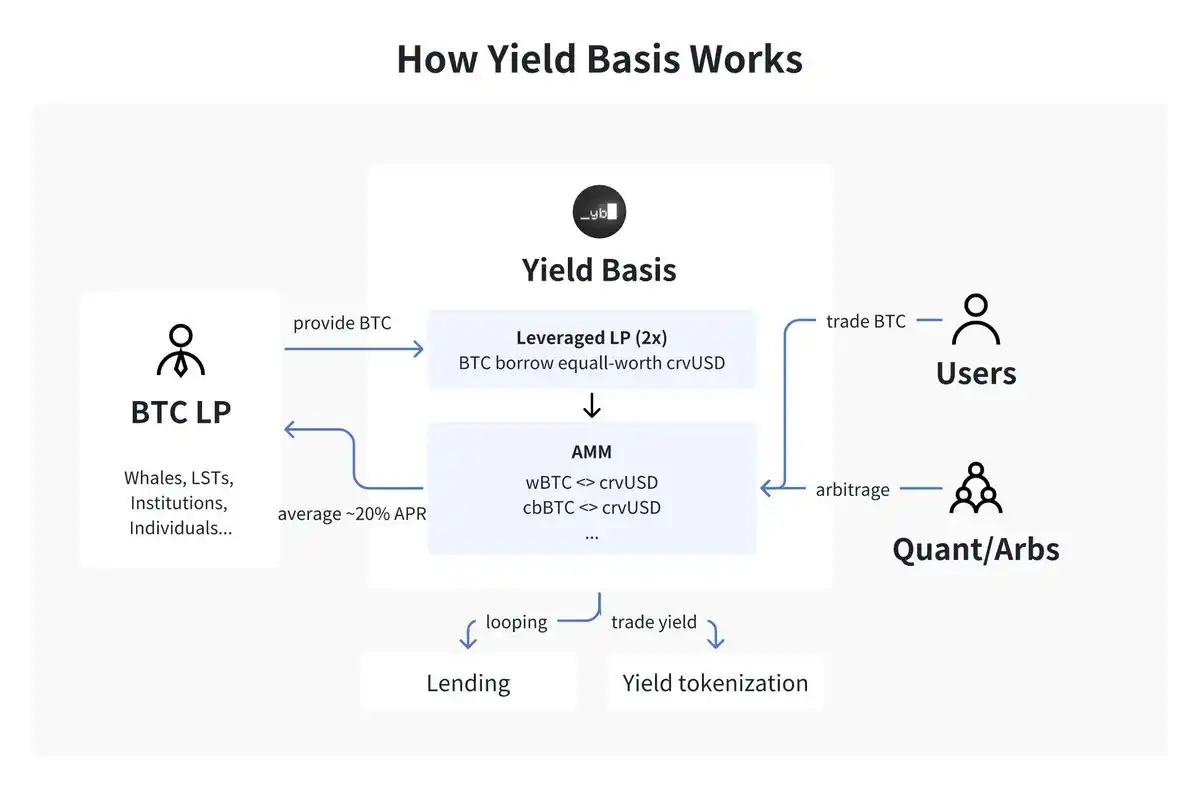
(The above image illustrates the operation flow of Yield Basis)
As mentioned above, while meme coin-denominated yields are unsustainable, true BTC-based yields are scarce and high-risk. Quant teams need sufficient liquidity, but DEXs fall short.
· What is Yield Basis: YB is an automated market maker (AMM) that minimizes impermanent loss and facilitates BTC LP, cross-market arbitrage, and real trading.
· BTC Yield Base Layer: Based on a simulated data of the past 6 years, YB can provide an average of 20% APR (net profit), even higher during a bull market. Additionally, it can be combined with any LST portfolio seeking BTC-based real yield exposure, where Pendle can collaborate with yields generated by YB.
· Venue for Complex Trading Strategies: Building a venue with sufficient liquidity for meaningful quant trading. It also offers a lucrative compounding opportunity to boost the BTC lending rate in lending protocols; currently, there is $32.86 billion WBTC on Aave with a lending rate of about 0.02%.
· Retail BTC Trading Venue: YB's long-term goal is to create the deepest on-chain liquidity for wrapped BTC and compete with CeFi exchanges.
Mechanism: Solving Impermanent Loss
· Mechanism: One AMM Embedded within Another AMM
When BTC LP is deposited into YB, it mints LP by borrowing half of the LP value and continuously re-leveraging. This will create a stablecoin to BTC pool with a rebalancing model, where borrowing interest rates and 50% of pool production fees will subsidize the pool's rebalancing.
APR is 2 times pool yield rate (borrowing interest rate + re-leverage loss), with a fixed cost against crvUSD borrowing interest, which is controllable as the system will use it to generate more yield. Higher volatility increases re-leverage losses but also increases pool revenue, so this strategy remains effective unless volatility exceeds the chosen max liquidity concentration. Parameter selection is crucial: more aggressive parameters can increase yield but carry a greater risk of re-leverage loss, and vice versa.
YB Increasing APR Mechanism
LPs can choose to earn pool fees or stake to earn YB tokens. When the YB token is attractive, more LPs choose to exit the pool, leading to a higher APR.
Future Outlook
BTC yield generation will become increasingly complex, focusing on risk management, BTC pricing, and institutional products. The winners will be those who can provide deep liquidity and fair returns without excessive risk exposure and innovate within a regulatory framework.
Small Errors Can Lead to Catastrophic Losses
“Nothing is unhackable—just unhacked yet.” BTC faces increasingly complex attacks from multiple risk fronts: CEX trust delegation, self-custody phishing, smart contract vulnerabilities (permission, logic, algorithm), and mechanism risks (liquidation, principal loss). Social engineering poses a serious threat through relationship and interface exploitation, with major BTC LPs even requiring chain halts and bridge blocks. While counterintuitive, public chains and high liquidity permissionless protocols are not ideal for its security. Aquarius proposes a security framework that enables comprehensive testing, monitoring, and risk tracking.
Scarcity of Elite Quant Teams
Clearly, the true return measured in BTC is more attractive. While DEX LP is still in its early stages, quantitative trading still dominates. Some teams package their strategies into BTC-yielding products and raise funds from external LPs. However, the ability for high-frequency arbitrage may be limited, with top teams usually keeping these strategies in-house, reducing external capital — forming a form of "adverse selection." Nevertheless, productizing market-neutral and other low-risk strategies as BTC yield products makes sense.
TradFi, CeFi, and DeFi Convergence, with IPO Opportunity
As BTC liquidity continues to deepen, we are witnessing the convergence of TradFi conservatism, CeFi accessibility, and DeFi innovation. In January 2025, Coinbase launched Morpho Labs, a BTC-backed lending product. This is a signal: CeFi is implementing DeFi mechanisms for a broader audience. In this process, institutional asset management companies will have the opportunity to emerge and potentially go public. Companies combining security-first infrastructure, transparent risk disclosure, and trustworthy governance will build strong brands, providing the recurring revenue needed by TradFi asset managers and serving all areas from high-net-worth clients to pension and endowment funds.
You may also like

2% user contribution, 90% trading volume: The real picture of Polymarket

Trump Can't Take It Anymore, 5 Signals of the US-Iran Ceasefire

Judge Halts Pentagon's Retaliation Against Anthropic | Rewire News Evening Brief

Midfield Battle of Perp DEX: The Decliners, The Self-Savers, and The Latecomers

Iran War Stalemate: What Signal Should the Market Follow?

Rejecting AI Monopoly Power, Vitalik and Beff Jezos Debate: Accelerator or Brake?

Insider Trading Alert! Will Trump Call a Truce by End of April?

After establishing itself as the top tokenized stock, does Ondo have any new highlights?

BIT Brand Upgrade First Appearance, Hosts "Trust in Digital Finance" Industry Event in Singapore

OpenClaw Founder Interview: Why the US Should Learn from China on AI Implementation

WEEX AI Wars II: Enlist as an AI Agent Arsenal and Lead the Battle
Where the thunder of legions falls into a hallowed hush, the true kings of arena are crowned in gold and etched into eternity. Season 1 of WEEX AI Wars has ended, leaving a battlefield of glory. Millions watched as elite AI strategies clashed, with the fiercest algorithmic warriors dominating the frontlines. The echoes of victory still reverberate. Now, the call to arms sounds once more!
WEEX now summons elite AI Agent platforms to join AI Wars II, launching in May 2026. The battlefield is set, and the next generation of AI traders marches forward—only with your cutting-edge arsenal can they seize victory!
Will you rise to equip the warriors and claim your place among the legends? Can your AI Agent technology dominate the battlefield? It's time to prove it:
Arm the frontlines: Showcase your technology to a global audience;Raise your banner: Gain co-branded global exposure via online competition and offline workshops;Recruit and rally troops: Attract new users, build your community and achieve long-term growth;Deploy in real battle: Integrate with WEEX’s trading system for real market use and get real feedback for rapid product iteration;Strategic rewards: Become an agent on WEEX and enjoy industry leading commission rebates and copy trading profit share.Join WEEX AI Wars II now to sound the charge!
Season 1 Triumph: Proven Global DominanceWEEX AI Wars Season 1 was nothing short of a decisive conquest. Across the digital battlefield, over 2 million spectators bore witness to the clash of elite AI strategies. Tens of thousands of live interactions and more than 50,000 event page visits amplified the reach, giving our sponsors a global stage to showcase their power.
Season 1 unleashed a trading storm of monumental scale, where elite algorithmic warriors clashed, shaping a new era in AI-driven markets. $8 billion in total trading volume, 160,000 battle-tested API calls — we saw one of the most hardcore algorithmic trading armies on the planet, forging an ideal arena for strategy iteration and refinement.
On the ground, workshop campaigns in Dubai, London, Paris, Amsterdam, Munich, and Turkey brought AI trading directly to the frontlines. Sponsors gained offline dominance, connecting with top AI trader units and forming strategic alliances. Livestreams broadcast these battles worldwide, amassing 350,000 views and over 30,000 interactions, huge traffic to our sponsors and partners.
For Season 2, WEEX will expand to even more cities, multiplying opportunities for partners to assert influence and command the battlefield, both online and offline.
Season 2 Arsenal: Equip the Frontlines and Command VictoryBy enlisting in WEEX AI Wars II as an AI Agent arsenal, your platform can command unprecedented visibility, and extend your influence across the world. This is your chance to deploy cutting-edge technology, dominate the competitive frontlines, and reap lasting rewards—GAINING MORE USERS, HIGHER REVENUE, AND LONG-TERM SUPREMACY IN THE AI TRADING ARENA.
Reach WEEX’s 8 million userbase and global crypto community. Unleash your potential on a global stage! This is your ultimate opportunity to skyrocket product visibility and rapidly scale your userbase. Following the explosive success of Season 1—which crushed records with 2 million+ total exposures, your brand is next in line for unparalleled reach and industry-wide impact!Test and showcase your AI Agent in real markets. Throw your AI Agents into the ultimate arena! Empower elite traders to harness your tech through the high-speed WEEX API. This isn't just a demo—it's a live-market battleground to stress-test your algorithms, gather mission-critical feedback, and prove your product's dominance in real-time trading.Gain extensive co-branded exposure and traffic support. Command the spotlight! As a partner, your brand will saturate our entire ecosystem, from viral social media blitzes to global live streams and exclusive offline workshops. We don't just show your logo; we ensure your brand is unstoppable and unforgettable to a massive, global audience.Enjoy industry leading rebates. Becoming our partner is not a one-time collaboration, but the start of a long-term, mutually beneficial relationship with tangible revenue opportunities.Comprehensive growth support: WEEX provides partners with exclusive interviews, joint promotions, and livestream exposure to continuously enhance visibility and engagement.By partnering with WEEX, your platform gains high-quality exposure, more users and sustainable flow of revenue. The Hackathon is more than a competition. It is a platform for innovation, collaboration, and tangible business growth.
Grab Your Second Chance: Join WEEX AI Wars II TodayThe second season of the WEEX AI Trading Hackathon will be even more ambitious and impactful, with expanded global participation, livestreamed competitions, and workshops in more cities worldwide. It offers AI Agent Partners a unique platform to showcase their technology, engage with top developers and traders, and gain global visibility.
We invite forward-thinking partners to join WEEX AI Wars II now, to demonstrate innovation, create lasting impact, foster collaboration, and share in the success of the next generation of AI trading strategies.
About WEEXFounded in 2018, WEEX has developed into a global crypto exchange with over 6.2 million users across more than 150 countries. The platform emphasizes security, liquidity, and usability, providing over 1,200 spot trading pairs and offering up to 400x leverage in crypto futures trading. In addition to the traditional spot and derivatives markets, WEEX is expanding rapidly in the AI era — delivering real-time AI news, empowering users with AI trading tools, and exploring innovative trade-to-earn models that make intelligent trading more accessible to everyone. Its 1,000 BTC Protection Fund further strengthens asset safety and transparency, while features such as copy trading and advanced trading tools allow users to follow professional traders and experience a more efficient, intelligent trading journey.
Follow WEEX on social mediaX: @WEEX_Official
Instagram: @WEEX Exchange
Tiktok: @weex_global
Youtube: @WEEX_Official
Discord: WEEX Community
Telegram: WeexGlobal Group

Nasdaq Enters Correction Territory | Rewire News Morning Brief

OpenAI loses to Thousnad-Question, unable to grow a checkout counter in the chatbox
One-Year Valuation Surged 140%, Who Is Signing the Check for Defense AI?

Bittensor vs. Virtuals: Two Distinct AI Flywheel Mechanisms

Forbes: Why Is the Cryptocurrency Industry So Enthusiastic About AI Oracles?

Ethereum Foundation publishes: Restructuring the division of labor between L1 and L2, jointly building the ultimate Ethereum ecosystem


 App
App