
 Buy Crypto
- Markets
 Futures
- Spot
- Copy Trade
- Earn
- More
AI Agent token issuance craze: Seize the future trend of tokenization

Original title: Random Sunday Thoughts on What Comes After Agent Tokenization?
Original author: Defi0xJeff, Crypto Kol
Original translation: zhouzhou, BlockBeats
Editor's note:This article discusses the trend of tokenization and its future development, covering the progress of tokenization in the fields of assets, art, income, AI agents, etc., introducing how the pioneers of various tokenizations drive industry changes, and explores possible tokenization trends in the future, including the tokenization of data, attention, and AI applications. Tokenization is not only a technological innovation, but also a force that changes people's interactions and creates new opportunities.
The following is the original content (the original content has been reorganized for easier reading and understanding):
The concept of tokenization has always fascinated me. It seems simple, but whenever something new is tokenized, everyone's attention quickly turns to it.
Here’s a summary of some of the tokenization trends we’ve seen so far, how they’ve developed, and what might happen in the future:
Tokenization of Assets
The original tokenization trend.
Bitcoin paved the way for digital representation of assets by creating the first decentralized, secure, and transparent ledger system. Then, the advent of Ethereum in 2015 introduced smart contracts, making assets programmable — whether it’s real estate, art, or DeFi.
Today, Ethereum’s market value is $470 billion, and that’s the impact that tokenization has had on assets.
Tokenization of Art (NFTs)
The rise of NFTs introduced tokenization to the art world.
In 2017, projects like CryptoPunks and CryptoKitties brought NFTs into the public eye. By 2021, NFTs had reached $13 billion in trading volume, becoming the preferred way to represent digital art and collectibles. Many collectibles like CryptoPunks, BAYC, Art Blocks, and others were priced in the millions of dollars at their peak in 2021.
Tokenization of Yield
Another major change is the tokenization of yield.
Pendle fi pioneered the concept of tokenizing future yields in 2021. It created a market that allowed the trading of fixed and variable yields, adding flexibility and liquidity to DeFi. Pendle began to grow rapidly in 2023, especially in the LST (Liquid Staking Token) and the Points market in early 2024.
Today, $PENDLE has a market cap of $1.6 billion.

Tokenization of AI Agents
Now, we are seeing the tokenization of AI agents.
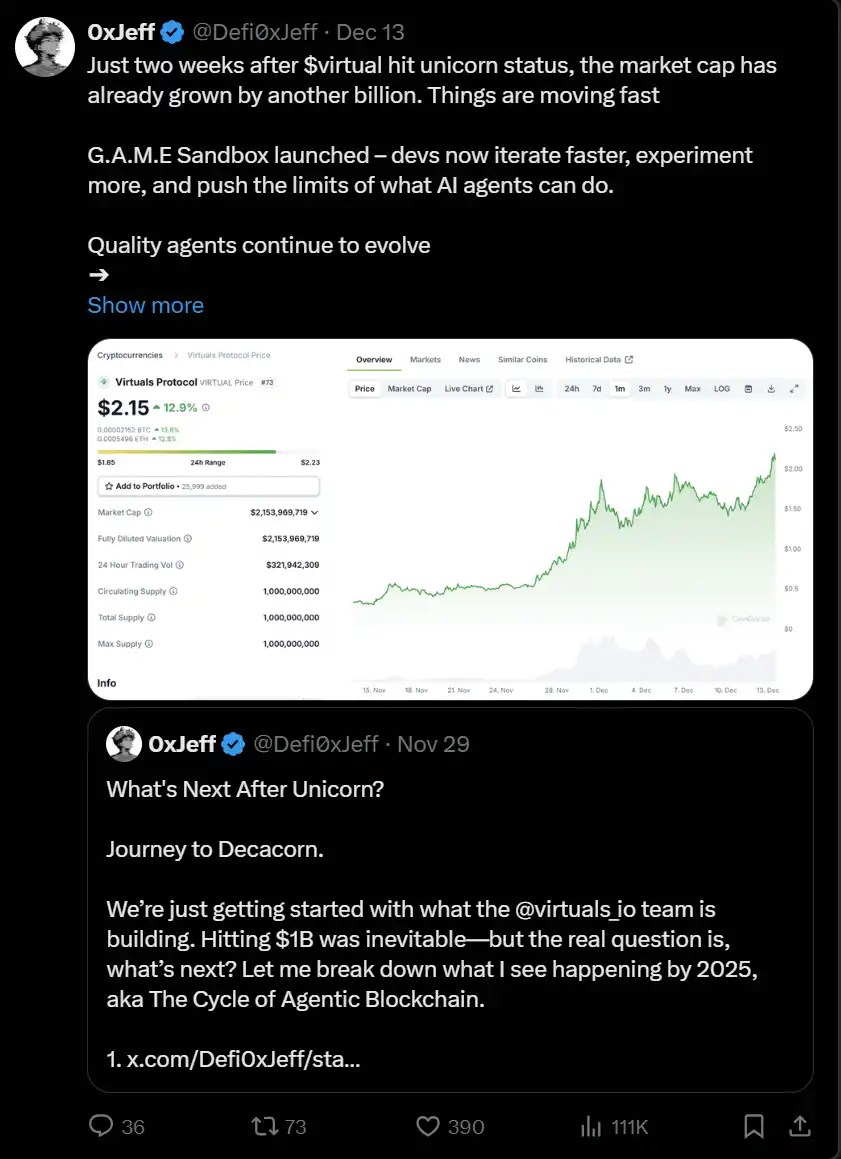
Virtuals io launched a platform where users can create AI agents and tokenize them, effectively funding their development costs.
The concept of AI agents began in October 2024, with Virtuals creating a market for agent ownership. Today, $VIRTUAL has a market cap of $2.5 billion.
What is the next big trend in tokenization?
Across these sectors — assets, art, yield, AI agents — we can see a clear pattern: pioneers in each space typically experience rapid adoption and significant price volatility.
Here are some ideas I’m watching:
Tokenization of Data
withvana is exploring DataDAOs and Data Liquidity Pools (DLPs).
Users can contribute data to these pools, maintain data ownership, and be rewarded based on the quality of their contributions.
Essentially, it turns data into a liquid, tradable asset.
$VANA went live on December 16th, and the concept of tokenized data ownership could be huge.
Tokenization of Attention
kaitoai is working on tokenizing attention in Web3, and they’ve demonstrated the ability to generate and facilitate more attention through their platform, the Mindshare dashboard, and most recently, the Yap-to-Earn feature.
Their Yapper leaderboard incentivizes thought leaders to speak out more, earn Yap points, and ultimately receive airdropped $KAITO tokens.
Basically, Yap = Attention = $KAITO. This is an interesting way to show how Web3 is redefining user engagement.
Tokenization of AI Applications
This looks like a natural extension of the AI agent trend.
With the rise of tools like Replit and an agent ecosystem, we are getting closer to personalized software creation.
Tokenized AI applications allow users to initiate development and own a share of the revenue generated by the application.
Competitors in the space include alchemistAIapp and myshell ai, both of which enable creators to build revenue-generating AI applications that provide real and scalable use cases.
Myshell goes a step further by allowing investors to invest directly in these applications and receive a share of the revenue generated by the applications in the future. This model not only supports development, but also aligns the interests of creators and investors.
Final Thoughts
Tokenization trends always bring new waves of innovation and adoption, but what’s exciting about them is not just the technology itself - it’s how they bring people together and turn the focus to new opportunities.
You may also like

Trump, the World's Largest Oil Trader

If the US and Iran have not reached an agreement in 5 days, what other cards does Trump have?

Tether Whale Dumps £12 Million, Backing Crypto’s ‘British Trump’
Ethereum Foundation Post: Rethinking the Division of Work Between L1 and L2 to Build the Ultimate Ethereum Ecosystem

Two Major Prediction Market Platforms Unite Rarely, What Is the Story Behind This New Fund?

WEEX Official Product Launch: Win LALIGA Tickets & Unlock the 3-in-1 Crypto Trading Suite
Trade crypto without downloading an app. Join the WEEX H5, API, SKILLs livestream to explore the new trading experience, win LALIGA VIP tickets, and share 420 USDT rewards.
Dragonfly Partners: Most agents will not engage in autonomous trading, how can crypto payments prevail?

US AI Startup Goes All In on Chinese Mega-Model | Rewire News Morning Brief

Trump Lies Again: A "Five-Day Pause" Psyop, How Wall Street, Bitcoin, and Polymarket Insiders Synced Uposciogen

When a Token Becomes Labor, People Become the Interface

Ceasefire News Leaked Ahead of Time? Large Polymarket Bets on Outcome Before Trump's Tweet
BlackRock CEO's Annual Shareholder Letter: How is Wall Street Using AI to Keep Profiting from National Pension Funds?

Sun Valley Releases 2025 Financial Report: Bitcoin Mining Revenue Reaches $670 Million, Accelerating Transformation to AI Infrastructure Platform
On March 16, 2026, in Dallas, Texas, USA, CanGu Company (New York Stock Exchange code: CANG, hereinafter referred to as "CanGu" or the "Company") today announced its unaudited financial performance for the fourth quarter and full year ended December 31, 2025. As a btc-42">bitcoin mining enterprise relying on a globally operated layout and dedicated to building an integrated energy and AI computing power platform, CanGu is actively advancing its business transformation and infrastructure development.
• Financial Performance:
Total revenue for the full year 2025 was $688.1 million, with $179.5 million in the fourth quarter.
Bitcoin mining business revenue for the full year was $675.5 million, with $172.4 million in the fourth quarter.
Full-year adjusted EBITDA was $24.5 million, while the fourth quarter was -$156.3 million.
• Mining Operations and Costs:
A total of 6,594.6 bitcoins were mined throughout the year, averaging 18.07 bitcoins per day; of which 1,718.3 bitcoins were mined in the fourth quarter, averaging 18.68 bitcoins per day.
The average mining cost for the full year (excluding miner depreciation) was $79,707 per bitcoin, and for the fourth quarter, it was $84,552;
The all-in sustaining costs were $97,272 and $106,251 per bitcoin, respectively.
As of the end of December 2025, the company has cumulatively produced 7,528.4 bitcoins since entering the bitcoin mining business.
• Strategic Progress:
The company has completed the termination of the American Depositary Receipt (ADR) program and transitioned to a direct listing on the NYSE to enhance information transparency and align with its strategic direction, with a long-term goal of expanding its investor base.
CEO Paul Yu stated: "2025 marked the company's first full year as a bitcoin mining enterprise, characterized by rapid execution and structural reshaping. We completed a comprehensive adjustment of our asset system and established a globally distributed mining network. Additionally, the company introduced a new management team, further strengthening our capabilities and competitive advantage in the digital asset and energy infrastructure space. The completion of the NYSE direct listing and USD pricing also signifies our transformation into a global AI infrastructure company."
"As we enter 2026, the company will continue to optimize its balance sheet structure and enhance operational efficiency and cost resilience through adjustments to the miner portfolio. At the same time, we are advancing our strategic transformation into an AI infrastructure provider. Leveraging EcoHash, we will utilize our capabilities in scalable computing power and energy networks to provide cost-effective AI inference solutions. The relevant site transformations and product development are progressing simultaneously, and the company is well-positioned to sustain its execution in the new phase."
The company's Chief Financial Officer, Michael Zhang, stated: "By 2025, the company is expected to achieve significant revenue growth through its scaled mining operations. Despite recording a net loss of $452.8 million from ongoing operations, mainly due to one-time transformation costs and market-driven fair value adjustments, the company, from a financial perspective, will reduce its leverage, optimize its Bitcoin reserve strategy and liquidity management, introduce new capital to strengthen its financial position, and seize investment opportunities in high-potential areas such as AI infrastructure while navigating market volatility."
The total revenue for the fourth quarter was $1.795 billion. Of this, the Bitcoin mining business contributed $1.724 billion in revenue, generating 1,718.3 Bitcoins during the quarter. Revenue from the international automobile trading business was $4.8 million.
The total operating costs and expenses for the fourth quarter amounted to $4.56 billion, primarily attributed to expenses related to the Bitcoin mining business, as well as impairment of mining machines and fair value losses on Bitcoin collateral receivables.
This includes:
· Cost of Revenue (excluding depreciation): $1.553 billion
· Cost of Revenue (depreciation): $38.1 million
· Operating Expenses: $9.9 million (including related-party expenses of $1.1 million)
· Mining Machine Impairment Loss: $81.4 million
· Fair Value Loss on Bitcoin Collateral Receivables: $171.4 million
The operating loss for the fourth quarter was $276.6 million, a significant increase from a loss of $0.7 million in the same period of 2024, primarily due to the downward trend in Bitcoin prices.
The net loss from ongoing operations was $285 million, compared to a net profit of $2.4 million in the same period last year.
The adjusted EBITDA was -$156.3 million, compared to $2.4 million in the same period last year.
The total revenue for the full year was $6.881 billion. Of this, the revenue from the Bitcoin mining business was $6.755 billion, with a total output of 6,594.6 Bitcoins for the year. Revenue from the international automobile trading business was $9.8 million.
The total annual operating costs and expenses amount to $1.1 billion.
Specifically, they include:
· Revenue Cost (excluding depreciation): $543.3 million
· Revenue Cost (depreciation): $116.6 million
· Operating Expenses: $28.9 million (including related-party expenses of $1.1 million)
· Miner Impairment Loss: $338.3 million
· Bitcoin Collateral Receivable Fair Value Change Loss: $96.5 million
The full-year operating loss is $437.1 million. The continuing operations net loss is $452.8 million, while in 2024, there was a net profit of $4.8 million.
The 2025 non-GAAP adjusted net profit is $24.5 million (compared to $5.7 million in 2024). This measure does not include share-based compensation expenses; refer to "Use of Non-GAAP Financial Measures" for details.
As of December 31, 2025, the company's key assets and liabilities are as follows:
· Cash and Cash Equivalents: $41.2 million
· Bitcoin Collateral Receivable (Non-current, related party): $663.0 million
· Miner Net Value: $248.7 million
· Long-Term Debt (related party): $557.6 million
In February 2026, the company sold 4,451 bitcoins and repaid a portion of related-party long-term debt to reduce financial leverage and optimize the asset-liability structure.
As per the stock repurchase plan disclosed on March 13, 2025, as of December 31, 2025, the company had repurchased a total of 890,155 shares of Class A common stock for approximately $1.2 million.

The US AI Startup Is Loving China's Open Source Model

Three Weeks of the US-Iran War: Who's Making Money, Who's Paying the Bill?

Interpreting Polymarket's Major Update Last Night: Fee Expansion, Self-Regulation, and New Incentives

From Human Application to Intelligent Collaboration: How GOAT Network Builds the Next Generation Digital Economy

CZ Washington Dialogue: Crypto Entrepreneurs are Accelerating Their Return to the United States
Trump, the World's Largest Oil Trader
If the US and Iran have not reached an agreement in 5 days, what other cards does Trump have?
Tether Whale Dumps £12 Million, Backing Crypto’s ‘British Trump’
Ethereum Foundation Post: Rethinking the Division of Work Between L1 and L2 to Build the Ultimate Ethereum Ecosystem
Two Major Prediction Market Platforms Unite Rarely, What Is the Story Behind This New Fund?
WEEX Official Product Launch: Win LALIGA Tickets & Unlock the 3-in-1 Crypto Trading Suite
Trade crypto without downloading an app. Join the WEEX H5, API, SKILLs livestream to explore the new trading experience, win LALIGA VIP tickets, and share 420 USDT rewards.


 App
App