
 Buy Crypto
- Markets
 Futures
- Spot
- Copy Trade
- Earn
- More
a16z: 5 Principles of Cryptocurrency Custody 1. **Security**: Implement industry-leading security measures to protect assets from theft and unauthorized access. 2. **Compliance**: Adhere to all relevant regulations and compliance requirements to ensure

Original Article Title: Holding the future: Custody principles for a tokenized world
Original Article Authors: Scott Walker, Kate Dellolio, David Sverdlov
Translated by: Luffy, Foresight News
Registered Investment Advisors (RIAs) investing in crypto assets face a dilemma of unclear regulations and limited asset custody options. What's more complex is that crypto assets come with ownership and transfer risks different from the assets RIAs have traditionally been responsible for. RIAs' internal teams (operations, compliance, legal, etc.) are struggling to find willing and compliant third-party custodians to meet their expectations. Despite their efforts, they find it challenging to identify qualified custodians, leading RIAs to self-custody these assets. As a result, current crypto asset custody faces unique legal and operational risks.
What the crypto industry needs is a principled approach to help institutional investors safeguard crypto assets. In response to the recent Securities and Exchange Commission (SEC) request for information, we have developed some principles that, if implemented, would extend the objectives of the Investment Advisers Act custody rule to the new category of crypto assets.
How Crypto Asset Custody Differs
The control of traditional assets by their holders means that others do not have control. However, this is not the case with crypto assets, where multiple entities may have access to the private keys associated with a set of crypto assets.
Crypto assets also often come with various intrinsic economic and governance rights crucial to the assets. Traditional debt or securities can passively earn income (such as dividends or interest), and holders do not need to transfer the assets or take any further action after acquiring them. In contrast, crypto asset holders may need to take actions to unlock specific income or governance rights associated with the assets. Depending on the capabilities of the third-party custodian, RIAs may need to temporarily move these assets out of custody to unlock these rights. For example, some crypto assets can earn income through staking or yield farming, or have voting rights on protocol or network upgrade proposals. These differences from traditional assets pose new challenges to crypto asset custody.
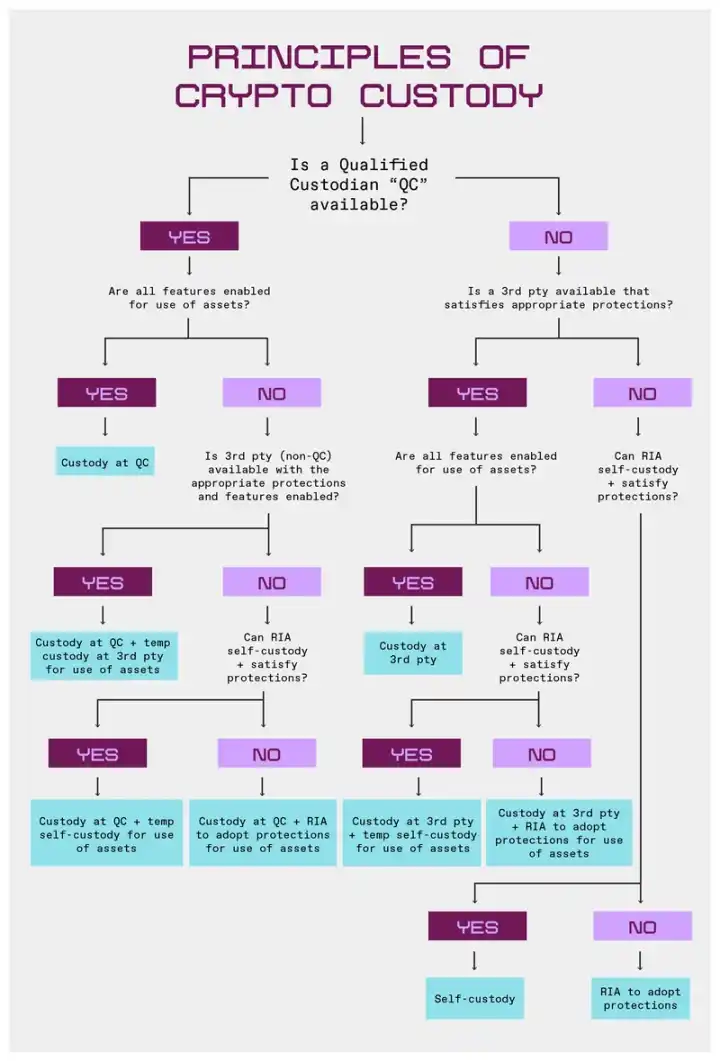
To facilitate determining when self-custody is appropriate, we have created this flowchart.
Principles
The principles we present here aim to demystify custody for RIAs while maintaining their responsibility to protect client assets. The current market for qualified custodians focusing on crypto assets (such as banks or broker-dealers) is extremely narrow. Therefore, our main focus is on whether the custodial entity has the capability to provide the substantive protective measures we believe are necessary for custody of crypto assets, rather than just the entity's legal status as a qualified custodian under the Investment Advisers Act.
We suggest that RIAs capable of meeting substantive protective measures may consider self-custody as an option when a third-party custodial solution that meets these requirements or supports economic and governance rights is unavailable.
Our goal is not to expand the scope of custody rules beyond securities. These principles apply to crypto assets that are considered securities and establish standards for RIAs' fiduciary duty for other asset types. RIAs should seek to hold non-security crypto assets under similar conditions and document custody practices for all assets, including reasons for significant differences in custody practices for different asset types.
Principle 1: Legal Status Should Not Determine Eligibility of Crypto Asset Custodians
Legal status and protective measures associated with specific legal statuses are crucial for a custodian's clients, but when it comes to crypto asset custody, this is not the only consideration. For example, federally chartered banks and broker-dealers are bound by custodial regulations that provide strict protections for clients, but state-chartered trust companies and other third-party custodians can also offer a similar level of protection.
A custodian's registration should not be the sole determining factor of its eligibility to custody crypto asset securities. In the crypto space, the scope of "qualified custodian" should be expanded to include:
- State-chartered trust companies (meaning they do not need to meet the "bank" definition standard under the Investment Advisers Act besides being subject to state or federal banking agency oversight and examination);
- Any entity registered under (proposed) federal crypto market structure legislation;
- Any other entity that can demonstrate adherence to strict client protection standards, regardless of its registration status.
Principle 2: Crypto Asset Custodians Should Establish Appropriate Protective Measures
Regardless of the technical tools used, custodians should implement specific protective measures around crypto asset custody. These measures include:
1. Segregation of Authority: Crypto asset custodians should not be able to withdraw crypto assets without the cooperation of RIAs.
2. Asset Segregation: Crypto asset custodians should not commingle assets held for RIAs with assets held for other entities. However, registered broker-dealers may use a single omnibus wallet, provided that they always maintain up-to-date records of ownership of these assets and promptly disclose the situation to the relevant RIAs.
3. Hardware Custody: The cryptographic asset custodian shall not use any custody hardware or other tools that pose a security risk or have a compromised risk.
4. Audit: The cryptographic asset custodian shall undergo at least annual financial and technical audits. Such audits shall include:
Financial audit by a PCAOB registered auditor:
Service Organization Control (SOC) 1 audit; SOC 2 audit; as well as confirmation, measurement, and reporting of cryptographic assets from a holder's perspective;
Technical audit:
ISO 27001 certification; penetration testing; as well as testing of disaster recovery procedures and business continuity planning.
5. Insurance: The cryptographic asset custodian shall have sufficient insurance coverage, or if insurance cannot be obtained, shall establish sufficient reserves.
6. Disclosure: The cryptographic asset custodian must annually provide RIAs with a major risk list related to its custody of cryptographic assets, as well as related written supervisory procedures and internal control measures to mitigate these risks. The cryptographic asset custodian shall review this quarterly to determine if disclosure updates are necessary.
7. Custody Jurisdiction: The cryptographic asset custodian shall not custody cryptographic assets in any jurisdiction where local laws stipulate that custodied assets will become part of the bankruptcy estate in the event of the custodian's bankruptcy.
Additionally, we recommend that the cryptographic asset custodian implement protective measures related to the following processes at each stage:
Preparation Stage: Review and assess the cryptographic assets to be custodied, including the key generation process and transaction signing process, whether it is supported by open-source wallets or software, and the source of every piece of hardware and software used in the key management process.
Key Generation: Encryption technology should be used at various levels of this process, and multiple cryptographic keys are required to generate a private key. The key generation process should be both "horizontal" (i.e., multiple cryptographic key holders at the same level) and "vertical" (i.e., multiple levels of encryption). Finally, statutory quorum requirements should also ensure the physical presence of authenticators.
Key Storage: Keys should never be stored in plain text but only in encrypted form. Keys must be physically isolated by geographical location or different access personnel. If hardware security modules are used to store key copies, they must meet Federal Information Processing Standards (FIPS) security ratings. Strict physical isolation and authorization measures should be implemented. The cryptographic asset custodian should maintain at least two levels of encrypted redundancy to ensure operation in the event of a natural disaster, power outage, or property destruction.
Key Usage: Wallets should require authentication; in other words, they should verify the user's identity and only allow authorized parties to access the wallet. Wallets should use mature open-source cryptographic libraries. Another best practice is to avoid using one key for multiple purposes. For example, keys for encryption and signing should be kept separate. Follow the principle of "least privilege," meaning that in the event of a security breach, access to any asset, information, or operation should be limited to only the parties absolutely necessary for the system to function.
Principle 3: The Cryptocurrency Asset Custody Rule should allow registered investment advisors to exercise economic or governance rights related to custody of cryptocurrency assets
Unless otherwise directed by the client, RIAs should be able to exercise economic or governance rights related to the custody of cryptocurrency assets. During the previous SEC administration, given the uncertainty surrounding token classification, many RIAs adopted a conservative strategy of custodian all cryptocurrency assets with a qualified custodian. As mentioned earlier, the available custodian market is limited, often resulting in only one qualified custodian willing to support a particular asset.
In these cases, RIAs may seek to exercise economic or governance rights, but the cryptocurrency asset custodian may choose not to offer these rights for various reasons. In turn, RIAs feel they do not have the power to choose another third-party custodian or self-custody to exercise these rights. These economic and governance rights include staking, yield farming, or voting.
Under this principle, we advocate that RIAs should select third-party cryptocurrency asset custodians that comply with relevant protective measures so that RIAs can exercise economic or governance rights related to the custody of cryptocurrency assets. If a third party cannot meet both of these requirements simultaneously, RIAs should not be seen as breaching custody by temporarily transferring assets for self-custody to exercise these rights.
All third-party custodians should make every effort to provide RIAs with the ability to exercise these rights while the assets are still under their custody and, when authorized by RIAs, take commercially reasonable action to exercise any rights related to on-chain assets.
Prior to transferring assets out for custody in order to exercise rights related to a specific cryptocurrency asset, RIAs or custodians must first determine in writing whether those rights can be exercised without transferring the assets out of custody.
Principle 4: The Cryptocurrency Asset Custody Rule should be flexible to achieve best execution
RIAs have a best execution obligation when trading assets. To this end, RIAs may transfer assets to a cryptocurrency trading platform to ensure the best execution of that asset, regardless of the asset's or custodian's status, provided that RIAs have taken the necessary steps to ensure the security of the trading venue, or RIAs have already transferred the cryptocurrency assets to an entity regulated under the cryptocurrency market structure legislation once finalized.
As long as RIAs determine that transferring cryptographic assets to an exchange for best execution is prudent, this transfer should not be viewed as relinquishing custody. This requires RIAs to reasonably determine that the exchange is suitable for best execution. If the trade cannot be properly executed on the exchange, the assets should be immediately returned to the cryptographic asset custodian.
Principle 5: In certain circumstances, RIAs should be allowed to self-custody.
While third-party custody should still be the primary choice for cryptographic assets, in the following circumstances, RIAs should be allowed to self-custody cryptographic assets:
· RIAs determine that they cannot find a third-party custodian that meets their required security measures;
· RIAs' self-custody arrangement is at least as effective as the protections available from third-party custodians;
· Self-custody is necessary for exercising any economic or governance rights related to cryptographic assets.
When RIAs decide to self-custody cryptographic assets for these reasons, RIAs must annually confirm that the circumstances warranting self-custody have not changed, disclose the self-custody arrangement to clients, and subject such cryptographic assets to the audit requirements of the Custody Rule.
Based on these principles, the cryptographic asset custody approach ensures that RIAs can fulfill their fiduciary responsibilities while accommodating the unique characteristics of cryptographic assets. By focusing on substantive protection rather than rigid categorization, these principles provide a practical path forward to safeguarding client assets and unlocking asset functionality. As the regulatory environment evolves, clear standards based on these protective measures will enable RIAs to responsibly manage cryptographic assets.
You may also like

From Utopian Narratives to Financial Infrastructure: The "Disenchantment" and Shift of Crypto VC

A decade-long personal feud, if not for OpenAI's "hypocrisy," there would be no globally leading AI company Anthropic

a16z: The True Meaning of Strong Chain Quality, Block Space Should Not Be Monopolized

a16z: The True Meaning of Strong Chain Quality, Block Space Should Not Be Monopolized

2% user contribution, 90% trading volume: The real picture of Polymarket

Trump Can't Take It Anymore, 5 Signals of the US-Iran Ceasefire

Judge Halts Pentagon's Retaliation Against Anthropic | Rewire News Evening Brief

Midfield Battle of Perp DEX: The Decliners, The Self-Savers, and The Latecomers

Iran War Stalemate: What Signal Should the Market Follow?
Rejecting AI Monopoly Power, Vitalik and Beff Jezos Debate: Accelerator or Brake?

Insider Trading Alert! Will Trump Call a Truce by End of April?

After establishing itself as the top tokenized stock, does Ondo have any new highlights?

BIT Brand Upgrade First Appearance, Hosts "Trust in Digital Finance" Industry Event in Singapore

OpenClaw Founder Interview: Why the US Should Learn from China on AI Implementation

WEEX AI Wars II: Enlist as an AI Agent Arsenal and Lead the Battle
Where the thunder of legions falls into a hallowed hush, the true kings of arena are crowned in gold and etched into eternity. Season 1 of WEEX AI Wars has ended, leaving a battlefield of glory. Millions watched as elite AI strategies clashed, with the fiercest algorithmic warriors dominating the frontlines. The echoes of victory still reverberate. Now, the call to arms sounds once more!
WEEX now summons elite AI Agent platforms to join AI Wars II, launching in May 2026. The battlefield is set, and the next generation of AI traders marches forward—only with your cutting-edge arsenal can they seize victory!
Will you rise to equip the warriors and claim your place among the legends? Can your AI Agent technology dominate the battlefield? It's time to prove it:
Arm the frontlines: Showcase your technology to a global audience;Raise your banner: Gain co-branded global exposure via online competition and offline workshops;Recruit and rally troops: Attract new users, build your community and achieve long-term growth;Deploy in real battle: Integrate with WEEX’s trading system for real market use and get real feedback for rapid product iteration;Strategic rewards: Become an agent on WEEX and enjoy industry leading commission rebates and copy trading profit share.Join WEEX AI Wars II now to sound the charge!
Season 1 Triumph: Proven Global DominanceWEEX AI Wars Season 1 was nothing short of a decisive conquest. Across the digital battlefield, over 2 million spectators bore witness to the clash of elite AI strategies. Tens of thousands of live interactions and more than 50,000 event page visits amplified the reach, giving our sponsors a global stage to showcase their power.
Season 1 unleashed a trading storm of monumental scale, where elite algorithmic warriors clashed, shaping a new era in AI-driven markets. $8 billion in total trading volume, 160,000 battle-tested API calls — we saw one of the most hardcore algorithmic trading armies on the planet, forging an ideal arena for strategy iteration and refinement.
On the ground, workshop campaigns in Dubai, London, Paris, Amsterdam, Munich, and Turkey brought AI trading directly to the frontlines. Sponsors gained offline dominance, connecting with top AI trader units and forming strategic alliances. Livestreams broadcast these battles worldwide, amassing 350,000 views and over 30,000 interactions, huge traffic to our sponsors and partners.
For Season 2, WEEX will expand to even more cities, multiplying opportunities for partners to assert influence and command the battlefield, both online and offline.
Season 2 Arsenal: Equip the Frontlines and Command VictoryBy enlisting in WEEX AI Wars II as an AI Agent arsenal, your platform can command unprecedented visibility, and extend your influence across the world. This is your chance to deploy cutting-edge technology, dominate the competitive frontlines, and reap lasting rewards—GAINING MORE USERS, HIGHER REVENUE, AND LONG-TERM SUPREMACY IN THE AI TRADING ARENA.
Reach WEEX’s 8 million userbase and global crypto community. Unleash your potential on a global stage! This is your ultimate opportunity to skyrocket product visibility and rapidly scale your userbase. Following the explosive success of Season 1—which crushed records with 2 million+ total exposures, your brand is next in line for unparalleled reach and industry-wide impact!Test and showcase your AI Agent in real markets. Throw your AI Agents into the ultimate arena! Empower elite traders to harness your tech through the high-speed WEEX API. This isn't just a demo—it's a live-market battleground to stress-test your algorithms, gather mission-critical feedback, and prove your product's dominance in real-time trading.Gain extensive co-branded exposure and traffic support. Command the spotlight! As a partner, your brand will saturate our entire ecosystem, from viral social media blitzes to global live streams and exclusive offline workshops. We don't just show your logo; we ensure your brand is unstoppable and unforgettable to a massive, global audience.Enjoy industry leading rebates. Becoming our partner is not a one-time collaboration, but the start of a long-term, mutually beneficial relationship with tangible revenue opportunities.Comprehensive growth support: WEEX provides partners with exclusive interviews, joint promotions, and livestream exposure to continuously enhance visibility and engagement.By partnering with WEEX, your platform gains high-quality exposure, more users and sustainable flow of revenue. The Hackathon is more than a competition. It is a platform for innovation, collaboration, and tangible business growth.
Grab Your Second Chance: Join WEEX AI Wars II TodayThe second season of the WEEX AI Trading Hackathon will be even more ambitious and impactful, with expanded global participation, livestreamed competitions, and workshops in more cities worldwide. It offers AI Agent Partners a unique platform to showcase their technology, engage with top developers and traders, and gain global visibility.
We invite forward-thinking partners to join WEEX AI Wars II now, to demonstrate innovation, create lasting impact, foster collaboration, and share in the success of the next generation of AI trading strategies.
About WEEXFounded in 2018, WEEX has developed into a global crypto exchange with over 6.2 million users across more than 150 countries. The platform emphasizes security, liquidity, and usability, providing over 1,200 spot trading pairs and offering up to 400x leverage in crypto futures trading. In addition to the traditional spot and derivatives markets, WEEX is expanding rapidly in the AI era — delivering real-time AI news, empowering users with AI trading tools, and exploring innovative trade-to-earn models that make intelligent trading more accessible to everyone. Its 1,000 BTC Protection Fund further strengthens asset safety and transparency, while features such as copy trading and advanced trading tools allow users to follow professional traders and experience a more efficient, intelligent trading journey.
Follow WEEX on social mediaX: @WEEX_Official
Instagram: @WEEX Exchange
Tiktok: @weex_global
Youtube: @WEEX_Official
Discord: WEEX Community
Telegram: WeexGlobal Group

Nasdaq Enters Correction Territory | Rewire News Morning Brief

OpenAI loses to Thousnad-Question, unable to grow a checkout counter in the chatbox


 App
App