
 Buy Crypto
- Markets
 Futures
- Spot
- Copy Trade
- Earn
- More
40 Million Token Liquidity Standstill: How Do Project Teams 'Eat' During a Bear Market?

Original Article Title: When Tokens Burn
Original Article Author: @desh_saurabh, Decentralised.Co
Original Article Translation: Deep Tide TechFlow
Zero-Sum Attention Game
In 2021, each cryptocurrency asset had an average of around $1.8 million in stablecoin liquidity. However, by March 2025, this number had plummeted to just $5,500.
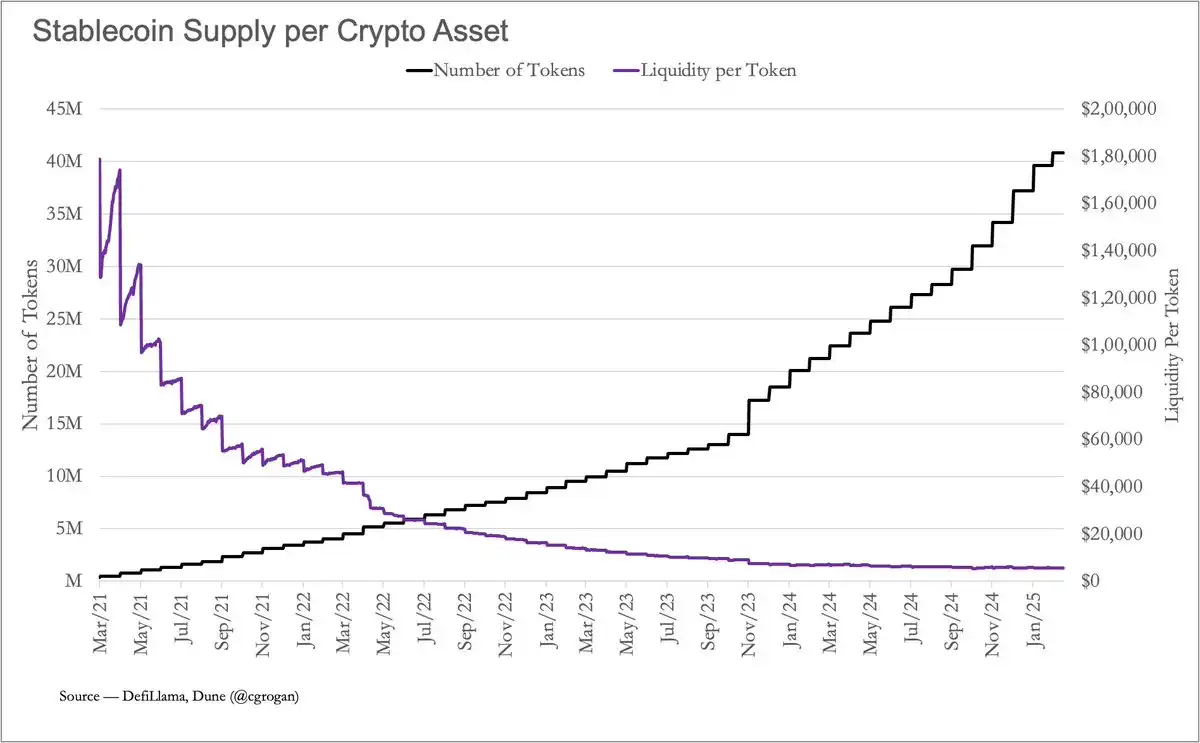
This chart visually demonstrates the decline in averages, while also reflecting the zero-sum nature of attention in today's crypto space. Despite the number of tokens skyrocketing to over 40,000 assets, stablecoin liquidity (as a rough measure of capital) has remained stagnant. The result is brutal—less capital per project, weaker communities, and rapidly declining user engagement.
In this environment, fleeting attention is no longer a channel for growth but a burden. Without the support of cash flow, this attention swiftly shifts, showing no mercy.
Income as the Anchor of Development
Most projects still build communities in the same way as they did in 2021: create a Discord channel, offer airdrop incentives, and hope users will "GM" (Good Morning) long enough to generate interest. However, once the airdrop ends, users quickly depart. This outcome is not surprising as they have no reason to stay.
At this point, the role of income becomes apparent—it is not just a financial metric but also a critical proof of project relevance. A product that can generate income implies demand. Demand supports valuation, and valuation, in turn, gives the token gravity.
While income may not be the ultimate goal for every project, without income, most tokens simply cannot survive long enough to become foundational assets.
It is important to note that some projects' positioning is vastly different from other parts of the industry. Take Ethereum, for example; it does not need additional income as it already has a mature and sticky ecosystem. Validator rewards come from an inflation of about 2.8% annually, but with EIP-1559's fee burn mechanism, this inflation can be offset. As long as burn and revenue can balance, ETH holders can avoid dilution risk.
However, for new projects, they do not have such a luxury. When only 20% of the tokens are in circulation and you are still struggling to find product-market fit, you are essentially like a startup. You need to make a profit and prove that you have the ability to sustain profitability in order to survive.
Protocol Lifecycle: From Explorer to Giant
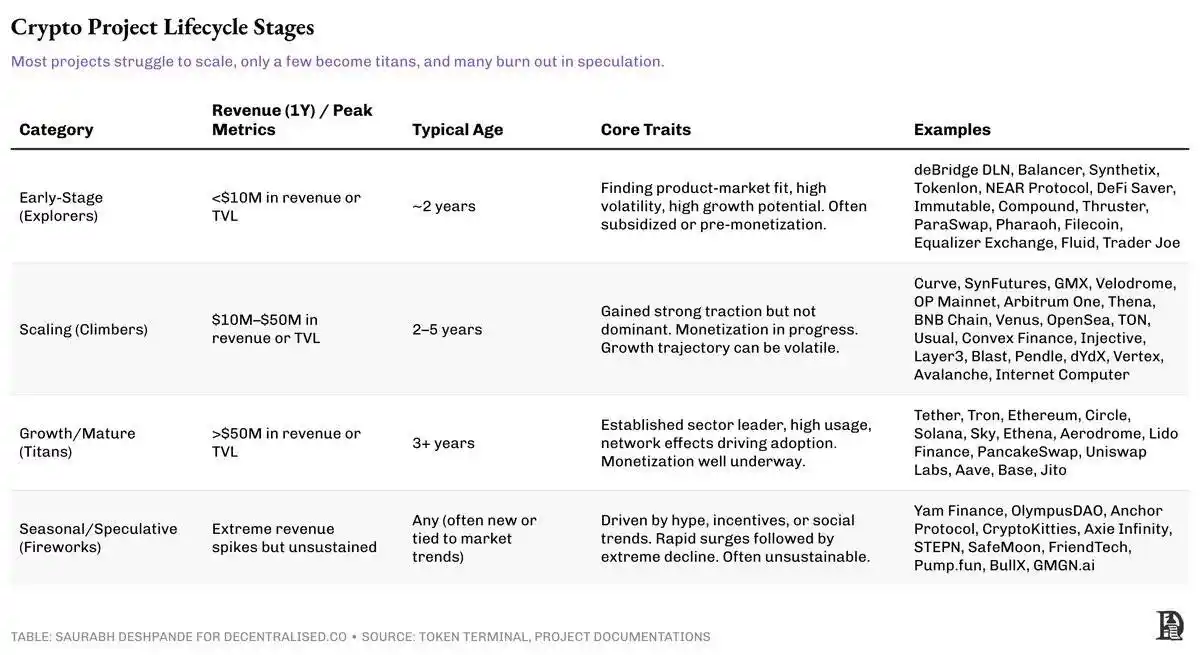
Similar to traditional companies, crypto projects go through different stages of maturity. At each stage, the relationship between the project and revenue—whether to reinvest or distribute revenue—undergoes significant changes.
Explorer: Prioritizing Survival
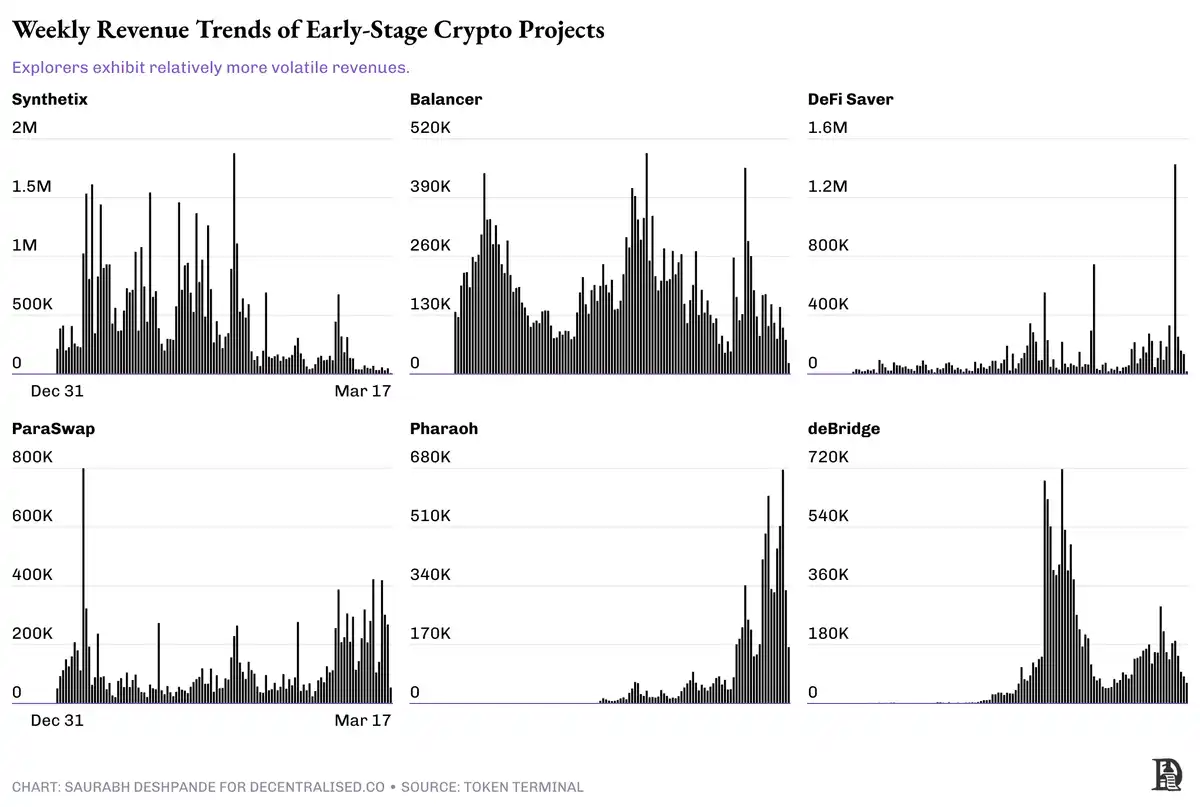
These are early-stage projects, usually with centralized governance, a fragile ecosystem, and a focus on experimentation rather than monetization. Even if there is revenue, it is often volatile and unsustainable, reflecting more market speculation than user loyalty. Many projects rely on incentives, grants, or venture capital to sustain themselves.
For example, projects like Synthetix and Balancer have been around for about 5 years. Their weekly revenue ranges from $100,000 to $1 million, with occasional spikes during peak activity. This significant volatility is a typical feature of this stage, not a sign of failure but a manifestation of volatility. The key is whether these teams can translate the experiment into a reliable use case.
Climber: Gaining Traction but Still Unstable
Climbers are projects in the advanced stage, with annual revenue between $10 million and $50 million, gradually moving away from a token issuance-driven growth model. Their governance structures are maturing, shifting their focus from mere user acquisition to long-term user retention. Unlike Explorers, Climbers' revenue has already proven demand across different cycles, not solely driven by one-off hype. Additionally, they are undergoing structural evolution—from centralized teams to community-driven governance and diversifying revenue streams.
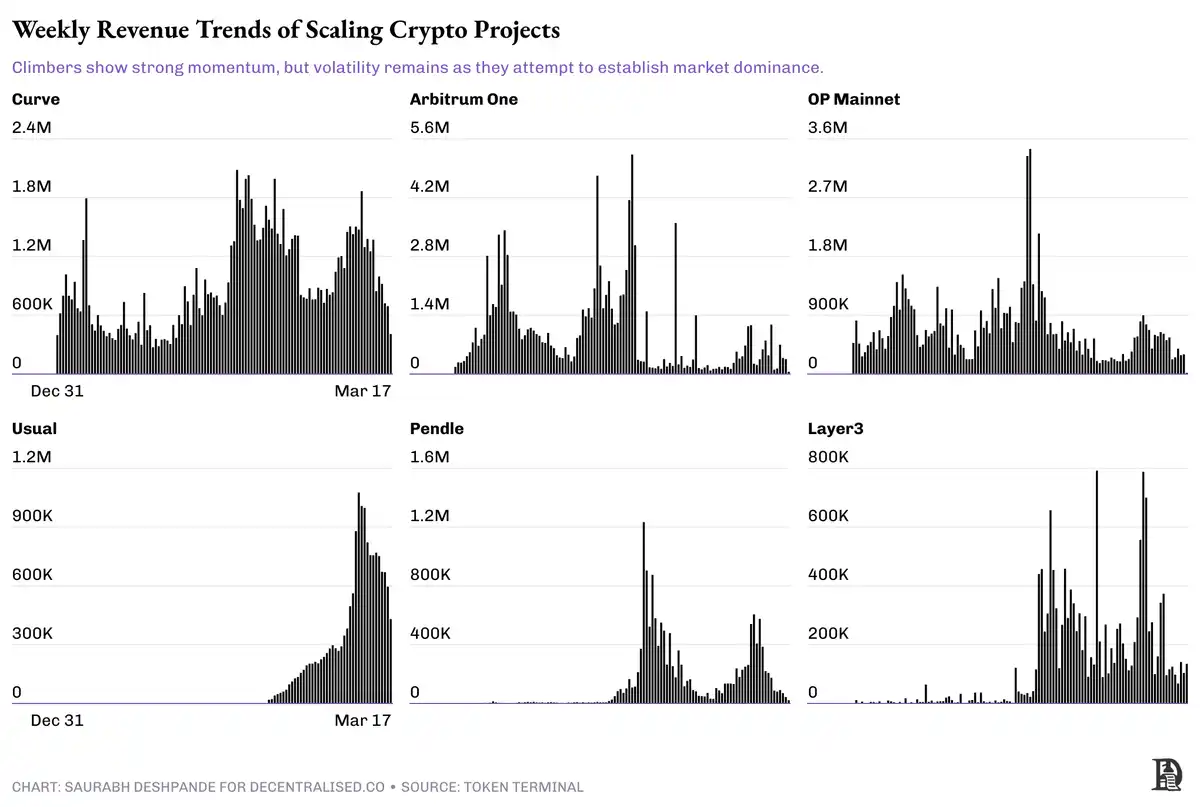
What sets Climbers apart is their flexibility. They have accumulated enough trust to experiment with revenue distribution—some projects are starting revenue sharing or buyback programs. However, they also face the risk of losing momentum, especially in cases of overexpansion or failure to deepen moats. While Explorers' primary task is survival, Climbers must make strategic trade-offs: choosing between growth and consolidation, revenue distribution or reinvestment, focusing on core business or diversifying.
The vulnerability at this stage is not about volatility, but about the stakes becoming visibly real.
These projects face the toughest decision: if they allocate revenue too early, it could hinder growth; but if they wait too long, token holders may lose interest.
Titans: Ready to Allocate
Projects like Aave, Uniswap, and Hyperliquid have already crossed the threshold. They can generate stable income, have decentralized governance, and benefit from strong network effects. These projects no longer rely on an inflationary tokenomics model, having a solid user base and a market-proven business model.
These titans typically do not try to "do it all." Aave focuses on the lending market, Uniswap leads in spot trading, and Hyperliquid is building an execution-centric DeFi stack. Their strength comes from defensible market positioning and operational discipline.
Most titans are leaders in their respective fields. Their efforts are usually focused on "growing the pie" — driving overall market growth rather than just expanding their own market share.
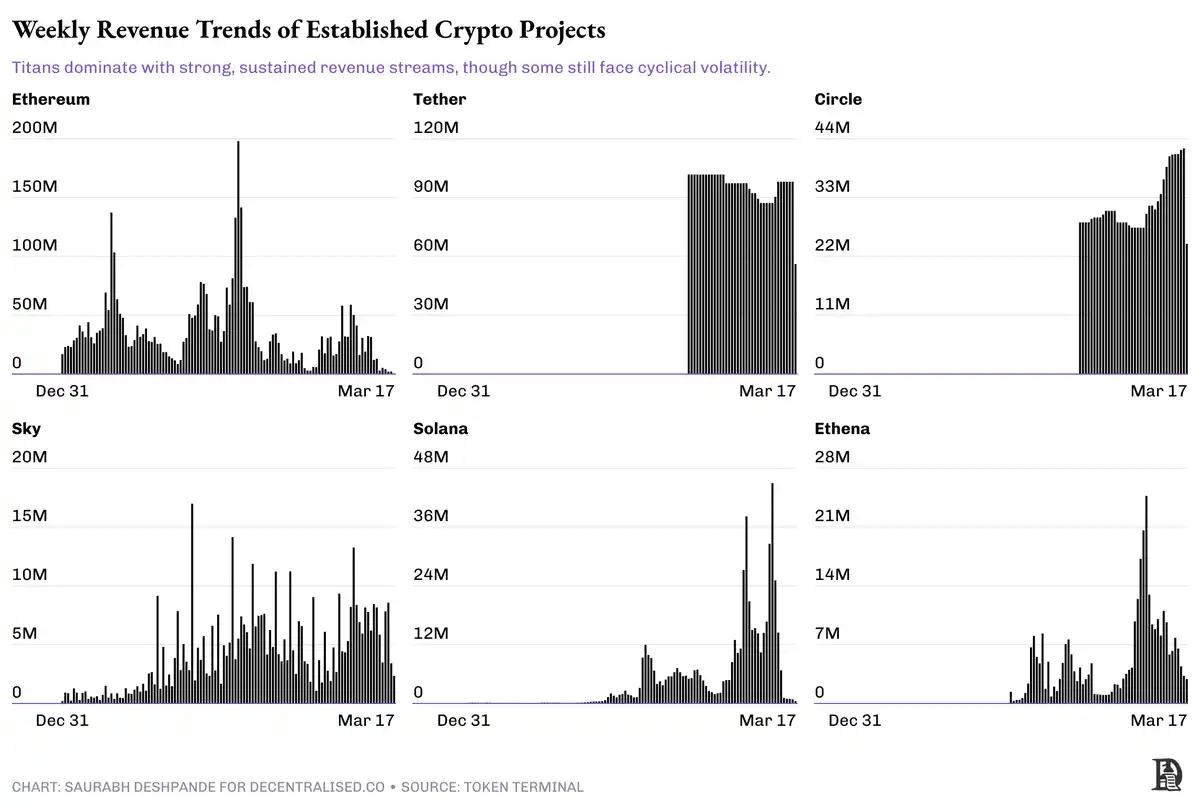
These projects are the kind that can easily conduct buybacks and still sustain operations for years. While they are not completely immune to volatility, they have enough resilience to cope with market uncertainty.
Seasonal Players: Flashy but Lacking Foundation
Seasonal players are the most prominent yet fragile type. Their revenue may rival or even surpass the titans in a short time, but this revenue is mainly driven by hype, speculation, or short-lived social trends.
For example, projects like FriendTech and PumpFun can create massive engagement and trading volume in a short time, but they rarely can convert these into long-term user retention or sustained business growth.
These projects are not inherently bad. Some may pivot and evolve, but most are merely reliant on short-term games of market momentum rather than building lasting infrastructure.
Lessons from the Public Markets
The public stock market provides a helpful analogy. Young companies usually reinvest free cash flow for scale, while mature companies distribute profits through dividends or stock buybacks.
The chart below illustrates how companies distribute profits. As companies grow, the number of companies engaging in dividends and buybacks increases.
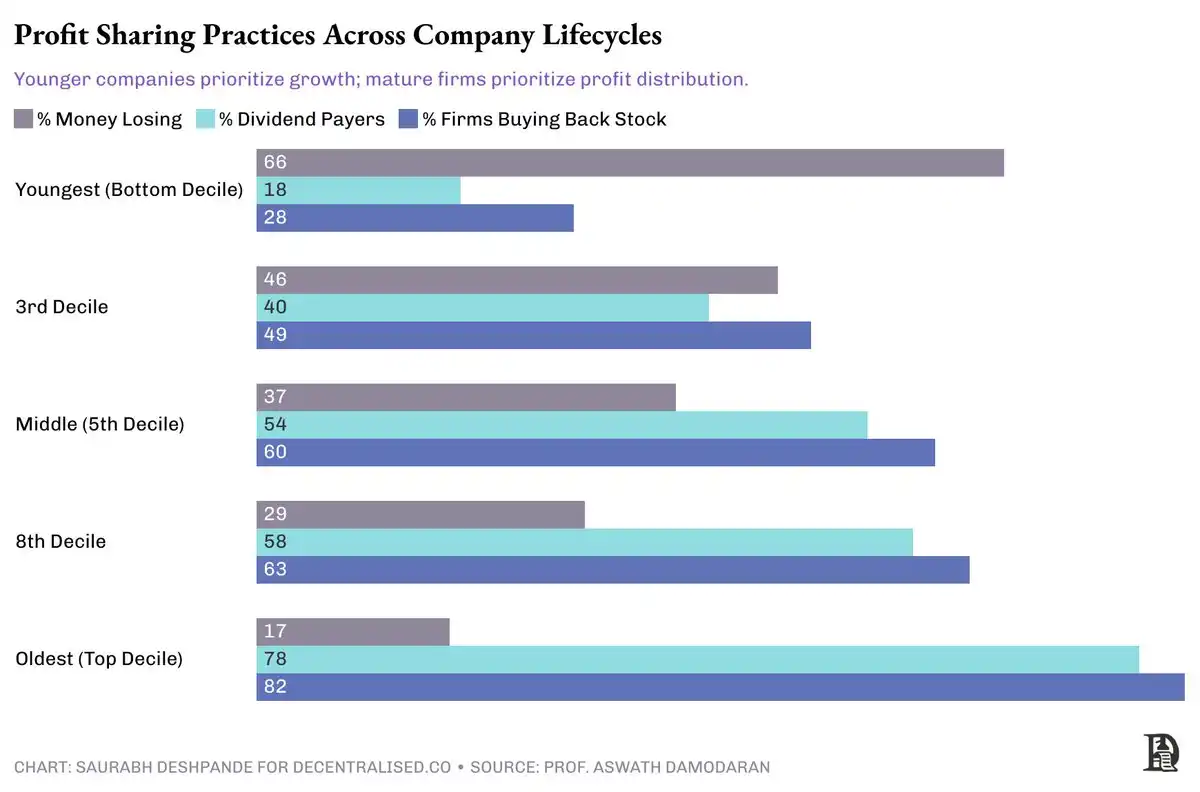
Cryptocurrency projects can learn from each other. Giants should focus on profit distribution, while explorers should emphasize retention and compounding growth. However, not every project clearly identifies which stage it belongs to.
Industry characteristics are also crucial. Projects similar to utilities (e.g., stablecoins) are more like consumer staples: stable and suitable for dividends. This is because these companies have existed for a long time, and demand patterns are largely predictable. Companies often do not deviate from forward-looking guidance or trends. Predictability allows them to consistently share profits with shareholders.
On the other hand, high-growth DeFi projects are more like the tech industry—where a flexible buyback plan is the preferred value distribution method. Tech companies usually experience higher seasonal fluctuations. In most cases, their demand is not as predictable as in some more traditional industries. This unpredictability makes buybacks the preferred way to share value.
If a quarter or year performs exceptionally well? Distribute value through share buybacks.
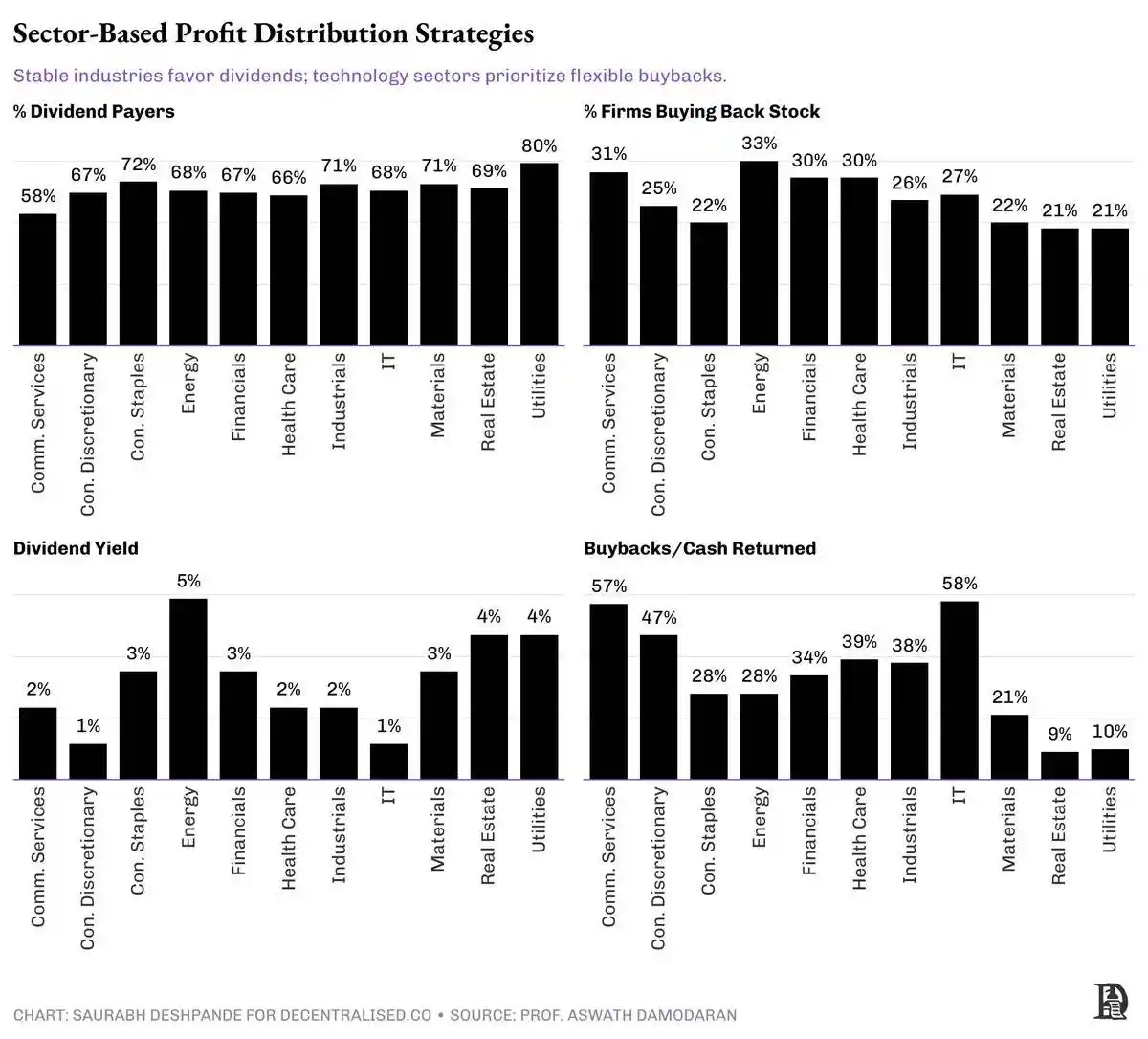
Comparison of Dividends and Buybacks
Dividends have stickiness. Once a dividend payment is committed, the market expects consistency. In contrast, buybacks are more flexible, allowing teams to adjust the timing of value distribution based on market cycles or when the token is undervalued. From a distribution of around 20% of profits in the 1990s to about 60% in 2024, buybacks have grown rapidly over the past few decades. In dollar terms, the scale of buybacks has exceeded dividends since 1999.
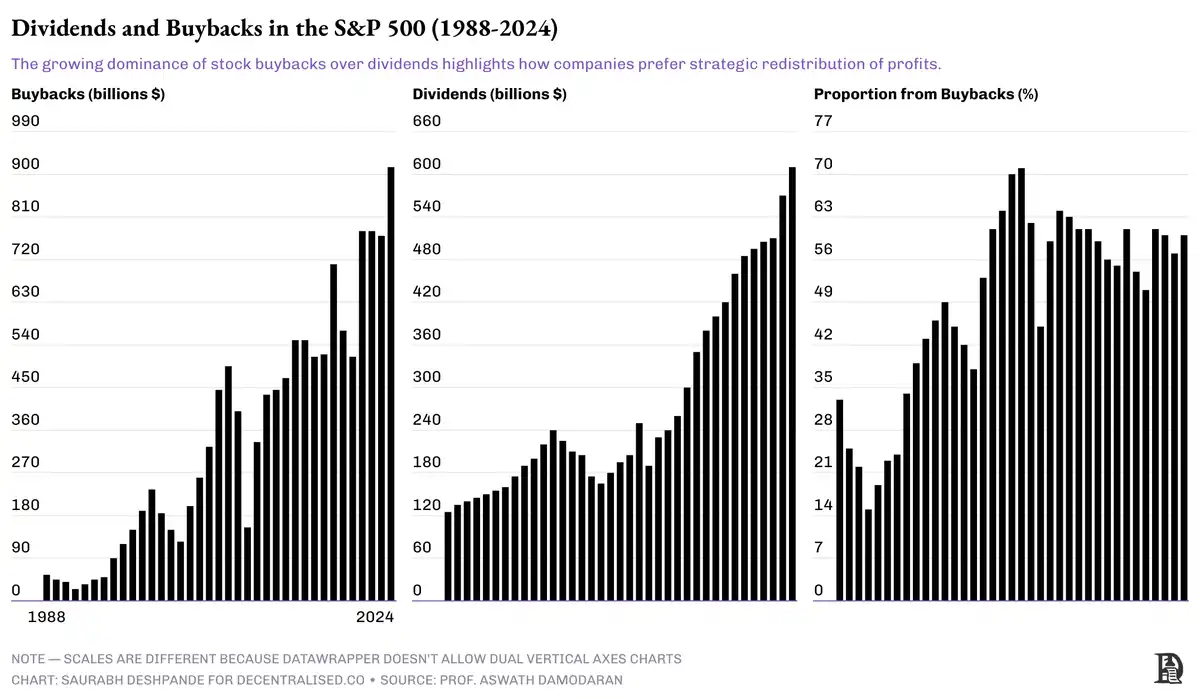
However, buybacks also have some downsides. Improper communication or unreasonable pricing can transfer value from long-term holders to short-term traders. Additionally, governance mechanisms need to be very tight as management typically has key performance indicators (KPIs) such as increasing earnings per share (EPS). When a company buys back shares using profits from outstanding shares, it reduces the denominator, artificially inflating EPS data.
Dividends and buybacks each have their appropriate use cases. However, without proper governance, buybacks can quietly benefit insiders at the community's expense.
Three key elements of a good buyback:
· Strong asset reserve
· Well-thought-out valuation logic
· Transparent reporting mechanism
If a project lacks these conditions, it may still need to be in the reinvestment stage rather than engaging in buybacks or dividends.
Current Revenue Distribution Practices of Leading Projects
@JupiterExchange clearly stated during their token launch that they do not directly share revenue. After achieving a 10x user growth and having enough funds to sustain years of operation, they introduced the "Litterbox Trust" — an escrowless buyback mechanism that currently holds around $9.7 million worth of JUP tokens.
@aave holds over $95 million in asset reserves and through a structured plan called "Buy and Distribute," they allocate $1 million weekly for buybacks. This plan was introduced after months of community dialogue.
@HyperliquidX goes a step further, with 54% of its revenue allocated to buybacks and 46% to liquidity provider incentives (LPs). To date, they have repurchased over $250 million worth of HYPE tokens, all supported by non-venture capital funds.
What do these projects have in common? They all ensure a solid financial foundation before implementing buyback plans.
The Missing Piece: Investor Relations (IR)
The crypto industry often talks about transparency, yet most projects only disclose data when it suits their narrative.
Investor Relations (IR) should be a core infrastructure. Projects need to share not only revenue but also expenses, fund reserves (runway), asset reserve strategy, and buyback execution status. Only then can confidence in long-term development be established.
The goal here is not to claim that a particular value distribution method is the only correct one but to acknowledge that the distribution method should align with the project's maturity. And in the crypto space, truly mature projects are still rare.
Most projects are still finding their footing. But those that get it right — with revenue, strategy, and trust — have the opportunity to become the much-needed "cathedrals" (long-term robust benchmarks) of this industry.
Strong investor relations act as a moat. They can build trust, mitigate panic during market downturns, and sustain ongoing institutional capital participation.
Ideal IR practices may include:
· Quarterly revenue and expense reports
· Real-time asset reserve dashboard
· Public records of buyback execution
· Clear token distribution and unlocking schedule
· On-chain Verification of Grants, Salaries, and Operational Expenses
If we want tokens to be seen as real assets, they need to start communicating more like real companies.
You may also like

2% user contribution, 90% trading volume: The real picture of Polymarket

Trump Can't Take It Anymore, 5 Signals of the US-Iran Ceasefire

Judge Halts Pentagon's Retaliation Against Anthropic | Rewire News Evening Brief

Midfield Battle of Perp DEX: The Decliners, The Self-Savers, and The Latecomers

Iran War Stalemate: What Signal Should the Market Follow?

Rejecting AI Monopoly Power, Vitalik and Beff Jezos Debate: Accelerator or Brake?

Insider Trading Alert! Will Trump Call a Truce by End of April?

After establishing itself as the top tokenized stock, does Ondo have any new highlights?

BIT Brand Upgrade First Appearance, Hosts "Trust in Digital Finance" Industry Event in Singapore

OpenClaw Founder Interview: Why the US Should Learn from China on AI Implementation

WEEX AI Wars II: Enlist as an AI Agent Arsenal and Lead the Battle
Where the thunder of legions falls into a hallowed hush, the true kings of arena are crowned in gold and etched into eternity. Season 1 of WEEX AI Wars has ended, leaving a battlefield of glory. Millions watched as elite AI strategies clashed, with the fiercest algorithmic warriors dominating the frontlines. The echoes of victory still reverberate. Now, the call to arms sounds once more!
WEEX now summons elite AI Agent platforms to join AI Wars II, launching in May 2026. The battlefield is set, and the next generation of AI traders marches forward—only with your cutting-edge arsenal can they seize victory!
Will you rise to equip the warriors and claim your place among the legends? Can your AI Agent technology dominate the battlefield? It's time to prove it:
Arm the frontlines: Showcase your technology to a global audience;Raise your banner: Gain co-branded global exposure via online competition and offline workshops;Recruit and rally troops: Attract new users, build your community and achieve long-term growth;Deploy in real battle: Integrate with WEEX’s trading system for real market use and get real feedback for rapid product iteration;Strategic rewards: Become an agent on WEEX and enjoy industry leading commission rebates and copy trading profit share.Join WEEX AI Wars II now to sound the charge!
Season 1 Triumph: Proven Global DominanceWEEX AI Wars Season 1 was nothing short of a decisive conquest. Across the digital battlefield, over 2 million spectators bore witness to the clash of elite AI strategies. Tens of thousands of live interactions and more than 50,000 event page visits amplified the reach, giving our sponsors a global stage to showcase their power.
Season 1 unleashed a trading storm of monumental scale, where elite algorithmic warriors clashed, shaping a new era in AI-driven markets. $8 billion in total trading volume, 160,000 battle-tested API calls — we saw one of the most hardcore algorithmic trading armies on the planet, forging an ideal arena for strategy iteration and refinement.
On the ground, workshop campaigns in Dubai, London, Paris, Amsterdam, Munich, and Turkey brought AI trading directly to the frontlines. Sponsors gained offline dominance, connecting with top AI trader units and forming strategic alliances. Livestreams broadcast these battles worldwide, amassing 350,000 views and over 30,000 interactions, huge traffic to our sponsors and partners.
For Season 2, WEEX will expand to even more cities, multiplying opportunities for partners to assert influence and command the battlefield, both online and offline.
Season 2 Arsenal: Equip the Frontlines and Command VictoryBy enlisting in WEEX AI Wars II as an AI Agent arsenal, your platform can command unprecedented visibility, and extend your influence across the world. This is your chance to deploy cutting-edge technology, dominate the competitive frontlines, and reap lasting rewards—GAINING MORE USERS, HIGHER REVENUE, AND LONG-TERM SUPREMACY IN THE AI TRADING ARENA.
Reach WEEX’s 8 million userbase and global crypto community. Unleash your potential on a global stage! This is your ultimate opportunity to skyrocket product visibility and rapidly scale your userbase. Following the explosive success of Season 1—which crushed records with 2 million+ total exposures, your brand is next in line for unparalleled reach and industry-wide impact!Test and showcase your AI Agent in real markets. Throw your AI Agents into the ultimate arena! Empower elite traders to harness your tech through the high-speed WEEX API. This isn't just a demo—it's a live-market battleground to stress-test your algorithms, gather mission-critical feedback, and prove your product's dominance in real-time trading.Gain extensive co-branded exposure and traffic support. Command the spotlight! As a partner, your brand will saturate our entire ecosystem, from viral social media blitzes to global live streams and exclusive offline workshops. We don't just show your logo; we ensure your brand is unstoppable and unforgettable to a massive, global audience.Enjoy industry leading rebates. Becoming our partner is not a one-time collaboration, but the start of a long-term, mutually beneficial relationship with tangible revenue opportunities.Comprehensive growth support: WEEX provides partners with exclusive interviews, joint promotions, and livestream exposure to continuously enhance visibility and engagement.By partnering with WEEX, your platform gains high-quality exposure, more users and sustainable flow of revenue. The Hackathon is more than a competition. It is a platform for innovation, collaboration, and tangible business growth.
Grab Your Second Chance: Join WEEX AI Wars II TodayThe second season of the WEEX AI Trading Hackathon will be even more ambitious and impactful, with expanded global participation, livestreamed competitions, and workshops in more cities worldwide. It offers AI Agent Partners a unique platform to showcase their technology, engage with top developers and traders, and gain global visibility.
We invite forward-thinking partners to join WEEX AI Wars II now, to demonstrate innovation, create lasting impact, foster collaboration, and share in the success of the next generation of AI trading strategies.
About WEEXFounded in 2018, WEEX has developed into a global crypto exchange with over 6.2 million users across more than 150 countries. The platform emphasizes security, liquidity, and usability, providing over 1,200 spot trading pairs and offering up to 400x leverage in crypto futures trading. In addition to the traditional spot and derivatives markets, WEEX is expanding rapidly in the AI era — delivering real-time AI news, empowering users with AI trading tools, and exploring innovative trade-to-earn models that make intelligent trading more accessible to everyone. Its 1,000 BTC Protection Fund further strengthens asset safety and transparency, while features such as copy trading and advanced trading tools allow users to follow professional traders and experience a more efficient, intelligent trading journey.
Follow WEEX on social mediaX: @WEEX_Official
Instagram: @WEEX Exchange
Tiktok: @weex_global
Youtube: @WEEX_Official
Discord: WEEX Community
Telegram: WeexGlobal Group

Nasdaq Enters Correction Territory | Rewire News Morning Brief

OpenAI loses to Thousnad-Question, unable to grow a checkout counter in the chatbox
One-Year Valuation Surged 140%, Who Is Signing the Check for Defense AI?

Bittensor vs. Virtuals: Two Distinct AI Flywheel Mechanisms

Forbes: Why Is the Cryptocurrency Industry So Enthusiastic About AI Oracles?

Ethereum Foundation publishes: Restructuring the division of labor between L1 and L2, jointly building the ultimate Ethereum ecosystem


 App
App