
 Buy Crypto
- Markets
 Futures
- Spot
- Copy Trade
- Earn
- More
2025 South Korea CEX Listing Post-Mortem: Investing in New Coins = 70% Loss?

Original Title: [Issue] 2025 Korean CEX Listings Postmortem
Original Author: c4lvin, Four Pillars
Original Translation: AididiaoJP, Foresght News
Key Findings
If $100 were invested in each of the 59 tokens listed on Upbit with KRW trading pairs in 2025, as of March 11, 2026, the value of this portfolio would only be 31% of the initial investment (i.e., each dollar would be reduced to $0.31). Bithumb (144 tokens) exhibited a similar performance, also at 31%; Binance (92 tokens) was slightly lower at 29%. All three major exchanges resulted in approximately 70% asset depreciation.
Among the 59 tokens listed on Upbit, only two ultimately turned a profit: KITE (up 232.8%) and BARD (up 9.3%). Bithumb fared slightly better, with 8 out of 144 tokens maintaining positive returns. The median ROI on Upbit was -80.9%, while for Bithumb, it was -82.1%.
For the 50 tokens that debuted on both major Korean exchanges, the average ROI (-69.4%) was almost identical to the 94 tokens that were exclusively listed on Bithumb (-68.9%). This data indicates that launching on multiple mainstream exchanges does not guarantee subsequent price performance.
Research Background
The inspiration for this analysis came from a data chart shared today by Messari research analyst @Degenerate_DeFi.
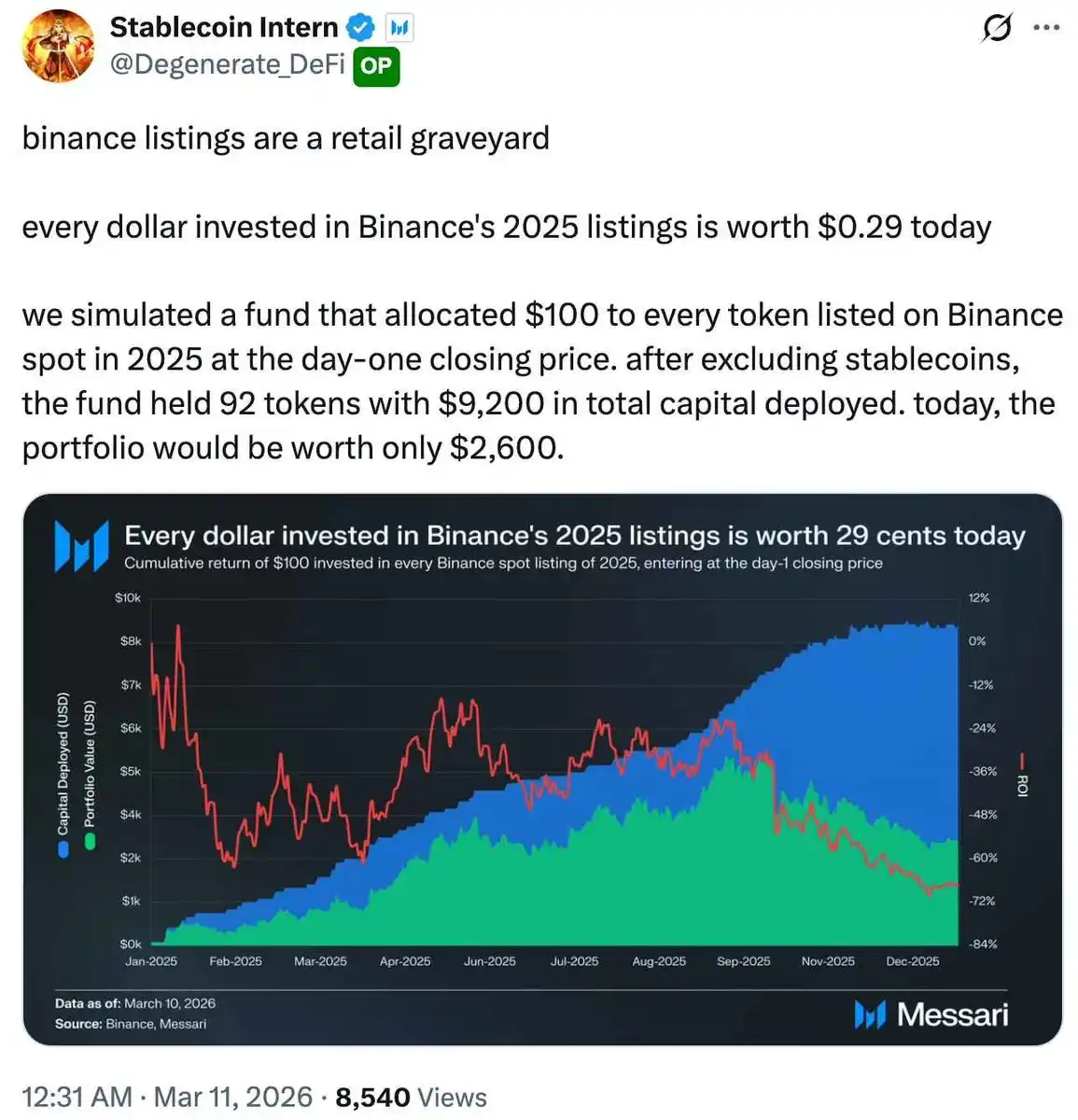
Data Source: @Degenerate_DeFi
The chart illustrates that if $100 were invested in each of the 92 tokens newly listed on Binance in 2025, as of today, each dollar invested would only be worth $0.29. This means that out of a total investment of $9,200, a cumulative loss of 71.7% was incurred, with the remaining value being only about $2,600.
As the world's largest cryptocurrency exchange by trading volume, Binance's listing standards are generally considered stricter than those of smaller exchanges, and its liquidity advantage is unmatched. If Binance's data performance is already like this, how will the situation be for Korean exchanges? The Korean market is dominated by retail investors, and the trading pattern is significantly different from the global market. Will these differences affect the performance of newly listed tokens? Or will the data ultimately reveal similar patterns?
This article will adopt the same methodology as the Binance analysis to systematically analyze all tokens that obtained KRW trading pairs on Upbit and Bithumb throughout the year 2025.
Research Methodology
Scope Definition and Selection Criteria
This study covers all tokens that were added to the KRW market trading pairs on Upbit and Bithumb from January 1, 2025, to December 31, 2025. There were a total of 59 on Upbit and 144 on Bithumb. For Elixir (ELX), Strike (STRIKE), and AI16Z, which were listed in 2025 but have since been delisted, this study treats them as a complete loss.
The investment simulation rules follow the framework used by Messari to analyze the performance of tokens listed on Binance. We assume an investment of $100 at the closing price on each token's listing day, holding without any sell operations. By tracking the daily cumulative value and return of this investment portfolio, a time series dataset is constructed.
The choice of the closing price on the listing day as the entry point was carefully considered. On Korean exchanges, the opening price on the listing day is often significantly inflated due to high volatility and speculative buying. Using the closing price can effectively filter out this short-term noise.
Data Collection
Price data is directly obtained through the public REST API of each exchange. For Upbit, we use the daily K-line interface to collect complete daily OHLCV data for each token from its listing date until March 11, 2026, and cross-validate the current price through the ticker interface (/v1/ticker). For Bithumb, the same period data is obtained using the 24-hour K-line interface. To simplify the model, this study does not consider the fluctuation in the USD/KRW exchange rate.
Overall Performance
The following figure intuitively presents the simulation results. Subsequent sections will provide a detailed interpretation and analysis of the data.
Comparison of Three Major Exchanges
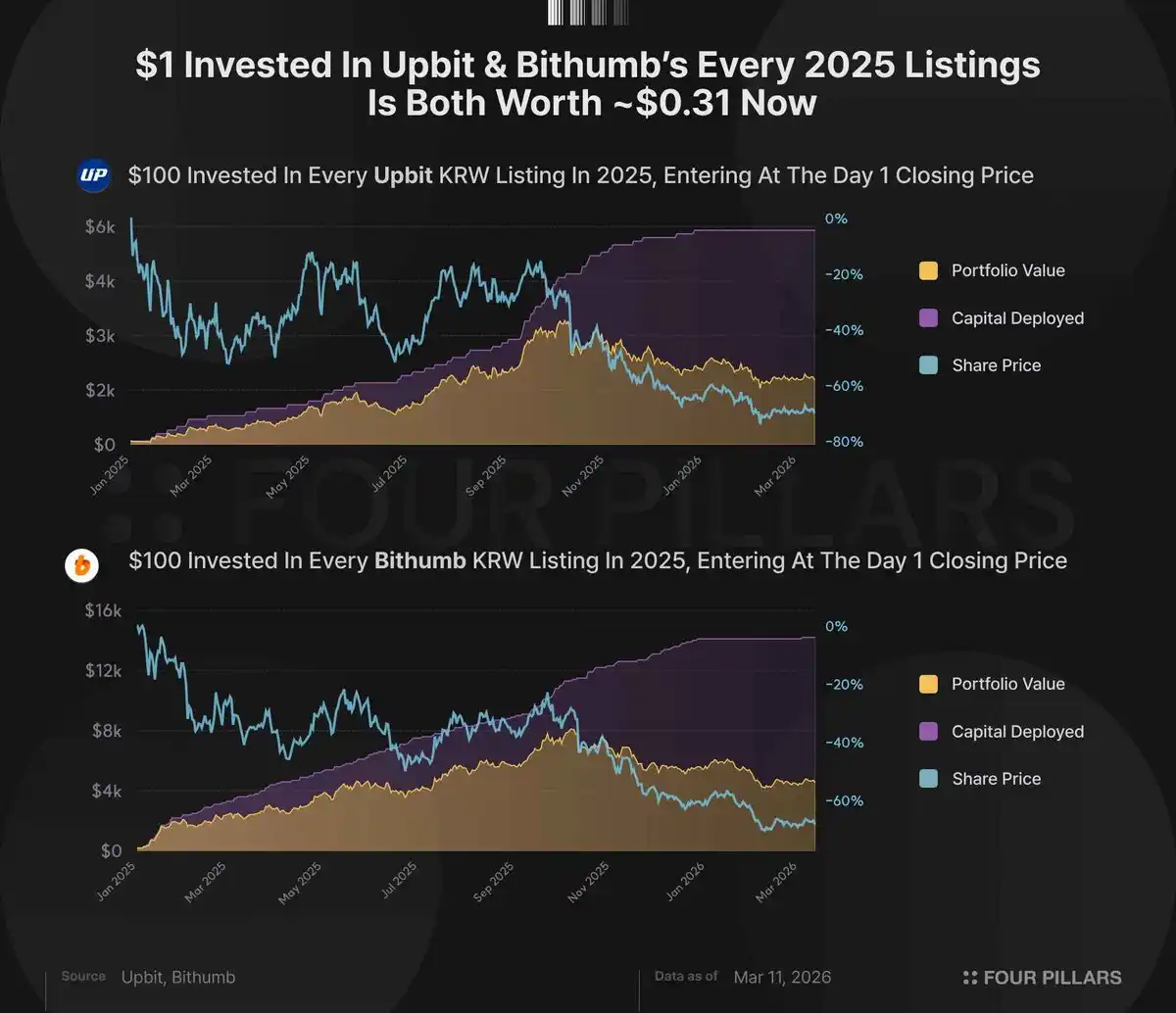
The performance comparison of new tokens listed on the three major exchanges in 2025 is as follows:
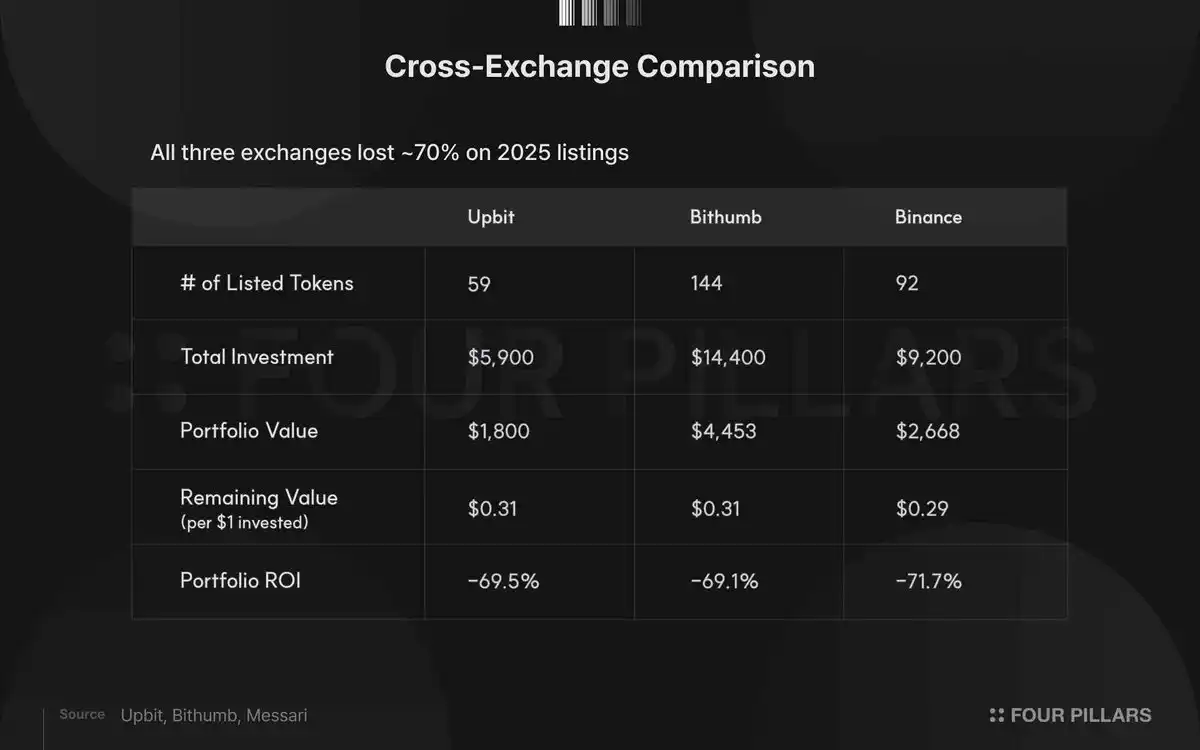
All three major exchanges recorded approximately 70% losses. Upbit (-69.5%) and Bithumb (-69.1%) performed almost equally, while Binance (-71.7%) was not far behind. Regardless of the chosen exchange, investors who bought the new tokens on the listing day suffered an average loss of about 70% of their initial capital.
Return Distribution Characteristics
The overall average value is not sufficient to reveal the performance differences of individual tokens. The detailed examination of each token's return is divided into intervals as follows:
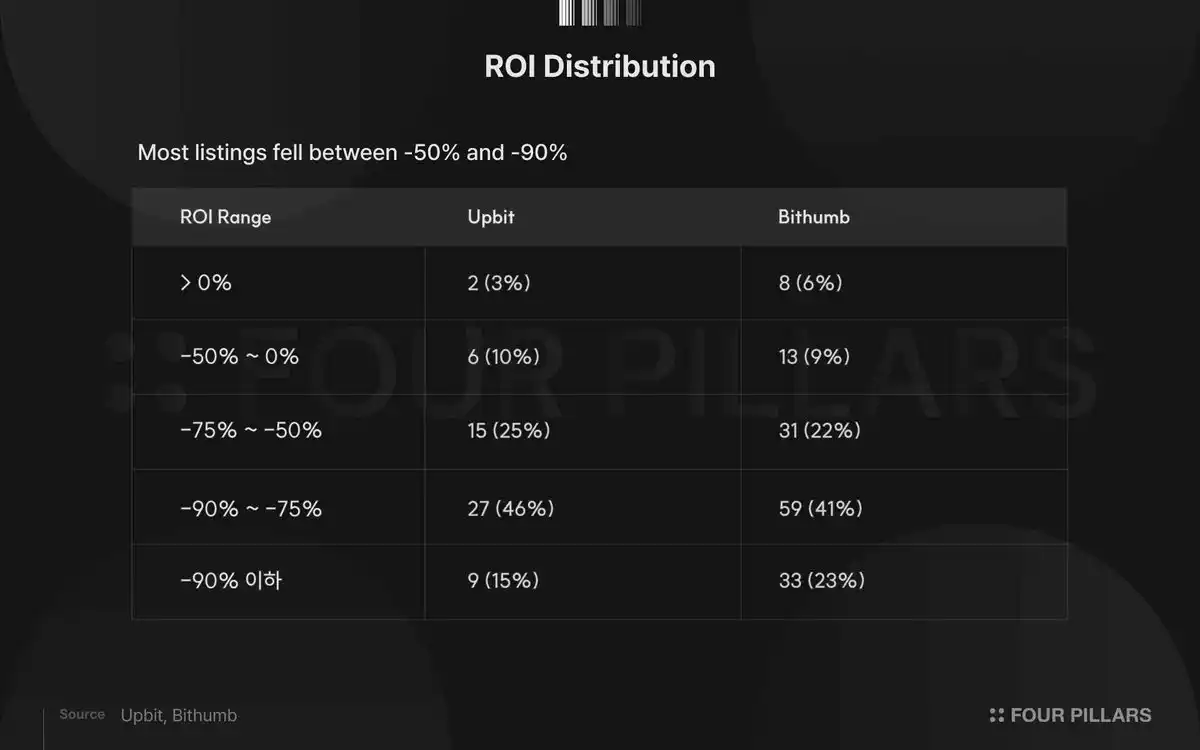
Both exchanges have over 40% of tokens concentrated in the -75% to -90% loss range. In Upbit, this range accounts for 46%, with an additional 9 tokens (15%) experiencing over 90% extreme losses. Only two tokens eventually achieved positive returns: Kite (KITE, up 232.8%) and Lombard (BARD, up 9.3%).
Bithumb's return distribution is more diversified. It has a higher number of profitable tokens, totaling 8, but at the same time, 33 tokens experienced over 90% extreme losses. This diversification is partly due to a larger sample size of 144 tokens but also reflects that Bithumb's listing strategy covers a more extensive range of project types compared to Upbit.
The median return reveals a harsher reality: Upbit at -80.9%, Bithumb at -82.1%, both below their respective averages. This indicates that a few relatively resistant tokens lifted the overall average level, and the typical performance of newly listed tokens is actually bleaker than the surface data suggests.
Impact of Listing Time on Performance
To examine whether the listing timing affects subsequent performance, we compare the data between the first half of the year (January to June) and the second half of the year (July to December).
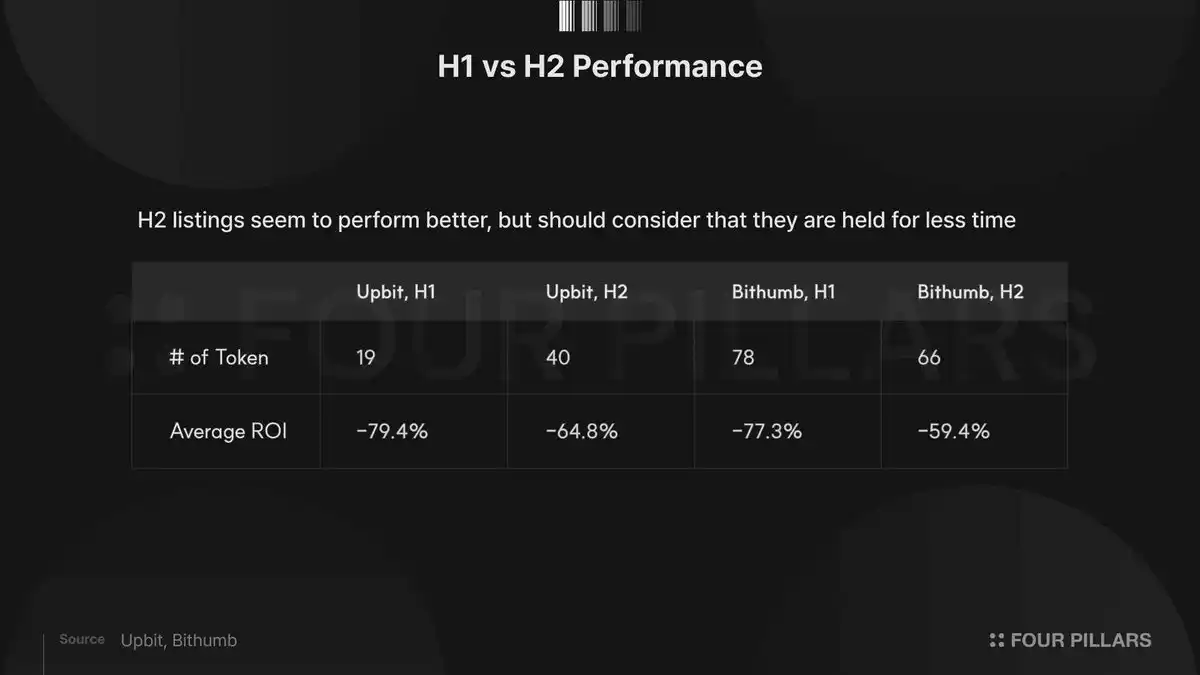
Data shows that tokens launched in the second half of the year performed better on both major exchanges. This phenomenon is in line with intuition: tokens launched at the beginning of the year went through a longer bear market. Considering the overall downtrend of the crypto market in 2025, the longer the holding period, the higher the likelihood of accumulating greater losses.
It is worth noting that the difference in performance between the first and second halves of the year is quite significant. On Bithumb, the return rates of tokens launched in the first half of the year (-77.3%) and the second half of the year (-59.4%) differ by about 18 percentage points, a difference that is difficult to explain solely by time factors. Possible reasons include: tokens launched in the second half of the year may indeed have stronger fundamental support, or market expectations have become more rational due to the lessons learned in the first half of the year.
Selection Bias
Relationship Between Number of Listings and Performance
Throughout 2025, Upbit added 59 Korean won trading pairs, while Bithumb added 144. Bithumb's number of listings is more than double that of Upbit and significantly exceeds Binance's 92 listings. Upbit is known for having the strictest listing standards among Korean exchanges. However, despite the huge difference in the number of listings, the investment portfolio return rates of the two major exchanges are almost identical: -69.5% for Upbit and -69.1% for Bithumb.
Cross-Listed Token Analysis
To further investigate, we compared the performance of tokens listed simultaneously on both major exchanges and tokens listed only on Bithumb. Data shows that a total of 50 tokens landed on both Upbit and Bithumb simultaneously.
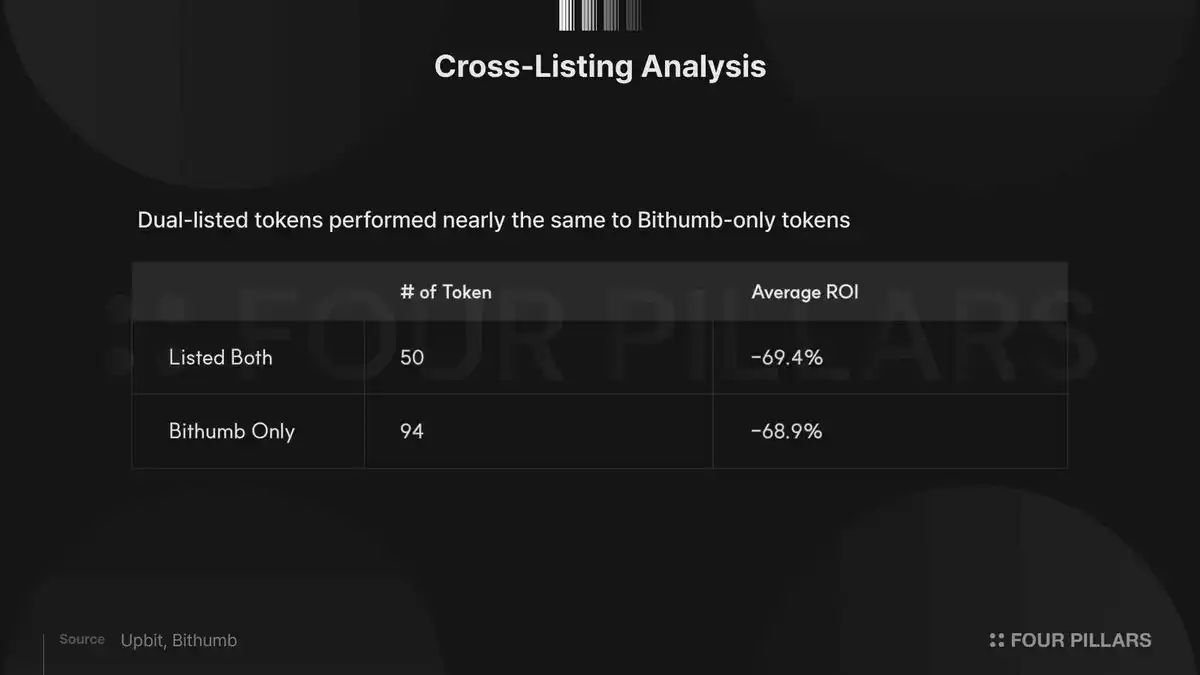
In theory, projects that can be listed on two major mainstream exchanges at the same time should have a certain level of industry recognition. However, the average return rate of these 50 tokens (-69.4%) is almost identical to the 94 tokens listed only on Bithumb (-68.9%).
This finding leads to the following two conclusions:
First, being listed on multiple mainstream exchanges does not guarantee any price performance.
Second, the price inflation on listing day is a structural phenomenon that occurs regardless of how much attention the project itself receives.
Whether a token is honored with a listing on Upbit or quietly lands on Bithumb, the ultimate loss for first-day buyers shows no significant difference.
Few Survivors Analysis
Among the 59 tokens listed on Upbit, only KITE (up 232.8%) and BARD (up 9.3%) ended up in positive gains. Only 8 tokens managed to keep their loss under 50%.
The 8 profitable tokens on Bithumb represent a more diverse sample.
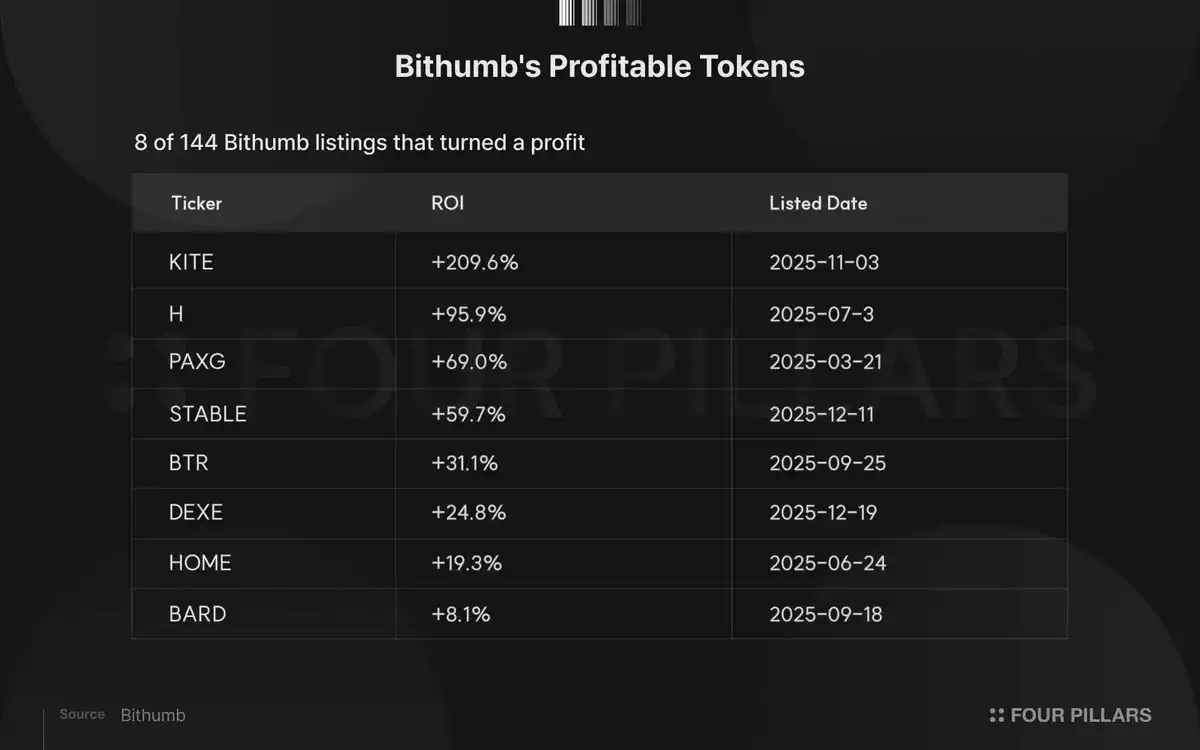
KITE recorded a significant outlier with a 209.6% increase. However, it is important to note that this token has only been listed for four months, so deeming its performance as a sustainable long-term result is still premature. Similarly, caution is advised when looking at STABLE and DEXE due to their tracking record of only three months.
More revealing is the case of PAXG. As a token pegged 1:1 to the live gold spot price, its 69.0% increase was solely driven by the steady rise in the price of gold by 2025. This performance has no connection to the cryptocurrency market fundamentals and merely reflects the macro trend of gold. In other words, the most reliable way to profit on Bithumb is surprisingly not to invest in cryptocurrency projects themselves.
Conclusion
This study concludes that the performance of tokens newly listed on Korean exchanges in 2025 shows no fundamental difference at a structural level compared to Binance. Despite the high proportion of retail participation in the Korean market, differences in listing strategies between exchanges, and varying regulatory environments, the average loss for first-day buyers on the three major exchanges converges to around 70%.
We believe the core insight revealed by this data is: The root of the problem lies not in the specific listing standards of a particular exchange or the quality of individual tokens, but in the inherent structural dynamics of listing events themselves. When a token is newly listed on a mainstream exchange, retail demand surges, driving up the price on the first day. Over time, the price naturally corrects, leading to losses for first-day buyers. The similar performance between tokens listed on both major exchanges and those listed on only one further confirms that these losses stem not from a specific exchange or token but from the structural features of the listing event.
It is important to note that this study measures the performance of a specific single strategy: buying at the first-day closing price and holding until now. If short-term trading strategies utilizing price fluctuations in the days following listing or strategies that enter after a significant price correction are employed, vastly different conclusions may be reached. However, such strategies require precise timing and differ greatly from the actual behavior of most retail investors.
The data from 2025 provides a clear insight: buying into a token solely because it is newly listed on a major exchange is a systematically losing strategy, regardless of the exchange chosen. This phenomenon is not unique to the Korean market but is a global structural issue. The reason is not that exchanges are selecting poor-quality projects but that the listing event itself creates a dynamic of concentrated demand that consistently works against first-day buyers.
You may also like

From x402 to MPP: Cloudflare's crucial vote, will it go to Coinbase or Stripe?

BlackRock CEO issues annual open letter: The wave of tokenization has arrived, and we will lead this trend

When Backpack backstabs the community

When gold is no longer a safe haven, and Bitcoin continues to panic

Trump, the World's Largest Oil Trader

If the US and Iran have not reached an agreement in 5 days, what other cards does Trump have?

Tether Whale Dumps £12 Million, Backing Crypto’s ‘British Trump’
Ethereum Foundation Post: Rethinking the Division of Work Between L1 and L2 to Build the Ultimate Ethereum Ecosystem

Two Major Prediction Market Platforms Unite Rarely, What Is the Story Behind This New Fund?

WEEX Official Product Launch: Win LALIGA Tickets & Unlock the 3-in-1 Crypto Trading Suite
Trade crypto without downloading an app. Join the WEEX H5, API, SKILLs livestream to explore the new trading experience, win LALIGA VIP tickets, and share 420 USDT rewards.
Dragonfly Partners: Most agents will not engage in autonomous trading, how can crypto payments prevail?

US AI Startup Goes All In on Chinese Mega-Model | Rewire News Morning Brief

Trump Lies Again: A "Five-Day Pause" Psyop, How Wall Street, Bitcoin, and Polymarket Insiders Synced Uposciogen

When a Token Becomes Labor, People Become the Interface

Ceasefire News Leaked Ahead of Time? Large Polymarket Bets on Outcome Before Trump's Tweet
BlackRock CEO's Annual Shareholder Letter: How is Wall Street Using AI to Keep Profiting from National Pension Funds?

Sun Valley Releases 2025 Financial Report: Bitcoin Mining Revenue Reaches $670 Million, Accelerating Transformation to AI Infrastructure Platform
On March 16, 2026, in Dallas, Texas, USA, CanGu Company (New York Stock Exchange code: CANG, hereinafter referred to as "CanGu" or the "Company") today announced its unaudited financial performance for the fourth quarter and full year ended December 31, 2025. As a btc-42">bitcoin mining enterprise relying on a globally operated layout and dedicated to building an integrated energy and AI computing power platform, CanGu is actively advancing its business transformation and infrastructure development.
• Financial Performance:
Total revenue for the full year 2025 was $688.1 million, with $179.5 million in the fourth quarter.
Bitcoin mining business revenue for the full year was $675.5 million, with $172.4 million in the fourth quarter.
Full-year adjusted EBITDA was $24.5 million, while the fourth quarter was -$156.3 million.
• Mining Operations and Costs:
A total of 6,594.6 bitcoins were mined throughout the year, averaging 18.07 bitcoins per day; of which 1,718.3 bitcoins were mined in the fourth quarter, averaging 18.68 bitcoins per day.
The average mining cost for the full year (excluding miner depreciation) was $79,707 per bitcoin, and for the fourth quarter, it was $84,552;
The all-in sustaining costs were $97,272 and $106,251 per bitcoin, respectively.
As of the end of December 2025, the company has cumulatively produced 7,528.4 bitcoins since entering the bitcoin mining business.
• Strategic Progress:
The company has completed the termination of the American Depositary Receipt (ADR) program and transitioned to a direct listing on the NYSE to enhance information transparency and align with its strategic direction, with a long-term goal of expanding its investor base.
CEO Paul Yu stated: "2025 marked the company's first full year as a bitcoin mining enterprise, characterized by rapid execution and structural reshaping. We completed a comprehensive adjustment of our asset system and established a globally distributed mining network. Additionally, the company introduced a new management team, further strengthening our capabilities and competitive advantage in the digital asset and energy infrastructure space. The completion of the NYSE direct listing and USD pricing also signifies our transformation into a global AI infrastructure company."
"As we enter 2026, the company will continue to optimize its balance sheet structure and enhance operational efficiency and cost resilience through adjustments to the miner portfolio. At the same time, we are advancing our strategic transformation into an AI infrastructure provider. Leveraging EcoHash, we will utilize our capabilities in scalable computing power and energy networks to provide cost-effective AI inference solutions. The relevant site transformations and product development are progressing simultaneously, and the company is well-positioned to sustain its execution in the new phase."
The company's Chief Financial Officer, Michael Zhang, stated: "By 2025, the company is expected to achieve significant revenue growth through its scaled mining operations. Despite recording a net loss of $452.8 million from ongoing operations, mainly due to one-time transformation costs and market-driven fair value adjustments, the company, from a financial perspective, will reduce its leverage, optimize its Bitcoin reserve strategy and liquidity management, introduce new capital to strengthen its financial position, and seize investment opportunities in high-potential areas such as AI infrastructure while navigating market volatility."
The total revenue for the fourth quarter was $1.795 billion. Of this, the Bitcoin mining business contributed $1.724 billion in revenue, generating 1,718.3 Bitcoins during the quarter. Revenue from the international automobile trading business was $4.8 million.
The total operating costs and expenses for the fourth quarter amounted to $4.56 billion, primarily attributed to expenses related to the Bitcoin mining business, as well as impairment of mining machines and fair value losses on Bitcoin collateral receivables.
This includes:
· Cost of Revenue (excluding depreciation): $1.553 billion
· Cost of Revenue (depreciation): $38.1 million
· Operating Expenses: $9.9 million (including related-party expenses of $1.1 million)
· Mining Machine Impairment Loss: $81.4 million
· Fair Value Loss on Bitcoin Collateral Receivables: $171.4 million
The operating loss for the fourth quarter was $276.6 million, a significant increase from a loss of $0.7 million in the same period of 2024, primarily due to the downward trend in Bitcoin prices.
The net loss from ongoing operations was $285 million, compared to a net profit of $2.4 million in the same period last year.
The adjusted EBITDA was -$156.3 million, compared to $2.4 million in the same period last year.
The total revenue for the full year was $6.881 billion. Of this, the revenue from the Bitcoin mining business was $6.755 billion, with a total output of 6,594.6 Bitcoins for the year. Revenue from the international automobile trading business was $9.8 million.
The total annual operating costs and expenses amount to $1.1 billion.
Specifically, they include:
· Revenue Cost (excluding depreciation): $543.3 million
· Revenue Cost (depreciation): $116.6 million
· Operating Expenses: $28.9 million (including related-party expenses of $1.1 million)
· Miner Impairment Loss: $338.3 million
· Bitcoin Collateral Receivable Fair Value Change Loss: $96.5 million
The full-year operating loss is $437.1 million. The continuing operations net loss is $452.8 million, while in 2024, there was a net profit of $4.8 million.
The 2025 non-GAAP adjusted net profit is $24.5 million (compared to $5.7 million in 2024). This measure does not include share-based compensation expenses; refer to "Use of Non-GAAP Financial Measures" for details.
As of December 31, 2025, the company's key assets and liabilities are as follows:
· Cash and Cash Equivalents: $41.2 million
· Bitcoin Collateral Receivable (Non-current, related party): $663.0 million
· Miner Net Value: $248.7 million
· Long-Term Debt (related party): $557.6 million
In February 2026, the company sold 4,451 bitcoins and repaid a portion of related-party long-term debt to reduce financial leverage and optimize the asset-liability structure.
As per the stock repurchase plan disclosed on March 13, 2025, as of December 31, 2025, the company had repurchased a total of 890,155 shares of Class A common stock for approximately $1.2 million.



 App
App