
RKLB Stock After Q2: Record Revenue, Wider Loss, Narrower Window

 Prefer us on Google



Rocket Lab put up the best quarter in its history on August 10, 2026, and the stock still closed the session at $80.04 — roughly 47% below the $150.23 record close it printed on May 27. That gap is the whole story of RKLB stock right now. The revenue line is working. The cash line is not, and the one event that would justify the valuation, Neutron's first flight, keeps sliding toward the edge of its window.
Here is what the Q2 numbers actually said, why the stock is where it is, and what has to happen before the bull case stops being a forecast.
RKLB stock price after the Q2 print: what actually moved
Rocket Lab reported after the close on August 10. The equity had already run hard into the event — up about 20% on the week and roughly 34% over 30 days — after a July slide that took it to its lowest level of the year. It traded between $77.38 and $83.90 during the August 10 session before settling at $80.04.
The initial after-hours reaction was negative despite a revenue beat, which tells you where the market's attention sits. Traders were not grading the top line. They were grading the loss per share, the cash burn commentary, and any hint about Neutron's schedule.
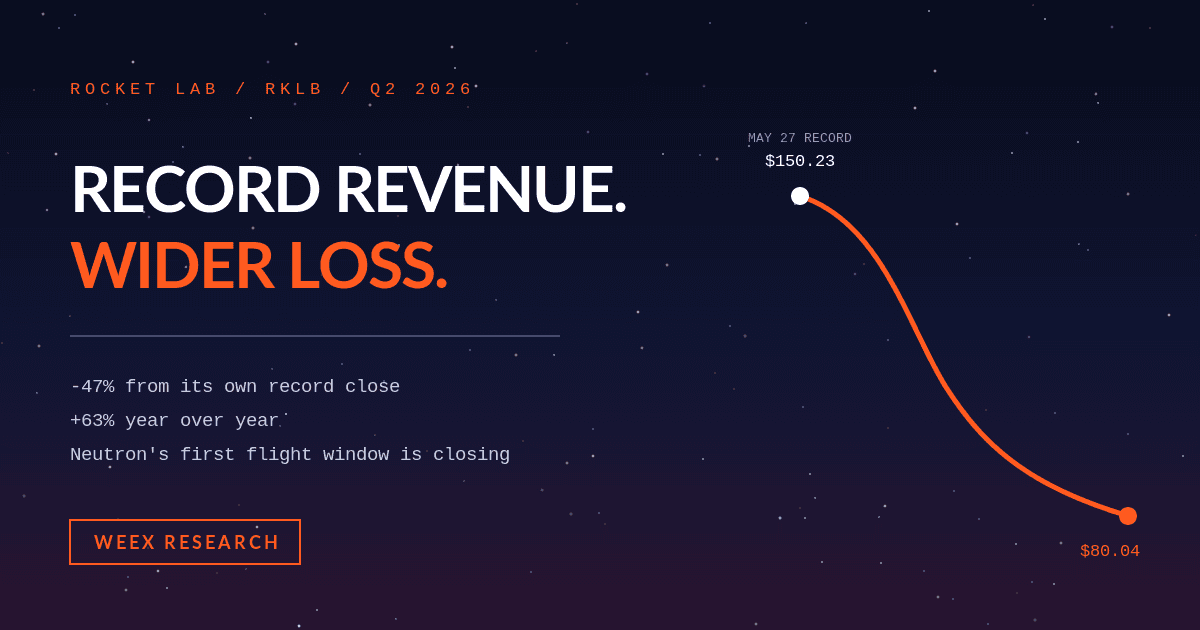
One detail worth holding onto: RKLB is up roughly 63% year over year and down roughly 47% from its own record inside the same twelve months. Both facts are true simultaneously. Any analysis that only quotes one of them is selling you a direction.
Record revenue, wider loss: reading Rocket Lab's Q2 2026 numbers
The quarter was operationally strong and financially messier than the headline suggested.
| Metric (Q2 2026, reported Aug 10) | Result | Context |
|---|---|---|
| Revenue | $234.06M | +62% YoY, +16.8% QoQ, quarterly record |
| Product revenue | $181.3M | Space systems remains the larger half |
| Service revenue | $52.7M | Launch services |
| GAAP gross margin | 36.1% | Above 33–35% guidance |
| Non-GAAP gross margin | 41.5% | Above 38–40% guidance |
| Adjusted EBITDA | –$8.8M loss | Better than guided –$20M to –$26M |
| EPS | –$0.08 | Missed consensus by $0.02; –$0.07 prior quarter |
| Backlog | $2.36B | +137% YoY |
| Launch backlog | 90+ missions | Q2 and post-quarter signings added $437M+ |
| Cash and securities | ~$2.4B | Includes restricted cash and marketable securities |
| Q3 2026 guidance | $250M–$265M | Continued sequential growth |
Margins beat guidance at both the GAAP and non-GAAP line, and the adjusted EBITDA loss came in less than half of what management had guided. Those are real operational wins. The EPS miss came largely from acquisition-related costs — Rocket Lab closed Mynaric and Motiv during the period — rather than from the core launch and space systems business deteriorating.
The more important point is the backlog. A 137% jump to $2.36 billion, with 90-plus missions committed, is the single hardest number for a bear to argue with. It means the demand question is largely settled. What is not settled is whether Rocket Lab can convert that backlog at a margin that produces free cash flow before the balance sheet needs topping up.
Why is RKLB stock down 47% from its record?
Three things happened between late May and August, and none of them were about demand.
Valuation compressed first. RKLB ran to its record close on space-sector enthusiasm, Nasdaq 100 index flows in June, and the SpaceX IPO halo. At the peak the stock traded on multiples that assumed Neutron worked. When the multiple came out, the price came out with it — that is a de-rating, not a downgrade of the business.
The Neutron window narrowed. Management said Neutron hardware is progressing toward pad delivery in Q4 2026, while acknowledging the year-end launch window is tightening. For a company whose valuation rests on graduating from small-lift Electron to medium-lift Neutron, every month of slip is a direct hit to the discounted value of that business line. Rocket Lab is pricing Neutron at a $50–55 million average selling price and has said it will not discount early launches heavily. That is a confident stance, and it only pays if the vehicle flies.
Cash usage is climbing. Neutron development, launch infrastructure, and an acquisition sequence culminating in the $8.0 billion Iridium deal all consume capital at once. Management flagged elevated cash usage explicitly. With roughly $2.4 billion on the balance sheet the company is not fragile, but the market repriced the risk that some of the Iridium consideration and future capex gets funded with equity.
Neutron, Iridium and the $2.36B backlog: what has to go right
The Iridium acquisition, announced June 29, 2026, is the most consequential decision Rocket Lab has made since going public. Rocket Lab is paying $54 per Iridium share — $27 in cash plus stock — for an enterprise value of about $8.0 billion, a 24% premium to Iridium's June 26 close, with a target close in mid-2027.
Strategically it is coherent: Rocket Lab becomes a company that builds rockets, builds satellites, and operates a revenue-generating global satellite network, rather than one that sells rides and hardware to other people's constellations. Iridium brings recurring service revenue, which is exactly what Rocket Lab's cash flow profile lacks.
The execution load is what gives investors pause. Between now and mid-2027 Rocket Lab has to fly Neutron for the first time, integrate Mynaric and Motiv, clear regulatory review on an $8 billion acquisition, and keep converting a 90-mission Electron manifest — all while burning cash. Any one of those is a normal corporate year. Doing them concurrently is not.
| Catalyst | Timeline | What a bull needs | What breaks the thesis |
|---|---|---|---|
| Neutron first flight | Pad delivery Q4 2026; launch window narrowing | A flight, even a partial success, before mid-2027 | Slip past 2027 or a launch failure |
| Iridium close | Targeted mid-2027 | Clean regulatory path, limited extra dilution | Deal delay, renegotiation, or a large equity raise |
| Backlog conversion | Ongoing | Margin holds near 36% GAAP as volume scales | Margin compression from Neutron ramp costs |
| Cash position | ~$2.4B as of Q2 2026 | Burn tapers as Neutron capex peaks | A capital raise at a depressed share price |
Is RKLB stock a buy at these levels?
Sell-side sentiment is bullish and has been consistently. Consensus sits at Buy, with average targets clustered in the $105–$112 range as of August 2026, a spread running from $60 at the low end to $150 at the high end. That $90 spread on a single name is the honest summary: the analyst community agrees on the direction and disagrees violently on the magnitude, because everything hinges on one binary event.
On valuation, one widely circulated estimate puts RKLB near 40x projected 2028 EV/revenue. That is not a value multiple. It is a multiple that already assumes Neutron flies, Iridium closes, and margins scale. Buying at that level is not a bet that Rocket Lab is a good company — that part is broadly accepted — it is a bet that the good outcome arrives faster than the market currently prices.
The practical read: RKLB is a position sizing problem more than a stock-picking problem. The distribution of outcomes is wide in both tails, so anyone taking exposure should decide in advance what a Neutron slip announcement does to their thesis, and what a dilutive equity raise does to it, before either happens rather than after.
Trading RKLB price exposure 24/7 without a U.S. brokerage account
This is where the mechanics matter for non-U.S. traders, and where a real structural quirk shows up.
The equity stops trading. The reference market does not. Rocket Lab reported after the August 10 close, and the USDT-settled RKLB reference price on WEEX kept updating through the after-hours gap and the following session. That is the practical argument for derivative exposure around a catalyst: earnings, launch announcements, and regulatory news on the Iridium deal rarely respect market hours.
Here is what the WEEX-side reference market showed on August 10, 2026:
| WEEX RKLB reference data (Aug 10, 2026, UTC+0) | Value |
|---|---|
| Reference price | $83.69 (14:36 UTC); $86.44 earlier at 12:33 UTC |
| 7-day change | +19.55% |
| 30-day change | +34.11% |
| 1-year change | +63.25% |
| All-time high | $145.21 (June 1, 2026) |
| Year low | $60.11 (July 28, 2026) |
| 14-day RSI | 35.14 (neutral-to-weak) |
| 50-day SMA | $79.91 |
| 200-week SMA | $98.77 |
| Momentum reading | Bearish; MACD in bearish crossover |
Two things stand out. First, the reference price sat above the 50-day SMA of $79.91 but well below the 200-week SMA of $98.77 — a market that has stabilized short-term without repairing the longer trend. Second, the reference price and the Nasdaq close do not match exactly. Tracking variance between a 24/7 USDT-settled instrument and the cash equity is normal and expected, but it is a real cost that traders underestimate. Check the mark price and the funding rate before assuming a derivative position replicates a share position.
If you want the product mechanics — contract specs, margin tiers, and liquidation logic — the WEEX RKLB-USDT perpetual futures page carries the live parameters, including leverage up to 100×. The live RKLB reference price page tracks the spot-equivalent quote and historical range, and the RKLB price forecast tools let you model target scenarios against the current level. If access rather than instrument choice is your constraint, trading alternatives when you can't buy RKLB shares walks through the routes in more detail.
One caution from watching how people actually lose money on single-name derivative exposure: leverage plus an earnings gap is the classic liquidation setup. A stock that moves 8% on a print will move 8% against a 20× position and take the account with it, and funding costs on a perpetual accrue even when the price goes nowhere. Size for the gap, not for the average day.
What matters most from here
RKLB stock is not currently trading on its income statement. Q2 2026 delivered a revenue record, better-than-guided margins, and a backlog up 137% — and the stock still sits near $80 rather than $150. The market is pricing execution risk on Neutron and dilution risk on Iridium, and both of those resolve on a timeline measured in quarters, not weeks.
For anyone tracking RKLB stock into the back half of 2026, the events that matter are narrow and identifiable: Neutron hardware reaching the pad in Q4, the first flight window holding or slipping, Q3 revenue landing inside the $250–265 million guide, and any signal about how the Iridium cash component gets funded. Everything else is noise.
If you want exposure to those events without a U.S. brokerage account, USDT-settled RKLB products on WEEX give you 24/7 access to the price — with the leverage and tracking caveats above taken seriously rather than skimmed.
FAQ
1. What is the RKLB stock price right now?
RKLB closed at $80.04 on the Nasdaq on August 10, 2026, after trading between $77.38 and $83.90 that session. The USDT-settled RKLB reference price on WEEX read $83.69 at 14:36 UTC the same day. Both figures move continuously, and the 24/7 reference market updates while the equity market is closed.
2. Why did RKLB stock fall despite record Q2 revenue?
Revenue beat and margins exceeded guidance, but EPS came in at –$0.08, missing consensus by $0.02, largely on acquisition costs from the Mynaric and Motiv deals. Management also flagged elevated cash usage tied to Neutron development and infrastructure. The market weighted the cash and schedule commentary more heavily than the revenue record.
3. When will Neutron launch?
Rocket Lab said Neutron hardware is progressing toward pad delivery in Q4 2026 while acknowledging the year-end launch window is narrowing. No firm launch date has been confirmed. Treat any specific date circulating outside company guidance as speculation.
4. What is Rocket Lab paying for Iridium?
$54 per Iridium share — $27 in cash plus Rocket Lab stock — for an enterprise value of roughly $8.0 billion, announced June 29, 2026 at a 24% premium to Iridium's June 26 close. The deal is targeted to close in mid-2027, subject to regulatory and shareholder approvals.
5. What are analysts' RKLB price targets?
Consensus was Buy as of August 2026, with average targets in the $105–$112 range and individual targets running from $60 to $150. The unusually wide spread reflects genuine disagreement about Neutron's timing rather than disagreement about the business itself.
6. Can I trade RKLB without a U.S. brokerage account?
Yes, through derivative and tokenized products that reference the RKLB price. These give price exposure only — no shares, no voting rights, no dividends, and no claim on Rocket Lab equity. Verify contract specs, funding rates, and tracking methodology before trading, since these instruments can diverge from the cash equity price.
Risk Warning
RKLB-linked derivative and tokenized products are volatile and can result in partial or total loss of capital. This article is informational and is not investment advice.
Rocket Lab is a pre-profitability company whose valuation depends heavily on a single unflown vehicle. A Neutron delay, launch failure, or renegotiation of the Iridium acquisition could move the price sharply and without warning, including outside U.S. market hours. Specific risks for anyone taking RKLB exposure through crypto-settled products: leverage risk — perpetual futures with leverage up to 100× can be liquidated by a single earnings gap; funding cost risk — perpetual funding payments erode P&L even in flat markets; tracking risk — a USDT-settled reference price will not perfectly match the Nasdaq quote, and the gap widens during volatility and outside market hours; liquidity risk — single-name equity derivatives on crypto venues are thinner than major crypto pairs, so slippage on exit can exceed expectations; and counterparty and regulatory risk — these products are not equity ownership, carry no shareholder protections, and availability varies by jurisdiction. Confirm eligibility in your region and size positions against the worst-case gap rather than the average daily range.
This content is provided for general informational purposes only and doesn't constitute financial, investment, legal, or tax advice. Any events, rewards, online promotions, or related information mentioned herein should not be considered a recommendation, solicitation, or invitation to purchase, sell, trade, or otherwise deal in any crypto assets. Crypto assets are highly volatile and may result in loss. The availability of WEEX services, products, and related events may vary by region. You are responsible for ensuring that your participation is in accordance with applicable local laws and regulations.
You may also like
TSMC Stock After Record Q2: Price, Valuation and 24/7 Access

Metaplanet (3350): What the Japanese Retail Boards Argue About — and How to Check Each Claim
How Euro-Area Macro Moves Bitcoin: ECB Rates, Energy, and the Euro-Denominated View (2026)
Hardware Wallet Security After the Coldcard Exploit: Custody Options Explained (2026)
What Is the Yen Carry Trade? How It Moves Bitcoin, Explained
Stock Market Futures: What They Price and When They Go Dark
Meme Coin Guide: Opportunities, Risks, and Strategy in 2026
Circle Stock Analysis: Business Model and Valuation in 2026

WEEX Trade to Earn Phase 2: Trade More but Pay Less in Futures Trading Markets

What is Canton Network: Pioneering Institutional Crypto with Canton Coin (CC) and Privacy-Preserving Blockchain Innovation

Introduction to Canton Network: A New Era for Institutional-Grade Digital Assets

What Is Recall Coin Crypto? A Deep Dive Into RECALL Token & the Recall Network
One-Click Margin Mode Setup for All Futures Pairs
Get Up To 100% APR On WEEX Auto Earn USDT
Crypto Trading vs.Traditional Investment, What's the Difference?
Why Celebrity Memecoins Often End in scandal and What Traders Can Learn?
What Is Swing Trading in Crypto?
Market Insight: Will ETH Break to New Highs?





TSMC Stock After Record Q2: Price, Valuation and 24/7 Access
Metaplanet (3350): What the Japanese Retail Boards Argue About — and How to Check Each Claim
How Euro-Area Macro Moves Bitcoin: ECB Rates, Energy, and the Euro-Denominated View (2026)
Hardware Wallet Security After the Coldcard Exploit: Custody Options Explained (2026)
What Is the Yen Carry Trade? How It Moves Bitcoin, Explained
Stock Market Futures: What They Price and When They Go Dark




